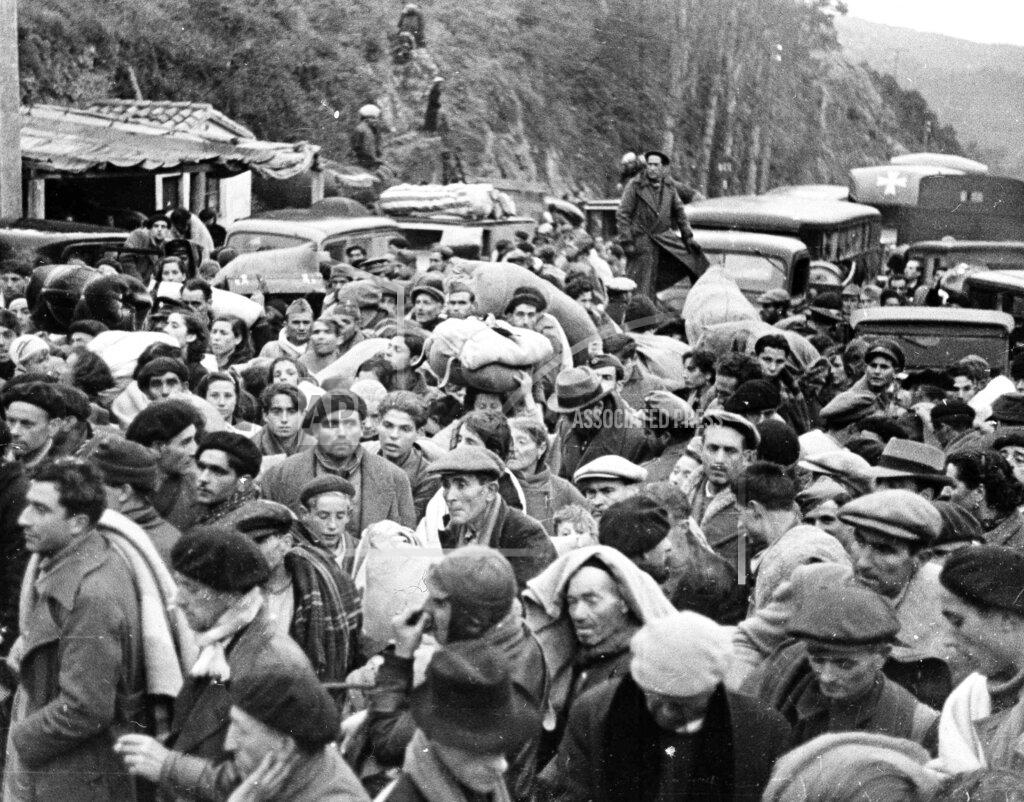
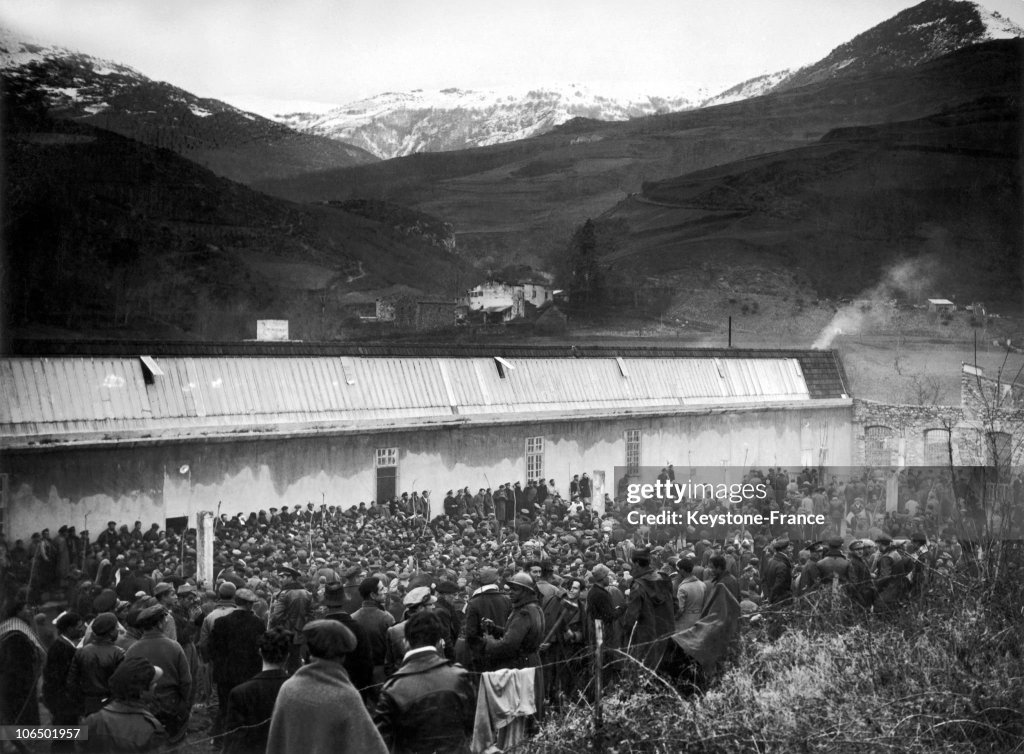
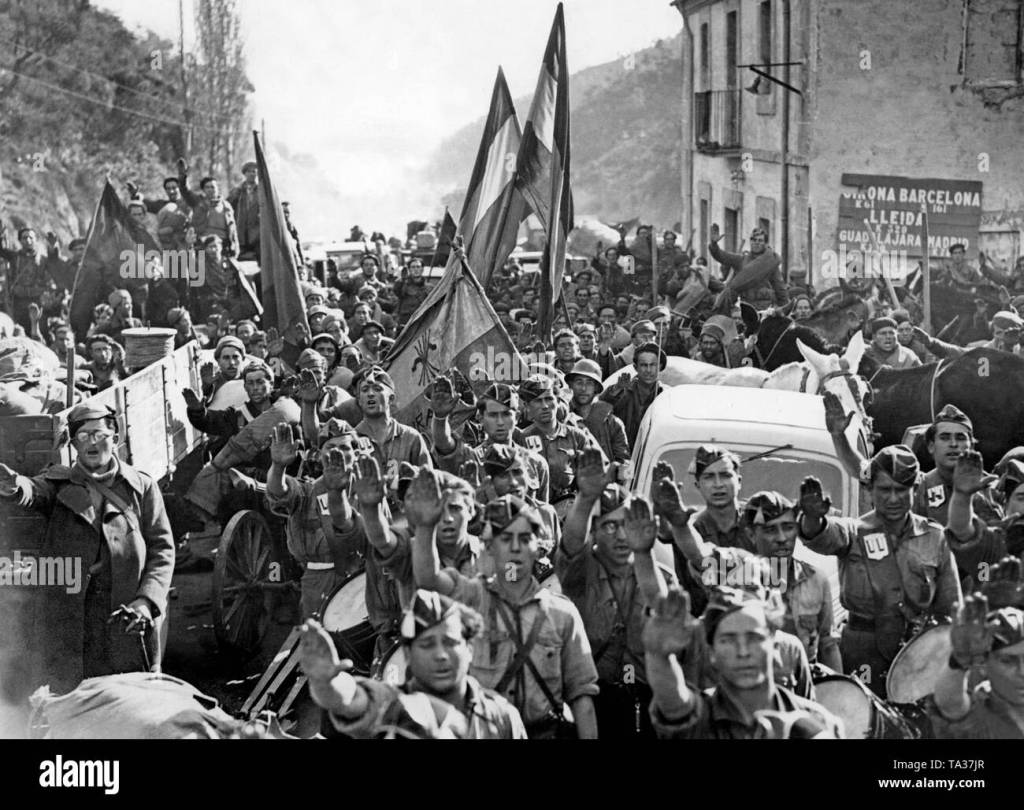
The Catalonia Offensive ended in Nationalist victory. The final Republican troops of General Modesto’s Army of the Ebro cross into France, just in time, as the border into France is totally sealed by Nationalist troops. Catalonia totally in Nationalist hands, the Republicans have lost 200,000 troops and the entire Catalan war industry. But the Republicans still hold thirty percent of Spain, and their Prime Minister is back in the country and confident they can continue to resist.
Spanish rebels complete their conquest of the frontier. The Spanish Insurgents reached the French frontier at Portbou at 1:15 this afternoon and at Bourg-Madame at 2:40, thus completing the conquest of Catalonia and the Pyrenees frontier. But now Premier Juan Negrín and Foreign Minister Julio Alvarez del Vayo are in Valencia, and, although there may be no more fighting in Spain, as far as anyone can say at present the war still goes on. It was Colonel Modesto’s army that covered the final retreat, fighting up to the last yard that could be defended without coming too close to the frontier and creating difficulties for the French. The troops came over singing. None were left behind except for the normal casualties suffered in the final combat.
A machine-gun battalion attached to Colonel Modesto’s army made the last action about five miles south of the frontier, blowing up the final bridges. As a result, although the last Loyalist troops sauntered across the French frontier at 8 o’clock this morning, the Insurgents had to take a roundabout route and did not arrive until hours later. All the prominent leaders of the Popular Army are out of Spain, safe and healthy here in Perpignan. They had many stories to tell, but that is for history. One should mention, however, the blowing up of the castle at Figueras. That was the tremendous explosion heard here two days ago. It must have been one of the greatest explosions ever known, for no less than 1,100 tons of explosives and 1,000,000 liters (more than 250,000 gallons) of gasoline were used. The concussion could be felt for miles. As the troops crossed the French frontier, the commanders gave each unit a brief talk, explaining how and why the battle had been lost, cautioning them to be on their good behavior in France and promising that the struggle would continue in Central Spain. They know nothing about their government’s plans, of course, but they all feel certain that, if the men have a genuine choice, the overwhelming majority in Colonel Modesto’s army — particularly in the two crack corps, the Fifth and the Fifteenth — will elect to stand by Premier Negrín.
France and Britain will accept Franco once the civil war officially ends and no longer insist upon foreign soldiers leaving the country as a condition of acceptance.
The Spanish loyalist government will move its capital to Madrid, and intends to fight to the end against Franco. Premier Juan Negrin returned today to what is left of Republican Spain. He announced tonight that the new Spanish Government headquarters would be in Madrid. He made the announcement after conferring with his still undefeated commander-in-chief for Central Spain, General José Miaja. Both said they intended to “fight to the end” from Central Spain, which includes Madrid, Valencia and Alicante. The victorious Insurgents, although they now hold three-fourths of Spain, have yet to crack the stout defenses of Madrid. Premier Negrín and Foreign Minister Julio Alvarez del Vayo arrived at Alicante by plane from France, where they had been forced to flee with thousands of their troops and civilians. Insurgent bombers raided Alicante as they conferred there with Civil Governor Ricardo Mella. There were no casualties, but property damage was heavy. It was the third raid in twenty-four hours, seventeen persons having been killed and thirty-five wounded in the previous two. Several persons were injured in an Insurgent raid on Cartagena. Two British ships were struck by Insurgent bombs at Valencia. Dr. Negrín and Señor Alvarez del Vayo came to Valencia this afternoon by automobile. The Premier) said he planned a lightning survey of the central zone’s defenses, troops and war supplies. The government now has half a million soldiers defending largely agricultural territory. Its big munitions and industrial works in Catalonia have been lost.
Premier Juan Negrín of the Spanish Republic left Toulouse today by the regular Air France plane for the Madrid-Valencia zone. While on French soil Dr. Negrín declined to state his future plans, in keeping with his pledge to the French Government that he would carry on no political activity in France. He had preserved strict incognito since his arrival in Toulouse.
Premier Juan Negrín arrived today in the central zone of Spain for the avowed purpose of carrying on resistance to Insurgents. At the same time General José Miaja, appointed only last night to command all government air, land and sea forces in Central Spain, termed “absurd” reports that his general staff was negotiating for peace. “My general staff would never think of doing such a thing,” said General Miaja at Valencia. “I, myself, only do what the government orders.”
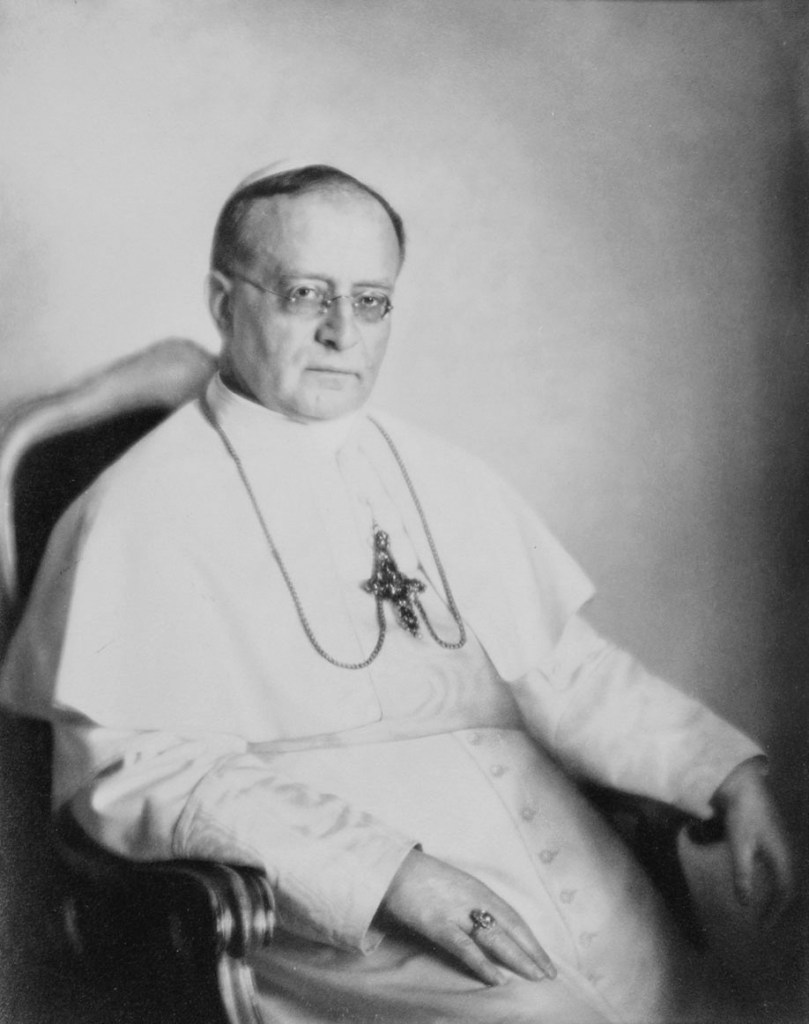
Pope Pius XI died. Pope Pius XI died at 5:31 a.m. (Rome Time) of a third heart attack on 10 February 1939, at the age of 81. His last words to those near him at the time of his death were spoken with clarity and firmness: “My soul parts from you all in peace.”
The Pope died at the height of European tensions between fascism, communism, and democracy. Pius IX gained an international reputation for standing firm against any regime which threatened religion or the rights of the individual. As a result, his policies often challenged the Communists and the Fascists.
To establish or maintain the position of the Catholic Church, Pius XI concluded a record number of concordats, including the Reichskonkordat with Nazi Germany, whose betrayals of which he condemned four years later in the encyclical Mit brennender Sorge (“With Burning Concern”). During his pontificate, the longstanding hostility with the Italian government over the status of the papacy and the Church in Italy was successfully resolved in the Lateran Treaty of 1929. He was unable to stop the persecution of the Church and the killing of clergy in Mexico, Spain and the Soviet Union. He canonized important saints, including Thomas More, Peter Canisius, Bernadette of Lourdes and Don Bosco. He beatified and canonized Thérèse de Lisieux, for whom he held special reverence, and gave equivalent canonization to Albertus Magnus, naming him a Doctor of the Church due to the spiritual power of his writings. He took a strong interest in fostering the participation of lay people throughout the Catholic Church, especially in the Catholic Action movement. The end of his pontificate was dominated by speaking out against Hitler and Mussolini, and defending the Catholic Church from intrusions into Catholic life and education.
On 11 November 1938, following the Nazi Kristallnacht pogrom, Pius XI joined Western leaders in condemning the pogrom. In response, the Nazis organised mass demonstrations against Catholics and Jews in Munich, and the Bavarian Gauleiter Adolf Wagner declared before 5,000 protesters: “Every utterance the Pope makes in Rome is an incitement of the Jews throughout the world to agitate against Germany”. On 21 November, in an address to the world’s Catholics, the Pope rejected the Nazi claim of racial superiority, and insisted instead that there is only a single human race. Robert Ley, the Nazi Minister of Labour declared the following day in Vienna: “No compassion will be tolerated for the Jews. We deny the Pope’s statement that there is but one human race. The Jews are parasites.” Catholic leaders, including Cardinal Schuster of Milan, Cardinal van Roey in Belgium and Cardinal Verdier in Paris, backed the Pope’s strong condemnation of Kristallnacht.
Eugenio Cardinal Pacelli, making use of his discretionary powers as Cardinal Camerlengo, has decided that the conclave for the election of a new Pope will begin sitting on March 1. It will be remembered that the period between the death of a Pope and the first conclave for the election of his successor was formerly ten ten days. Cardinal O’Connell, Archbishop of Boston, arrived too late for the last conclave and protested strongly to Pope Pius XI. As the first act of his pontificate Pope Pius extended the period to a minimum of fifteen days, extensible at the discretion of the Cardinal Camerlengo to eighteen days. Cardinal Pacelli has decided to make the period the longest permitted by the papal Bull and has fixed the opening conclave for the morning of March 1. In this way all the Cardinals, including those in South America, who are farthest from Rome, will be able to reach the Vatican in time.
The Defense Committee of the French Senate votes to speed up rearmament plans.
A high Soviet police official is shot for framing an innocent person.
Olympic officials drop women’s gymnastics.
Republicans support nearly all of President Roosevelt’s defense plan, but are uncertain about the importance of fortifying Guam.
The Zionist delegates to the Palestine discussions were asked by Malcolm MacDonald, Secretary for Colonies, today if they expected Britain to continue to maintain the Jewish national home in Palestine at the point of a bayonet. Dr. Chaim Weizmann, head of the Jewish delegation, and other Zionist delegates made no reply to this question but they are expected to answer next week.
The question was asked this morning during a session between the British Government and the Jews in which Mr. MacDonald presented his comments on the Jewish demands that Palestine be continued as the national home open to all Jews-especially in view of the present need for finding a home for Jewish refugees from Germany and Central Europe. Most of Mr. MacDonald’s speech, which was described as containing no signs of pressure on the Jews, was confined to summing up the Arab arguments that they are being seriously hampered by Jewish settlement in their country. Mr. MacDonald is reported to have repeatedly reminded his hearers that he was giving the Arab argument and not that of the British Government.
Despite the careful impartiality Mr. MacDonald showed, there is a report of Jewish uneasiness over what was thought to be an ominous undertone in the whole statement. This uneasiness appeared to spring rather from the discussion after Mr. MacDonald had completed his formal comment rather than from anything in the statement itself. Dr. Weizmann and others are understood to have asked if the British did not recognize the moral right of the Jews in Palestine. It was then that Mr. MacDonald asked his question about the use of force. It is obvious that under present conditions the national home can only be maintained, even with the temporary cutting off of immigration, by the use of battalions of British soldiers.
In Washington, President Roosevelt canceled all engagements, being confined to his bed with an attack of grippe, which also has affected some members of his staff. President Roosevelt’s doctor confines him to bed with a 99.6-degree fever.
The Senate was in recess. The Military Affairs Committee decided to make public, except for military secrets, details of future private meetings; a special committee continued hearings on reciprocal taxation of Federal and State securities; the Agricultural Committee questioned Secretary Wallace on farm legislation; the Interstate Commerce Committee received a subcommittee report on Missouri Pacific Railroad financing, and the Monopoly Committee decided to abandon further study of elections as conducted by the Metropolitan Life Insurance Company.
The House also was in recess. The World War Veterans’ Committee continued hearings on veterans’ legislation, and the Ways and Means Committee continued hearings on social security legislation.
The Senate Military Affairs Committee decided today to lift, at least partially, the cloak of secrecy which has shrouded its consideration of President Roosevelt’s emergency national defense programs thus far. The action was forced by a group of members who believe that the mixture of foreign policy, neutrality and national defense which has been discussed at its meetings should be made known to the public. Committee members said that future hearings would be held behind closed doors, with members of the committee at liberty to discuss testimony publicly afterward except for portions which the full membership decided should be kept in confidence as military secrets. There were conflicting versions among some members as to other decisions by the committee. Senator Sheppard, chairman of the committee, did not seem enthusiastic about the new plan. He said that only a trial would demonstrate whether it would work or not. Senator Austin, ranking minority member, offered a motion to throw future hearings open to the public. It lost by a tie vote, 8 to 8, but he described the final compromise as “splendid.” He said it would accomplish three things, which he considered valuable in the public interest.
“It will do away with the fear of the public,” he said, “that we are evolving during these discussions of neutrality, foreign affairs and national defense, a policy which will affect their lives and interests without letting them know of developments. “The new procedure will permit us to get expressions of public opinion in regard to phases of any policy we work out while it is still in the making. We like to hear from the folks back home, and we ought to hear from them. “It will act as a healthful influence on the administrative side of the question by letting the people know what mistakes, if any, have been made, so that responsible officials can guard against them in the future.”
The House Ways and Means Committee votes to tax government workers the same as private individuals.
The Chairman of the Securities and Exchange Commission says that huge corporations degrade moral values and threaten democracy.
Senator James Byrnes files a relief reform bill that combines six different agencies and creates a permanent relief organization.
The WPA extends dental service for the most needy.
Joan Crawford, film star, filed suit today for a divorce from Franchot Tone, now playing in New York, on grounds of mental cruelty. The complaint asserts that they had signed a property settlement, of which it asks court approval. Tone would expect her to socialize on evenings she needed to practice movie lines, the suit claims.
Fighting dogs bite actress Helen Hayes. She has injuries on her chin and arms and is also treated for nervous shock.
The film “The Adventures of Huckleberry Finn” starring Mickey Rooney was released.
“Stagecoach” western film directed by John Ford, starring Claire Trevor and John Wayne, premieres in Miami.
“The Three Bears” (Terry Toons) was released.
Ethel Merman and Jimmy Durante perform “Stars in Your Eyes” at the Majestic Theater.
The National Football League names Joe Carr as president for a 10-year term.
Future hall of Fame boxers Eddie Booker and Fritzie Zivic faced off in Madison Square Garden. Zivic victorious.
The American-owned oil company Petrolera is forced to cease operations in Mexico. The Mexican government claims Petrolera owes back wages.
India withdraws from the League of Nations, accusing the League of failing to carry out punitive powers and protesting Britain’s policy in Palestine. India’s legislature passes a resolution urging withdrawal from the League of Nations. A resolution for India’s immediate withdrawal from the League of Nations was adopted today by the Assembly of the Indian Legislature. The resolution accused the League of failure to carry out its punitive powers and Britain of a persistently wrong policy in Palestine, in “contravention of the League article dealing with mandates and in open disregard of the feelings of the Indian nation.” It was considered unlikely that the resolution, adopted 55 to 45, would obtain the approval of the Viceroy, necessary to give it effect. Indian membership in the League includes not only the eleven provinces of British India but also many of the self-governing native States. Withdrawal, therefore, also would have to come from the native States concerned.
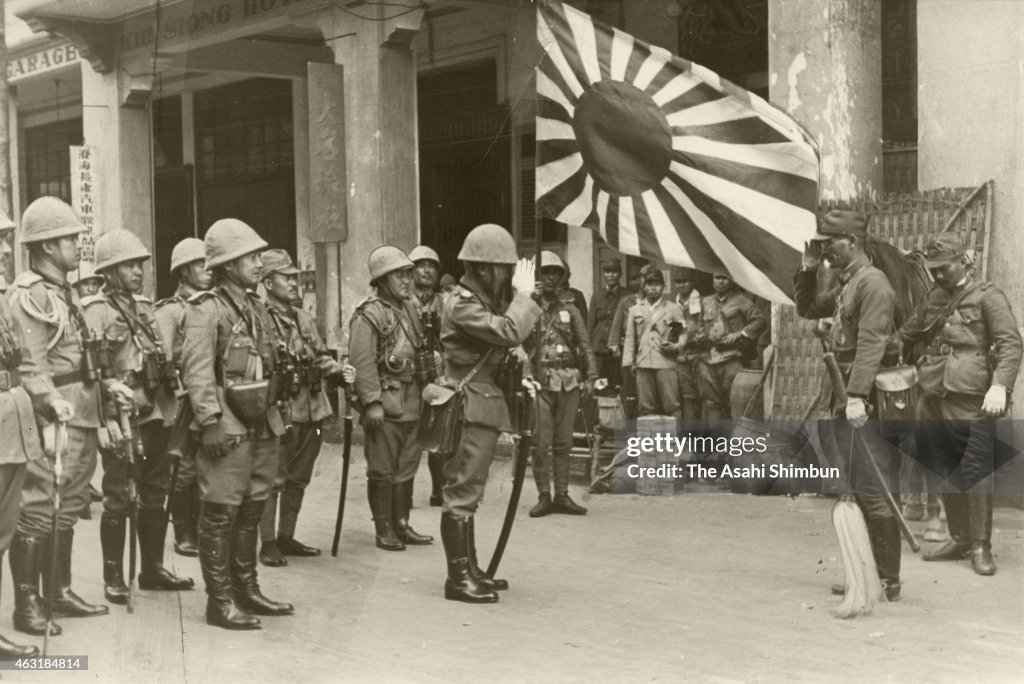
The Hainan Island Operation started with the landing of Japanese troops on the northern coast of Hainan. Japanese forces began occupying the island of Hainan, giving the Japanese greater control over the southern Chinese coast. Japanese Special Naval Landing Forces troops landed at Haikou, Hainan Island in southern China, across from the Gulf of Tonkin. France and Britain worry over their interests in Southeast Asia.
At 3 o’clock this morning the Japanese Army landed forces on Hainan Island, according to a bulletin issued by Imperial Headquarters. The strength of the force landed is not disclosed. The news is read as a confirmation of fears felt for some time in British and French circles that Japan would seize this island as a preliminary step to the occupation of Pakhoi, with the ultimate intention of advancing into Yunnan Province to cut off supplies and munitions from French ports and from Burma over the new motor road. Lying across the Gulf of Tongkin, Hainan is of vital importance to the safety of French Indo-China and its occupation by Japanese troops is in the strategic sense a menace to the safety of French possessions there. Recently the Japanese Foreign Office, departing from its usual custom, announced that the French Government had refused to accept Masayuki Tani as Ambassador. The motive for this step, which mystified diplomats at that time, is now shown in the occupation of Hainan which must cause the French Government grave anxiety.
Dow Jones Industrial Average: 143.68 (-0.31).
Born:
Adrienne Clarkson, Canadian journalist, politician and 26th Governor General of Canada, in British Hong Kong.
Peter Purves, television presenter and actor (“Doctor Who”, “Blue Peter”), in Preston, Lancashire, England, United Kingdom.
Died:
Pope Pius XI, 81, 259th Pope of the Catholic Church (1922-1939).

 History Diaries