All 260,000 coal miners in the United Kingdom went on strike as a result of a wage dispute with the National Union of Mineworkers. The British coal miners’ strike has officially begun. Britishers are afraid of violence and a possible general strike throughout Britain. The all-out strike raises the threat of a severe power shortage and an industrial standstill.
A survey shows that Britain’s Conservative party currently leads in the national election campaign. A coal strike is likely to hurt the Labour party. Labour leader Harold Wilson criticized the Heath government and claimed that the campaign centers on overall economic problems. British Prime Minister Edward Heath replied that the economic troubles are being caused by militant union leaders, and he declared that voters will decide whether they desire militant or rational rule. A bitter political battle lies ahead.
Two young Italians chained themselves to the railing inside the dome of St. Peter’s Basilica to protest the papal decision to dismiss Cardinal Josef Mindszenty as Hungarian primate and archbishop. The two men, who described themselves as members of an ultraconservative Roman Catholic movement, showered the basilica with leaflets calling Cardinal Mindszenty a martyr and his dismissal “a treason to God.” Vatican police unchained the men.
West Germany’s public workers began walking off their jobs today. Talks have been scheduled to head off the spreading strike.
Secretary of the Treasury George P. Shultz intends to ask Congress again for a $1.5 billion contribution to the International Development Association loan fund, according to diplomatic sources in Washington. The sources said that despite a House rejection by 248 to 155 two weeks ago, Shultz has promised 24 other nations who contribute to the loan fund that the Nixon Administration will stand by its original request to Congress. Shultz called the House rejection of the request a “major setback” for U.S. foreign policy. The loan fund is a vital function of the World Bank.
Israeli and Syrian forces fought in the Golan Heights. Israeli foreign minister Abba Eban reported that the Soviet Union is attempting to get Syria to release a list of its POWs and arrange for the Red Cross to visit them. Syrian and Israeli artillery exchanged fire today after having been silent for four days, the military headquarters here announced. Syrian shells landed in the wedge jutting toward Damascus that Israel captured in the October war. According to report from the front, Syrian gunners began firing without apparent provocation at Israeli frontline positions. Four Israeli soldiers were reported hurt. Major General Mordechai Gur, the former Israeli military attaché in Washington and newly appointed commander of the northern command, was in the area during the exchange on an inspection tour. The shooting continued for two hours, the reports said, and then it stopped as suddenly as it had started.
The quiet on the Golan Heights front preceding today’s outbreak had been attributed by officers to the effectiveness of an Israeli counter-bombardment Wednesday; according to the newspaper Maariv, Israeli observation post reported direct hits on Syrian artillery batteries, arms dumps, tanks and other vehicles. Tonight, the officers said that the Syrians apparently felt that they had to keep the situation simmering to strengthen their hand in proposed negotiations for the separation of forces. The Israelis have refused to start negotiating on this until the Syrians supply lists of Israeli prisoners and permit Red Cross visits in accordance with the Geneva conventions. More than a hundred Israelis were reported missing on the Syrian front in the war. Damascus has refused to say how many it holds.
The United States is equipping the Jordanian army with sophisticated antitank missiles of the sort used by Israel during the October war, reliable sources in Amman said. It is the first time that the United States has provided such weapons to an Arab country. The Soviet Union delivered large supplies of a comparable antitank missile to Egypt and Syria before and after the October fighting. The sources said the Jordanian army had used the weapon in training.
An Iranian-Iraqi border fight breaks out. Iraq claimed that a frontier clash early yesterday with Iranian forces backed by heavy artillery and armor left 70 Iranians dead and wounded and caused 23 Iraqi casualties. The Iranians, according to the Baghdad radio, were gathering more forces on the border and continuing attacks, while Iranian jet fighters were “crossing deep into Iraqi airspace.”
The former editor of Egypt’s most prestigious newspaper claims he was fired for expressing doubts about President Nixon’s influence in the Middle East, Time magazine reported. Mohammed Hassanein Heikal, former editor of Al Ahram, said he began to differ with Egyptian President Anwar Sadat because he felt Mr. Nixon was too busy defending himself over Watergate to have any influence in the Mideast, Time quoted Heikal as saying. Heikal said he was not surprised at his firing by Sadat, and felt that if he didn’t speak out, he would betray his Profession.
In a plan to make poppy cultivation uneconomical, Turkey is preparing a $700 million program to develop the nation’s former opium poppy cultivation areas for industry and high-yield agriculture, political sources reported. To begin in 1975, the five-year program would encompass 1,680 former poppy-cultivating villages. Included in the plan are long- and short-term industrial development, Increased irrigation facilities and growing and marketing programs for high-yield crops. Turkey banned cultivation of the opium poppy 14 months ago after a decade of negotiations with the United States.
Delegates from the world’s leading oil‐consuming countries gathered in Washington yesterday for the energy conference that begins today. They agreed on an agenda for the meeting, which is being held to find ways of easing the current and long‐range fuel crisis. But on the basis of preliminary talks, most American and European officials seemed to agree that the results of the two‐day conference called by President Nixon would probably be limited to general declarations and would fall short of the “action conference” contemplated by Washington in the first place.
Police in Gujarat fired on looters, killing two and thus raising to 50 the death toll in one month of riots against food shortages and soaring prices in the Indian coastal state of 27 million people. The New Delhi government has accepted the resignation of Gujarat’s chief minister and placed the state under federal rule but militant students are pressing for dissolution of the state assembly, which would open the way for new elections.
Former Vice President Francisco Augusto Lora accepted the nomination of the Movement for Democratic Integration Party in the Dominican Republic’s May 16 presidential elections. Lora, 64, will campaign on a platform calling for a constitutional amendment prohibiting presidential reelection. He is the fourth announced candidate for president. Lora’s main opponent will be incumbent President Joaquin Balaguer.
Prime Minister Eric Gairy of the Caribbean island of Grenada, which became independent of Britain only four days ago, ordered striking telephone and electrical workers to return to their jobs or face prosecution. Gairy called a cabinet meeting for today, touching off speculation that he might declare a state of emergency.
Silver futures hit record $4.81½ an ounce in London.
The Soviet Mars 4 space probe, launched in July 1973, flew past Mars at a distance of about 1,300 miles (2,100 km) and took pictures but failed to enter orbit due to a malfunction.
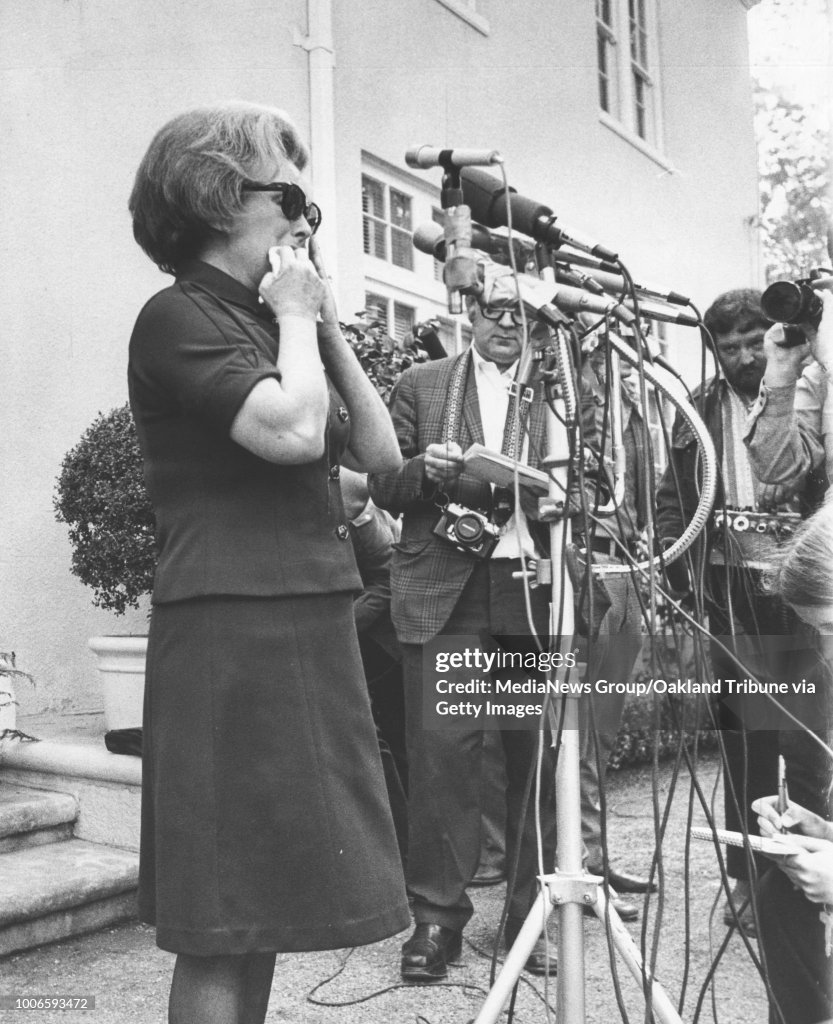
The Federal Bureau of Investigation today linked two more persons to the kidnapping of 19‐year‐old Patricia Hearst. But Thomas Druken, assistant special agent in charge of the investigation, said that the underground radical group that says it is holding the daughter of Randolph A. Hearst, the newspaper executive, had failed again to make its expected ransom demand. “There nothing new as far as I know,” Mr. Druken said. “We haven’t heard anything.” The group, which calls itself the Symbionese Liberation Army, said that it was responsible for abducting Miss Hearst from her Berkeley apartment on Monday night. The group passed word, in a letter to a Berkeley radio station, that it was involved in the kidnapping.
The FBI said today that it was seeking two more persons — a white man and a white woman — as potential witnesses and possible suspects in the abduction of Miss Hearst, a student. The addition of the couple brings to seven the number of persons the bureau has now linked to the kidnapping. According to Mr. Druken, the man and the woman were seen in a car parked in the immediate area of Miss Hearst’s apartment for “well over an hour” just prior to the kidnapping. The car was described as a dark colored, late model Volkswagen.
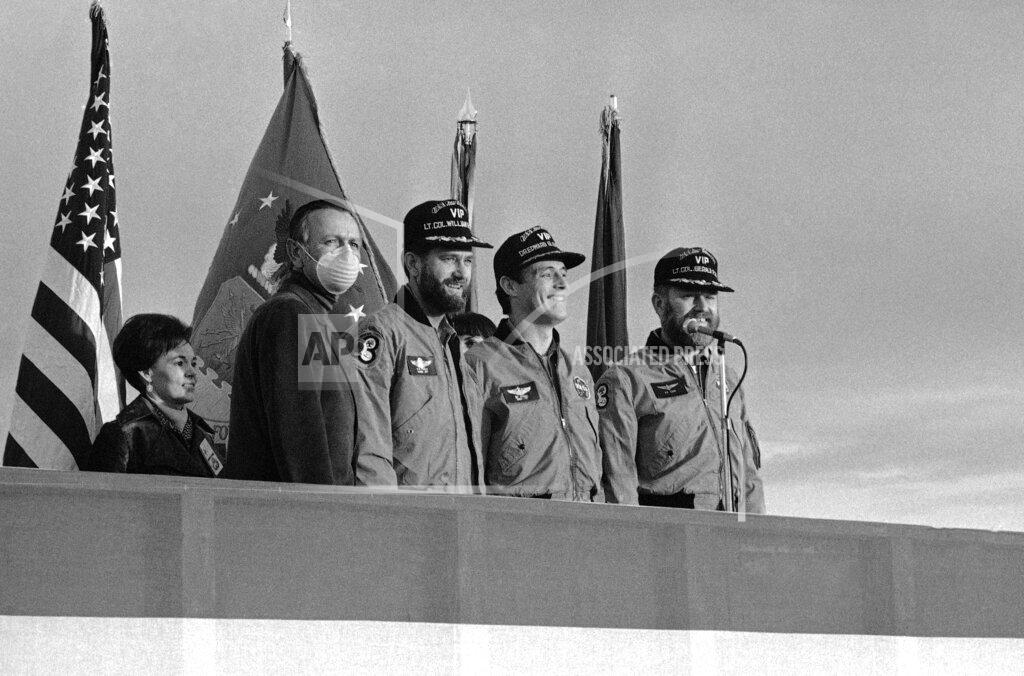
NASA doctors reported that Skylab 3 astronauts Edward Gibson, Gerald Carr and William Pogue are in excellent physical condition. The astronauts appeared in public today in San Diego. Carr discussed the accomplishments of the Skylab program. Pogue said he’s extremely glad to be home again.
The United States plans to fly an unmanned spacecraft in orbit around the moon in 1978 to complete some of the major lunar science studies begun by the Apollo astronauts. The craft will use instruments left over from the Apollo program. A major difference in the $50 million project is that the vehicle will orbit in a north-south direction. The manned Apollo spacecraft flew around the moon in an equatorial orbit because their landing sites were close to the equator.
Senator Edward M. Kennedy (D-Massachusetts) said he was prepared to compromise with the Administration on a national health insurance program and expected Congress to pass a bill this year. “I want to work with the Administration in every possible way, in a constructive and positive way, to see that we will (have a bill) but it’s still going to take some adjustment from their point of view,” Kennedy said. Kennedy, speaking on the television program “Face the Nation,” called President Nixon’s new health plan “an important step forward, radically different from the initial proposals of two years ago.” But he said it failed to “guarantee quality health care as a matter of right to all Americans.”
More and more independent truckers returned to the highways. Independent truckers wheeled their rigs onto the nation’s highways in increasing numbers yesterday, but in some areas striking drivers defied President Nixon’s pleas to return to work. Reports from the authorities generally indicated heavier than usual truck traffic for a Sunday, stimulating hopes that consumer and industrial shortages would taper off. The independent truckers are protesting the increased cost of diesel fuel and the lowered speed limits that are cutting into their income. The President, in a nationwide radio broadcast Saturday, had urged the drivers to get back to work “to provide food, fuel and other supplies to all Americans.” In Pittsburgh, William J. Hill, a leader of the independents, said yesterday that members of his group “are voting overwhelmingly” to accept the agreement.
The federal energy administrator, William E. Simon, announced today that the nation’s oil refiners could begin producing more gasoline if they had stockpiled enough home heating fuel to last the winter. Announcing the shift toward more gasoline production, Mr. Simon said some refiners had already increased their gasoline output. He said reports indicated that gasoline production for the week ending February 1, was 2 percent higher than the week before. “We want refiners who have adequate distillate and residual stocks to increase gasoline yields in order to alleviate some of the shortages we are experiencing,” Mr. Simon said. “However, we must be cautious about making shifts to maximum gasoline production where inventories of distillate and residual stocks are not adequate.” Last December, the President’s energy adviser had ordered the refiners to produce more home heating oil and less gasoline.
American farmers expect to plant the largest corn and wheat crops in history this spring, as well as a soybean crop only slightly smaller than last year’s record-breaker. If so, despite a fertilizer shortage and the uncertainties of the fuel shortage, the crops could lead to a leveling off of soaring retail beef prices by late summer and stabilize pork and poultry prices.
Representative Peter Rodino, chairman of the House Judiciary Committee, said that the committee members would “be shirking our responsibility” if President Nixon were not personally summoned — if deemed necessary — to answer questions on his conduct of the presidency. In a television interview, he contended that the House has given his committee the authority to investigate “impeachment in totality” by overwhelmingly voting it broad subpoena powers, and that the vote gave the committee the right to override any future claim of executive privilege by the President.
Service station owners and motorists in New York and New Jersey braced for confusion with the beginning of plans — voluntary in New York, mandatory in New Jersey — for restricting gasoline purchases to alternate days. The plans differ in significant details but basically provide that motorists with even‐numbered license plates get gasoline on even‐numbered dates and motorists with odd‐numbered license plates get gasoline on odd‐numbered dates.
Attorneys for the New York Times were determining what action they would take to protect telephone records of the newspaper’s Washington bureau, some of which were obtained by subpoena last week by the Internal Revenue Service. The IRS confirmed it has subpoenaed telephone company records of long distance calls and said the records were obtained because of a report that an IRS employee had leaked information about a corporation’s tax records to a Times reporter. Reporter David Rosenbaum said he assumed the charges were connected with his attempts to uncover information about a possible tax evasion investigation against a large contributor to President Nixon’s 1972 campaign.
“Gigi” closes at Uris Theater NYC after 103 performances.
Judy Ikenberry wins 1st Us women’s marathon (2:55:17).
Born:
Elizabeth Banks (born Elizabeth Irene Mitchell), American actress (“The 40-Year-Old Virgin”, “Man on a Ledge”) and film director; in Pittsfield, Massachusetts.
Ty Law, NFL cornerback (Pro Football Hall of Fame, inducted 2019; NFL Champions, Super Bowl 36 and 38-Patriots, 2001, 2003; Pro Bowl, 1998, 2001-2003, 2005; New England Patriots, New York Jets, Kansas City Chiefs, Denver Broncos), in Aliquippa, Pennsylvania.
R.J. Bowers, NFL running back (Pittsburgh Steelers, Cleveland Browns), in Honolulu, Hawaii.
David Datuna, Georgian-American artist; in Tbilisi, Georgian SSR, Soviet Union (d. 2022, lung cancer).
Ivri Lider, Israeli pop singer; in Givat Haim (Ihud), Israel.
Died:
Gaston Bergery, 81, French international lawyer, co-founder of the Frontist Party, and aide of Vichy French leader Philippe Petain.




 History Diaries