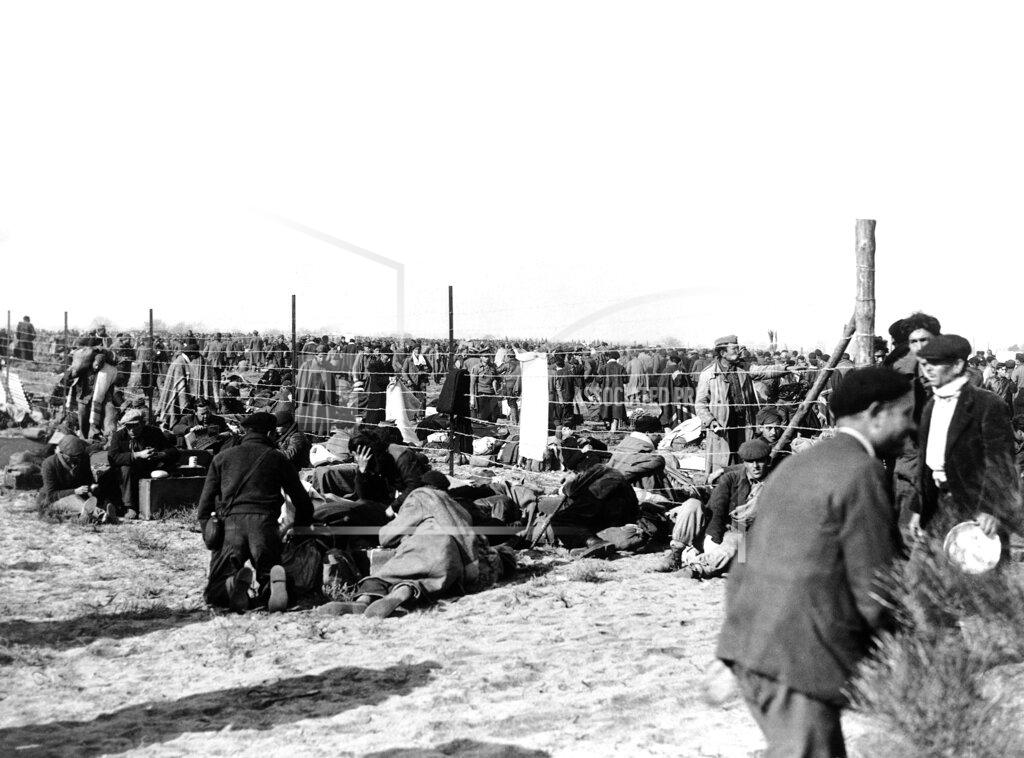
The Nationalists captured Figueres. The Spanish Civil War in Catalonia entered its final phase yesterday when the Insurgents broke through near Figueras and the Republican (Loyalist) general staff and Cabinet decided to retreat into France. It will probably be another forty-eight hours before the withdrawal is completed, for it is taking place in perfect order. At 1 o’clock this morning, Lieutenant Colonel Francisco Galan’s Republican Twelfth Army Corps was withdrawing after fighting a covering action near Pont de Molins. First the engineers, then the tanks and material and later the infantry will cross the border. Meanwhile Colonel Modesto’s force, which for a short time appeared to be cut off at Figueras when the Insurgent infiltration nearly reached the road, extricated itself. Colonel Modesto has established his staff somewhere down the Junquera Road. Apparently, Lieutenant Colonel Enrique Lister will have the duty of fighting the final rear-guard action.
Premier Juan Negrín of Spain and members of his Cabinet are in Le Perthus, although still technically on Spanish soil. They occupy a house on the side of the street between the international bridge and the customs building belonging to Spain. To all practical purposes, however, the Spanish Republican Government has left Catalonia. The army staff, headed by General Enrique Jurado and Lieutenant Colonel Antonio Cordon, has occupied a little building on the Spanish side of the bridge, where the Carabineros used to check passports and automobiles. It had not been decided at that time whether Colonel Modesto’s retreat should be through Le Perthus, over the mountains, or through Portbou. Actually, every possible avenue of egress will be used, but the main bodies of troops must take one of the two highways. A detour can be made around Pont de Molins to the Junquera Road.
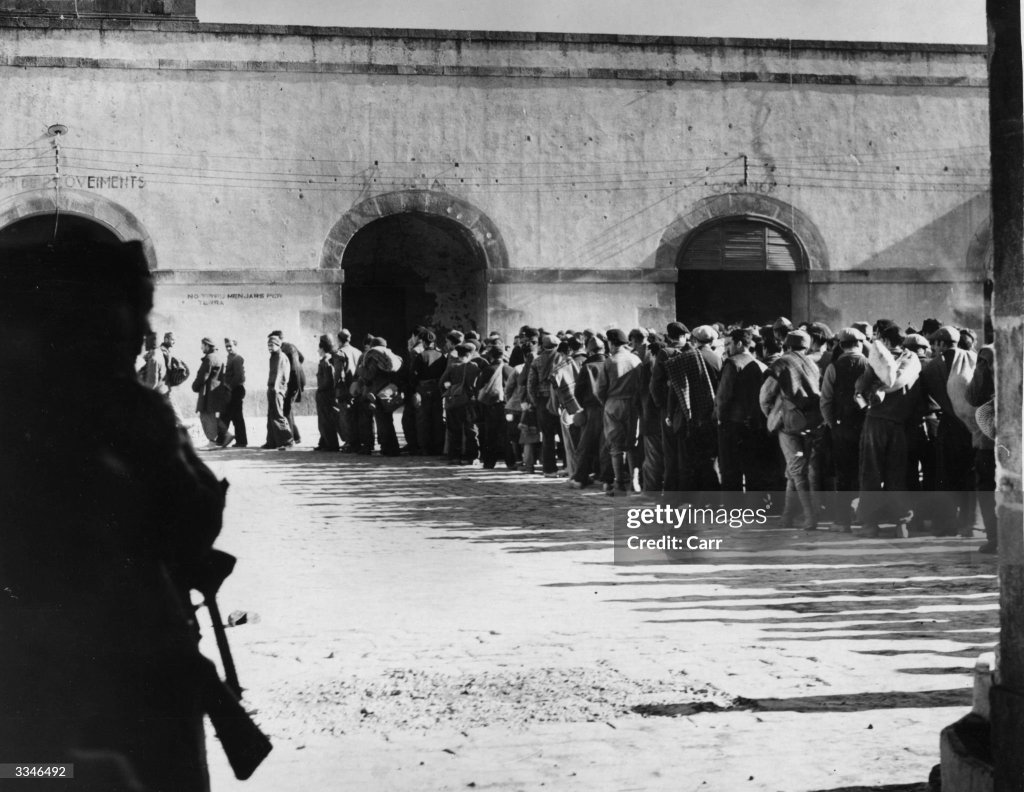
All Republican troops are ordered to get to the border and are now also allowed to cross into France, along with the hundreds of thousands of refugees trying to reach the border. On foot, or on carts or trucks, Republican Spaniards are facing sleet and snow to try to reach France.
Rumors are flying in Paris that the Spanish Civil War will be over within the next two days and that France and Great Britain will recognize Generalissimo Francisco Franco’s government and send Ambassadors as quickly as possible. Events moved rapidly today. Dr. Juan Negrin, the Spanish Republican Premier, and Julio Alvarez del Vayo, his Foreign Minister, who have been announcing until the last minute that they would return to Valencia and carry on the war in Central Spain, were suspended tonight on the Catalan-French frontier, now on one side and now on the other. From Madrid General José Miaja, commander of the central army, has asked the French for safe conduct, indicating that he is ready to begin, if he has not already begun, negotiations for the surrender of Madrid and Castille. Whether he surrenders or not, it is believed here that the Spanish Republican regime can no longer be recognized either de facto or de jure as the government of Spain. The way is therefore open for recognition of General Franco, and a decision to do so will be taken at the next French Cabinet meeting,
Meanwhile, in close contact with the British, negotiations are said to have been carried through for the surrender of the island of Minorca by the Spanish Republicans there, The British, supported by the French, have insisted that no Italian airmen, troops or ships be employed, and to this General Franco has agreed. He had 10,000 men ready for an attack on Minorca in the event of resistance. In Paris Senator Léon Bérard, French envoy to Burgos, seat of the Franco regime, had long talks today with Premier Edouard Daladier, and Foreign Minister Georges Bonnet. He reported his favorable reception at Burgos and is understood to have strongly recommended de jure recognition of General Franco’s government.
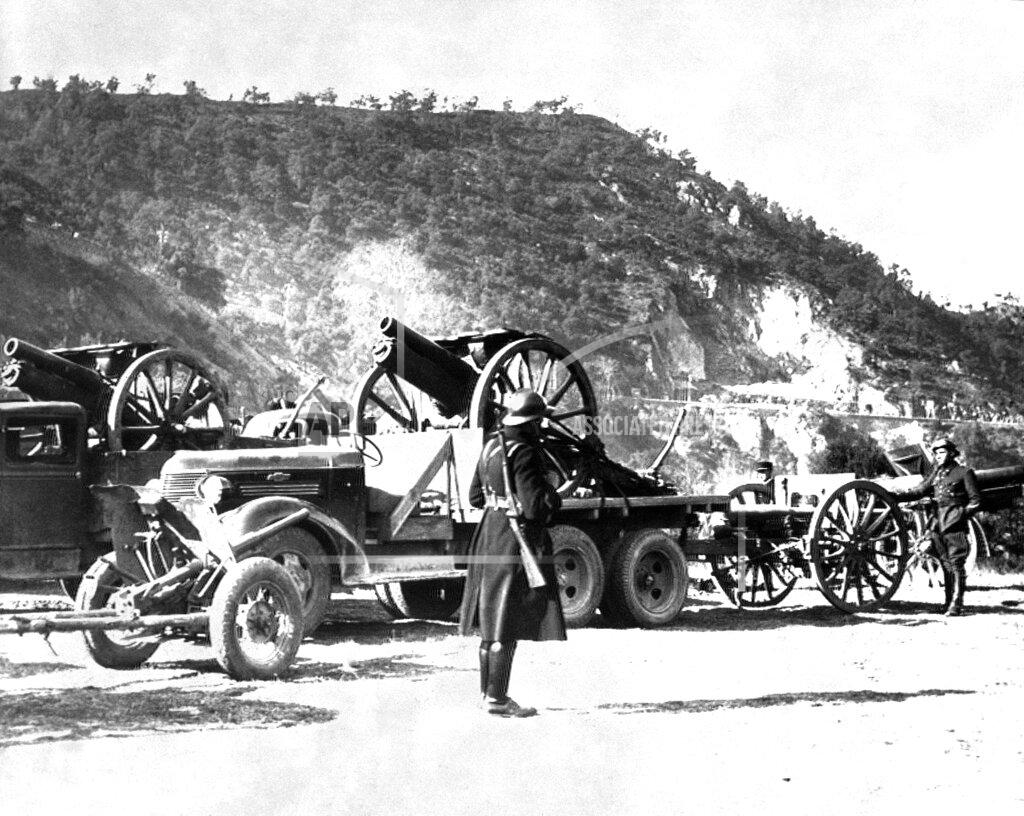
Fleeing Loyalist soldiers bring large quantities of arms to France.
The Spanish President, Manuel Azaña, will remain in France and live in the Spanish Embassy.
Generalissimo Francisco Franco’s demand for unconditional surrender by the Spanish Republican forces as an indispensable condition for the cessation of hostilities and his refusal therefore to consider any proposal of an armistice or mediation are unanimously approved today by the Italian press, which regards this decision as the only possible course of action at this moment. At the same time France is charged with openly violating her neutrality by permitting the Spanish Loyalist Cabinet to carry on political activities on French territory. If those nations that have not yet recognized the Burgos government wish to re-establish normal relations, it is said, they must fulfill three conditions: First, acknowledge the final dismemberment of the Spanish Republican Government; second, recognize the Franco government without reservations, and third, give proof of their good faith by appointing an Ambassador to Nationalist (Insurgent) Spain and by handing over to General Franco all the Spanish goods and valuables they have received from the Republicans, such as gold, jewels, works of art, ships and the like.
The United Kingdom and France inquired Germany on why no German guarantee of Czechoslovakian sovereignty has been signed as agreed upon in the Munich Agreement.
Two Bills giving the Government of Ireland (the territory formerly known as the Irish Free State) extraordinary powers were introduced in the Dáil. The first of these, called the Treason Act, imposed the death penalty for persons guilty of treason as defined in Article XXXIX of the Irish Constitution. This penalty was to apply whether the act was committed within or outside the boundaries of the State. Its aim was curtailing IRA activity both within the Irish state and the United Kingdom. The second measure, called the Offences against the State Act, made it possible for citizens to be interned without trial, and conferred elaborate powers of search, arrest, and detention upon the police. It declared seditious any suggestion in a newspaper or magazine that the elected Government of Ireland was not the lawful government.
The IRA had been declared an illegal organisation under the Constitution (Declaration of Unlawful Association) Order passed 18 June 1936, but the Irish Free State Government had only used this power on a few IRA volunteers. Éamon de Valera spoke about the IRA and S-Plan in the Dáil for two hours. He said that the IRA had no right to assume the title “Irish Republican Government” and that the then Irish Minister for Justice, PJ Ruttledge, planned to bring “energetic measures” before the house to combat the IRA.
A growing belief that Great Britain will lay down a number of destroyers during the coming year as a reply to Germany’s expanding submarine fleet was partly confirmed today by Geoffrey Shakespeare, Financial Secretary of the Admiralty. In addition, he announced unequivocally that sixteen trawlers and one “drifter” (a fishing boat similar in size to a trawler) — which would be most useful in wartime — for minesweeping and minelaying had been acquired “for urgent fleet services.” In the first part of his statement Mr. Shakespeare gave the House a detailed account of the steps whereby the Reich gradually asserted its full right under the Anglo-German naval agreement of 1935 to build five 8-inch gun cruisers and to equal Britain’s submarine tonnage.
Rejecting a Laborite’s suggestion that Germany’s increased submarine fleet could be aimed only at Britain and France, he said: “The Admiralty cannot agree that the exercise of a right by a power with which we have a treaty is a threat to us or anybody else.” Then, however, Mr. Shakespeare gave assurances that Britain’s new building program would “clearly take account of all factors of naval development in any part of the world.” Asked specifically whether destroyers would be included, he said he had already given his answer. Presumably because Germany, heretofore, had been content with a submarine fleet only 45 percent of British submarine tonnage, the Admiralty failed to include a single destroyer in the building program for the current fiscal year. In naval circles it is believed that at least one flotilla and perhaps two will be authorized in the next building program. Because most of the German submarines are small and new, the British destroyers will be speedy 1,000-tonners, it is thought.
King George writes to President Roosevelt expressing gratitude for his help in arranging the forthcoming Royal visit to the United States.
Six members of the Romanian Legion of St. Michael (Iron Guard) are arrested in Romania and later murdered by Armand Calinescu’s police.
A Soviet suggestion has been made for a pact among the powers bordering the Black Sea, with the object of safeguarding peace in that region. This has evoked much interest among foreign diplomats here, who see in it the first concrete indication of what direction Soviet foreign policy may take, now that the Czecho-Slovak settlement has shaken the whole structure of collective security on which the Soviet Union in recent years based its foreign policy. How seriously this suggestion was meant and whether it was more than a tentative feeler is not yet clear, but it coincides with other less tangible indications that the Soviet Government desires — now that her Czecho-Slovak alliance has been wrecked and her mutual assistance treaty with France seriously depreciated — to build as well as may be a barrier of friendly States against any German advance eastward. The suggestion of a Black Sea pact was dropped in the most informal manner at a luncheon given a week ago by the Turkish Ambassador for several diplomats, including Maxim Litvinov, Soviet Foreign Commissar. It was Mr. Litvinov himself who dropped it.
The contention that Palestine is the only country where Jews from Germany and Central Europe can be received on a scale that will solve the refugee problem was stressed tonight by Dr. Chaim Weizmann in opening the Jewish case as the conference on Palestine got down to business. Dr. Weizmann, who is president of the Jewish Agency for Palestine, spoke in a private meeting, but it was learned later that his speech had repeated the Zionist contention that Palestine should be made a national home for the Jews. The fact that he opened the conference by linking Palestine with the present refugee problem was regarded as significant, since the Intergovernmental Committee on Refugees is to meet next Monday. It is believed certain that the importance of keeping Palestine open to Jewish immigration will be stressed at Monday’s meeting. From the tenor of Dr. Weizmann’s speech, which strongly minimized the value of all other areas suggested as havens for refugee Jews, it appeared certain that the Jews intend to stress the present refugee problem in pressing for immigration into Palestine up to the country’s absorptive capacity — estimated by Dr. Weizmann at 100,000 persons immediately and more in the future.
Presentation of the Jewish case was the only official business transacted today. But behind the scenes the British Government continued its efforts to bring the two groups of Palestine Arabs together into one delegation. These efforts continued until late tonight, but there was little expectation of a settlement between the Mufti’s group and the Defense Party delegates before tomorrow. In fact, there is admittedly some prospect that no settlement at all will be reached. In any case, it was indicated tonight that the attempt to bring the two factions into a united front would not be continued beyond tomorrow afternoon. If the Mufti’s representatives and those of the Defense Party cannot sink their differences by then the British will hold the first Arab meeting. If necessary, Colonial Secretary Malcolm MacDonald will meet with the two Arab groups in the same manner that he plans to hold separate meetings with the Jews and the Arabs. It is generally agreed that there is no difference between the two groups of Palestinian Arabs as to objectives. The dispute is over the use of violence in Palestine, which the Defense Party says is directed against the Mufti’s personal Arab. rivals as much as against the Jews. The Mufti’s delegates say they are quite willing to allow the Defense group to be represented in the Palestinian delegation to the extent of two men-which, they say, is more generous than Fakhri Nashashibi, the Defense leader, deserves. The Defense Party delegates contend they represent half the population of Palestine and should be represented here accordingly.
Carter Glass fired back today at the President in a statement which charged that Mr. Roosevelt had appointed Floyd H. Roberts to the Federal bench in Virginia as part of a scheme to “purge” first his colleague, Senator Byrd, and then himself from the national legislature. In a long statement presenting the reasons of the Virginia Senators for opposing confirmation of Judge Roberts, Senator Glass asserted, “with as much deference as the occasion requires,” that Mr. Roosevelt had deliberately gone out of his way to offend him and Senator Byrd. He also attributed to the Chief Executive “an attempt to dishonor us in our State and among our colleagues.” “The Virginia Senators are still perfectly willing to accept any capable nominee of the President who is not willing to concede to the Governor of Virginia or a bitterly hostile Congressman the right to veto the suggestions by the Senators of men of the highest character and capability,” said Senator Glass.
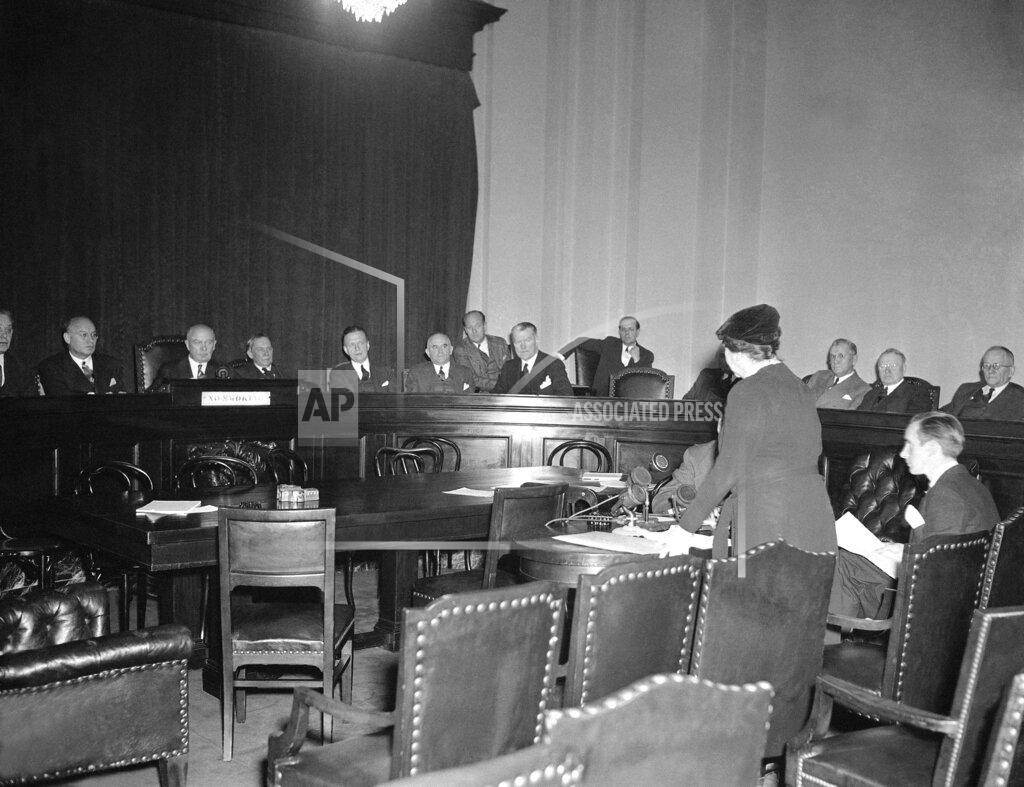
Secretary Frances Perkins appeared voluntarily today before the House Judiciary Committee which is considering a resolution looking-toward impeachment of her and two other Labor Department officials, and accepted full responsibility for enforcing the immigration laws and denied that they had conspired to prevent the deportation of Harry Bridges, West Coast CIO leader, who is accused of being a Communist. In a statement defending her course in the cases involving Mr. Bridges and Joseph Strecker, which formed the basis of charges made in a resolution introduced by Representative Thomas, New Jersey Republican, Miss Perkins said that the two officials accused jointly with her were acting under her orders and were not to be held responsible. These officials are James L. Houghteling, Commissioner of Immigration, and Gerard D. Reilly, solicitor of the department. Inferentially, Miss Perkins attributed the charges to her restraint in the “arbitrary use” of the enormous power given the Secretary of Labor under the immigration laws, in the administration of which she said she had proceeded with efforts to be scrupulously fair.
The House Military Affairs Committee made its report today recommending passage of the May bill designed to carry out the proposals contained in President Roosevelt’s national defense message. Indications that “war may come in Europe at an early date” were the chief reasons dictating immediate strengthening of this country’s defenses, the committee said. The bill would increase the authorized strength of the air corps from 4,000 to 5,500 serviceable planes. The committee was in unanimous agreement “that our present military establishment is woefully inadequate and that early improvements as contemplated in the legislation are immediately necessary.” A minority report, signed by the ten Republican members of the committee and one Democrat, called the bill “a reasonable and sound program” and suggested only one major change. Representative May, chairman of the committee, will go before the Rules Committee tomorrow or Friday to ask special procedure under which the measure can be brought to the floor of the House Monday, with general debate limited to six hours. Leaders planned to give the bill right of way on that day.
The majority report pointed to the difficulties Great Britain and France were having in the production of arms and equipment, especially airplanes, which caused both of them to buy military planes in this country, as evidence of the time element in preparing a defense program. From the fact that these countries sought large quantities of planes in a great hurry, the committee drew the conclusion that war in Europe is imminent. The bill would authorize the expenditure of $300,000,000 for airplanes, which would provide 3,032 craft in addition to those now on order, the report stated. The authorized total would be reached in 1941, and of this number 2,100 would be held in reserve, without personnel, and 1,300 would be combat planes. To provide pilots and mechanics for the expanded air corps the bill would authorize the Secretary of War to pay for their training at approved civilian schools, to take civilian instructors into service training establishments and to lend aircraft and equipment to civilian schools.
First Lady Eleanor Roosevelt scorns Nazi advice to stop discussing politics and she repeats her views.
A barber who charges a quarter for a haircut is sent to jail for price fixing.
After a Staten Island, New York third-grader, Lillian De Nora, 8 years old, pours her father’s wine into her coffee, her father forces her to drink the mixture and then sends her to school. The girl falls and fractures her head.
Mothers-in-law form an association to promote marital bliss, and refuse to censure jokes made about them.
New Japanese attempts to capture the Soviet Russian island “No. 227” in the Argun River, along the northwestern border between Siberia and Manchukuo, were reported in a Soviet Government communiqué tonight. The Japanese were repulsed on Monday and again yesterday, the announcement said, with aggregate Japanese casualties of fifteen killed or wounded and one killed and two wounded on the Soviet side. The Soviet chargé d’affaires in Tokyo again has been asked to protest energetically, it was announced. One week ago, the Soviet Government reported that a first clash had occurred on January 31 in an attempt to take the island in the Argun River, which runs northeast of Manchull. The attackers were reportedly repulsed with seven killed and wounded.
The British are partially successful at removing money from Japanese institutions.
Military experts suggest that Japan needs 500,000 more troops to subdue China.
The Japanese delay an attack on a Chinese resort so that an American gunboat can evacuate stranded foreign citizens. A British diplomatic request and inability to establish contact with twelve Americans and fifty-three other foreigners at Kuling caused Japanese army officers today to postpone a long-announced attack at the resort town. The officers agreed to extend the time limit for the evacuation of Kuling, where the foreigners have been stranded since last Summer, beyond Friday, the original date set, but it was emphasized that “no commitments regarding possible military operations in that vicinity” could be made. An army spokesman said that “the army is willing to assist the isolated foreigners as far as conditions permit,” but he added that necessity would govern future plans. Foreign circles felt increasing concern for those at the mountain resort fifteen miles south of the Yangtze River port of Klukiang and 125 miles southeast of Hankow.
The United States gunboat Oahu was sent from Hankow this morning to Kiukiang to try to help the United States citizens in Kuling. American authorities, however, still lacked direct information about the stranded colony. It was reported no reply had been received from Kuling to notes reported to have been dropped by Japanese airmen warning of the contemplated attack. The foreigners have been surrounded by Japanese soldiers besieging 4,000 Chinese guerrillas entrenched on Lushan, the mountain on which Kuling is perched. The Japanese warned foreign consuls February 2 of the planned assault, but it was understood the United States officials made it clear that they would not admit the Japanese disclaimer of responsibility for damages or casualties resulting to Americans from the attack.
Dow Jones Industrial Average: 145.43 (+1.33).
Born:
Ken Iman, NFL center (NFL Champions-Packers, 1961, 1962; Green Bay Packers, Los Angeles Rams), in St. Louis, Missouri (d. 2010).
Dan LaRose, NFL and AFL tackle, guard, and defensive end (NFL: Detroit Lions, Pittsburgh Steelers, San Francisco 49ers; AFL: Denver Broncos), in Crystal City, Missouri (d. 2019).
Ed Nutting, NFL tackle (Cleveland Browns, Dallas Cowboys), in Washington, District of Columbia (d. 2022).
Egon Zimmermann, Austrian alpine ski racer (Olympic gold medal, Downhill, 1964), in Lech, Austria, Greater German Reich.
Harvey Branch, MLB pitcher (St. Louis Cardinals), in Memphis, Tennessee.
Linda Marsh [as Linda Cracovaner], American actress (“America, America”), in New York, New York.
Naval Construction:
The Nihon Kaigun (Imperial Japanese Navy) seaplane tender Sanuki Maru (讃岐丸) is launched by Mitsubishi Shipbuilding & Engineering (Nagasaki, Japan).
The Royal Navy Bar-class boom defense vessel HMS Barcombe (Z 16) is commissioned.






 History Diaries