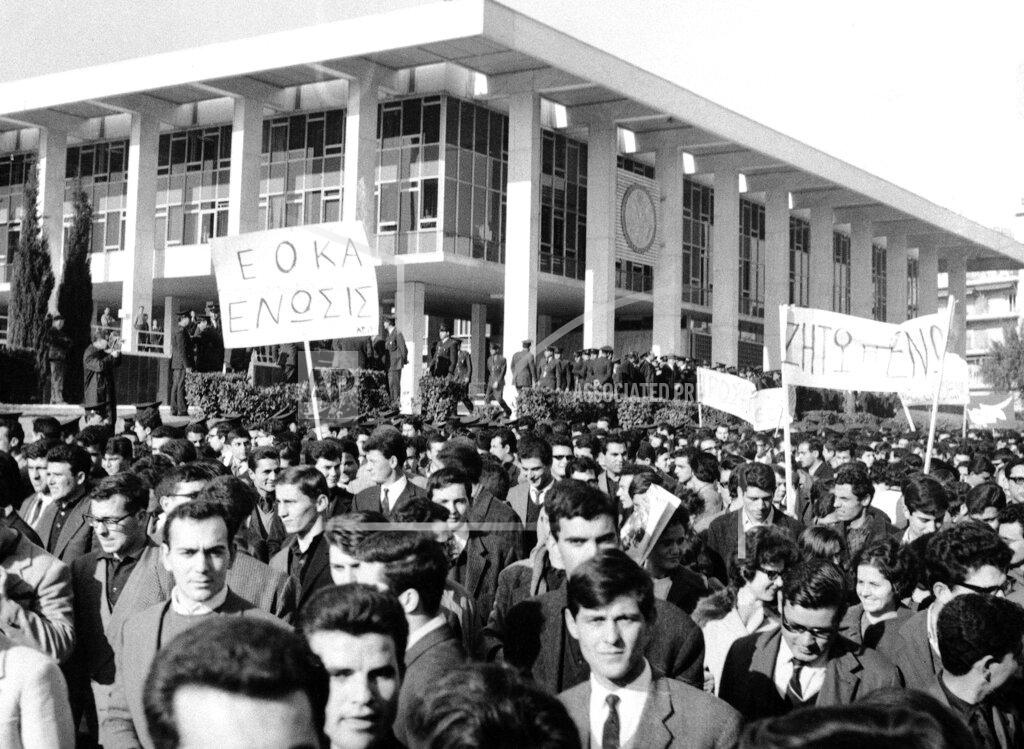
Premier Khrushchev sent letters to President Johnson and other Western leaders today warning the Atlantic alliance powers to refrain from interfering in the internal affairs of Cyprus. He declared that attempts to encroach on Cyprus’s sovereignty would present a “serious danger to general peace” and, could become “the source of international complications fraught with grave consequences.” The text of the letter to President Johnson was virtually identical to messages sent to the British Prime Minister, Sir Alec Douglas‐Home, President de Gaulle and the Premiers of Turkey and Greece. Ambassador Foy D. Kohler and representatives of the other countries were called separately to the Foreign Ministry and handed the messages by Andrei A. Gromyko, the Foreign Minister. The content of the messages was read on the Moscow radio tonight.
The United States tonight shut off the flow of dollars to Cuba from the Guantanamo naval base. In retaliation for Cuba’s action yesterday in cutting off Guantanamo’s water supply, President Johnson ordered the Defense Department to discharge most of the Cuban workers on the base unless they chose to live there or agreed to spend all their earned dollars there. This, in effect, jeopardized the jobs of the 2,500 workers who live in Cuban territory and who go daily to work at the base. About 500 others have lived on the base all along. It seemed unlikely that the Cubans would be allowed by Havana to spend all their money in Guantanamo since the principal reason why Premier Fidel Castro has allowed them to go on working on the base since he took power five years ago was that Cuba has needed the $5 million annually that has come from their wages.
President Osvaldo Dorticos Torrado of Cuba said in a broadcast, reported by The Associated Press, that the Havana Government would lay claim to the Guantanamo base “at a time we consider convenient.”
The United States gave the Security Council today a detailed refutation of Cuban charges that the seizure of four Cuban fishing boats by the United States Coast Guard off Key West on Monday was a “crude act of piracy.” It also disclosed that two of the crew members had asked for and received political asylum in the United States. The United States said that two of the four skippers had admitted that they were knowingly fishing in United States territorial waters less than three miles off the coast when they were seized. Adlai E. Stevenson, chief United States delegate, made the statements in a letter addressed to Carlos Alfredo Bernardes of Brazil, this month’s president of the 11‐member Council, for circulation to all members. With regard to the charges of piracy and improper procedures, United States sources remarked privately that both Mexico and Peru had repeatedly seized North American fishing boats in what those countries consider the traditional three-mile limit.
Secretary of State Dean Rusk said today that he had “no doubt” about the long‐range success of efforts to help South Vietnam survive Communist guerrilla attacks and subversion. Mr. Rusk attempted at a news conference to sort out a series of conflicting Administration assessments of recent weeks. He said South Vietnam had the resources and the will “to get this job done.” He implied that there was no need for a greater involvement by the United States. The formation of a new government in Saigon in the next few days and the disruption caused by two coups d’état in three months, he suggested may give Communist forces further, but temporary, successes. But the United States will not withdraw and leave South Vietnam even more exposed, he asserted. The Secretary called on the Soviet Union to help persuade Communists in China and North Vietnam to let South Vietnam live in peace.
Some 500 Viet Cong cross from a base in Cambodia and seize three strategic hamlets at Bến Cầu, South Vietnam; they are forced to withdraw after a 14-hour battle and reportedly lose 100 men, but ARVN losses are 114. Major General Richard G. Stilwell, American deputy chief of staff for operations in the mission advising the Vietnamese army, flew to the scene of the battle 50 miles northwest of Saigon today. The battle was the third heavy communist attack in the last three days. It coincided with incidents of terrorism, sabotage and small-scale ambushes which affect civilian morale as well as the military position.
A bomb explodes in a Saigon bar, killing five Vietnamese and wounding six U.S. servicemen and 20 civilians. A bar waitress was among those killed by the blast, which tore apart a cafe known as the Playboy. The police speculated that the bomb might have been attached to a bicycle that had been placed against the wall of the cafe.
The pro‐Communist forces in Laos have announced that they will block any attempts by the International Control Commission to investigate cease‐fire violations, Hsinhua, the Chinese Communist press agency reported today. Hsinhua, said this was made plain in a broadcast yesterday by the radio of the Pathet Lao forces. The Chinese Communist agency quoted the Laotian broadcast as having said it was “regrettable” that Premier Souvanna Phouma had asked the commission set up by the Geneva conference to investigate reported Communist attacks in central Laos. “Any proposal to the I.C.C., without the consent of the Neo Lao Hak Sat (the Communist party of Laos, which acts through the Pathet Lao), that is without the unanimous approval of the three sides, will be regarded as null and void, the broadcast said. “The I.C.C. cannot carry out investigations in these areas on the basis of distortion of facts and slanders by one or two sides.”
More than 1,000 persons demonstrated outside the grounds of the garden‐ringed United States Embassy in Accra, Ghana on Tuesday. Some of their placards read: “Stop your lies, stop your rumors,” and “Yankee imperialists, your days are numbered.” The demonstrators were orderly. Ghanaian police stood by, watching. The demonstrators were led from a sound truck owned by the Convention People’s party. The Ghanaian Government today disavowed responsibility today for a demonstration Tuesday at the United States Embassy and said it “deeply regrets the incidents.” A Foreign Affairs Ministry statement said: “The attention of the Ghana Government has been drawn to the allegation that demonstrations and other incidents which took place at the American Embassy in Accra have been inspired or condoned by the Ghana Government. This allegation is unfounded. The Ghana Government disassociates itself from and deeply regrets the incidents.”
President Johnson’s disclosure of an offer of United States cooperation with Israel on research for desalting sea water was received in the Arab world today like a blow in the face. Ignoring Mr. Johnson’s offer to cooperate also with other countries, press editorials interpreted the President’s speech along these lines: Just when Arab chiefs of state have met to devise means of heading off Israel’s diversion of Jordan River waters, the United States Government first issues a statement through U. Alexis Johnson, Deputy Under Secretary of State for Political Affairs. The statement, the Arabs say, warns them not to use force. Then Washington indicates willingness to send troops to Cyprus, where they could be used for Israel’s protection. Then, the Arabs declare, the United States doubles the number of its Marines in the Mediterranean and now the President wants to help the Israelis distill sea water.
As for the statement by Under Secretary Johnson, what he said recently was that the United States followed a policy of neutrality in the Middle East, but would not stand idly by if aggression was committed. It was later said in Washington that the statement had not been aimed at any one in particular. “Johnson the Jew,” wrote Michel Abdul Jawdeh, a columnist on Al Nahar. He said the speech was “serious because it has officially revealed American‐Israeli cooperation in nuclear research at the Rehovot nuclear center, which has been evoking Arab fears because of the possibility that Israel may develop the atomic bomb.” He called the speech equal in importance to United States recognition of Israel as a state. He said: “The speech goes beyond recognition of the birth of Israel to recognition of Israel’s future — as if Israel were America’s 51st state!”
Troops from Somalia crossed into Ethiopia and attacked the border post at Tog Wajaale, triggering a war between the two African nations. A ceasefire between the two sovereign nations would be implemented on April 1.
Fulbert Youlou, the first President of the Republic of the Congo was freed from the prison where he had been held since his overthrow on August 15, 1963, after his supporters overpowered guards and liberated him.
A Jackson, Mississippi jury, trying Byron De La Beckwith for the murder of Medgar Evers on June 12, 1963, reported that it could not reach a verdict after 11 hours of deliberation, and a mistrial was declared at 11:30 in the morning. An unidentified source told the press that the jury had been deadlocked, with 7 jurors in favor of acquittal and 5 for a conviction, after more than 20 ballots. Judge Leon F. Hendrick declared a mistrial, and on March 23 will set the date for a second trial. Beckwith, a fertilizer salesman from Greenwood who was so confident of an acquittal that he told the jury as much, listened soberly when, one by one, the jurors told the court they would never be able to agree.
The outcome of the two‐week trial was a surprise to many in Mississippi, both Negro and white, who had expected an acquittal. The votes for conviction meant that some of the men on the all‐white jury did not believe two police officers and a businessman from Beckwith’s home town who testifed they saw him 95 miles from the scene of the crime about the time Mr. Evers was killed. The victim’s widow, Mrs. Myrlie Evers, one of the state’s 40 witnesses, had prepared a statement for release in the event of an acquittal. She was not expecting a hung jury. The votes for conviction — which would have meant life imprisonment or death in the gas chamber — were believed at least partly the result of a vigorous prosecution by the young district attorney, William L. Waller.
The Senate passed the Administration’s tax reduction bill today, 77 to 21. The measure, which cuts income tax rates for all individuals and corporations, now goes to a conference committee for reconciliation with the House-approved text. It is expected to reach President Johnson’s desk before the end of this month. The Senate version provides $11.6 billion in annual tax relief by top‐to‐bottom rate reductions coupled with structural revisions of the Revenue Code. The version passed by the House last September called for a net cut of slightly less than $11.1 billion.
Soon after the Senate’s one-sided vote for the bill, President Johnson issued a statement praising Congress and calling on the Senate‐House conferees to resolve their differences quickly. Declaring that each day’s delay was costly, he said final action on the measure would give the national economy “new life” through increased consumer buying, new investment and more jobs. Administration forces maintained control in the final round of Senate voting, as they had done throughout the seven‐day debate, and staved off all major amendments. Senator Russell B. Long, Democrat of Louisiana, was floor manager. The bill, in both House and Senate versions, calls for the biggest tax cut in the country’s history. About two‐thirds of the reduction would apply to income received this year. The cut would be fully effective on income received in 1965. The present 18 percent income‐tax withholding rate will drop to 14 percent one week after the bill becomes law, probably early in March. This is expected to increase the take‐home pay of the nation’s taxpayers by $800 million a month.
The House of Representatives completed action tonight on the section of the civil rights bill empowering the President to cut off funds from federally assisted programs where discrimination is practiced. It was a long and sometimes stormy day, enlivened by oratory and unexpected drama. The drama was supplied in late afternoon when two Southern leaders sought to save their forces from total defeat. They suddenly proposed to substitute the softer version of the Title I section originally suggested by President Kennedy. The present version was worked out by the Judiciary Committee and Attorney General Robert F. Kennedy.
The maneuver threw the House into turmoil. The civil rights forces, suspecting a deal, threatened revolt and then went on to defeat the amendment overwhelmingly. Tomorrow the House will take up the last controversial section, outlawing discrimination in private employment and labor unions. A final vote on the bill is scheduled tomorrow night. The section under debate today states that no person is to be denied the benefits of federally assisted programs because of race. Every Government department is directed to frame regulations to carry out the purpose of the antidiscrimination order. The department is permitted, but not required, to cut off funds for noncompliance. Before it does so, however, it must consult with the responsible state or local agency receiving the Federal funds and seek compliance by persuasion. The Southerners bitterly resent this provision. It poses a threat to Federal funds for roads, acreage retirement, unemployment compensation and a host of other programs in their states and communities if discrimination persists in the administration of the programs.
Persons within and close to the Johnson Administration have attempted to use secret Government documents to impugn the testimony of a witness in the Robert G. Baker case. The witness is Don B. Reynolds, who told the Senate Rules Committee that he paid for a $542 stereophonic phonograph given in 1957 to President Johnson, then the Senate Democratic leader. Mr. Reynolds said he gave the gift at the insistence of Mr. Baker, then the secretary to the Senate’s Democratic majority. The business activities of Mr. Baker, who has resigned, have been under investigation by the committee since last October. Some reporters and editors concerned with the Baker investigation have been advised by persons in the White House that Mr. Reynolds is an unreliable witness.
A defense lawyer in the jury tampering trial of James R. Hoffa, president of the International Brotherhood of Teamsters, accused the presiding United States District Judge today of permitting a “drumhead court‐martial.” Jacques M. Schiffer of New York City made the accusation in a shouting, arm‐waving attack in which he leveled accusations at Government prosecutors, as well as at District Judge Frank W. Wilson. Outside the courtroom, Mr. Hoffa offered to fight a federal marshal in a hotel corridor.
Judge Wilson listened patiently to Mr. Schiffer and other defense lawyers criticize his handling of the trial and attack government attorneys. Several of the defense lawyers asked to be allowed to withdraw from the case on the ground that their clients were not getting a fair trial. They also asked for a mistrial or separate trials for each of the six defendants. When they were through, Judge Wilson said quietly: “If there is nothing further, all motions for severance and a mistrial will be overruled, and also motions for relief of counsel.”
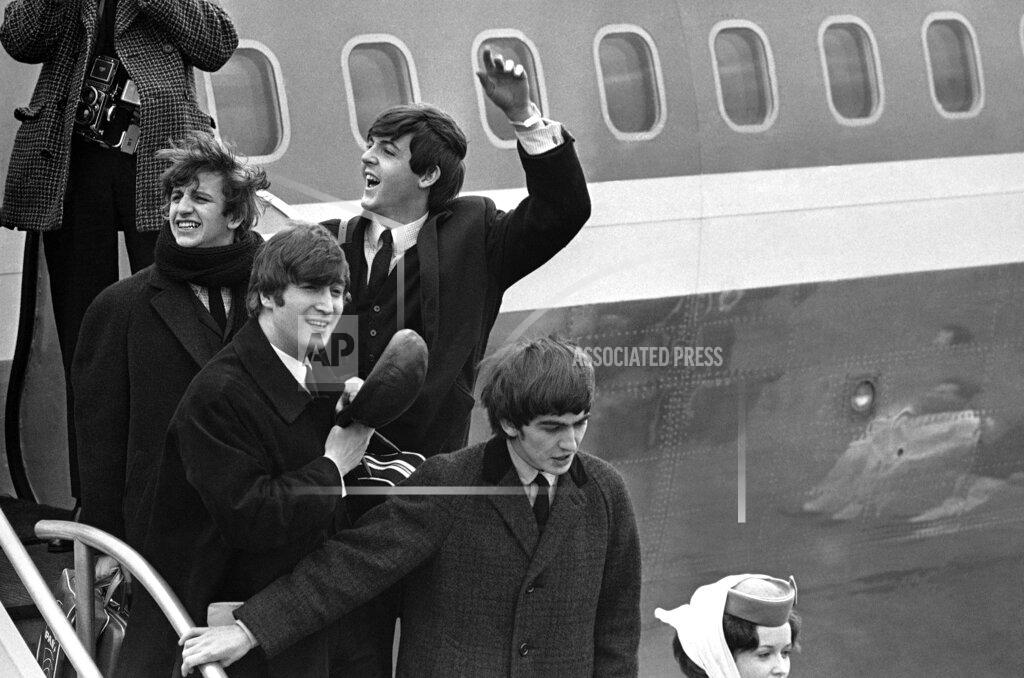
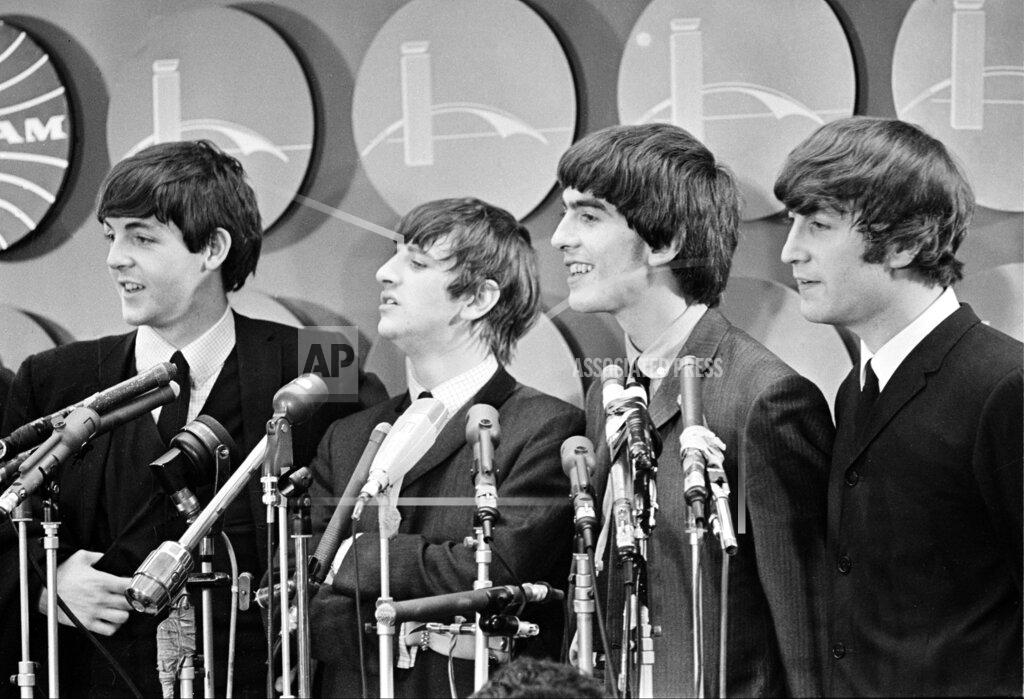
The Beatles arrived from England at New York City’s JFK International Airport at 1:20 in the afternoon on Pan American Airlines Flight 101 from London, and received a tumultuous reception from a throng of screaming fans, marking the first occurrence of “Beatlemania” in the United States. The “Fab Four” stayed in suites 1260, 1263, 1264 and 1273 of the Plaza Hotel.
Baskin-Robbins introduces Beatle Nut ice cream.
The Golden Hawks, aerobatic team of the Royal Canadian Air Force, was disbanded after less than five years of operation. Canada’s Department of National Defence dropped the program because of its one million dollar per year cost and because the team’s seven Canadair Sabre jet planes were difficult to maintain.
The ABC television detective series “77 Sunset Strip,” which had fired all of its regular cast except for Efrem Zimbalist, Jr. prior to its final season, ended a six-year run with its last original episode. It was replaced in the 7:30 Eastern time slot with a short-lived Western series, “Destry.”
Roger Sessions’ 5th Symphony premieres in Philadelphia with Eugene Ormandy conducting the Philadelphia Orchestra.
Dow Jones Industrial Average: 791.59 (+5.18).
Born:
Cynthia “Sippy” Woodhead, swimmer (Olympic silver medal, 200-meter freestyle, 1984), in Riverside, California.
Doug Dadswell, Canadian NHL goalie (Calgary Flames), in Scarborough, Ontario, Canada.
Bien Figueroa, Dominican MLB shortstop and second baseman (St. Louis Cardinals), in Santo Domingo, Dominican Republic.
Died:
Hermann A. J. Kees, 77, German Egyptologist (“Problems of Egyptology”).
Lillian Copeland, 59, U.S. discus thrower (Olympic gold medal, 1932).




 History Diaries