After initially rejecting the demands of a guerrilla group that seized the Japanese Ambassador to Kuwait and other embassy officials, the Kuwaiti government accepted an appeal from the Japanese government to allow four guerrillas to be flown from Singapore in exchange for the hostages in the embassy. The four, who had been on a ferry boat in Singapore harbor after trying to blow up an oil refinery, belong to the same Palestinian and Japanese extremist organizations as the group that seized the embassy in Kuwait.
The Senate Foreign Relations Committee approved the nomination of G. McMurtrie Godley to be ambassador to Lebanon. There was no opposition from senators who had opposed his activities as ambassador to Laos. Godley, a career foreign service officer, was nominated last year to be assistant secretary of state for the Far East. But his approval was blocked by committee members who felt he should not be in a major policy-making role in Asia because he had headed U.S. military operations in Laos, including supervising bombing.
Senator Thomas F. Eagleton (D-Missouri), reporting on the combat performance of the U.S.-built M-60 tank during the October Middle East fighting, said the vehicle’s highly explosive hydraulic system resulted in some Israeli crews being burned. alive after a hit by the Russian-built “Sagger” missiles employed by Arab forces. Eagleton, a member of the Senate Armed Services Committee, made a year-end trip to Israel to investigate complaints about the M-60, the main U.S. battle tank first used by American forces in the Vietnam war. He said the Israelis consider the tank’s armor too thick but liked the vehicle’s mobility and firepower.
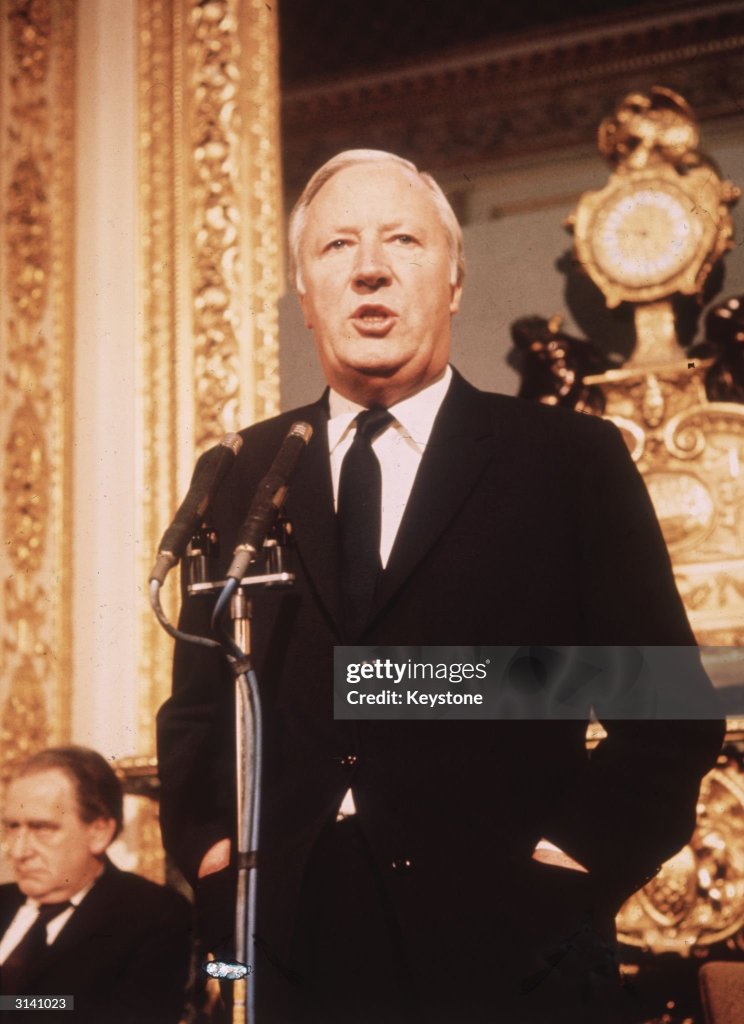
After being unable to resolve his nation’s strike of coal miners, Prime Minister Edward Heath of the United Kingdom said in a televised speech that he would ask for the Crown to dissolve Parliament and to call for a new election for the House of Commons to take place on February 28. The election struggle — held amid labor and economic troubles that have reduced industry to a three‐day week and threaten to squeeze it still further — is widely expected to be the bitterest and most divisive in recent British history. It will be a test of support: on the one side, the governing Conservative party’s determination to hold firm against what it considers inflationary wage claims, on the other, the assertion by unions and the Labor party that this policy bears down unfairly on the workers.
The announcement, made from Mr. Heath’s office at 10 Downing Street shortly after noon, follows the coal miners’ decision on Tuesday to advance, their overtime ban into a full strike, starting Sunday. The most significant immediate reaction to Mr. Heath’s move was a statement by the miners’ president, Joseph Gormley, favoring suspension of the strike until after the election. But several other miners’ leaders came out vehemently against this idea. A decision will be made tomorrow at what promises to be a stormy meeting of the miners’ national executive board. The decision whether to go ahead with the strike is expected to have a crucial effect on the tone and climate of the election campaign. Apart from its effects on the economy — drastic power cuts and a sharp drop in steel production — a strike holds the threat of collisions between pickets and policemen and serious heightening of the mood of confrontation that already exists.
The Soviet bloc and the North Atlantic Treaty Organization have advanced widely divergent proposals at the European talks on mutual force reductions under way in Vienna, making early progress highly unlikely. Diplomats and Nixon Administration officials have disclosed details of the proposals on both sides and the reasoning behind them in recent interviews with The New York Times. The NATO proposal would reduce only ground forces — now totaling 770,000 for NATO and 925,000 for the Soviet bloc — to what is termed “an illustrative common ceiling” of 700,000 and would also specify Soviet units to be removed from the central front.
The proposal by the Soviet bloc, which is represented at the talks by the Warsaw Pact grouping, would reduce both ground and air manpower by more than 15 percent, bringing NATO forces from million to 820,000 and Warsaw Pact forces from 1.3 million to 1.15 million, and would designate units on both sides to be withdrawn from the front.
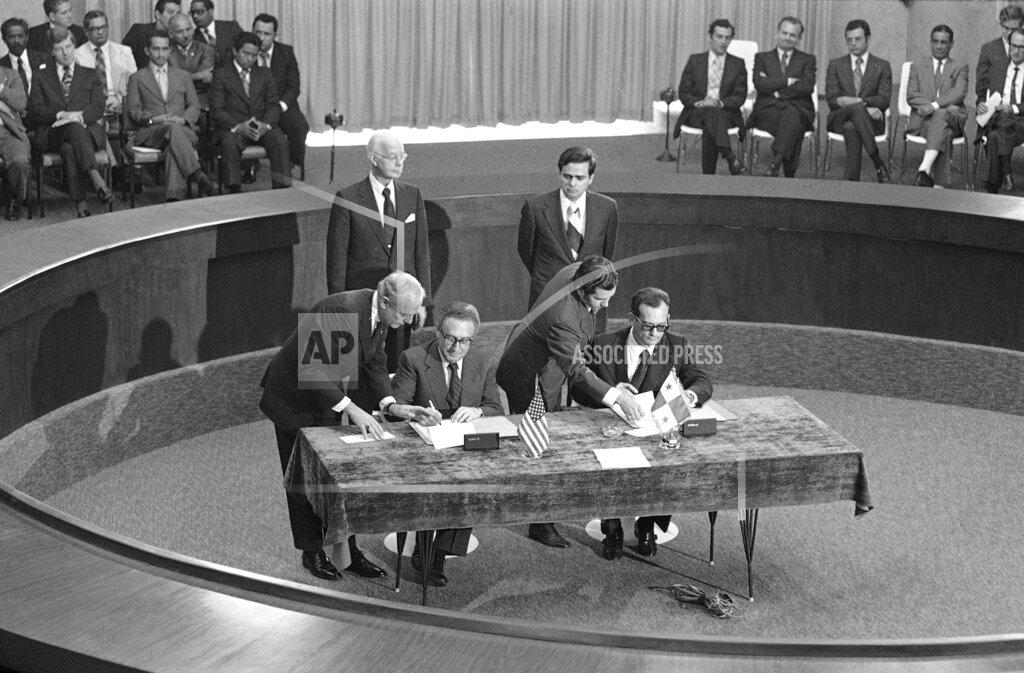
An agreement between the U.S. and Panama to negotiate a revision of the 1903 Panama Canal Treaty was signed in Panama City by U.S. Secretary of State Henry Kissinger and Panamanian Foreign Minister Juan Antonio Tack. The United States and Panama today concluded an agreement on the principles that will guide the negotiation of a new Panama Canal treaty, eventually transferring sovereignty over the waterway to the Panamanians. The agreement, whose eight principles include a statement that there shall be “a fixed termination date,” was signed, in a solemn ceremony by Panlama’s Foreign Minister, Juan Antonio Tack, and Secretary of State Kissinger. As envisioned in the declaration and underlined in a speech by Mr. Kissinger, the new treaty would give Panama a sense of equality with the United States for the first time, ultimately ending the grant “in perpetuity” of the 550‐square mile Canal Zone laid down by the canal treaty of 1903.
Daniel Oduber won the Costa Rican presidential election with 43% of the vote, according to tentative final ballot figures released by the Electoral Board. The board is expected to officially declare the 53-year-old lawyer, candidate of the ruling National Liberation Party, president-elect next week. He needed 40% of the vote to win without a runoff. Oduber’s party lost its congressional majority, winning only 27 of the 57 seats.
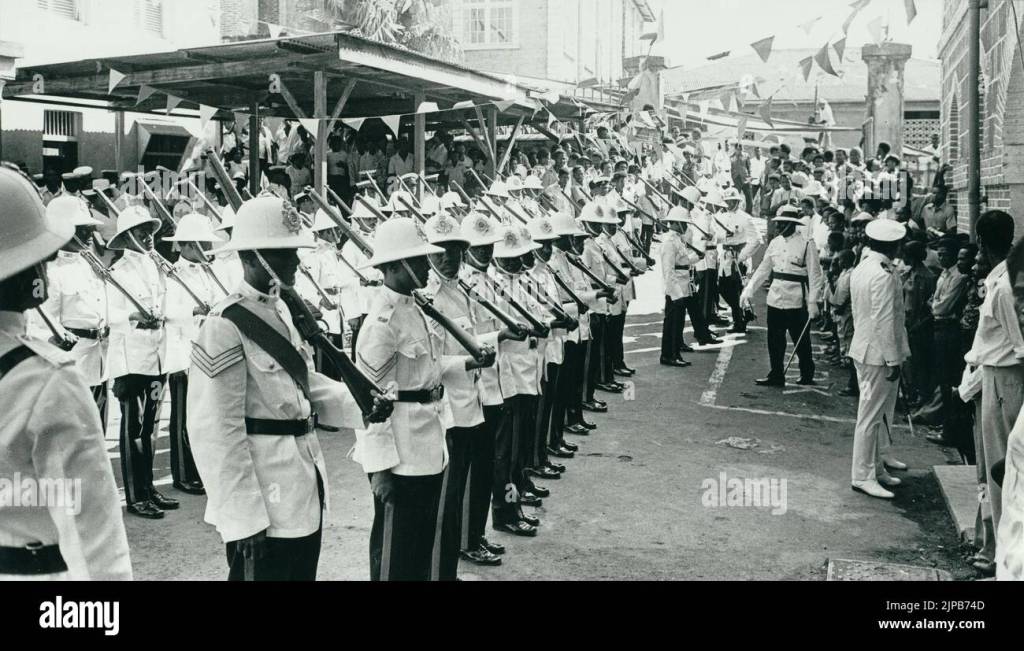
At one minute after midnight, the Caribbean island of Grenada became independent of the United Kingdom after 210 years as a British colony. Eric Gairy became the nation’s first Prime Minister, while former colonial governor Leo de Gale became the nation’s first Governor-General.
The Cambodian command said today that government troops had made gains on both banks of the Bassac River southeast of Phnom Penh. The command said that its troops had cleared three miles of Route 21 south of the industrial suburb of Takhmau seven miles southeast of Phnom Penh on the western bank of the Bassac. On the eastern bank, about 50 rebels were killed in fighting at the village of Prek Prah, the command said. Some 1,000 insurgent troops were reported concentrated in the bend of the Bassac southeast of Prek Prah. Government reinforcements were reported moving toward the area. The Cambodian Navy reported that it killed 52 insurgents and seized a number of weapons during January. It said that 19 navy men had been killed and 107 wounded. The government also reported that 31 insurgents defected between January 22 and January 28.
Seventy two Viet Cong civilian prisoners were flown by helicopter from Biên Hòa Air Base to the Communist‐held town of Lộc Ninh today to start the resumption of prisoner exchanges which have been stalled since last July. The prisoners were the first batch of a total of 200 Viet Cong military and civilian prisoners to be set free in Lộc Ninh, 75 miles north of Saigon. They were loaded in groups of eight into unarmed orange striped helicopters of the two party joint military commission.
Moro rebels in the Philippines massacred 25 civilians in a raid on the town of Pikit on the island of Mindanao. Muslim secessionists in the Philippines killed 25 persons — including a Muslim family and a Christian family — in raids on the central Mindanao town of Pikit. Mayor Ramondo Flores said the deaths were the largest single toll in his town since fighting flared among Muslims, Christians and government troops after imposition of martial law in 1972. The decree resulted from fighting between Muslims and Christians that has roots in a land rivalry raging since Christian settlers from the north started migrating into mostly Muslim Mindanao early in the century.
Four Christian clergymen were sentenced to 15-year prison terms by a South Korean military court and two other clerics drew 10-year sentences on charges of defying a presidential decree banning opposition to the constitution. The court said the six held an indoor rally, signed a petition and scattered leaflets demanding retraction of the decree. The action is the latest in a series of measures taken by the regime of President Park Chung Hee in an effort to stop spreading protests against the 1972 constitution, promulgated under martial law and ratified without debate in a national referendum.
Six American teenagers, members of a tour group from the American high school in Singapore, were fined $50 each and given three-month suspended jail sentences for committing sacrilege by climbing on a statue of Buddha. They were arrested at Sukhothai, Thailand, last month. They admitted climbing on the statue but said they did not know it was sacred. The U.S. Embassy said the teenagers, who were well-treated by Thai authorities, were on their way back to Singapore.
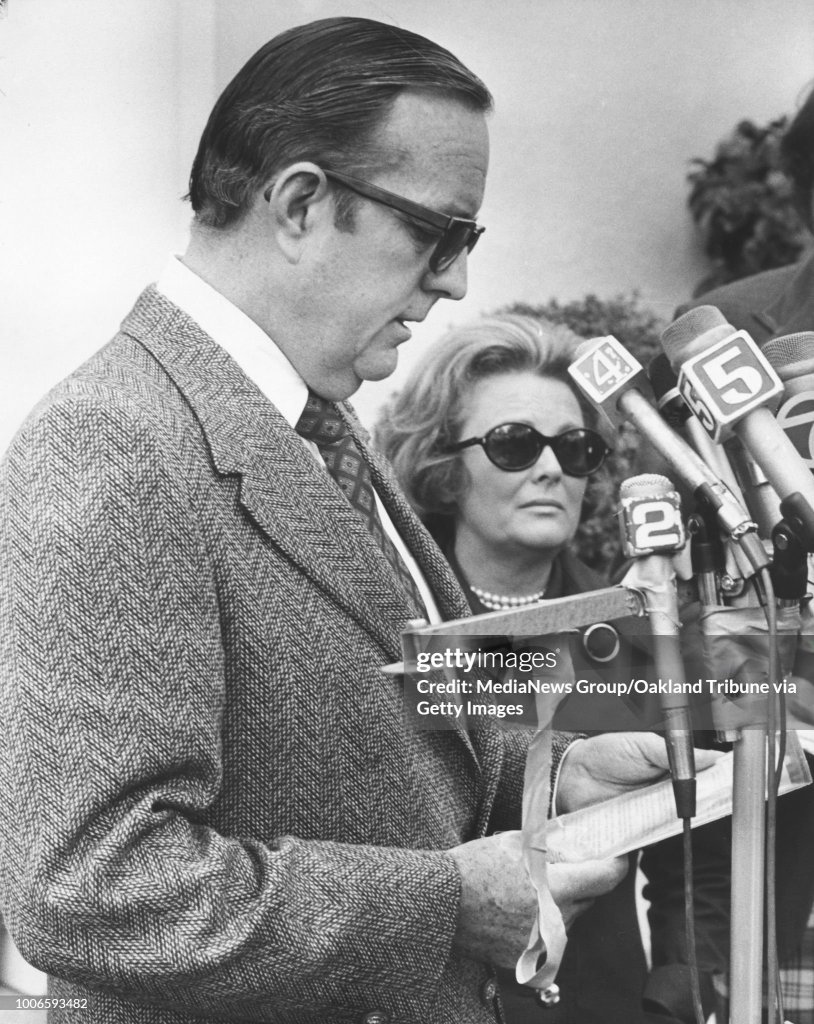
A major breakthrough occurred in the Patty Hearst kidnapping. U.S. attorney James Browning reported that a letter from the “Symbionese Liberation Army” was received at a Berkeley radio station, claiming responsibility for Miss Hearst’s kidnapping. The organization was unknown until two of its members, Joseph Remiro and Russell Little, were recently charged with the murder of an Oakland, California, school superintendent.
The SLA was a small, moronic yet dangerously violent group of Maoist Communist loonies active between 1973 and 1975; it claimed to be a vanguard movement. The FBI and wider American law enforcement considered the SLA to be the first terrorist organization to rise from the American left. Six members died in a May 1974 shootout with police in Los Angeles. The three surviving fugitives recruited new members, but nearly all of them were apprehended in 1975 and prosecuted. During its existence from 1973 to 1975, the group murdered at least two people, committed armed bank robberies, attempted bombings and other violent crimes, including the kidnapping in 1974 of newspaper heiress Patty Hearst. Its spokesman was escaped convict Donald DeFreeze, but Patricia Soltysik and Nancy Ling Perry were believed to share group leadership.
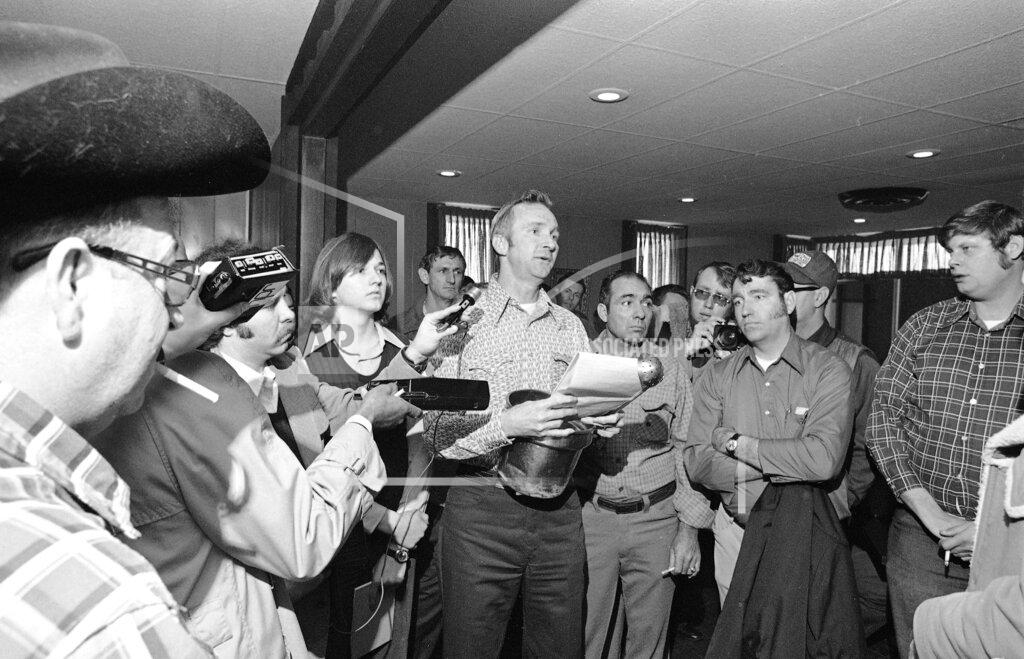
The tentative agreement to end the truckers’ strike may not be holding. Many drivers rejected the agreement and the overwhelming majority of wildcat strikers may remain off the highways until fuel prices are rolled back.
The White House is going to take a tough stand on the strike and highway interference. The administration is prepared to use military force to keep trucks moving if necessary. Press spokesman Gerald Warren announced the formation of a new high-level task force to ensure that the nation’s highways are kept open. Transportation Secretary Claude Brinegar will head the task force. Deputy energy director John Sawhill stated his hope that the truckers will return to work soon, but warned that military force will be used to offset the strike if necessary. Attorney General William Saxbe is monitoring the strike closely to make sure that federal laws are not being violated.
The American Meat Institute reported that a serious meat shortage will be at hand if trucks don’t start making deliveries. Meat packers and processors will be forced to close.
Transportation Secretary Brinegar said that federal and state laws pertaining to maximum truck sizes may be scrapped. With the energy crisis and slower speed limits, larger trucks may be the only answer.
The emergency energy bill faces problems in Congress; the bill is at a standstill. Representatives Gillis Long and John Young joined five Republicans today to prevent floor action on the bill in the House. Roadblocks in the Senate are also keeping the bill from floor action. Senators Lloyd Bentsen, John Tower, Henry Bellmon, Dewey Bartlett, Pete Domenici, J. Bennett Johnston, Robert Dole and Paul Fannin all denounced the proposed crude oil price rollback provision in the bill.
Prime Minister Heath of Britain took his struggle with the nation’s coal miners to the voters by ordering Parliament dissolved and calling a general election for February 28. The campaign, expected to be the bitterest and most divisive in recent British history, will test the Conservative government’s determination to resist what it considers inflationary wage demands and the Labor party’s claim that the government’s anti-inflation policy is unfairly directed at workers.
The chairman of the House Judiciary Committee announced that lawyers representing the committee and the President would hold an early meeting at the White House to discuss the extent of Mr. Nixon’s cooperation with the committee’s impeachment inquiry. Though Peter Rodino, the committee chairman, declined to speculate on the nature of the meeting, a Republican member said he was confident that “real cooperation would be forthcoming.”
Vice President Ford said that President Nixon had assured him that a public release of key White House tape recordings and documents relating to Watergate was being “actively considered.” Presidential aides and Senator Hugh Scott of Pennsylvania have said repeatedly that the White House materials would clear President Nixon of any involvement in the Watergate affair.
President Nixon’s new national health insurance plan is vastly more liberal than the one he introduced in 1971, but it extremely complicated, and critics contend it has serious flaws. Critics knowledgeable in the health field are unhappy about its reliance on the private health insurance industry, which they contend has had a mixed performance over the years, and about the use of state governments to regulate the insurance carriers. But they applaud the new plan’s comprehensive coverage. The plan is so broad that it may well cover up to 80 per cent of the personal health expenses of Americans, for a total cost of $70‐billion if the estimate of one senior Federal health official is correct.
The amount is so large that it puts the Nixon Administration and Caspar W. Weinberger, the Secretary of Health, Education and Welfare, in some difficulty. The most liberal health insurance proposal before Congress, a plan introduced by Senator Edward M. Kennedy, Democrat of Massachusetts, has repeatedly been criticized by the Administration as too expensive — from $70‐billion to $80‐billion. Now it appears that the Nixon version would cost roughly the same as the Kennedy version, although Administration officials had been saying for several months that the cost would be about $40‐billion.
The Senate Banking Committee approved a massive bill that sponsors have called one of the most important housing measures ever presented to Congress. The bill authorizes several hundred million dollars more than President Nixon is seeking in this field and would continue two FHA programs designed to subsidize private home ownership and low-rent apartments for the poor — programs the President would terminate. The measure also includes $30 million a year for 10 years sought by Mr. Nixon to try out a program of cash housing allowances. And the measure would lower down payments on FHA-insured mortgages and raise the ceiling on the amount of a mortgage that can be insured.
The Pentagon announced that six Army headquarters would be eliminated and the manpower savings converted into new combat brigades. The six are U.S. Army Alaska; U.S. Army Forces in the Southern Command, Panama Canal Zone; U.S. Army Pacific; Engineer Command in Europe; Theater Army Support Command in Europe, and the Army Intelligence Command at Ft. Meade, Maryland. The intelligence command will be shut down by June 30; the other five will be closed during the bookkeeping year beginning July 1. The Army said its initial goal was to increase its combat forces from 13⅓ divisions to 14, adding two brigades.
Longshoreman union official Alfred F. Chittenden was indicted by a federal grand jury in New Orleans on 70 counts, most of them charging embezzlement of union funds. Chittenden — vice president of the International Longshoremen’s Association, president of a New Orleans local and secretary-treasurer of a Baton Rouge local — was charged with embezzlement of $37,252. U.S. Attorney Gerald Gallinghouse said the indictment ended the first phase of a broader investigation into alleged irregularities in the area’s dock unions.
Produced by Mel Brooks, the popular satire of movie westerns, “Blazing Saddles,” had its world premiere in Burbank, California, at the Pickwick Drive-in Theater for 250 invited guests who rode in on horseback rather than in cars, before being released to other U.S. theaters during the winter and spring.
Dow Jones Industrial Average: 828.46 (+3.84, +0.47%).
Born:
Steve Nash, Canadian NBA point guard (NBA Most Valuable Player, 2005, 2006; NBA All-Star, 2002, 2003, 2005-2008, 2010, 2012; Phoenix Suns, Dallas Mavericks, Los Angeles Lakers), in Johannesburg, South Africa.
Adrian Brown, MLB outfielder (Pittsburgh Pirates, Boston Red Sox, Kansas City Royals, Texas Rangers), in McComb, Mississippi.
Ryan Phillips, NFL linebacker (New York Giants, Indianapolis Colts), in Renton, Washington.
Bob Rosenstiel, NFL tight end (Oakland Raiders), in Prineville, Oregon.
J Dilla (stage name for James Dewitt Yancey), American record producer and rapper; in Detroit, Michigan (d. 2006, cardiac arrest due to thrombotic thrombocytopenic purpura and lupus).
Nujabes (stage name for Jun Seba), Japanese record producer and DJ; in Nishi-Azabu, Minato, Tokyo, Japan (d. 2010, traffic collision).
Died:
Arline Judge, 61, American actress (“Girls in Chains”, “Mad Wednesday”, “Age of Consent”).
Donald C. McGraw, 76, American publisher who served as president of McGraw-Hill from 1953 to 1966.
Hiroshi Nakamura, 83, Japanese biochemist, cartographer and nutritionist.

 History Diaries