
Beirut was in chaos as Shiite and Druze gunmen demanding the resignation of President Amin Gemayel took over most of West Beirut. As groups of Muslim youths attacked key Lebanese Army bases, some army officers and soldiers put up fierce resistance, while others broke and ran. As the fighting raged, the United States Marine contingent at Beirut airport came under fire, and American fighter-bombers and naval gunners responded by bombarding the bases of anti-Government militias in the hills overlooking the capital.
The use of U.S. air and naval forces against positions of anti-Government militiamen near Beirut was ordered by President Reagan as a show of support for President Amin Gemayel and as a warning to Syria and its Lebanese supporters, Administration officials said.
Israel is unlikely to come to the aid of President Gemayel with any major military operation, according to Israeli officials and Western diplomats. Limited action, such as air strikes or naval bombardment of Shiite and Druze positions, would be taken only in coordination with the United States, the officials said.
A senior Soviet spokesman said in Helsinki that Moscow considers the new U.S. Pershing 2 and cruise missiles in Europe to be strategic weapons and that is why the Soviet Union walked out of the strategic arms reduction talks, as well as the European missile negotiations. Leonid M. Zamyatin, rejecting Western calls for a resumption of the U.S.-Soviet talks, said the deployment of the North Atlantic Treaty Organization missiles in Western Europe “makes it impossible to resume the Geneva talks” until they are withdrawn.
Soviet Defense Minister Dmitri F. Ustinov, 75, canceled this week’s planned visit to India because he is ill, Western embassy sources said in Moscow. The sources said the information came informally from Soviet officials in an apparent effort to dampen speculation that the Ustinov trip may have been called off because of the health problems of Soviet President Yuri V. Andropov, who has not been seen in public since Aug. 18. No details of Ustinov’s ailment were disclosed.
A petition bearing the signatures of 939 Czechoslovaks has been sent to President Gustav Husak protesting the basing of Soviet missiles in Czechoslovakia, emigre sources said in Vienna. The petition, according to the sources, declared that “if we are really sincere in our utterances about peace, we cannot be indifferent to any kind of armament.” The official Prague media have defended the Soviet move as necessary to counter the deployment of new missiles in Western Europe.
The British police said today that they were questioning Kashmiris throughout the country in their hunt for the killers of an Indian diplomat. The body of the diplomat, Ravindra Mhatre, who was abducted in Birmingham on Friday, was found late Sunday night in a farm lane. The Birmingham-based Kashmir Liberation Front, which denies any connection with the kidnapping, said the police raided dozens of homes and questioned many natives of the disputed territory on the Indian subcontinent living in Britain, in some cases confiscating passports. The police said there had been no further word from the Kashmir Liberation Army extremist group, which said in a letter delivered to Reuters in London late Friday that it had kidnapped an Indian diplomat who would be shot if its demands were not met. The document demanded the release of 10 named prisoners, the release of all political prisoners in Indian-held Kashmir and payment of a $1.4 million ransom.
A jailed Solidarity activist, Janusz Palubicki, is in critical condition after almost eight weeks on a hunger strike, opposition sources said today. Mr. Palubicki, who was a leader of the banned union in Poznan in western Poland, was moved to the hospital wing of Wroclaw Prison on Saturday, they said. The opposition sources said that Mr. Palubicki’s weight had fallen from 154 to 105 pounds and that he could die within a few days. They said Mr. Palubicki, an art historian, had told prison authorities he was prepared to die unless Solidarity prisoners were given political status and more access to their families.
Spain’s Under Secretary for Defense, Eduardo Serra, said today that his government might have to cut back on future purchases of United States military equipment unless the United States buys Spanish equipment for American troops. Mr. Serra spoke to reporters on his return from the United States, where he held talks with Pentagon officials and with McDonnell Douglas, from whom Spain agreed last year to buy 72 F-18A fighters worth $1.8 billion. “Either we have a real presence as suppliers to the armed forces of the United States or we will see ourselves obliged to drastically reduce our purchases there,” Mr. Serra said. The United States Army is considering the purchase of a logistic support plane and Spain wants it to choose a Spanish model, the Aviocar C-212 rather than the British-made Sherpa.
Three Taiwanese jet fighters scrambled to intercept a Soviet Tupolev Tu-95 bomber that entered Taiwan’s airspace 16 miles southwest of Taiwan’s west coast, the Defense Ministry in Taipei said. The Soviet bomber, apparently flying from Vladivostok to its base at Cam Ranh Bay in Vietnam, was followed by 37 minutes by the Taiwanese F-5s, a ministry spokesman said. Military sources speculated that the Soviet plane’s intrusion may have been due to bad weather.
Prime Minister Yasuhiro Nakasone told the opening session of Japan’s Parliament that he was “severely chastened” by his sharply reduced margin of victory in elections last December, and he pledged to deal with the question of political ethics during his second term. Nakasone’s Liberal Democrats apparently suffered at the polls because of their links to former Prime Minister Kakuei Tanaka, who was convicted of accepting bribes from Lockheed Aircraft Corp. while in office.
Environment ministers from eight West European countries will come to Ottawa next month to discuss the growing menace of acid rain. The conference, scheduled for March 20-21, was arranged by Environment Minister Charles Caccia of Canada and a spokesman for Mr. Caccia said today that one of his chief aims was to maintain pressure on the United States to reverse its stand over the problem. Ministers from West Germany, Norway, Sweden, Denmark, Finland, Switzerland, Austria and France will take part in the conference, the spokesman said. The acid rain issue is a major irritant in relations between Canada and the United States. President Reagan’s refusal to call for pollution controls has been described by Mr. Caccia as a serious setback to Canada.
Nicaragua’s leftist government has reversed its decision to delay preparations for next year’s general elections and has decided that the official date for the voting will be announced on February 21 as scheduled. The Council of State had said Saturday that it would delay presentation of an electoral law due today until the government learned more about two air raids last week that it blamed on Honduras. The council now says it will unveil the electoral law on Wednesday.
The Salvadoran army has sent 1,000 troops into the northern province of Chalatenango to clear the region of leftist guerrillas who seized nine unprotected villages over the weekend, a military spokesman said. The rebels’ clandestine Radio Farabundo Marti said a guerrilla battalion temporarily occupied the nine villages without resistance and conducted a propaganda campaign aimed at discouraging participation in national elections scheduled for March 25.
Brazil will get advanced technology for its fast-growing arms industry under an accord signed with the Reagan Administration. The agreement re-establishes American-Brazilian military ties that were broken during the Carter Administration in a dispute over human rights.
A dispute over hockey players was apparently resolved when five men who had competed in National Hockey League games were withdrawn by their countries from the XIV Olympic Winter Games in Sarajevo, Yugoslavia. The five withdrawn players are Mark Morrison and Don Dietrich of Canada, Jim Corsi and Rick Bragnalo of Italy and Greg Holst of Austria.
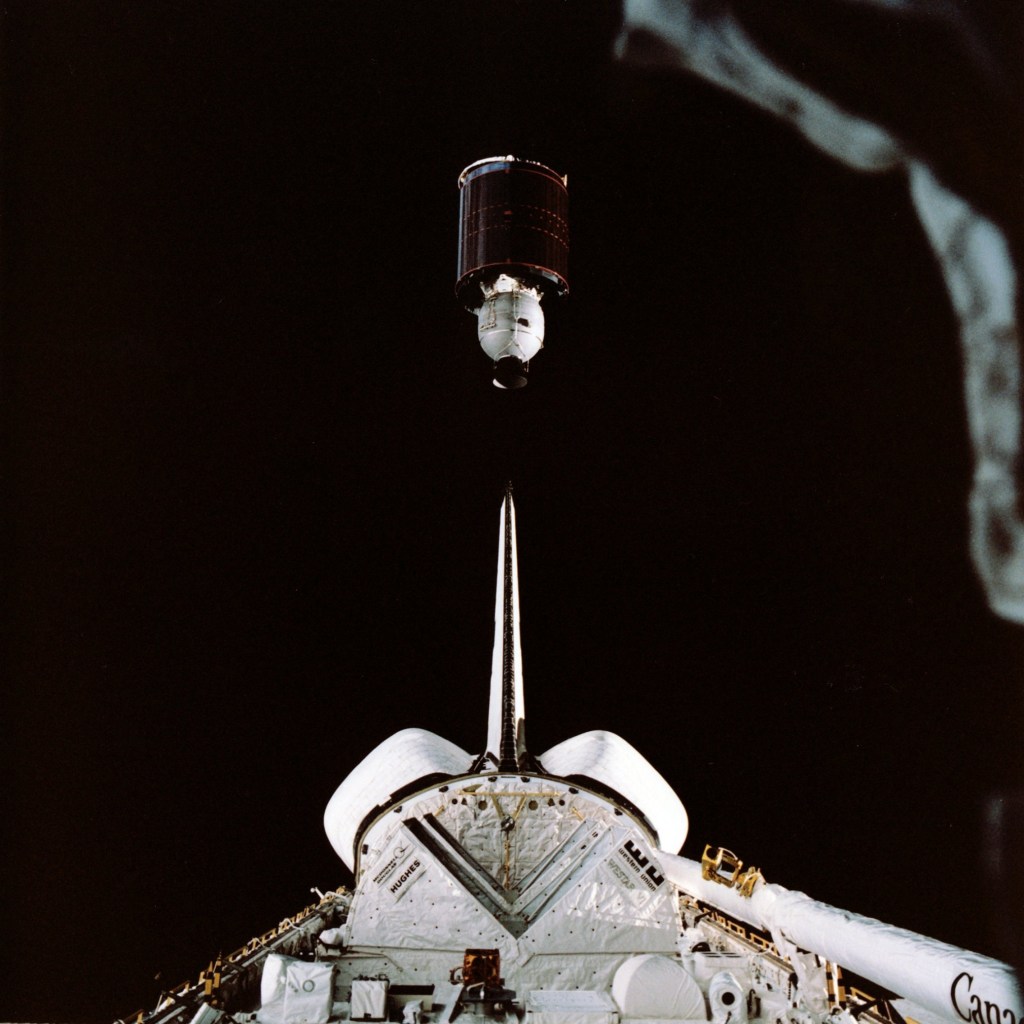
A third major failure occurred in the space shuttle Challenger’s mission. The second satellite deployed by the shuttle misfired and strayed off course in an orbit too low for it to serve as a useful communications relay outpost. It thus apparently met the same mysterious and disquieting fate as the first satellite launched Friday. On Sunday, a target balloon exploded.
Despite the accidents that have beset the space shuttle’s mission, the Challenger astronauts were ready to proceed with plans today for their most daring venture, jet-powered excursions outside in orbit and free of any link to the spaceship. Never before have space-walking astronauts been without a safety line.
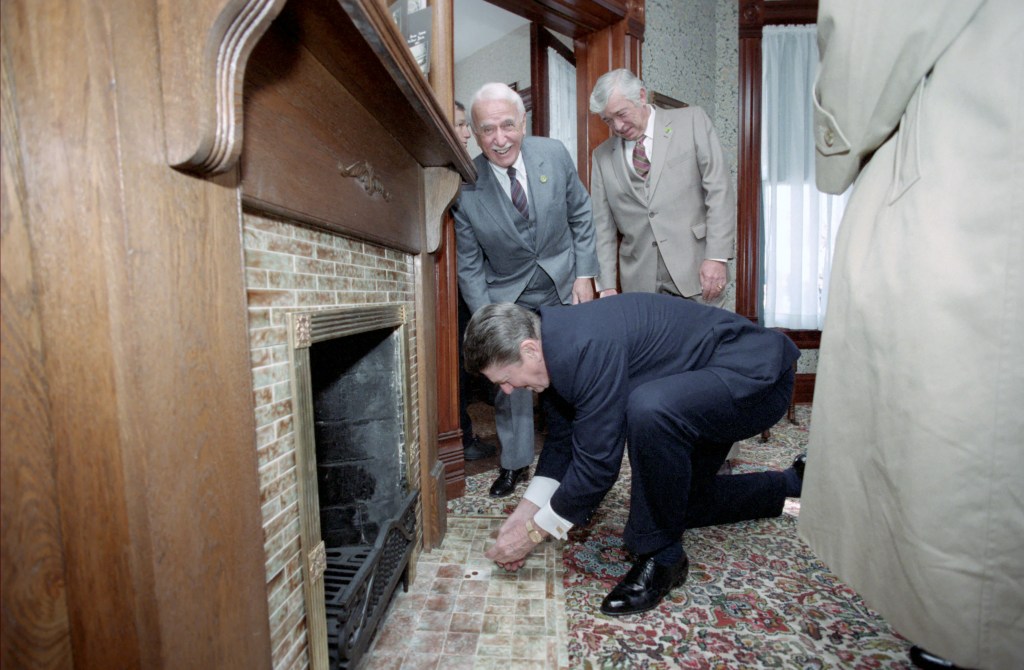
President Reagan celebrates his 73rd birthday. President Reagan proclaimed an end to an era of “paralyzing self-doubt” in the nation and a restoration of the “just and legitimate uses of American power.” Mr. Reagan began his 73rd birthday in his boyhood home of Dixon, Illinois, led a parade, and with his brother toured their boyhood house on Hennipen Avenue and had lunch there. He later addressed a crowd at Dixon High School. President Reagan addressed 3,000 Dixonians.
Six months after President Reagan was wounded in an assassination attempt, a Secret Service security breach allowed a man with a history of mental disorders and three members of his family to get to the doorway of the Oval Office, it was disclosed. Secret Service documents released by the Better Government Association, a nonprofit citizens’ watchdog agency, showed that the incident occurred October 3, 1981, when a uniformed agent let a van pass when the intruder sounded the horn and displayed what the agent mistook at a distance to be a White House pass. The intruder was not identified. Sources said the Secret Service agent was fired and two other agents were suspended for five days as a result of the security lapse.
The Rev. Jesse Jackson, buoyed by gains in recent polls and hints that he may be able to attract a sizable number of white voters, is focusing more attention and time on New England. He spent all last week and part of the previous week in Massachusetts, New Hampshire, Vermont and Rhode Island and is expected to return to the region next week. Massachusetts, say aides to the contender for the Democratic Presidential nomination, presents a real opportunity to show his appeal to white voters. The state will hold its primary March 13, the same day as primaries in Florida, Georgia and Alabama, where large numbers of blacks are expected to support Mr. Jackson. The outcome in Massachusetts could provide a big boost in projecting him as a “serious candidate running a national campaign,” said Melvin Reynolds, his Northeast coordinator. The campaign has been buoyed by the results of a New York Times/CBS News Poll last month showing Mr. Jackson supported nationally by 14 percent of the Democrats, up from 7 percent two months ago, and tied for second place with Senator John Glenn of Ohio.
The Senate approved legal reforms to curb “endless” appeals to federal courts from criminals who challenge the constitutionality of their convictions. On a vote of 67 to 9, the Senate passed the habeas corpus reform, setting a statute of limitations for certain kinds of appeals by state and federal prisoners.
Stable growth in the money supply is planned this year, according to the Federal Reserve Board. Several analysts said the board’s growth targets, combined with the current high Federal budget deficits, meant at best little change in interest rates this year and possibly an increase.
A police scandal in Puerto Rico resulted in a 44-count indictment against 10 current or former officers of the commonwealth’s police force. A Federal grand jury charged the 10 men with conspiring to cover up the 1978 beatings and shooting deaths of two young terrorist suspects who advocated independence.
A Superior Court judge today made permanent his injunction blocking Elizabeth Bouvia from starving herself in a California hospital, but lawyers said the order was unlikely to change the resolve of Mrs. Bouvia, who has crippling cerebral palsy, to die. “It is extremely clear that she intends to remain forever, permanently at Riverside General Hospital and refuse to eat or cooperate with her treatment,” said Barbara Milliken, a deputy county counsel who argued for a permanent injunction. She said the order would give Riverside County legal tools to try to resolve the case. Judge John H. Hews reaffirmed his earlier decision that the 26-year-old quadriplegic did not have the right to end her life with the assistance of the county-operated Riverside General, where she has been force-fed since December 19. In recent weeks she has refused to leave her bed at all, and hospital officials have predicted she may get pneumonia.
Hunger “has returned to America” because of unemployment and government policy, according to a 112-page study that differs sharply with the recent conclusions of a White House task force. The report by a private commission of educators, physicians, religious leaders and social workers found that “hunger is widespread and increasing.” “We found hunger, and it wasn’t hard to find,” said the Citizens Commission on Hunger in New England, which is composed of educators, physicians, religious leaders and social workers. “Hunger is the result of clear and conscious actions taken by government leaders,” the study concluded. The White House had no immediate response.
A National Institutes of Health advisory committee overrode protests from arms-control and anti-genetic engineering activists to approve a military project designed to produce a vaccine against dysentery. The committee voted 8 to 4 to allow researchers at the Uniformed Services University of the Health Sciences to manipulate genes to work toward producing a vaccine against one of the dysenteries and other serious diarrheal diseases that are the primary cause of death among children in developing countries. The protesters said the project could lead to a biological weapon and should be deferred until an “arms-control impact statement” is available.
Congress’ Office of Technology Assessment, declaring that the “nuclear era is drawing to a close,” said in a report that commercial atomic power is unlikely to grow in this century without major reforms. Nuclear power plants involve “too many financial risks as a result of uncertainties in electric demand growth, very high capital costs, operating problems, increasing regulatory requirements and growing public opposition,” the nonpartisan agency concluded. The study said the 1979 accident at Pennsylvania’s Three Mile Island nuclear plant marked “a watershed in U.S. nuclear power history because it proved that serious accidents could indeed occur.”
The Massachusetts Public Health Council ordered a statewide ban today on the sale of 18 grain-based products due to the presence of the suspected cancer-causing pesticide EDB. The 18 products include eight Duncan Hines cake mixes, and corn muffin, pancake mix and flour products from a variety of manufacturers. In Connecticut, EDB levels in 24 products tested were below suggested Federal standards and offered no cause for alarm, state scientists said today. The emergency regulation in Massachusetts orders an immediate end to the sale of products with more than 10 parts per billion of ethylene dibromide, a chemical compound used as a pesticide and linked to cancer in laboratory animals. The order also calls for a ban, effective March 7, on products found to contain one part or more per billion. Florida has a similar ban.
Earthquake activity leveled off at Mount St. Helens early today after a steady increase, but scientists stood by their prediction that a potentially explosive eruption of the volcano was only hours away. Scientists have interpreted the pattern of quakes as meaning molten rock was pushing upward inside the volcano in southwestern Washington. On Sunday night the university and the United States Geological Survey issued an eruption alert, predicting the 8,300-foot volcano would erupt within 24 hours. An explosive eruption nearly four years ago that blew away the top of the mountain left 57 people dead or missing, devastated a 154-square-mile area and threw up a plume of volcanic ash that spread around the globe.
The unconscious mind is again exciting psychologists in the wake of new and compelling evidence that the unconscious is the site of a far larger portion of mental life than even Freud envisioned. The studies show that the unconscious mind may understand and respond to meaning, form emotional responses and guide most actions, largely independent of conscious awareness.
Record-breaking cold air surged into the South with snowstorms that clogged roads from Alabama to New England and left behind at least 31 dead, many of them motorists who were stranded by blowing snow. Temperatures dropped below freezing as far south as Louisiana and Alabama. The icy air was heading toward Florida, threatening citrus groves already heavily hit by a hard freeze in December. North Carolina had up to six inches of snow in the mountains and snow and icy bridges in South Carolina forced school closures in several counties.
Dow Jones Industrial Average: 1174.31 (-22.72).
Born:
Antoine Wright, NBA shooting guard and small forward (New Jersey Nets, Dallas Mavericks, Toronto Raptors, Sacramento Kings), in West Covina, California.
Eric Frampton, NFL defensive back (Detroit Lions, Minnesota Vikings, Dallas Cowboys, New Orleans Saints), in San Jose, California.
Keith Ellison, NFL linebacker (Buffalo Bills), in Los Angeles, California.
Brandon Hammond, American actor (“Gregory Hines Show”), in Baton Rouge, Louisiana.







 History Diaries