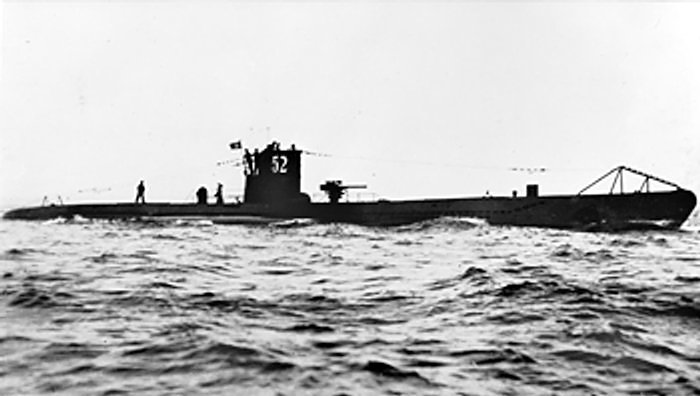
U-52 made eight war patrols; 13 ships sunk, total tonnage 56,333 GRT.
Decommissioned on 22 October 1943 at Danzig and used as instructional boat.
Sunk on 3 May 1945 at Neustadt, in position 54.07N, 10.50E, by rockets from four British Typhoon aircraft (175 Sqn RAF). Wreck broken up in 1946/47.
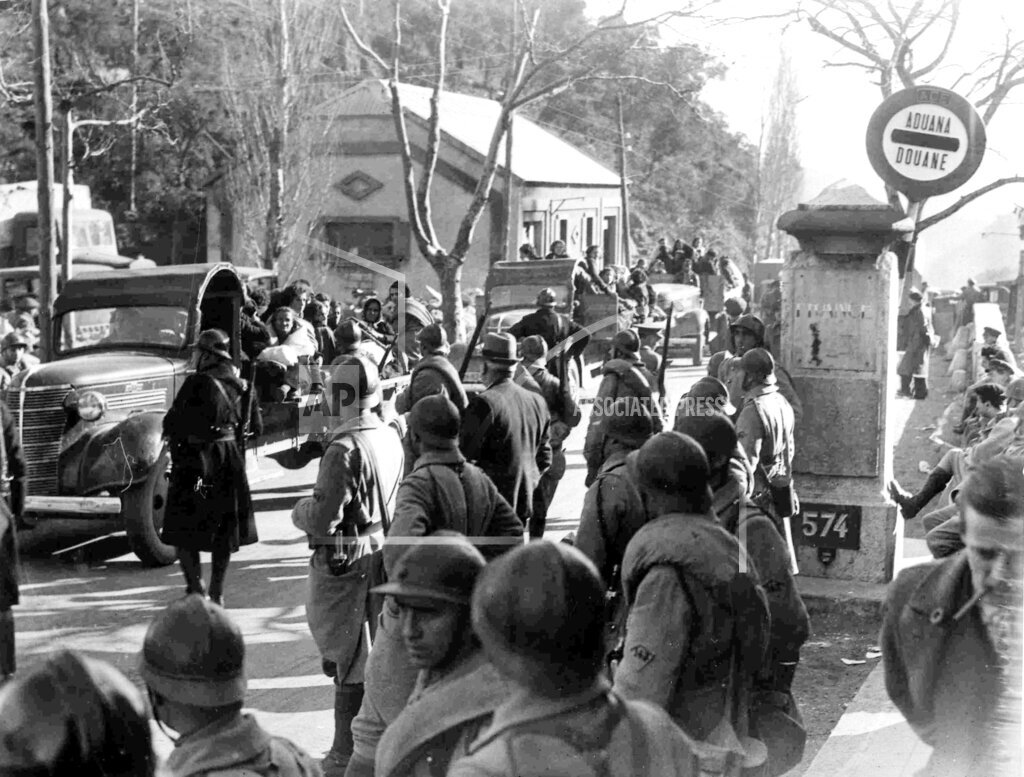
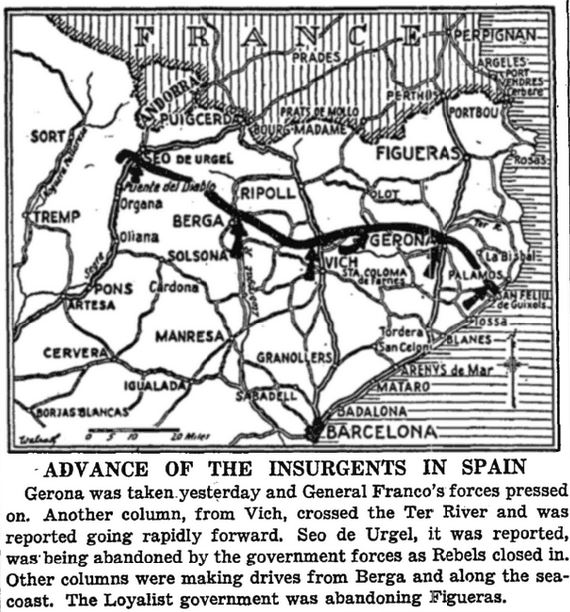
During the Catalonia Offensive, the Spanish Nationalists (Francoists) took Girona. Generalissimo Francisco Franco’s troops captured Girona today. The Navarre Army Corps had surrounded that provincial capital, whence the Republicans (Loyalists) first intended to transfer their government seat after abandoning Barcelona ten days ago, and almost at the same time that the Navarrese entered the city from the west the mixed Legionary Corps marched in from the east. Little serious resistance was offered, the Republicans apparently having withdrawn the main body of their forces last night. The greater part of the government files and documents removed from Barcelona, however, are expected to be found in Girona, for it is not believed there were sufficient facilities available for carrying much, northward to Figueras, the Republicans’ new temporary capital. The Maestrazgo Army Corps, under General Garcia Valino, was also reported to be making rapid progress toward the French frontier after having passed the Ter River between Vich and Girona. The most advanced Nationalist [Rebel] divisions were said to be about nineteen miles from the French border, with the rest of the forces operating in the part of Catalonia still in Republican hands nowhere farther than thirty miles from the frontier.
It is officially announced that in the forty-four days of General Franco’s offensive in Catalonia his troops have marched more than 190 miles from their starting point and captured the three provincial capitals remaining in Republican hands-Tarragona, Barcelona and Girona. Early this morning the village of Riudellots, six miles south of Girona, was occupied by the Nationalists. The mixed Legionary troops advanced east of the railroad line while the Navarre corps pushed northward along the western side of the main highway from Barcelona to Girona. Both corps converged in the Ter River Valley and captured Aiguaviva, four miles from Girona. Girona is an ancient walled and fortified city dominating the Ter Valley, and as the Nationalists approached it along this valley they again divided, and soon it was in their hands.
At the field headquarters of the Fourth Navarre Division in Aiguaviva a colonel on the staff of General Camilo Alonso Vega later said that upon entering Girona the Nationalist troops found much destruction. He said that when they had reached the center of the city a spirited, though short-lived, resistance was offered by several small groups of Republican machine-gunners, who had barricaded themselves in buildings and behind parapets. These detachments had been left behind, evidently, to delay a little longer the Nationalists’ pursuit of the Republicans fleeing toward Figueras. The machine-gunners died at their posts, and at 1:30 P. M., the occupation of all quarters of the city had been completed.
Generalissimo Francisco Franco’s troops — conquerors of the important city of Girona — today smashed steadily northward toward the French frontier tonight. They were quickly cutting away the little Catalonian territory left in Government control. The Government’s temporary capital of Figueras was only twenty miles from the fighting lines. Government army officers arriving here frankly admitted the Insurgent advance had turned into a rout for their troops. Insurgent planes flew at will over Northern Catalonia, bombing and machine-gunning the few remaining Government-controlled towns.
The Battle of Valsequillo ended in Republican failure. After a month of fighting, the Valsequillo Offensive comes to end, as Nationalist forces around Peraleda del Zaucejo on the Extremadura/Andalucia border recapture all the area the Republicans had initially captured. At one stage, the Republicans had 500 square miles of land taken, though none had any strategic benefit, and the Nationalists have quickly taken it all back. The Republicans have suffered 6,000 deaths and casualties, only 2,000 for the Nationalists in an utterly pointless battle. Meanwhile, the Republican Army in Catalonia has been essentially destroyed.
Spanish Loyalists are said to ask Britain to negotiate peace with General Franco. The Republican terms for peace are simple fantasy. He has no reason to grant the Republicans anything at this point, with final victory in sight. The Spanish Government was reported in reliable quarters tonight to have requested Great Britain to open secret negotiations with the Insurgents to end the two-and-one-half-year-old civil war. The reported overtures contained such broad qualifications, however, as to raise the question of their success. They were disclosed at a time when Premier Juan Negrín’s government took first steps toward abandoning all of Catalonia — Spain’s northeastern corner — to Insurgent General Francisco Franco’s conquering forces in an attempt to make a last stand in the central “island” quarter of Spain, embracing Valencia and Madrid. It was understood that in the request to the British Government the Spanish Government authorities stipulated that the peace talks be opened with three points enunciated by Dr. Negrín Wednesday as the background.
Then Dr. Negrín told the Cortes (Parliament) at Figueras that the government’s aims were:
- A guarantee of independence for Spain and freedom from foreign influence.
- A government desired by the people, as shown by plebiscite.
- Liquidation of the war without persecution to permit all Spaniards to join in the country’s reconstruction.
There was no indication at Burgos of General Franco’s reaction to the Spanish Government’s move. Some diplomats believed the Insurgent leader would balk at negotiation on such a broad basis, particularly in view of his military successes.
Spanish President Manuel Azaña crossed the border to France and went into exile.
The Fascist Grand Council served notice today that Italian volunteers “will not abandon” the Spanish struggle “before it has ended, as it must end, with [Generalissimo Francisco] Franco’s victory.”
An inquiry at Marseilles disclosed that arms were still being shipped to the Loyalists, many of them having come from Panama.
The Italian press played up President Roosevelt’s denial of backing France and Britain in any European confrontation in banner headlines, terming it a “cold shower” designed to dash French hopes of American support, but still reflected its concern over the trend of this country’s foreign policy.
Questions were asked in the British Parliament about the IRA’s 12 January ultimatum to the British government. The ultimatum had previously been publicised in the British newspapers following the 17 January attack. British Home Secretary Sir Samuel Hoare informed the House of Commons that the police had already arrested 33 people in connection with the attacks up to that point and that the security authorities were doing everything within their power to find the perpetrators.
In Liverpool, an unsuccessful attempt was made to blow up one wall of Walton Gaol, but the wall was not penetrated. In London, fires broke out within half an hour of each other in shops in one of the suburbs. The British police established that in each case the fire was due to a chemical mixture which ignited when exposed to the air. Plans to blow up Buckingham Palace were reported by The Times to have been found in Belfast. As a result, night and day guards were placed around the grounds of Royal Lodge and Windsor Great Park. All visitors to the state apartments at Windsor Castle and St. George’s Chapel were also reported to have been stopped and searched before being allowed entry. The Houses of Parliament have been closed to the public, for the first time since the World War.
Britain agrees with the U.S. suggestion to explore British Guinea as a refuge for Jews.
Britain has increased her order for purchase of American planes from 400 to 650, the Air Ministry announced yesterday. Paris heard that France was planning to buy a large number of aircraft in addition to 200 already ordered.
Martial law was proclaimed tonight throughout Hungary by the government for the punishment of all offenses committed with guns and explosive materials and for attempts to organize such outrages. The move was a reaction to yesterday’s bombings before the main Budapest synagogue, in which about twenty persons were injured. The government also prohibited the publication of the leading National Socialist daily, the Magyarsag, for two months because it had published articles considered to have endangered public order. Evidently to counter this order, the 8 Orai Ujsag, organ of Count Stephen Bethlen, former Premier, has been suppressed for four weeks for having published comments about a recent by-election criticizing the government’s attitude. Investigation of yesterday’s bombing resulted in the discovery that the bombs had been thrown from a house opposite the synagogue. The inquiry is continuing, but no further arrests have been made.
Princess Juliana of the Netherlands is expecting her second child.
Author James Joyce completes “Finnegans Wake” after 17 years.
Foreign policy debate in the U.S. Senate next week is expected to turn on the question whether the President intends this country to back Britain and France, except for manpower, in the event of war. Both opposition and support were expressed by Senators regarding Mr. Roosevelt’s present course. Strict isolationists and some Republicans will try to elicit by questions from the floor the answer to the question that looms largest in their minds: Does President Roosevelt intend, or does he not, to use his influence toward throwing the support of this country, short of manpower, exclusively to Great Britain, France and their allies in the event of European war? Both houses meet on Monday and both have little of pressing urgency before them. The parliamentary situation is such that prolonged debate on foreign affairs could go on in either chamber practically throughout the week. The issue is almost certain to be raised in the House on Thursday, which day has been set tentatively by Democratic leaders for beginning debate on the bill intended to carry out President Roosevelt’s emergency national defense message.
The House considers a financial reorganization bill for railroads.
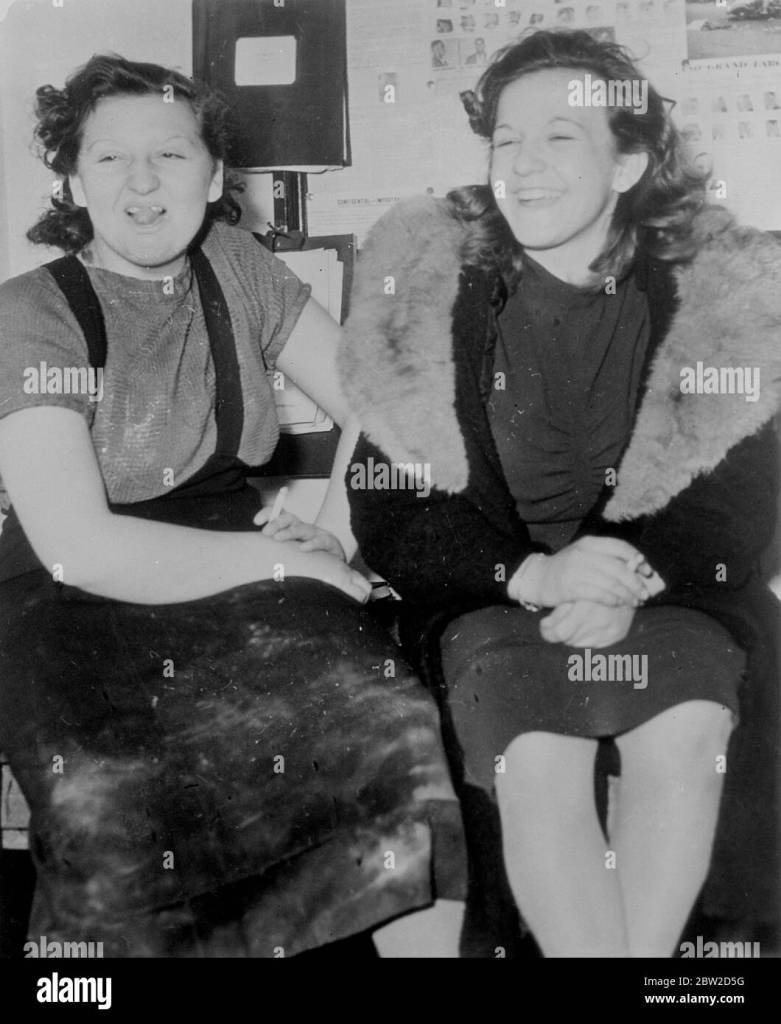
Mrs. Frances Flegenheimer, widow of Arthur (Dutch Schultz) Flegenheimer, slain gangster, was placed on the witness stand yesterday in the trial of James J. Hines, Tammany district leader. She revealed that Schultz and Hines had held a conference just before the former became a fugitive, and told of a series of rendezvous between Hines and J. Richard (Dixie) Davis, lawyer for the Schultz gang, while attempts were being made to settle Schultz’s income tax troubles. The testimony of Mrs. Flegenheimer, a diminutive brunette about 24 years old, was introduced by District Attorney Thomas E. Dewey in a surprise move. She pictured the political leader as an intimate of the gang leader and the racketeering lawyer but as one whose association with him her husband had told her she “should forget.”
Matthew Woll, labor leader, charged in Miami that the Treasury had given preferential treatment to Germany, enabling the Nazi Government to obtain millions of dollars’ worth of war materials here.
Florida is split into two opposing camps over President Roosevelt’s recent letter to congressional committee chairmen urging revival of the 200 million dollar Florida Gulf-Atlantic ship canal project. From the southern part of the state protests are raised that the canal would transform it from a peninsula into an island and sever its fresh water supply in underground rivers, causing heavy damage to the citrus industry and the winter vegetable crop. The Miami region is vociferous in claiming that the canal scheme is the product of groups in Jacksonville and Ocala to the northward. Palm Beach and West Palm Beach, which strongly opposed the scheme two years ago, are little stirred as yet, deeming that the project will get nowhere in congress. Tampa is another seat of opposition.
Iowa legislators sleep in death row cells for a “thrill.” One says the bed was “nice and soft.”
New York City club women honor the wife of Chiang Kai-shek for her peace work and spirit of humanity.
A lawyer confesses to perjury in the Waterbury conspiracy case.
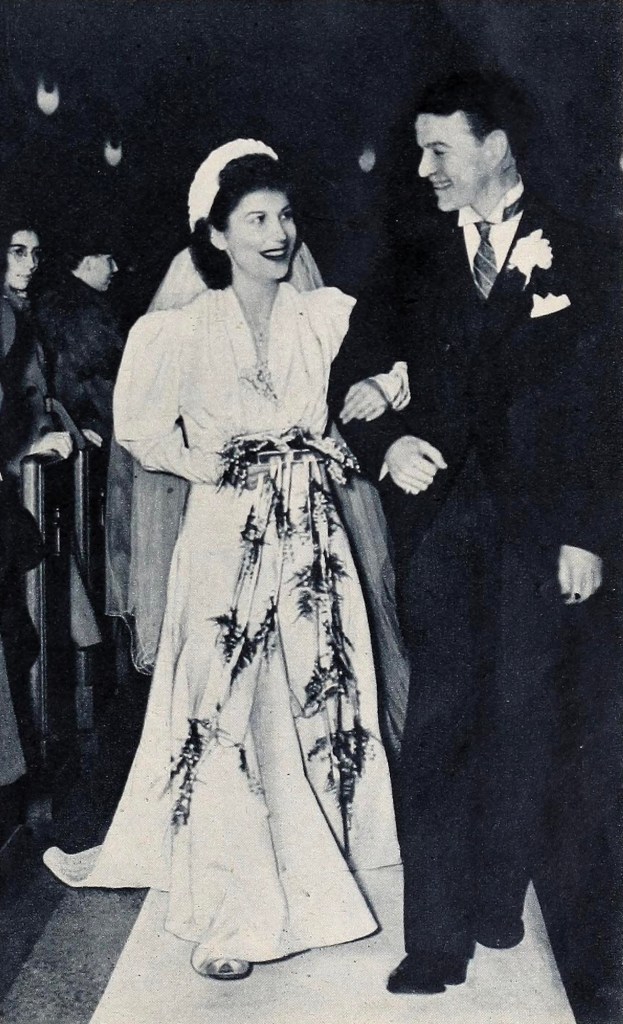
American singer Frank Sinatra (23) marries 1st wife Nancy Barbato (21) at Our Lady of Sorrows catholic church in Jersey City, New Jersey; they divorce in 1951.
The Brazilian press uniformly welcomed a strong defense position by the United States, praised President Roosevelt and assailed his critics in the totalitarian States.
Japan reports four days of continuous fighting with the Russians along Manchukuo’s borders. The government of Japanese-dominated Manchukuo today reported four days of almost continuous fighting between Soviet forces and Manchukuoan border guards, but failed to state definitively the outcome or number of casualties. Communiqués issued at Hsinking, the Manchukuoan capital, indicated that Russian “assaults” had been thrown back. While they described the “defending” forces as border guards, it was believed in Tokyo that Japanese regulars were involved. Some of Japan’s finest troops are along the Siberian border. Apparently, these were the most serious border hostilities since last July and August, when Japanese and Russian units battled at Changkufeng, near the intersection of Siberia, Manchukuo and Korea. The Manchukuoan Government charged that Soviet cavalry attacked a Manchukuoan border garrison Tuesday morning, but was beaten back. Four other attacks followed that day.
Minor skirmishing and maneuvering ensued, the communiqué from Hsinking said, until the Russians assaulted the same border point three times Friday afternoon and evening. The scene of the fighting was given as Mengoskili, an isolated region sixty miles northeast of Manchuli. Manchukuo has protested to Russia. On Wednesday the Russian Government reported a clash in which it said eighteen Japanese and Manchukuoan soldiers had attempted on Tuesday to take a Soviet island in the Argun River, Manchukuo’s northwestern boundary.
Explorer Lincoln Ellsworth’s ship is due at Tasmania today, as his Antarctic expedition comes to a close.
Dow Jones Industrial Average: 145.07 (+1.52).
Born:
Stan Lundine, American politician (Rep-D-New York, 1976-1986, Lieutenant Governor of New York. 1987-1994), in Jamestown, New York.
Fred Whittingham, NFL linebacker and guard (Los Angeles Rams, Philadelphia Eagles, New Orleans Saints, Dallas Cowboys, Boston Patriots), in Boston, Massachusetts (d. 2003).
Died:
Edward Sapir, 55, American linguist and cultural anthropologist (North American Indian languages).
Henri Deterding, 72, Dutch oil tycoon.
Naval Construction:
The U.S. Navy Sims-class destroyers USS Anderson (DD-411) and USS Hammann (DD-411) are launched by the Federal Shipbuilding & Drydock Co. (Kearny, New Jersey, U.S.A.).
The Kriegsmarine (German Navy) Type VIIB U-boat U-52 is commissioned. Her first commanding officer is Oberleutnant zur See Wolfgang Barten.
The Kriegsmarine (German Navy) Type IIC U-boat U-58 commissioned. Her first commanding officer is Oberleutnant zur See Herbert Kuppisch.
The Vasilikón Naftikón (Royal Hellenic Navy) destroyer RHS Vasilissa Olga (Βασίλισσα Όλγα), name ship of her class, is commissioned.
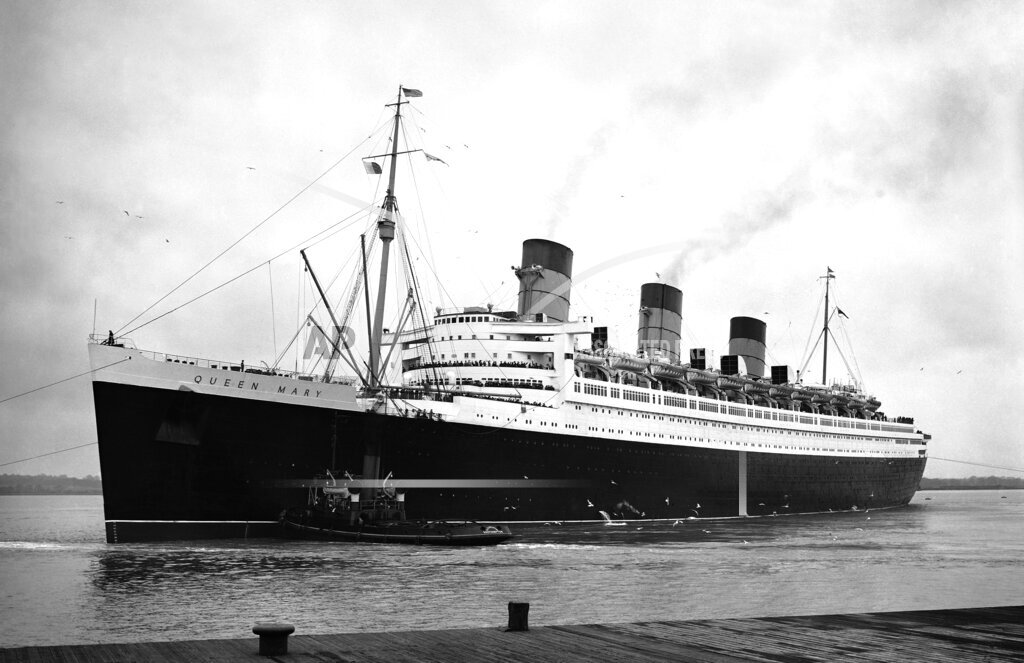
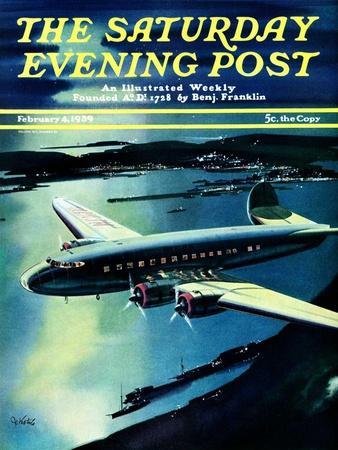
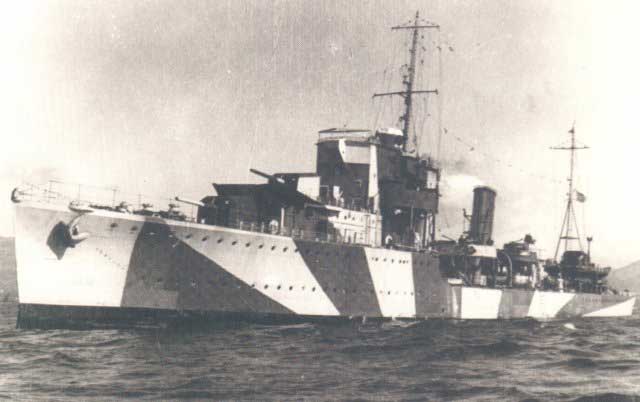
Vasilissa Olga participated in the naval operations of the Greco-Italian War, in convoy escort duty and in the first and third naval raids against Italian shipping in the Strait of Otranto (14-15 November 1940, and 4-5 January 1941).
After the German invasion of Greece, along with several other ships, she escaped to Alexandria in May 1941. She was assigned the British pennant number H 84, and after undergoing modernization in Calcutta (November-December 1941), she returned to active duty in the Mediterranean Sea. Under her captain, Lt. Cmdr. G. Blessas, she enjoyed several successes:
On December 15, 1942, she sank the Italian submarine Varsciek (620 tons) off Malta, along with the British destroyer HMS Petard.
On January 19, 1943, Olga, along with the British destroyers HMS Pakenham and HMS Nubian, intercepted and sunk the Italian transport ship Stromboli (475 tons) off the Libyan coast.
On June 2, 1943, Olga and the British destroyer HMS Jervis sunk the Italian torpedo boat Castore (652 tons) off Cape Spartivento.
Olga also participated in the capture of Pantelleria and the Allied invasion of Sicily. During the Allied operations in the Aegean Sea in September 1943, together with the British destroyers HMS Faulknor and HMS Eclipse, she sunk a German convoy, consisting of the transports Pluto (2,000 tons) and Paolo (4,000 tons), near Astypalea.
Lost, September 26, 1943.
During the Battle of Leros, she transported members of the LRDG to the island, but on September 26, she was attacked and sunk by 25 Junkers Ju 88 bombers in the Gulf of Lakki in Leros. Cmdr. Blessas, 6 officers and 65 other members of the crew perished with the ship. A monument has been erected in Lakki in honour of the ship.
 History Diaries