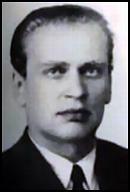
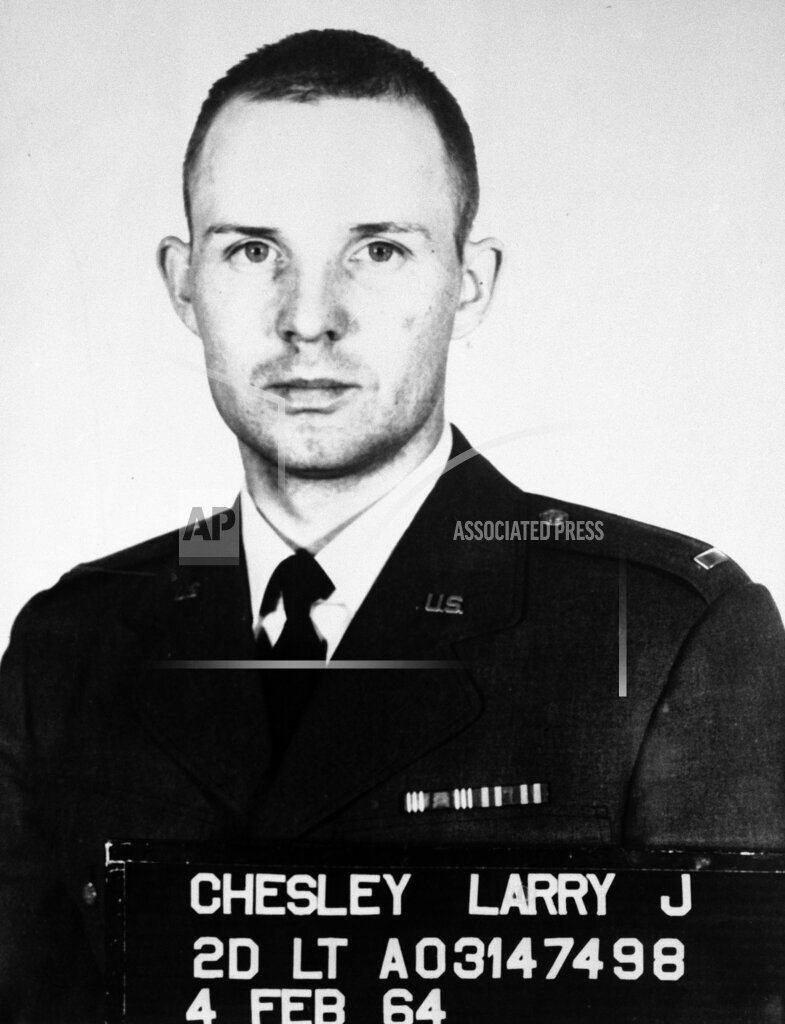
Yuri Nosenko, an officer of the Soviet spy agency, the KGB, defected to a representative of the American spy agency, the CIA, in Geneva. Instead of receiving favorable treatment, Nosenko instead would be imprisoned by the CIA for nearly four years in a CIA holding area near Clinton, Maryland, and interrogated regularly (and brutally) because the agency believed that he was a double agent. On October 27, 1967, Nosenko would be moved and confined in “a comfortable safehouse in the Washington area” and interrogation gave way to his being “interviewed under friendly, sympathetic conditions” by another office within the CIA. A 1970 internal CIA report would later conclude not only that Nosenko was a bona fide defector, but also that he was “the most valuable and economical defector this Agency has ever had.” Some doubt remains, however. Some in the intelligence community were never convinced that Nosenko was anything other than a KGB plant.
The Soviet Union today dimmed the outlook for serious negotiation on a reduction and the eventual elimination of missiles as part of a disarmament accord. Semyon K. Tsarapkin, the Soviet delegate, told the disarmament conference that the West would have to accept in principle Moscow’s latest proposal on missiles before it could be examined in detail. The Soviet representative also said that foreign‐based missiles would be eliminated first under the Soviet plan for the retention of a “nuclear umbrella” until the last of the three projected disarmament stages. The West has always refused to be committed in principle to a Soviet proposal so as not to appear to be reversing its position should a final accord prove impossible. Moscow’s attempts to have disarmament begin with the elimination of foreign bases have also been rejected by the West on the ground that they are designed to tip the balance of power in favor of the Soviet Union.
Viet Cong troops smash an ARVN battalion headquarters at Hậu Mỹ, killing 12 and wounding 20 ARVN troops; Viet Cong forces also ambush an ARVN battalion in Thừa Thiên Province and kill eight. Several hundred Communist troops overran a government headquarters position in the Mekong Delta before dawn today in the heaviest Viet Cong attack since last November’s offensive. Military sources said a battalion of 400 or more Communist troops smashed their way into Vietnamese Army battalion headquarters at the Hậu Mỹ strategic hamlet, about 55 miles southwest of Saigon, under cover of intense mortar, machine‐gun and recoilless‐rifle fire. During the three‐hour battle Communist forces killed 12 government soldiers, wounded 20 and seized a number of weapons, including two 81 mm. mortars, military sources said. The Viet Cong broke off their attack after a government aircraft started dropping flares in the battle area and 105 mm howitzer opened fire on the attackers at point‐blank range. Military sources said at least six guerrillas were killed.
This afternoon a military spokesman reported that about 100 Communist troops ambushed soldiers at the rear of a Vietnamese Army battalion marching down a road in mountainous Thừa Thiên Province, about 400 miles north of Saigon, at noon yesterday. Viet Cong forces hiding in the jungle raked the government column with automatic‐weapon fire, killing eight soldiers and wounding 13.
1,000 college‐age students marched through the streets of Saigon today, calling for a return of the ousted military leader, Major General Dương Văn Minh, and effective new war efforts against the Communist Viet Cong. The students’ march implied criticism of the new junta, headed by Major General Nguyễn Khánh, which seized power last Thursday. Some students charged that the United States had concurred in the coup, which, in their view, could only set back this country’s struggle against the guerrilla forces.
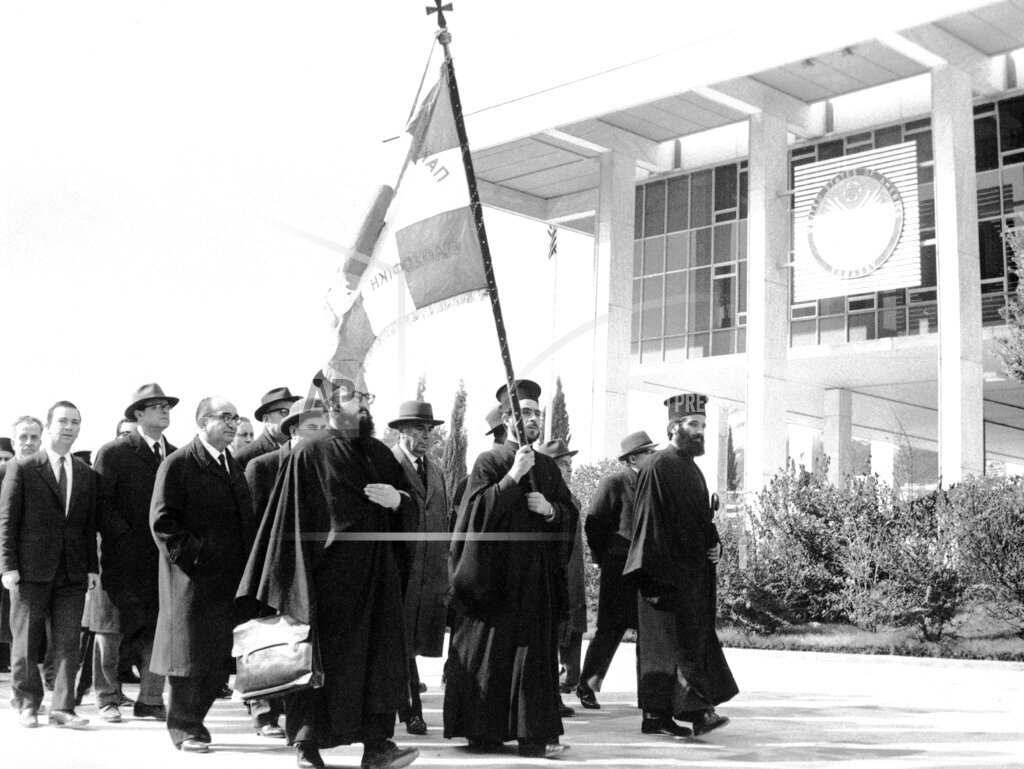
Archbishop Makarios, President of Cyprus, accepted in principle today the British‐United States proposal to place a peace‐keeping force on the island, but only if it is made responsible to the United Nations Security Council. In general, the Archbishop found the terms of the proposal either unacceptable or seriously in need of clarification. Taking account of all the reservations, President Makarios’s acceptance in principle amounts to something close to outright rejection, according to diplomats here. In a real sense, they said, the parties to the Cyprus problem were still in a deadlock over a method to ensure that communal violence will not resume between the ethnic Greeks and ethnic Turks on the island. The violence erupted last December after President Makarios had announced plans to revise the Constitution in a way that the Turkish minority felt would jeopardize its rights.
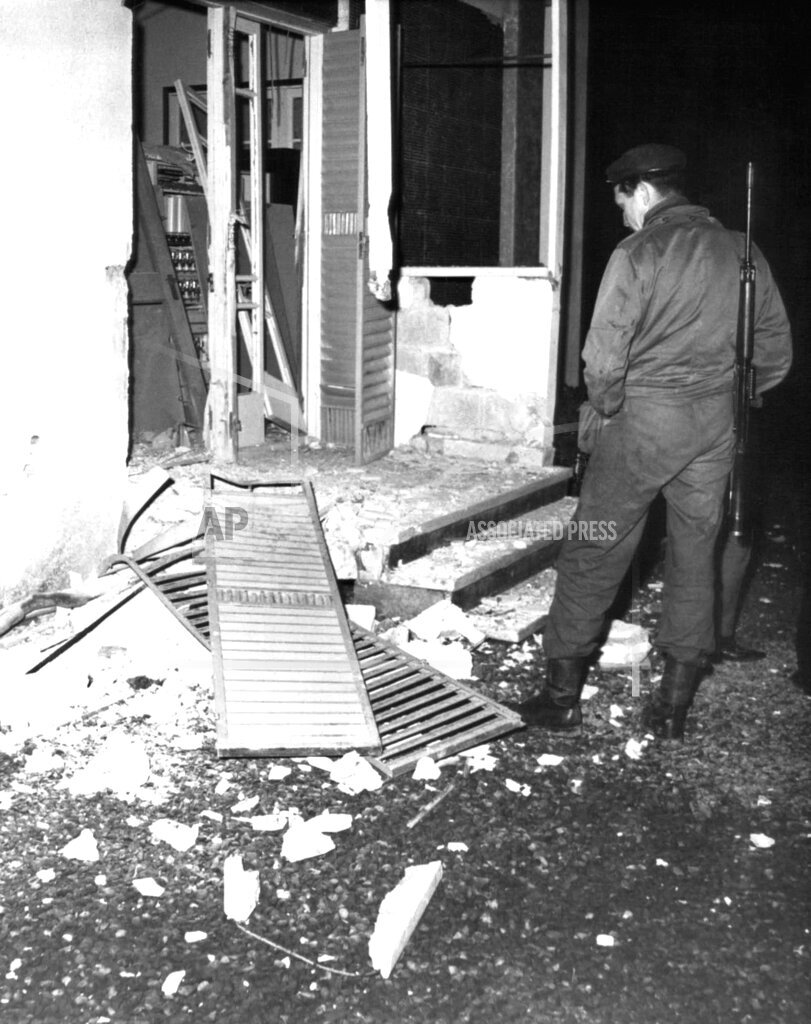
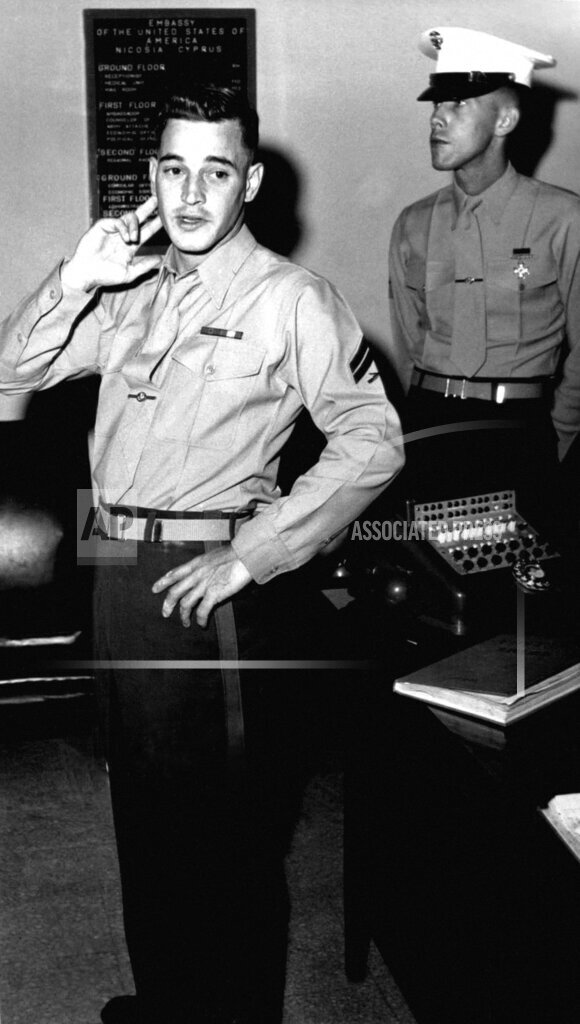
Two bombs exploded at the United States Embassy tonight and the Ambassador authorized the evacuation of American civilians who wished to leave Cyprus. There were no injuries in the bombings, but damage was extensive in three rooms of the Embassy. A third bomb exploded an hour later in a car draped with a British flag parked at a hotel not far from the British High Commission’s headquarters. The bombings came as tension reached the breaking point on the island following the reply by Archbishop Makarios, President of Cyprus, to the United States‐British proposal for a peace force on Cyprus. Shortly before the bombings, the Archbishop appealed both to Turkish and Greek Cypriotes to refrain from violence.
The United States Ambassador, Fraser Wilkins, authorized the evacuations after he told the Archbishop that he had “no confidence” in the ability of the Cypriote police to protect American lives. The Ambassador went to the Presidential; Palace with his family to protest the bombings. There are 1,700 Americans on Cyprus. Planes will be arriving tomorrow to evacuate those who wish to go. The United States Information Agency and United States aid missions will cease operations. After the bombings at the embassy the Archbishop issued a statement describing them as “a crime of the most revolting nature.” Police in the village of San Pablo District of the Canchis Province of Peru fired into a crowd of about 8,000 peasants who had protested at an open market, killing 19 people, mostly women. Afterward, government troops imprisoned about 200 agitators in the region.
Communist China accused Premier Khrushchev today of seeking world domination through collaboration with the United States. Peking warned that Mr. Khrushchev must give up any effort to establish friendly relations with the Johnson Administration if the Kremlin wished to restore the unity of the international Communist movement. Condemning what they call the “revisionist” policies of Moscow, the Chinese Communists put forward a new ideological thesis that the Soviet party could no longer be regarded as the vanguard of the international Communist movement. Peking’s bid for the ideological leadership of Communism was made in an authoritative editorial in Hung Chi, the ideological journal of the Communist party’s Central Committee. The Peking radio began broadcasting the lengthy declaration last night. The text was printed this morning on the first four pages of Jenmin Jih Pao, official organ of the Chinese party.
Diplomatic analysts said the text established the ideological groundwork for a formal break with Moscow unless the Soviet Union abandoned some of the principal tenets upon which it had developed its relations with other Communist parties as well as its relations with the United States. In an exhaustive historical review of splits in the Communist movement, including Lenin’s decision in 1919 to quit the Second International and to form the Third International under his influence, Hung Chi said: “This demonstrates that like everything else the international working‐class movement tends to divide itself in two. The class struggle between the proletariat and the bourgeoisie is inevitably reflected in the Communist ranks.”
The Organization of American States set its security machinery in motion today to consider Panama’s complaint against the United States. The organization’s council voted 16 to 1 to constitute itself a ministerial‐level “organ of consultation” after a tense twohour session. The members heard new Panamanian charges that the United States committed aggression when troops in the Canal Zone fired on invading Panamanian rioters on January 9 and 10. Panama and the United States, as interested parties to the dispute, did not vote. As the Latin American delegates explained their vote, they emphasized that no member of the American community should be denied the right to invoke the Inter‐American Treaty of Reciprocal Assistance if it considered itself to be threatened. But they stressed that by agreeing to apply the treaty, known also as the Rio de Janeiro Pact of 1947, they were in no way judging the merits of the charges.
A chanting crowd of Ghanaians, waving placards proclaiming “Yankee rogues, go home,” swarmed around the United States Embassy in Accra today and succeeded in running down the American flag. Reports from Ghana’s capital said the demonstrators were militant members of President Kwame Nkrumah’s Convention Peoples party. American observers expressed the opinion that the demonstration had been Government inspired. A highly suspect nationwide constitutional referendum last week entrenched the party as the official organ of Ghana’s one‐party, socialist system.
In a ceremony at the White House, the Twenty-fourth Amendment to the United States Constitution was officially certified, 12 days after it had been ratified by the 38 states. Bernard L. Boutin, the Administrator of General Services signed the certificate as required by law, and U.S. President Lyndon Johnson signed as a witness to the amendment, which outlawed the poll tax in federal elections. President Johnson hailed “the triumph of liberty over restriction” today as the 24th Amendment, abolishing the poll tax formally, became part of the United States Constitution. “Today, the people of this land have abolished the poll tax as a condition for voting,” the President declared. “By this act they have reaffirmed the simple but unbreakable theme of this Republic: Nothing is so valuable as liberty and nothing is so necessary to liberty as the freedom to vote without bans or barriers.”
Proposals for special tax allowances to help college students and their parents were rejected today by a closely divided Senate. The proposals were offered as amendments to the Administration’s $11.6 billion tax reduction and reform bill. One was defeated by three votes. The other lost on a tie vote. The Johnson Administration, opposing both, had to exert extraordinary pressure to line up a sufficient number of Democratic votes for their rejection. Telephone calls by President Johnson to several Administration supporters were reported to have tipped the balance. Senator Abraham A. Ribicoff, Democrat of Connecticut, sponsored one of the amendments. It called for $750 million a year in tax relief for parents and others who finance the education of college students.
The proposed ban on discrimination in public accommodations, the emotion‐laden core of the civil rights bill, weathered its first test today and seemed headed for unscathed passage through the House of Representatives. By a vote of 165 to 93, the Northern bipartisan coalition of civil rights forces defeated an amendment that would have limited the ban on discrimination in hotels and motels to those that “predominantly” serve “interstate travelers,” rather than the all‐encompassing “transient guests” in the coalition bill. Meanwhile, it appeared that the Southerners were in a mood to retaliate by withholding needed votes from some Administration bills. In the House Agriculture Committee, five Southern Democrats joined with 14 Republicans to pigeonhole an expanded food‐stamp plan for needy families.
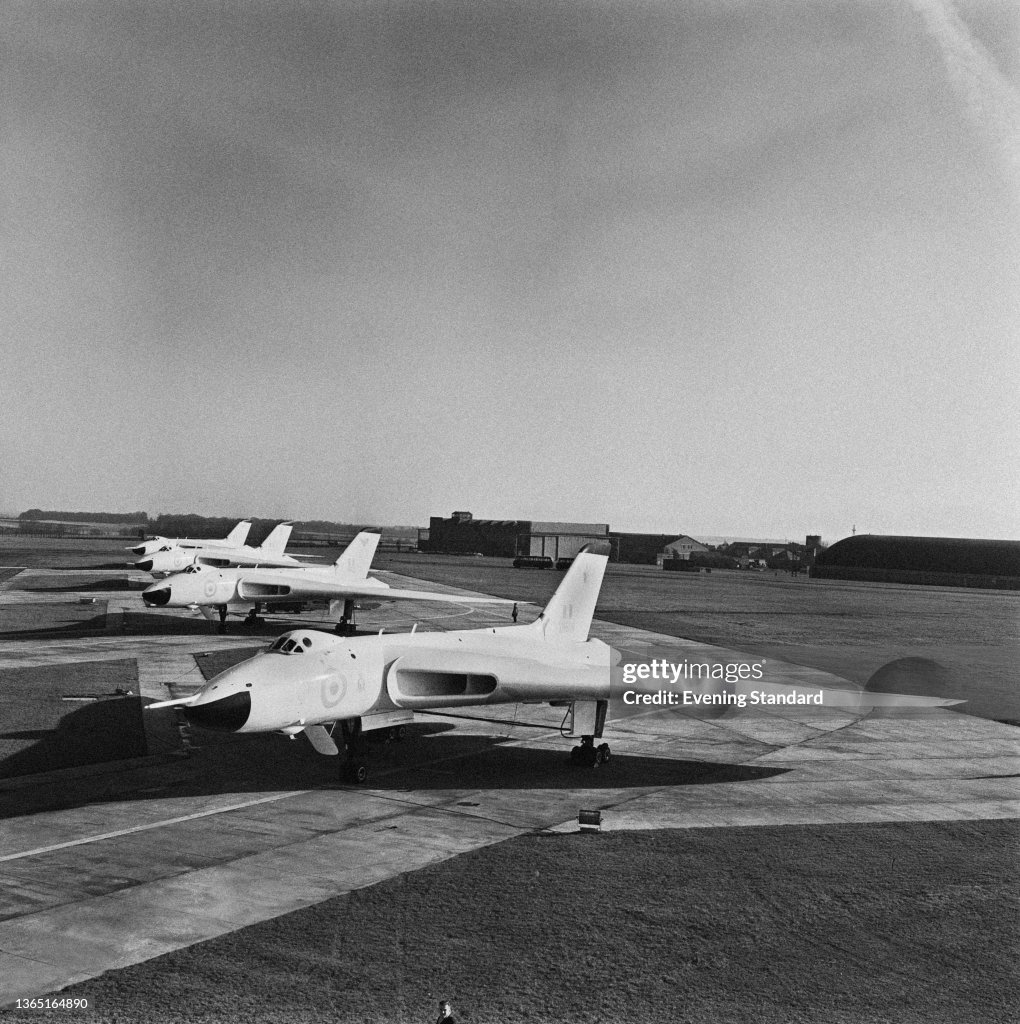
General Curtis E. LeMay, Air Force Chief of Staff, emphasized before the House Armed Services Committee today his belief in the future need for manned bombers. General LeMay indirectly criticized the termination of the Dynasoar space glider program. He also expressed concern over the economy wave at the Pentagon, saying he thought it might be “going too far.” The committee, which met in closed session, released the general’s 28‐page opening statement before questioning him. It also made public the 17-page statement of the Secretary of the Air Force, Eugene M. Zuckert, who also testified. General LeMay’s testimony was clearly in conflict with current policies under which no new bombers are being built and the future requirements for them are seriously challenged.
James E. Webb, head of the National Aeronautics and Space Administration, warned Congress today that any cuts in the “minimal” space budget would make a manned lunar landing in this decade impossible. He also cautioned that any extension in the time table of the moon program would increase the cost of the lunar expedition, now estimated at $20 billion. Mr. Webb opened his defense of the space budget in testimony before the House Committee on Science and Astronautics. The space agency is requesting $5.3 billion in appropriations for the next fiscal year and $141 million in supplemental funds for the current fiscal year, which ends June 30. It was the opening of what will undoubtedly be the agency’s most critical budgetary battle on Capitol Hill since it was established more than five years ago with a $339 million budget. The basic issue is whether the United States wants to abandon the goal, laid down by President Kennedy in May, 1961, of landing a manned expedition on the moon “within this decade.”
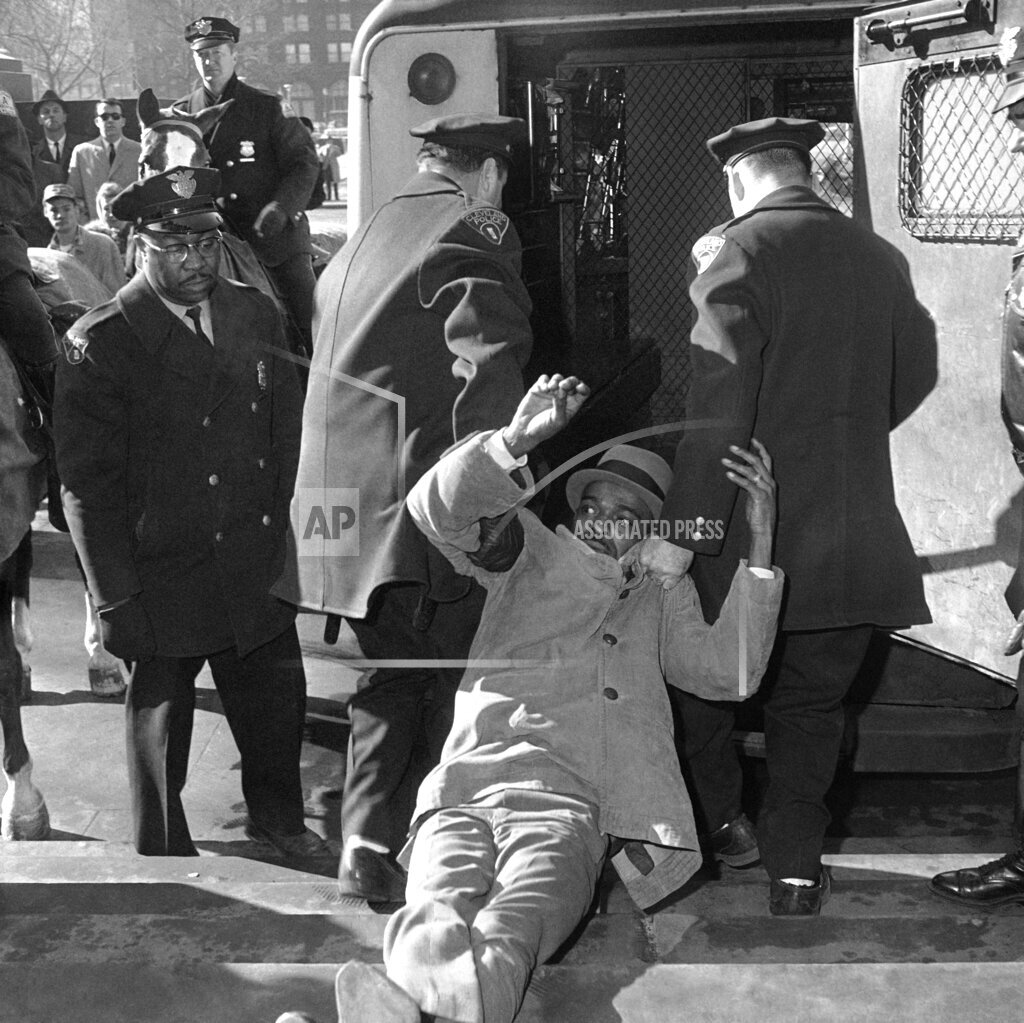
Ten of 26 pacifist demonstrators called for trial in Recorder’s Court in Albany, Georgia were carried up a stairway to the second‐floor court room to day when they refused to walk from their cells. Five of the 26 were convicted of having paraded illegally and having refused to obey orders. They refused to pay fines of $102 each and were returned to jail for 30‐day sentences. Two refused to budge from their seats when they were asked to rise. Judge Adie N. Durden postponed their trials indefinitely. The trial of the 19 others were carried over until Wednesday. Most of them are held on the same charges. All are held under $200 bonds which they have refused to make. Seven of the demonstrators were arrested Monday near a gate at Turner Air Force Base, where they displayed placards protesting work in military establishments service in the armed forces and the “arms race.”
President Johnson will fly into Manhattan by helicopter late tomorrow afternoon, becoming the first President to arrive here that way. His 29‐hour visit will include speeches tonight at the annual dinner of the Joseph P. Kennedy Jr. Foundation at the Americana Hotel and tomorrow night at a dinner of the Weizman Institute of Science at the Waldorf‐Astoria. The President is to arrive at Kennedy Airport at 4:30 P.M. He will then transfer to a military helicopter for a 15‐minute flight to the Downtown Manhattan Heliport.
The FAA begins a 6-month test of reactions to sonic booms over Oklahoma City.
The City Commission on Human Rights in New York failed yesterday in an attempt to bring together the opposing sides in the school integration controversy. The Board of Education turned down an invitation by the commission’s chairman, Stanley H. Lozell, to meet tomorrow with civil rights leaders. But the board left the door ajar for future meetings — under board auspices — if the rights leaders want to present “specific, constructive proposals” or if the board wants to obtain their views.
General Motors introduced the Oldsmobile Vista Cruiser and the Buick Sport Wagon.
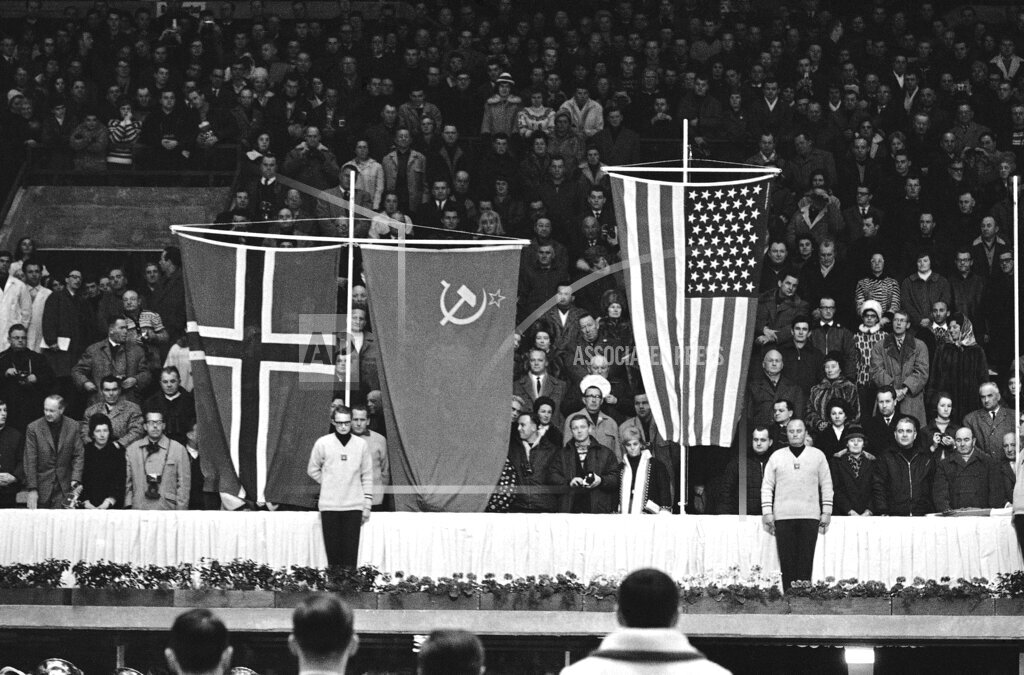
The United States has won a gold medal at the Winter Olympics. With a roaring drive down the stretch, Terry McDermott catapulted to the Olympic 500‐meter speed‐skating championship today. His time of 40.1 seconds smashed an Olympic record. McDermott beat Yevgeny Grishin, the great Soviet skater who had held the Olympic mark of 0:40.2 and has the world record of 0:39.5. The margin of the 23‐year-old barber from Essexville, Michigan, was half a second over Grishin and two others for the 547‐yard distance. McDermott’s medal was the third for the United States in the IX Winter Olympic Games. The other two — a silver and a bronze — had been won by Jean Saubert, of Ogden, Utah, in the women’s giant slalom and the slalom.
Dow Jones Industrial Average: 783.30 (-1.42).
Born:
Jeff Gardner, MLB second baseman, third baseman, and shortstop (New York Mets, San Diego Padres, Montreal Expos), in Newport Beach, California.
Died:
Alfred Wiener, 78, German Jewish politician who had been General Secretary of the Central Organization of German Citizens of the Jewish Faith during the 1920s, before fleeing Nazi Germany in 1933.

 History Diaries