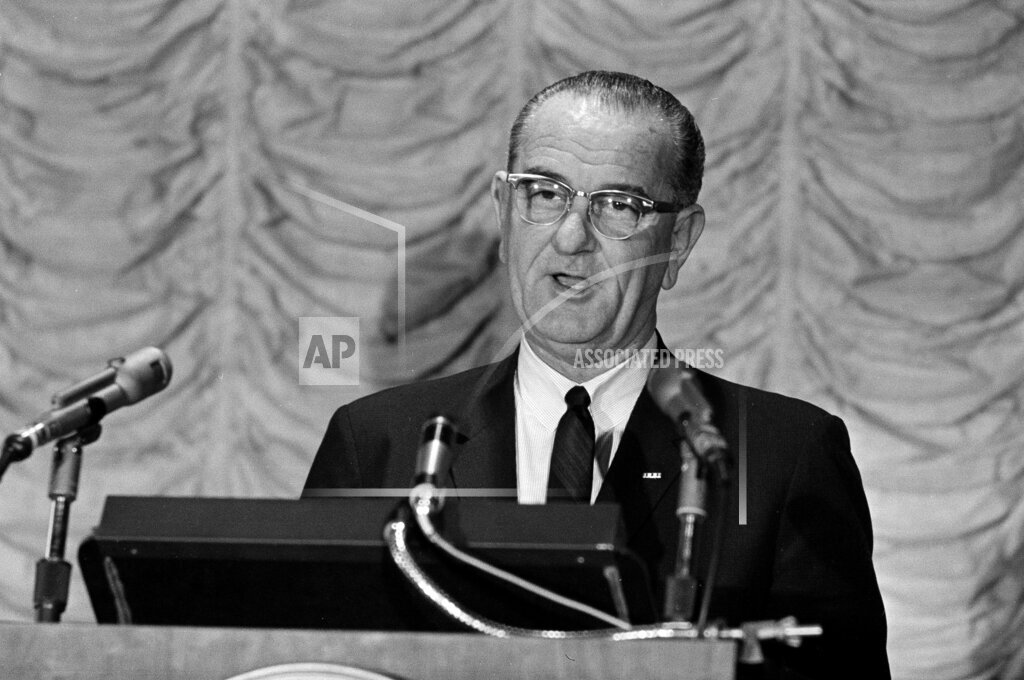
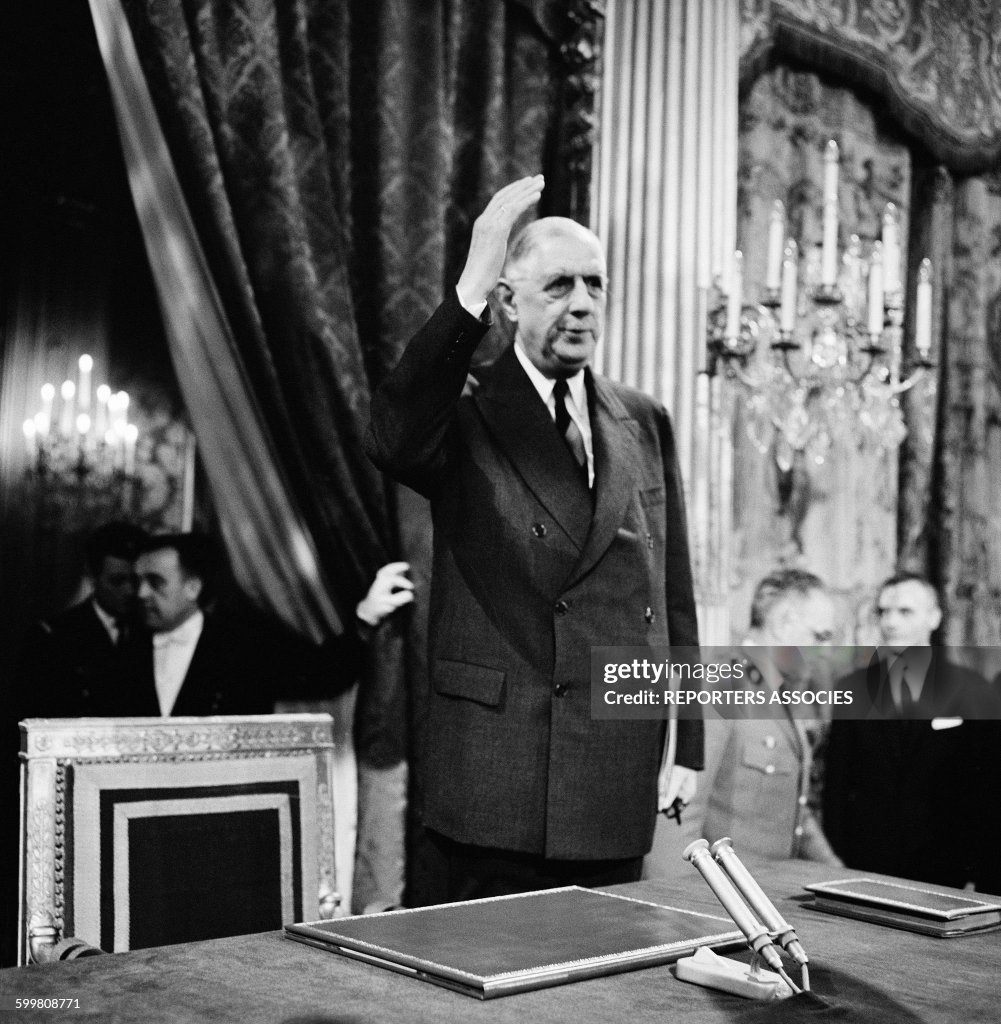
At a press conference, President Johnson says he has General Khánh’s pledge to spur the war effort and that he, in turn, has pledged full U.S. support for the new regime. Johnson also says he is prepared to consider any plan that truly ensures the neutralization of both North and South Vietnam. President Johnson said today that he saw no chance now of negotiating a peace for Southeast Asia, as proposed by President de Gaulle, and pledged instead a greater effort in the guerrilla war in South Vietnam. President Johnson partly endorsed and partly rebutted the French leader’s call for neutralization in Southeast Asia. But Mr. Johnson saw no alternative to the Administration’s present course and assured the new military rulers of South Vietnam of the full support of the United States.
At his first formal news conference since moving to the White House more than two months ago, Mr. Johnson also offered assurances to the country — and to some critics—that there was no emergency despite the hectic pace of foreign affairs and that he was in full control of the nation’s diplomacy. He urged that developments abroad be seen in the perspective of history rather than headlines. He acknowledged that progress was often slow and undramatic but said the Administration was working quietly, steadily and confidently.
Mr. Johnson indicated that a proposal to neutralize both North and South Vietnam would be considered “sympathetically.” But he sees no prospect of that at the moment, he said. Since, by French interpretation, President de Gaulle was proposing the neutralization of former French Indochina — including North and South Vietnam and the already neutral states of Laos and Cambodia — Mr. Johnson appeared to be expressing at least partial agreement with the French leader’s suggestion. President Johnson went further. He said that if the United States could expect the Communists in North Vietnam to let South Vietnam live in peace, the Administration would change its attitude. As long as South Vietnam is threatened, he said, United States support for military resistance is the only course. “And i think that the operations should be stepped up there,” he added.
The official beginning of the Oplan 34A with its elaborate covert operations against North Vietnam.
Divided Vietnam was named by qualified sources today as the chief target of President de Gaulle’s policy of neutralization and peace in Asia. France has no thought of imposing neutrality on Vietnam, it was emphasized. But President de Gaulle apparently is convinced that neutrality is the only way to avoid a fight to the finish between the South Vietnamese and their United States allies and the North Vietnamese backed by the Chinese Communists. When the French President proclaimed yesterday his neutrality policy for what he called Southeast Asia, he was speaking of the states of the Indochinese peninsula once governed by France. Of these, Cambodia is moving toward neutrality and asking that this be guaranteed by an international conference. Laos, under the international agreement of 1962, is theoretically neutral. This leaves only Vietnam as an objective of active Gaullist policy.
One U.S. soldier is killed and five are injured by a bomb explosion in Saigon. A powerful bomb exploded in an alley outside a Saigon bar last night, killing one United States serviceman, and wounding five other American servicemen and an American civilian. One of the wounded persons was in critical condition and was not expected to live. The bomb exploded in the hands of the serviceman who was killed. Two servicemen, a sailor and an airman, had gone outside to take a package suspected of being a bomb off a window ledge of the bar. They had taken a few steps when it exploded.
The International Control Commission agreed today to investigate charges that the pro‐Communist Pathet Loa had violated the cease‐fire and attacked neutralist forces in central Laos. Diplomatic sources said the commission, composed of India, Canada and Poland, acted unanimously on a request by the neutralist Premier, Prince Souvanna Phouma. This was the first unanimous decision reached by the commission since last April, when the current Laotian crisis started. The delegates are the new chairman, Ashok Bkadkamkar of India, Paul Briddle of Canada and Jerzy Dudzinsky if Poland, who recently replaced Marek Thee. Poland had cast the negative votes before.
Archbishop Makarios, President of Cyprus, rejected today a United States-British proposal for an international peace‐keeping force on the island. His rejection came before the full details of the proposal were officially communicated to him. The decision was taken at a meeting this morning of the Greek Cypriote ministers in the Government. President Makarios, who is also leader of the Greek Cypriote community, presided at the meeting. It was reported on the highest authority that the ministers decided “definitely and unanimously” to reject the proposals as wholly unacceptable. A basic United States condition to the implementation of the proposals was the approval of President Makarios.
The proposals were made at a conference in London on the Cyprus problem. The conference was called after proposals by President Makarios for constitutional changes in the four‐year‐old republic led to fighting between the Greek Cypriote majority and the Turkish Cypriote minority on the island during Christmas week. The proposed peace force would be made up of at least 10,000 troops from North Atlantic Treaty Organization countries other than Britain, Turkey and Greece. These three countries already have contingents in Cyprus. All have a treaty right to intervene in Cyprus to maintain the status quo.
A series of new peace‐making efforts were developing here today in the dispute between the United States and Panama. The efforts were directed at producing at least a preliminary solution before Tuesday afternoon, when the Council of the Organization of American States is due to meet to take up Panama’s charge of aggression against the United States. Against this background, President Johnson said at his news conference this afternoon that the United States was working for a settlement. “We have been patiently continuing our efforts to resume relations with our neighbors in Panama, and to reconsider with them, without preconditions on either side, all issues which threaten to divide us,” the President said.
At least 70 people, most of them passengers on the Argentine Railways “Firefly Express” train, were killed in a head-on collision with a freight train. The express train was carrying 1,040 passengers who were returning to Buenos Aires from the vacation resort of Mar Del Plata. As it was approaching the station at Altamirano, 65 miles from Buenos Aires, the express crashed into a steam-hauled freight train. Both locomotives exploded, spreading burning diesel fuel over a wide area and setting the first three-passenger cars on fire. Rescue workers were unable to search for survivors for several hours because of the intensity of the blaze. A police doctor, giving an estimate of 34 deaths, conceded that “There is no telling how many bodies burned up in the fire”.
As the House continued debate on the civil rights bill, President Johnson said today he hoped and believed it would be passed “without any crippling amendments.” In an afternoon news conference, the President expressed hope that the tax bill, now on the Senate floor, could “withstand the onslaughts” of those seeking to amend it. Mr. Johnson said he would like to have the civil rights bill passed by the House and the tax bill passed by the Senate before members leave for Lincoln’s Birthday meetings, February 12. Along with these two bills, the President said, he placed great importance on farm legislation, hospital care for the aged, the bill to set up wilderness areas, and housing legislation.
President Johnson pointedly called attention today to United States advances in weapons, including missiles. in a statement intended to blunt criticisms by Senator Barry Goldwater. The President did not mention the Arizona Republican, nor did he deal directly with his charge. Mr. Goldwater, an aspirant for his party’s Presidential nomination, had said that United States long‐range missiles were insufficiently reliable.
The President cited this country’s continued efforts to improve strategic missiles in an opening statement at his news conference this afternoon. He included the successful launching of the Saturn rocket this week in his catalogue of examples of how the United States is meeting its foreign policy responsibilities. The Saturn, with 1.5 million pounds of thrust, launched a satellite weighing 37,700 pounds, more than twice the greatest weight launched by the Soviet Union. The President also cited three new missile weapons. These were the Redeye, a bazooka‐like rocket that can be fired from the shoulder by soldiers on the ground against attacking aircraft; the Shillelagh, designed as an antitank weapon; and the Walleye, which is essentially a glider bomb for use by naval aircraft.
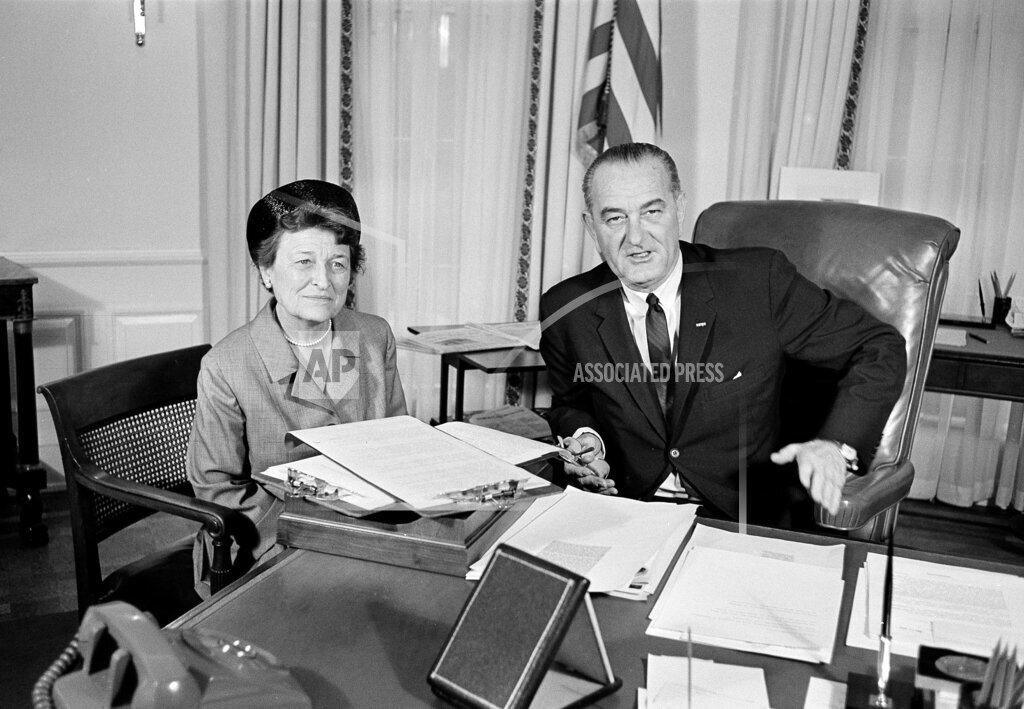
Sargent Shriver has been chosen by President Johnson to organize and direct the Administration’s anti‐poverty program. The President announced at his news conference today that Mr. Shriver would undertake the role in addition to his duties as director of the Peace Corps. Mr. Shriver, the 48‐year‐old brother‐in‐law of President Kennedy, had a 45‐minute conference with Mr. Johnson yesterday to discuss his recent trip abroad and the progress of the Peace Corps. It was understood that the “war against poverty,” as President Johnson describes the new program soon to be disclosed, was also a major topic at the White House meeting.
Agents of the Federal Bureau of Investigation testified today that the .30‐06 Enfield rifle found at the scene of the murder of Medger W. Evers was the one traded to Byron De La Beckwith in 1960. A gun shop owner also testified that he had traded a telescopic sight similar to the one on the rifle to Beckwith last May 12, one month before the Negro civil rights leader was shot. One FBI agent told the jury of white men that the bullet that killed Mr. Evers was so mutilated that it could not be positively identified as having been fired by the Beckwith rifle. But he said it was the same caliber and make as six live rounds found in the rifle and that it had been fired by an Enfield. A Jackson police officer was standing by to testify, as he had in a preliminary hearing, that a fresh fingerprint found on the rifle matched that of Beckwith, 43-year-old Greenwood, Mississippi, salesman and a member of the White Citizens Council.
The United Automobile Workers has told President Johnson that the automobile industry can afford to make “substantial price reductions” and still give its workers “significant improvements.” Walter P. Reuther, the unions president, took this stand in a five‐page letter sent to the President last Wednesday and made public today. Mr. Johnson said in his Economic Report of Jan. 20 that he saw no reason for inflationary wage and price actions this year. His Council of Economic Advisers, in an accompanying report, suggested price reductions in highly profitable industries.
Integrationists and Ku Klux Klansmen picketed in the business district tonight after Mayor Ivan Allen Jr. had rejected Black truce terms in this city’s racial crisis. The police arrested three men, two on charges of cursing and one on a charge of disorderly conduct. More than two dozen policemen kept spectators moving at the intersection of Luckie and Forsyth Streets, the scene of the demonstrations. Last Saturday night, brawling broke out in a confrontation of the two groups. From 20 to 30 civil rights advocates, including a few Georgia Tech students and other whites, paraded tonight outside Leb’s Restaurant, one of the chief targets of the demonstrators. They began picketing shortly after 4:15 P.M., took an hour break for dinner and then returned.
Robed and hooded Klansmen — officers in red and cavaliers in white — began demonstrating before the arrival of the integrationists. The Klansmen picketed desegrated restaurants and hotels and a barber shop that recently employed a Black barber. They left at 6 o’clock and returned two hours later. Other Klansmen dressed in green jackets and wearing white crash helmets with black throat straps walked the sidewalks in twos. They wore red armbands with the letters “S.G.” for “Security Guard” and had shiny, three‐cell flashlights strapped to their sides. There was no singing or chanting by the anti‐segregation demonstrators, who passed out leaflets. The leaflets said that the demonstrators were not only protesting segregation and discrimination here but also marking the fourth anniversary of the sit‐in movement.
The first commercial Boeing 727 flight was made as Eastern Airlines Flight 638 departed Miami at 8:30 a.m., on a flight to Washington D.C.’s Dulles Airport and a final arrival at Philadelphia. United Air Lines would inaugurate its service on February 6, and American Airlines would follow on April 12.
“Stop the World, I Want to Get Off…” closes at Shubert, NYC, after 556 performances.
Indiana Governor Mathew Walsh tries to ban “Louie Louie” for obscenity.
The Beatles vaulted to the #1 spot on the U.S. singles charts for the first time, with “I Want to Hold Your Hand”, starting the British Invasion of the United States.
French sisters Christine Goitschel (gold) and Marielle Goitschel (silver) become first female siblings to win Olympic gold and silver in the same event when they dominate the slalom in Innsbruck.
Born:
Jamie Holland, NFL wide receiver and kick returner (San Diego Chargers, Los Angeles Raiders, Cleveland Browns), in Raleigh, North Carolina.
James FitzPatrick, NFL tackle and guard (San Diego Chargers, Los Angeles Raiders), in Heidelberg, Baden-Wurttemberg, West Germany.
Freddie Robinson, NFL safety (Indianapolis Colts), in Mobile, Alabama.
Don Sommer, NFL tackle (Buffalo Bills), in Corsicana, Texas.
Willie Turral, NFL running abck (Philadelphia Eagles), in Tallahassee, Florida.
Jani Lane [John Oswald], American heavy metal rock songwriter, and singer (Warrant – “Cherry Pie”), in Akron, Ohio (d. 2011).
Kaitlin Hopkins, American actress (Kelsey-“Another World”), in New York, New York.
Linus Roache, English actor, in Manchester, England, United Kingdom.
Sharon Bruneau, Canadian actress (“Sensuous Muscle”), born in Toronto, Ontario, Canada.
Died:
J. Robert Atkinson, 76, blind American publisher and founder of the Braille Institute of America
 History Diaries