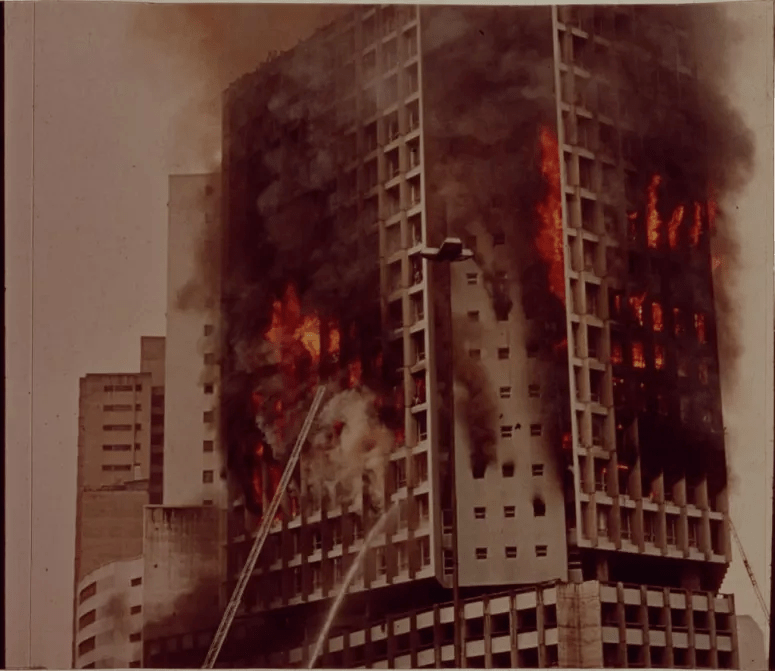
A fire killed 177 people and injured 293 others in the 23-story Joelma Building at São Paulo in Brazil. Another 11 later died of their injuries. The blaze began on the 12th floor of the building, apparently from a short-circuit in a faulty air conditioner. Many of the dead jumped out of windows. A police inspector said that the building, completed less than a year ago, had no fire escapes. Flammable plastic was said to have been widely used in its construction.
Europe’s economic prospects look brighter than they did a few months ago because oil is now flowing more plentifully. While concern remains that recessionary forces could get out of hand, reflecting the deflationary impact of the fourfold increase in oil prices, experts in Paris, Brussels and Bonn are no longer forecasting a deep recession this year. They see only a downswing in the growth rate instead.
President Anwar el‐Sadat won support for his disengagement agreement with Israel from most of the other Arab leaders during his recent tour of their capitals, according to informed sources here, but there is a time limit on their commitment. Mr. Sadat, the sources say, must achieve further Israeli withdrawals beyond the new truce line, and other Israeli concessions, to assure continued Arab support. The qualified nature of the Arab backing is believed to be the reason that Mr. Sadat has gone out of his way to stress the limitations of the Israeli Egyptian agreement. At a meeting here last night, for example, Mr. Sadat told leaders of the Palestine liberation movement that he would refuse to open the Suez Canal to Israeli shipping until Israel recognized “the legitimate rights of the Palestinians” and returned all the Arab territories that she took in 1967. He added that until Israel met these conditions, Egypt would also refuse to end the state of belligerency between the countries.
A Syrian communiqué said that at least 10 Israelis were killed early today when they tried to ambush a Syrian force on the Golan Heights. The communiqué said that Syrian patrol clashed in the central sector of the front with an Israeli ambush force, “destroyed all its personnel and vehicles” and fired on the Israelis with mortars as they withdrew. Israeli losses were put at “at least 10 enemy soldiers killed.”
A spokesman for the Israeli command denied a Damascus report that the Syrians had clashed with an Israeli ambush force and killed 10 men. He said the Syrians fired some rocket shells during the night and that there was some small‐arms fire, but no Israeli casualties.
Three persons were found guilty today of having helped murder a Moroccan in the international war between Arab and Israeli agents. The three defendants and two others were also found guilty of illegal intelligence activities in gathering data on Palestinian guerrillas. The five defendants — all of them Jewish and two of them Israelis — were sentenced to prison terms ranging from one to five and one‐half years. A sixth defendant, an Israeli, was acquitted.
All six were charged with aiding and abetting in the murder of Ahmed Bouchiki, a Moroccan waiter, last July 21. Mr. Bouchiki was killed by shots fired from a car on street in the Norwegian town of Lillehammer. The prosecution said the waiter had been mistaken for Palestinian agent. Found guilty of the charges of complicity in the murder and illegal intelligence activities were Sylvia Rafael of South Africa and Abraham Gehmer of Israel, each sentenced to five and one‐half years in prison, and Dan Aerbel of Denmark, sentenced to five years in prison.
Secretary of State Kissinger plans to assess Soviet reaction to the Egyptian‐Israeli agreement on troop separation and to discuss the next phase in Middle East peace negotiations when he meets soon with Foreign Minister Andrei A. Gromyko of the Soviet Union, Administration officials said today. Mr. Gromyko, currently accompanying Leonid I. Brezhnev, the Soviet Communist party leader, on a visit to Cuba, is expected to fly from Havana to Washington some time Sunday. A formal announcement is planned tomorrow, officials said. They said that Mr. Gromyko would see President Nixon while in Washington and was expected to leave for Moscow Tuesday night or Wednesday.
Although the officials would not rule out the possibility that Mr. Gromyko might discuss Premier Fidel Castro’s attitude toward possible, contacts with the United States, they said the primary focus of the Russian’s visit would be on the Middle East and on such East‐West issues as the talks on limitation of strategic arms. Publicly, the Russians have been less than enthusiastic about being left omit of the Egyptian‐Israeli talks and their press has made a point of not mentioning that Mr. Kissinger was the mediator in those negotiations. Officially, Moscow has endorsed the results of the negotiations.
Acting without authority from the Brazilian government, British detectives captured master thief Ronald Biggs in Rio de Janeiro at the Hotel Trocadero on the Copacabana Beach. Biggs, who had been sentenced to 30 years imprisonment for the “great train robbery” of 1963, had been living in Brazil under the alias Michael Haynes and working as a carpenter after escaping from prison in 1965.
Insurgent forces bombarded Phnom Penh and its suburbs with more than 100 rounds of artillery before dawn today in one of the heaviest attacks of the almost four‐year‐old Cambodian war. At least six people were killed and 45 wounded, according to reports from the field. The attack against Phnom Penh and Pochentong Airport west of the city lasted for 45 minutes. The artillery rounds hit the same sections in the southern and southwestern parts of Phnom Penh that had been, damaged in previous artillery attacks. Thousands of residents. have fled their homes to escape the attacks.
At least 10 of the artillery rounds exploded in the Pochentong Airport complex, about four miles west of the capital. Most of the rounds, reports said, went off in an area near a Cambodian Air Force base, just east of the civilian terminal. Damage to the air base was minor, the reports added. Yesterday, an insurgent force of about 500 men reportedly infiltrated Government lines south of Phnom Penh and penetrated within three miles of the capital. The insurgents made no attack, and Government forces reportedly made no immediate move to drive them back.
Breaking a six‐month deadlock, the Saigon Government and the Vietcong set a date today for the resumption of their exchange of prisoners. The agreement was reached at an hour-and-45-minute meeting of the Two-Party Joint Military Commission, which set February 8 as the beginning of a seven‐stage exchange that is to last three weeks. Both Saigon and the Viet Cong’s Provisional Revolutionary Government announced the agreement, with each accusing the other of having disrupted previous prisoner exchanges. The release of prisoners halted in July after Government officials charged that a planeload of prisoners being transferred to the Viet Cong in Lộc Ninh, a Communist‐controlled city 75 miles northwest of Saigon, had been surrounded by 300 to 400 Communist youths who chanted slogans, pushed the prisoners and tried to stop them from choosing to stay with the Government side.
A special “emergency” court-martial at the South Korean Defense Ministry today sentenced two adversaries of the Government to 15 years in prison for criticizing the nation’s Constitution in violation of presidential decree. They were arrested on January 15, a week after President Park Chung Hee issued an “emergency” decree banning any criticism of the 1972 Constitution, which replaced a more liberal charter and gave Mr. Park much broader powers. This was the first time that any violators of the decree were given prison terms. But 14 others — seven university students, six Christion clergymen and an assistant instructor at a private preparatory school — are under arrest and awaiting military trial. The convicted are Chang Joon Ha, a former opposition member of the National Assembly and now an adviser to the Democratic Unification party, a splinter opposition group, and Paik Ki Wan, the director of political research institute who was once an opposition politician.
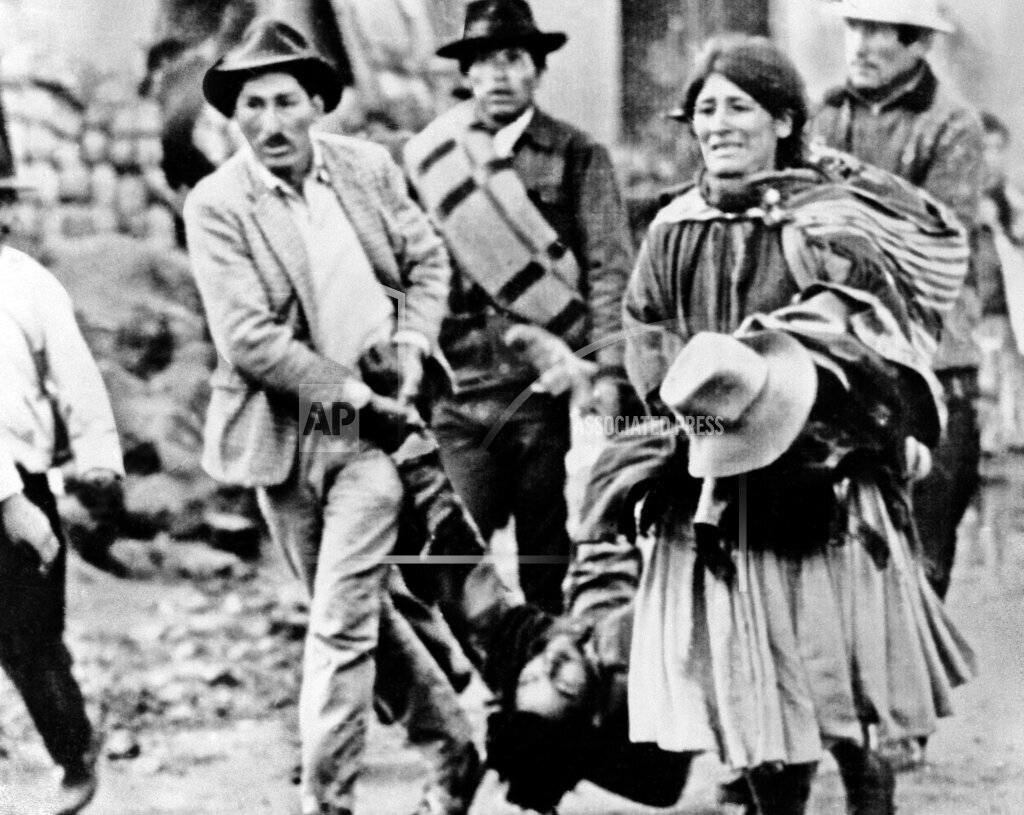
A new confrontation developed today in Bolivia’s two‐week‐old political crisis when 4,800 tin miners announced a 48‐hour wildcat strike to protest food shortages and the economic policies of President Hugo Banzer Suárez’s Government. Earlier in the day, the political unrest had appeared to be subsiding after military units said they had forcibly opened key highways blocked by peasants in the Cochabamba Valley who were protesting price increases. In radio broadcasts from the Oruro mining region, about 150 miles south of the capital, leaders of the striking workers, who represent about 10 per cent of the total mining force, declared their “solidarity with the peasants of Cochabamba.” Tin mining provides the country with more than half of her foreign exchange. The miners, for $100 a month, work at 15,000 feet, their cheeks bulging with coca leaves to ward off hunger, cold, and fatigue.
On the last day of the 1974 British Commonwealth Games in Christchurch, New Zealand, Tanzanian athlete Filbert Bayi set a new world record of 3 minutes, 32.2 seconds in the 1500-meter race.
Kuala Lumpur, the capital of Malaysia, was declared a Federal Territory.
President Nixon sent his report on the economy to Congress. The Labor Department announced that unemployment has risen considerably. The President’s report hints at decontrol of wages and prices. Inflation, unemployment, and economic growth all look gloomy for ’74.
The nation’s unemployment rate increased to 5.2% in January; the energy crisis was blamed. Unemployment in Los Angeles reached 6.8%. The plastics industry in Southern California has been hit hard by unemployment. Oil is needed for plastic production, so the energy squeeze has affected the employment picture. Car sales dropped 31% compared to last January. More unemployment is foreseen.
The President and his economic advisers warned of price increases. Checks of grocery stores prove that such warnings are valid. A monthly survey of four cities confirmed that prices are up from 10 to 20 percent since last March, and a significant part of that increase has occurred just within the past month.
The Cost of Living Council lifted price controls on major chain stores; other controls remained intact.
Some oil companies announced increases in wholesale gasoline prices; heating oil prices are expected to rise also. Texaco maintained prices at the January level.
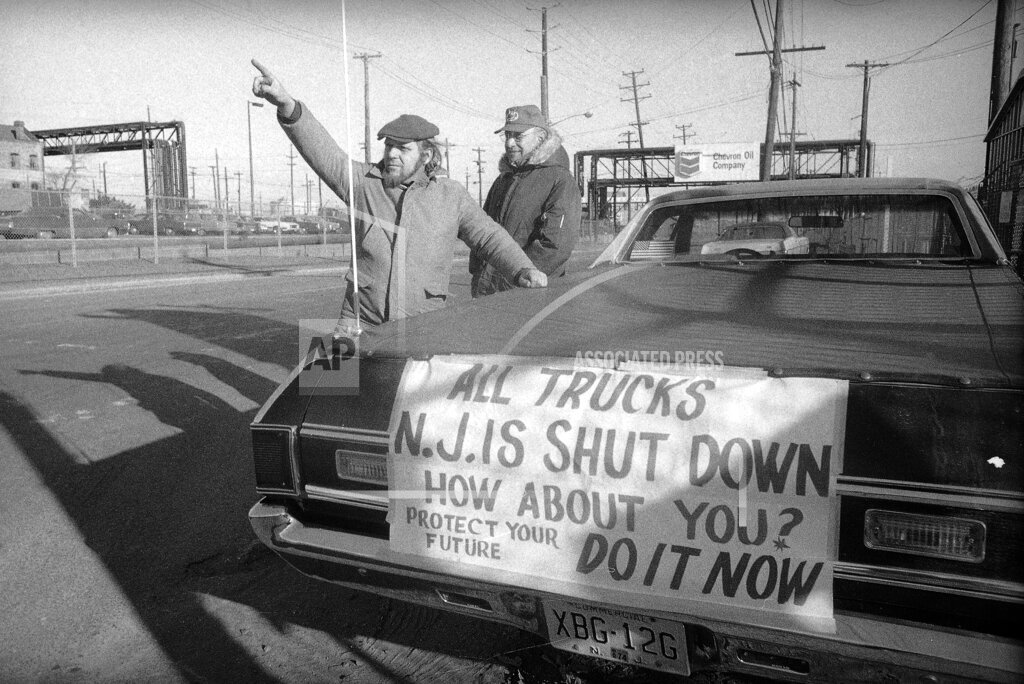
Independent truckers went on strike; some violence occurred. Dozens of truckers stopped gasoline shipments to the Northeast. Many truckers complied with “requests” to shut off their trucks in an effort to avoid violence.
Pennsylvania Governor Milton Shapp placed the National Guard on alert in his state. Truckers travelled in groups to ward off violence. The Teamsters union insisted that its truckers work, however the Steel Hauler’s Association said truckers should strike.
Thousands of motorists in the New York City metropolitan area with fuel-gauge needles close to “E” were denied their first tankful of February’s gasoline allotments by picketing independent truck drivers who were protesting the fuel squeeze on their industry. Motorists who were lucky enough to find service stations selling gasoline had to wait in line and paid up to 6 cents more a gallon than they had last month.
Mike Mansfield, the Senate Democratic leader, said that Congress and the courts must pursue their Watergate investigations “in order to cleanse the political processes of the nation.” Senator Mansfield, responding on behalf of the Democratic majority in Congress to President Nixon’s State of the Union Address Wednesday, pledged that his party would put “the regular business of the nation” ahead of Watergate, but he said that Congress would deal fully with the inquiry into the possible impeachment of the President, and he specifically rejected President Nixon’s plea for an end to the Watergate investigations.
Senator Hugh Scott of Pennsylvania said today that he was not “backtracking one single inch” on his charge that John W. Dean 3rd had lied about President Nixon’s role in the Watergate cover‐up. Mr. Scott, the Senate Republican leader, made the statement to reporters after meeting with Mr. Nixon to discuss the budget for the next fiscal year. An assistant special prosecutor, Richard J. Davis, said in court yesterday that the prosecutor’s office had no reason to believe that Mr. Dean had not told the truth.
A former White House speech writer said that Secretary of State Kissinger and Gen. Alexander M. Haig Jr., the White House chief of staff, had urged the President to cut off all contact with H. R. Haldeman and John D. Ehrlichman, his former top aides, but that Mr. Nixon had refused to do so.
The attorney for Rose Mary Woods, the President’s personal secretary, asserted that the court‐appointed technical experts who found that the tape of an important Watergate conversation had been manually erased were “not experts [but] six professors who don’t know what they’re doing.”
President Nixon signed today a $60‐million, three‐year measure establishing a national center to deal with child abuse and neglect. The agency, under the Health, Education and Welfare Department, will authorize grants and contracts for demonstration programs and projects for child abuse prevention and treatment programs. The legislation authorizes an outlay of $15‐million for the current fiscal year ending June 30; $20‐million for 1975 and $25‐million for each of the following fiscal years.
Mr. Nixon also signed a bill that increases the Government’s contributions to federal employes, health insurance premium payments from 40 percent to 60 percent by January, 1975. The bill raises the benefits from 40 to 50 percent retroactive to January and extends coverage to certain retired employes who now participate in a special Federal retired employe health benefits program.
In the U.S., Lynda Ann Healy, a 21-year-old student at the University of Washington in Seattle, disappeared from her basement apartment and was subsequently killed, becoming the earliest of at least 30 women murdered by serial killer Ted Bundy.
A federal judge temporarily extended the life of the 119-year-old Rheingold brewery in Brooklyn, where workers were sitting-in to protest the plant’s permanent closing. The stay prohibits the company from closing the brewery before midnight Monday to give lawyers for two unions representing brewery workers time to appeal a court decision issued this afternoon that refused to halt the brewery’s closing.
Dow Jones Industrial Average: 843.94 (-11.61, -1.36%).
Born:
Jennifer Lien, American actress (Hannah Moore-“Another World”), in Palos Heights, Illinois.
David Meca, Spanish open water swimmer (World Championship gold 10k 2000, 25k 2005), in Sabadell, Spain
Roberto Heras, Spanish road cyclist and 4-time winner of the Vuelta a España; in Béjar, Spain.
Walter McCarty, NBA power forward and small forward (New York Knicks, Boston Celtics, Phoenix Suns, Los Angeles Clippers), in Evansville, Indiana.
Died:
Lynda Ann Healy, 22, first Ted Bundy murder victim, abducted and killed in Seattle, Washington.
Jackie Kannon, 47, Canadian stand-up comedian, entrepreneur and publisher, died of a heart attack.
Alice Eversman, 88, American opera singer and music critic.



 History Diaries