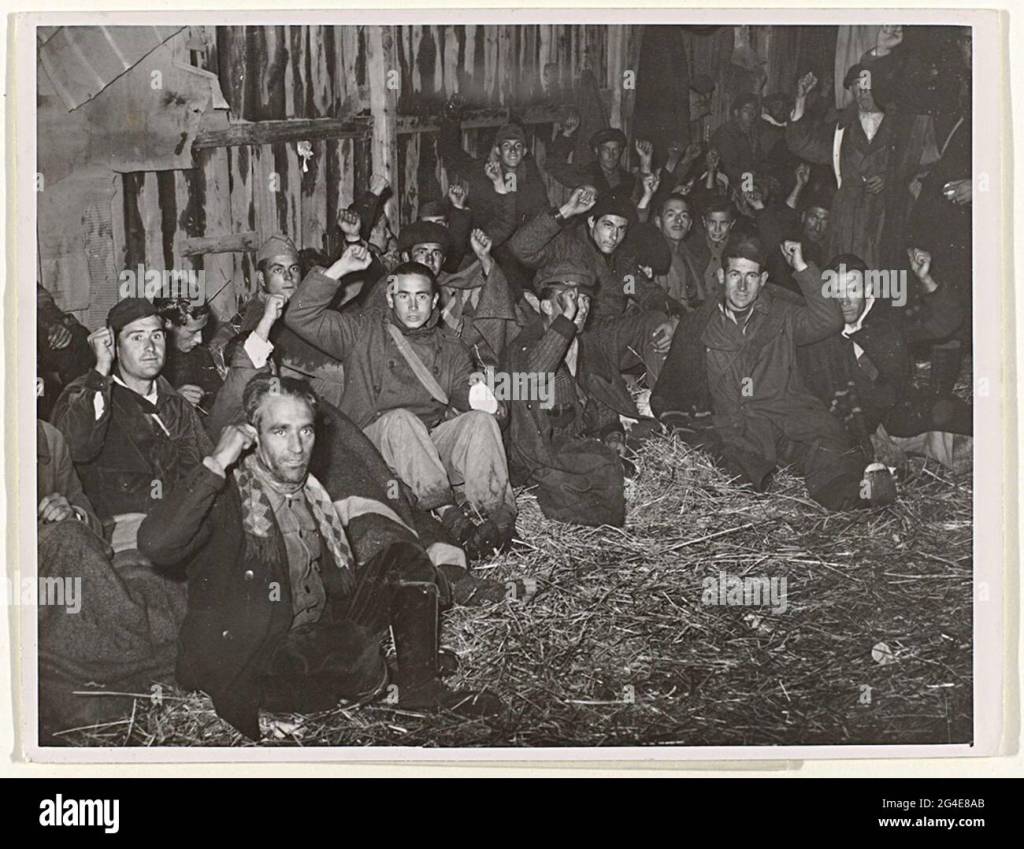
The French government, who announced they opened the border on January 28, start receiving the first of 400,000 – 500,000 refugees into the country, those who are first to make the walk through the snow. Republican troops are not yet permitted to enter, yet the remaining men are flanking the refugees on their dangerous walk, while the German Condor Legion continues to bomb them from overhead. Once the Nationalists reach the frontier, they plan to close the border. The Loyalists have only ten more days to make the freezing, bomb-ridden march towards France. The French continue to reinforce the border with cavalry and motorized units.
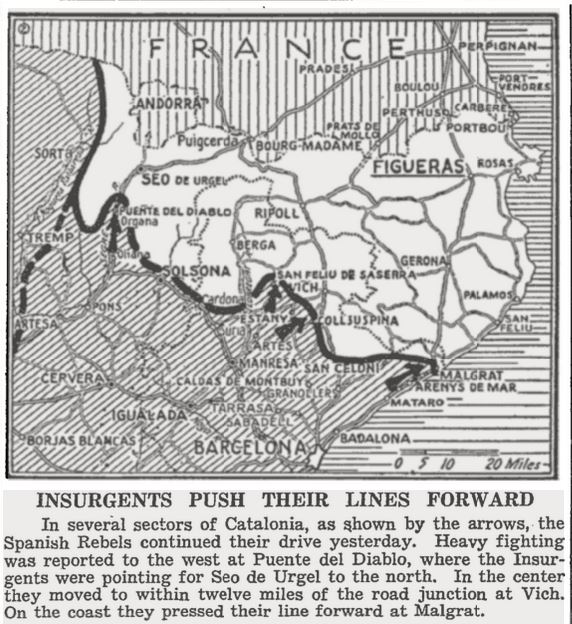
The Spanish Nationalists (Insurgents) advanced all along the Northern Catalan front today, according to tonight’s military communiqué. Departing from Canet on the coastal road this morning, a Moroccan army corps and mixed legionary forces marched ten miles northeastward to occupy Calella and Pineda before reaching the outskirts of Santa Susana. Early this afternoon they took Malgrat, on the boundary line dividing Barcelona and Girona Provinces, where 1,500 Republican (Loyalist) militiamen surrendered without offering any resistance. North of Granollers in the sector near the coast, the village of San Celoni also was occupied. Many prisoners belonging to the Lister Brigade were taken there. In the zone south of Vich, the Maestrazgo army corps, led by General Garcia Valino, captured San Feliu de Saserra, Pla de Pedrera, Estany, Puigrodo, and Colisupina, as well as a large number of prisoners belonging to forces only recently rushed up from the Barcelona area.
It is believed in Barcelona that occupation of Seo de Urgel, Puigcerda, and Girona may take place simultaneously within the next few days, if not hours. No serious resistance was being encountered today along the east coast, and it is said the only reason territory is not being conquered faster is that troops not entirely motorized cannot accelerate their movement. In Mataro early this afternoon a correspondent found five bearded, footsore and nearly exhausted men who had been prisoners of the fleeing Republicans until Sunday night, when they profited by the relaxed vigilance of their guards in Girona to escape under cover of darkness. They had walked forty-five miles to Mataro in almost the same number of hours. They said that before they met Nationalist advance patrols north of San Pol de Mar they had passed countless Republican soldiers hiding in the woods or in farm houses after deserting and throwing away their arms, which were seen in large numbers lying by the roadside or in the fields. All Republican Government officials who fled from Barcelona to Girona had already moved on to Figueras, they added, and the general demoralization prevailing in Girona was such that, altogether, about 200 prisoners were able to escape easily at the same time they made their get-away.
All five said they were natives of Barcelona and among 800 prisoners removed from clandestine jails for transfer to Girona last Tuesday. They said they had taken a train as far as Arenys de Mar, whence they were forced to march the rest of the way to Girona, about thirty miles. During the first three days of their journey, they related, they had no food and several died from exhaustion. Each of the five said he was arrested in Barcelona by S. I. M. military information service investigation brigades after evidence had been found of their affiliation with the Falange Española, the Spanish Fascist group. They explained that their confinement in “mental torture” cells like those reported yesterday in clandestine jails in Barcelona was intended to force them to reveal the identity of other Falange members and of General Franco’s “fifth column” of sympathizers in Barcelona. After confinement, completely nude for a week or two in a type of cell having weird designs painted on the walls, most of the prisoners would come out either mad or in such a weakened mental state that they would make any sort of declaration desired by their captors.
At Bourg-Madame this afternoon French authorities were predicting that Generalissimo Francisco Franco’s forces would reach the frontier within three days. Heavy fighting was reported at Puente del Diablo, about ten miles south of Seo de Urgel on the frontier. The Spanish Loyalists still have the equivalent of one army corps, approximately 30,000 men, in this sector. They are aided by extremely rough terrain. The booming of cannon, presumably from that front, could be heard at Bourg-Madame today. The road at Puente del Diablo runs between high mountains, where military observers say some judiciously placed machine guns could easily check attackers. But the defenders would have to reckon with an advance on the Berga Road in their rear, which, if successful, would squeeze them out.
Several buildings in central Madrid were struck by 8-inch shells this morning in a half-hour attack by Insurgent artillery.
Well-informed quarters today said that most of the Spanish Government fleet last night left its base at Cartagena, about 250 miles east of Gibraltar, for an undisclosed destination. At the same time the arrest of a number of British subjects from Gibraltar was reported at La Linea, in Insurgent-held Spanish territory just across the border from Gibraltar. It was believed the arrests were in reprisal for an anti-Insurgent demonstration staged last Friday in front of the Burgos regime’s agency in Gibraltar.
German SS leader Reinhard Heydrich ordered that Jews can only be released from protective custody if they present documents for emigration, and that Jews who were being committed to a concentration camp a second time would be committed to concentration camps for life.
Prime Minister Neville Chamberlain provides a guarded response to Hitler’s speech, saying peaceful actions must accompany words. Prime Minister Neville Chamberlain today gave a cool and guarded welcome to Chancellor Adolf Hitler’s speech in the German Reichstag last night with a reminder that peaceful deeds as well as words would be needed. before Europe could hope to settle its differences around the conference table. With an unexpected touch of irony in his voice, Mr. Chamberlain told the House of Commons that he just had not had time “to examine with care every phrase” in Herr Hitler’s speech, which was so long and touched on so many topics. “I very definitely got the impression,” Mr. Chamberlain went on, “that it was not the speech of a man who was preparing to throw Europe into another crisis. It seemed to me that there were many passages in the speech which indicated the necessity of peace for Germany as well as for other countries.”
But Mr. Chamberlain refused to rhapsodize over Herr Hitler’s speech, although on the Stock Exchange relief was so great and prices shot up so fast that the day’s trading came to be described as a “Hitler boom.” Unless the atmosphere was favorable, Mr. Chamberlain reminded the House, there was no use in starting discussions aiming at “general settlement of differences, satisfaction of aspirations and removal of grievances.” When he said that, he explained, he meant “unless those who come to the table are all convinced that all those who sit around it want a peaceable settlement and have no sinister idea in their minds.” And he emphasized the word “all” each time.
Reaction to Hitler’s speech is mostly positive in most capitals in Europe. They seem pleased with his lip service to peace, and unconcerned with his threats to Jews.
While a party of Fascists was breaking up a meeting of Sir Kingsley Wood, the air minister, and shouting against War Secretary Leslie Hore-Belisha in Limehouse tonight, political organizations supporting the Spanish Government staged a noisy demonstration in the West End that resulted in fifty arrests. The chanting of the slogan “Arms for Spain!” by thousands around the Houses of Parliament while the Commons was sitting at one time could be heard a quarter of a mile away. A band playing “The Red Flag” and “Forward, You Workers” headed a contingent of fifty members of the International Brigade and hundreds of followers on a march to Parliament Square where the leaders found every entrance guarded by a large body of police. “Let Chamberlain come out here!” they shouted, unfurling red-lettered banners. Police shepherded the crowds into side streets, but parties reformed and made their way to Piccadilly Circus. There the demonstration became boisterous, men lying down in the street to snarl traffic, and several were arrested.
Sir Kingsley Wood quelled an ugly scene at his meeting by starting to sing “God Save the King,” at which his Fascist tormentors halted and joined in.
The Jewish Elective Assembly names six members to go to a forthcoming London conference. They include Isaac Herzog, later the founder of the state of Israel.
President Franklin Roosevelt agrees to help European democracies in all ways short of war. Members of the Senate Military Affairs Committee were called to a conference at the White House today, and came away with the impression that President Roosevelt would go to every possible length, short of war, to back the democracies of Europe in any conflict with the dictatorships. The President is understood to have spoken in extremely practical terms of sale by the United States of arms, munitions and airplanes to France and England, and other nations which might soon be hard pressed if the gloomy world picture he painted to the Senators should change to one of international conflagration. When the President asked the Senators to see him at noon, Washington buzzed with reports that he was thus attempting to silence the agitation of certain of their numbers over the reported revelation of American military secrets to the French air mission. What Mr. Roosevelt was reported to have told them, however, went far beyond any such subject. As one member expressed it, the President’s disclosures of his intended policy in case of war between the democracies and dictatorships in Europe, or even in moves to prevent such a contingency, made the reputed revealing of air secrets a matter of mere “chicken feed.”
The view of world conditions which the President gave the Senators was, in the words of another committee member, “truly alarming.” The situation was so grave in his own estimation that he admonished the greatest secrecy as to the details of his remarks for fear they would alarm the people of this country. Furthermore, he took the opportunity to request in the strongest terms that influential members of Congress refrain from petty criticism of his acts in relation to foreign affairs for the immediate future.
President Franklin Roosevelt directs Attorney General Frank Murphy to investigate efforts to influence Federal judges. George Burns is fined nearly $18,000 in a jewelry smuggling conviction. President Roosevelt accepted yesterday the resignation of Judge Martin T. Manton of the Federal Circuit Court of Appeals, effective next Tuesday, a date about three weeks before that suggested by Judge Manton as a convenient date for his retirement. Judge Manton was directed by the President not to sit in any cases in the meantime. A “John Doe” investigation into Judge Manton’s business dealings was begun yesterday by the United States grand jury here at the instigation of Attorney General Frank Murphy. The conduct of Judge Manton and certain of his business associates has been the subject of a grand jury investigation directed by District Attorney Thomas E. Dewey of New York County for nine months.
A grand jury inquires into WPA fraud and graft. Charging “a general laxity in the administration of public works,” the November Federal grand jury, which has returned several indictments against Works Progress Administration contractors and others, handed up a presentment yesterday to Federal Judge William Bondy, urging a broad investigation of all WPA frauds in New York. The presentment, copies of which were sent to Frank Murphy, United States Attorney General, and to Gregory F. Noonan, United States Attorney, urged that the inquiry be conducted “under the jurisdiction of one prosecutor.”
Harry Hopkins suspends 17 ship operators who may have accepted gratuities.
For smuggling jewelry valued at less than $5,000 into the port of New York last Fall, George Burns of the radio and motion picture team of Burns and Allen received a suspended prison sentence of a year and a day yesterday, was placed on probation for that period and received ten days in which to pay a fine of $8,000, which is $3,000 less than he is said to earn each week as a comedian. In addition to the fine, it was disclosed, Burns, who appeared before Federal Judge William Bondy, having flown here from California to be punished, has paid $9,770 to customs authorities in settlement of civil penalties. The total cost of his confessed smuggling venture with Albert N. Chaperau, discredited consular attaché, amounts to $17,770. His wife, Gracie Allen, to whom he gave the jewelry, two bracelets and a diamond ring, may keep them. They have a total value of only $4,885.
The judicial notice of George Weinberg’s death, a bare statement that this principal accuser of James J. Hines had killed himself, was delivered yesterday to the jurors hearing the second trial of the Tammany leader by Judge Charles C. Nott Jr., in General Sessions. Then the accusations of the dead man were renewed through the voice of an assistant district attorney reading from the record of his testimony at the first trial. Weinberg shot himself in White Plains Sunday afternoon. The jurors got the news at 2:25 P.M. yesterday, nearly forty-eight hours later. They took it with rapt absorption, and the suspense that had been slowly growing against that moment hung over the courtroom after Judge Nott had finished. In that atmosphere the first ten pages of the cold record of what Weinberg had said last August about his associations with Arthur (Dutch Schultz) Flegenheimer and Hines in the early months of 1932, when the policy racket was forming, was read.
The notorious swindler known as Dapper Dan is caught posing as an immigration agent.
Volcano activity joins earthquakes in Chile.
General Chen Chien of China’s army denies reports that General Wu Pei-fu has agreed to head a puppet government.
Chancellor Adolf Hitler’s omission of any reference to the Ukraine in his Reichstag speech has disappointed the Japanese, for whom the entire value of the ties with Germany is their effect on Russia. Expressing this disappointment, the newspaper Asahi notes the importance of the things Herr Hitler left unsaid. But it would be hasty, Asahi adds, to conclude that Germany has put off her program of eastward expansion or Ukrainian independence. Analyzing the speech, Asahi finds indications that German policy during 1939 will move in a direction that will facilitate Japan’s advance in East Asia, not by direct action but by occupying the powers that might obstruct Japan. The newspaper declares that “we much appreciate Herr Hitler’s praise of the Japanese race and his avowal that Germany is on Japan’s side in her determination to prevent the Bolshevization of the world,” but it concludes on a curious note of depression that indicates it would prefer the friendship of the United States and Britain. “Notwithstanding the hopeful signs we read into Herr Hitler’s speech,” Asahi says, “we feel all the more the heavy mission with which we are charged to prevent the Bolshevization of China.”
Dow Jones Industrial Average: 143.76 (+2.2).
Born:
Earl Faison, AFL defensive end (AFL Champions-Chargers, 1963; AFL All-Star, 1961-1965; San Diego Chargers, Miami Dolphins), in Newport News, Virginia (d. 2016).
Johnny Egan, NBA point guard (Detroit Pistons, New York Knicks, Baltimore Bullets, Los Angeles Lakers, Cleveland Cavaliers, San Diego-Houston Rockets) and coach (Houston Rockets), in Hartford, Connecticut (d. 2022).
Claude Gauthier, Canadian folk singer-songwriter, and actor, in Lac-Saguay, Quebec.
Naval Construction:
The Kriegsmarine (German Navy) Type XB U-boats U-116, U-117, and U-118 are ordered from F. Krupp Germaniawerft AG, Kiel (werk 615, 616, and 617).
The Вое́нно-морско́й флот СССР (ВМФ) (Soviet Navy) Project 7U-class (Storozhevoy-class) destroyer Slavny (Славный, “Glorious”) is laid down by Sergo Ordzhonikidze Zavod (Leningrad, U.S.S.R.) / Yard 189.
The Koninklijke Marine (Royal Netherlands Navy) O-19-class submarine HrMs (HNMS) O-20 is launched by Wilton-Feijenoord (Schiedam, Holland).
The Armada de la República Argentina (Argentine Navy) light cruiser and training ship ARA La Argentina (C-3) is commissioned.
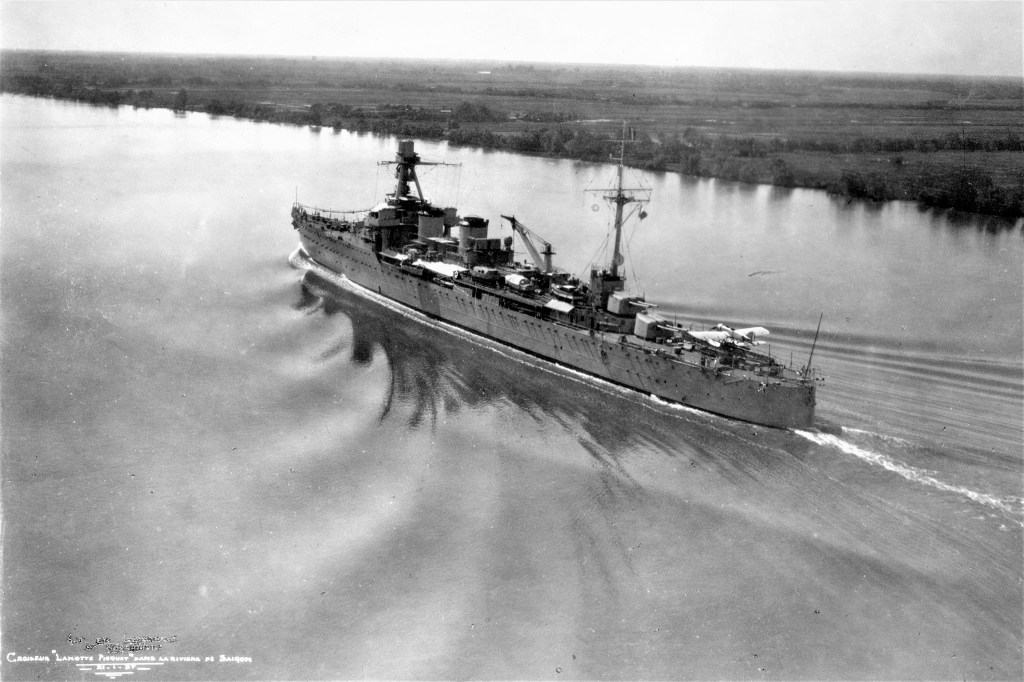
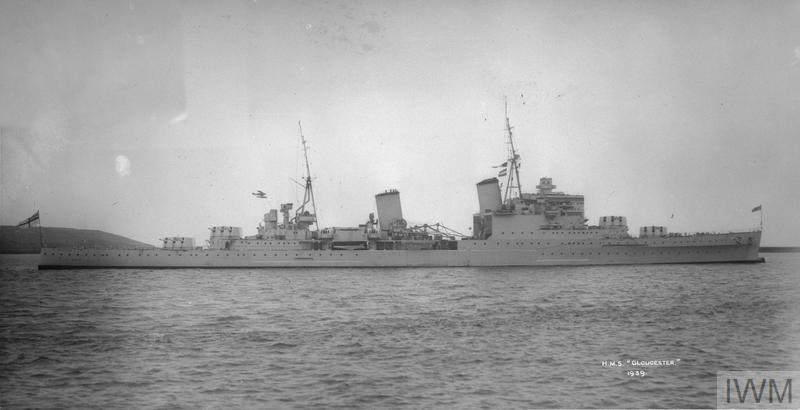
The Royal Navy Town-class light cruiser HMS Gloucester (62), name ship of her subclass of 3, is commissioned. Her first commanding officer is Captain Frederick Rodney Garside, RN.


https://en.wikipedia.org/wiki/HMS_Gloucester_(62)#Construction_and_career
Lost 22 May 1941. HMS Gloucester (Capt. Henry Aubrey Rowley, RN) was sunk in the Eastern Mediterranean in the Antikythera Channel about 15 nautical miles west of Antikythera island, Greece in position 35º50’N, 23º00’E by German Ju-88 and Ju-87 bombers during the German invasion of Crete. The commanding officer Captain Henry Aubrey Rowley, 45 officers and 648 more men were killed when she sank.
Battle Honours: CALABRIA 1940 – MATAPAN 1941 – CRETE 1941 – MALTA CONVOYS 1941 – MEDITERRANEAN 1941
 History Diaries