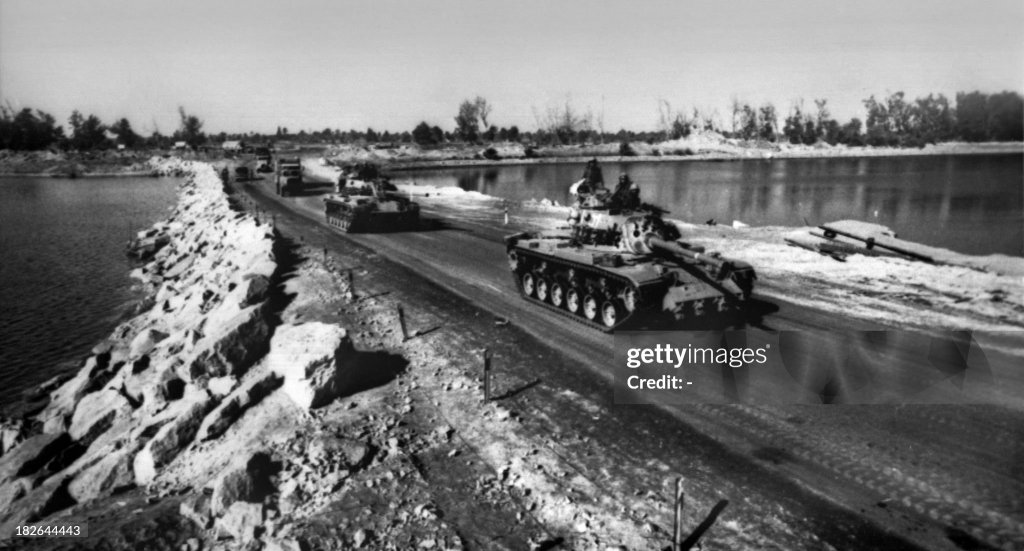
Secretary of State Kissinger said that several Arab leaders planned to recommend lifting the oil embargo when representatives of the Arab oil-producing nations meet in Libya on February 14 — or at an earlier date. In offering his most optimistic assessment of the prospects for a renewed oil flow, Mr. Kissinger did not say which leaders would propose ending the ban, but it was reported that King Faisal of Saudi Arabia had told President Nixon that he would support the move.
Arab leaders are reportedly linking a lifting of the oil embargo to progress in achieving a pullback of Israeli forces from the Golan Heights in Syria. In Damascus, where Syria’s leaders are discussing their position, there is said to be disagreement whether to settle for an Israeli withdrawal from territory captured last October or to insist on a pullback to pre-1967 lines.
Israel’s top leaders have indicated a willingness to withdraw from Syrian territory captured in October as part of a troop separation agreement to be negotiated with Syria similar to the one now being carried out with Egypt. The leaders hope that this offer, communicated in recent public statements, will induce Syria’s President, Hafez al-Assad, to overcome domestic opposition to negotiations with Israel.
The People’s Republic of China released Gerald Emil Kosh, a U.S. civilian captured during the Battle of the Paracel Islands.
Rebel rocket teams fired three Soviet‐built 122‐mm. rockets into the western section of Phnom Penh and an airport complex today, wounding a Cambodian senator and 10 other persons. Field reports said Senator Mey Khat was among those injured when two of the rockets struck in the western suburb of Phnom Tuol Kok — an area hit repeatedly during the dry‐season offensive that began in mid‐December. The third rocket hit the Pochentong airport complex but caused no damage or injuries were reported. President Lon Nol proclaimed a six‐month state of emergency yesterday to cope with the most intense insurgent offensive against Phnom Penh in nearly four years of war.
The South Vietnamese government and the Viet Cong announced that they would resume prisoner of war exchanges on February 8, after a suspension of seven months.
Military sources said yesterday that about 120 South Vietnamese soldiers had landed on a barren, uninhabited island group in the South China Sea, apparently in an effort to head off its occupation by Chinese forces. The Chinese have claimed the territory — the Spratly Islands — as well as the Paracels, about 500 miles to the north, which China took nearly two weeks ago in an attack with MIG’s, missile ships and ground troops. According to the military sources in Saigon, the South Vietnamese force has not yet encountered any Chinese in the Spratly Islands.
A Pentagon spokesman announced that the United States Air Force was dropping charges against Captain Donald Dawson, who had refused to fly a bombing mission over Cambodia after the signing of the Vietnam peace agreement. He was granted conscientious objector status and would be honorably discharged the following month.
Two members of the Japanese Red Army (JRA) and two members of the Popular Front for the Liberation of Palestine (PFLP) made a failed attempt to blow up oil tanks at the Shell oil refinery complex on Pulau Bukom at Singapore. The terrorists then hijacked the ferry Laju and took its five crew members hostage.
Britain’s 260,000 miners began voting today on a strike that could bring industry to a halt and lead to unemployment for millions. The prospect of a “yes” vote appeared to be about as inevitable as rain in London. Reports from the pits suggested that the miners were voting overwhelmingly to give their union leaders the authority to order a shutdown of the coal mines. The results of the voting, which extends over two days, will not be known until Sunday or Monday. If more than 55 per cent back the strike call, the pits could be closed as early as next Sunday in protest against the Government’s refusal to meet the miners’ pay demands. Prime Minister Heath, who ordered most of British industry on a three‐day work week because of the refusal of the miners to work overtime, is now gambling on a new proposal to prevent the strike. But the chances of success appeared slim tonight because the proposal calls, in effect, for more money later, rather than now.
The dispute with the coal workers, who have refused to work overtime for the last three months, has already led to a series of emergency measures, including the nation’s compulsory three‐day week. rising unemployment and darkening of shops and streets. About 70 per cent of power is generated here by coal. Coal supplies remain relatively high, partly because of mild weather and power-saving measures, but Government officials acknowledge that a strike would inevitably lead to a work week of two days or less and other drastic moves to conserve power. The economic crisis has already been described by Mr. Heath as the gravest since World War II.
In Newtownabbey, County Antrim, a suburb north of Belfast, two armed robbers entered a workmen’s hut and seized the week’s wages of the 13 laborers inside. They then ordered the Protestants present to kneel on the floor. After two or three men did so, the gunmen opened fire on the other people in the hut, killing two Catholics (37-year-old Terence McCafferty and 29-year-old James McCloskey) and wounding three other men, including a Protestant. The gunmen were members of the Ulster Freedom Fighters.
Two Soviet demonstrators who spent the night in the West German Embassy in Moscow after eluding police guards, left the building voluntarily and were believed to have been arrested immediately. Margarethe Gretzinger, 48, and Heinrich Gross, 34, were among six ethnic Germans who demonstrated outside the embassy to protest official Soviet refusal to allow them to emigrate to West Germany. The other four were arrested at the time of the protest.
West German police wounded and captured a gunman who took over a bank in Hilden, south of Dusseldorf, for six hours and then drove around the Rhineland for four more hours with $257,000 in ransom and the bank cashier as hostage. The cashier was released unharmed and the money was recovered. Prior to his getaway, the gunman released the three hostages he had taken when he burst into the bank at closing time. He said he was armed with a pistol and a hand grenade and would blow up the building unless he was given ransom, a high-powered car and safe conduct.
An investigation of the crash of a Soviet TU-144 supersonic airliner at the Paris Air Show last year cleared the plane of technical faults, aviation sources said in Paris. “The pilot exceeded the safety limits of the plane by taking it through tight maneuvers,” said one source. “This produced structural weakening which caused the controls to jam.” A French-Soviet team of experts has compiled a report on the investigation but the sources said it was not likely to be published because of Soviet objections.
Brisbane, Australia’s third largest city, already wracked by floods, faced the threat of disease as untreated sewage poured into the Brisbane River from flood-damaged sewage treatment plants and septic tanks. As the floodwaters continued to recede, police discovered the bodies of four more men, bringing the death toll to 13. Householders found dead cows and other animals rotting in their yards.
Bolivian farm workers threatened renewed defiance of the government after troops easily swept aside their barricades at Cochabamba, leaving a reported nine persons dead and at least 30 wounded. The peasants were reported throwing up new road blockades to protest a doubling of food prices. Meanwhile, army Gen. Juan Perez Tapia denied government reports that he had been taken hostage by the peasants and rescued by soldiers. He said he was returning from Cochabamba after successful talks with peasant leaders in a nearby village when he encountered a column of tanks and was unable to halt their advance.
Chile’s Supreme Court approved a government request for the extradition of three leading political figures of the Salvador Allende era from the embassies where they have sought refuge. They are former Interior Minister Herman del Canto, accused of arms smuggling and breaching customs regulations, who is in the Colombian Embassy; former Industry and Commerce Director Patricio Palma, said to be in contempt of court, in the Panama Embassy; and former Concepción Mayor Vladimir Lenin Chavez, accused of refusing to cooperate with the military regime, in the West German Embassy.
Argentine fishing tycoon Francisco Ventura, 40, kidnapped by urban guerrillas three weeks ago, was released after his family paid a ransom equivalent to $335,000, police sources said. Ventura, who owns a fish cannery and boat-building firm, was seized by a group of young men and women near his home in the Atlantic coast resort of Mar del Plata, but a guerrilla group calling itself the “Perónist Armed Forces” claimed responsibility for the kidnapping.
Senator Hugh Scott leads President Nixon’s supporters in his belief that evidence exists to refute John Dean’s testimony and prove the innocence of the President in the Watergate scandal. Supposedly the special prosecutor’s office has that same evidence, however the prosecutor’s office insists that no evidence exists to refute Dean.
That statement came unexpectedly during former White House appointments secretary Dwight Chapin’s request for a change of venue for his trial. Dean is to be the chief prosecution witness in Chapin’s trial. Dean’s attorney demanded that Judge Gerhard Gesell be given any information surrounding Dean’s possible perjured testimony. Prosecutor Richard Davis then revealed that no basis exists for perjury charges against Dean. Later, Nixon lawyer James St. Clair hinted that the White House may stop giving tapes to prosecutors. He stated his hope that the White House could work with the prosecutor’s office, but no promises were made.
The House Judiciary Committee voted unanimously to ask the full House for subpoena power in its impeachment probe of President Nixon. Committee counsel John Doar requested a resolution to give the committee power to call the President to give testimony. Minority counsel Albert Jenner agreed.
Members of the Senate Watergate Committee refused to accept blame for President Nixon’s implication that the Watergate probe has dragged on too long. Senator Sam Ervin criticized the President for refusing to supply information to the committee. Senator Howard Baker stated that the hearings should stop. Baker and Ervin met with special prosecutor Leon Jaworski to discuss the committee’s preliminary report. Jaworski believes that report could prejudice upcoming criminal indictments.
The Senate Armed Services Committee will probe alleged spying by the Pentagon on the White House. Secretary of State Henry Kissinger and Admiral Thomas Moorer will be called as witnesses.
Another sharp increase in farm prices has set the stage for further retail price climbs in the weeks ahead. Led by big rises in the price of meat animals, the Department of Agriculture’s monthly index for the period mid-December to mid-January rose from 184 to 200 — a level exactly double the average for 1967.
A Pan American World Airways Boeing 707 crashed and burned during a landing approach at Pago Pago in American Samoa, reportedly killing 95 of the 101 persons who were aboard the flight from New Zealand to the United States.
By a vote of 18 to 6, the United States House Committee on Education and Labor rejected an amendment to a school aid bill that would have prohibited the use of federal funds for desegregation busing.
The Justice Department won a final court order requiring the Georgia Power Co. to pay more than $2 million to black victims of job discrimination. Attorney General William B. Saxbe, said the settlement, which Georgia Power will not contest, was the largest ever obtained in a job discrimination case. The order directed that $1.7 million in back wages be paid to 360 employees who held menial jobs that were regularly assigned to blacks, and to others who were denied jobs. Another $207,000 would go in back pension benefits and black employees who were denied travel and living expenses also would be reimbursed. The order further told the company to launch a program to hire blacks and to set racial quotas.
The average pay of black American men is only 60% that of whites, although there is evidence the racial income gap has narrowed slightly, a government report said. President Nixon’s annual economic report to Congress, prepared by his Council of Economic Advisers, cited a recent survey showing the pay of black males had been rising 3.2% a year, compared with 2.6% for white males. A lessening in racial discrimination and heavy migration of blacks from the poorer Southern states were the probable reasons given. Black women fare relatively better, earning 80% as much as whites. The income comparison was based on 1969 figures, the latest available.
Mayors decided to press for $3.6 billion a year of federal money, more than double President Nixon’s recommendation, to help build, equip and operate mass transit systems. Delegates to the two-day meeting in Washington of the U.S. Conference of Mayors were critical of Mr. Nixon’s State of the Union message, in which he proposed a 50% increase in transit funds. But they applauded his recommendation that funds be made available for transit operations for the first time, which the President called a “major breakthrough.” Approximately $1 billion a year of federal money is now available to build and equip, but not to operate transit systems.
Lee Huebner, a speechwriter for U.S. President Nixon, resigned to join Whitney Communications.
General Motors announced record profits of $2.4 billion for 1973. Delta Air Lines announced that its net profits for 1973 were $74.9 million, the highest earned to that date by an air carrier from ordinary operations in one calendar year.
A 34-year-old woman in Littleton, Colorado committed suicide by carbon monoxide poisoning, but inadvertently killed her husband and three of her children, along with a resident of neighboring apartment. Betty Foster had started her car in the closed garage of her condominium building and a forced-air heating system sucked the fumes into two apartments.
Brooklyn will remember today as the day they poured the beer down the drain — 62,000 gallons of foaming Rheingold dumped into the city’s sewers. Why? The brewery is being closed, and the company said it would be too expensive to finish processing the last batch. A total of 3.2 million gallons had been slated for the sluice, but by day’s end a prospective buyer was negotiating to acquire the remaining brew.
“The Outlaw” actress Jane Russell (52) weds real-estate broker John Calvin People (45) in Santa Barbara, California.
Samuel Goldwyn, one of the last of the pioneer Hollywood producers, died at his Los Angeles home. He was 91 years old and had been in frail health since 1968.
At a meeting in Scottsdale, Arizona, National League baseball team owners approved the sale of the San Diego Padres to Ray Kroc, the founder of the McDonald’s chain of fast-food restaurants.
Dow Jones Industrial Average: 855.55 (-6.77, -0.79%).
Born:
Anna Silk, Canadian actress (“Lost Girl”). in Fredericton, New Brunswick, Canada.
Othella Harrington, NBA power forward and center (Houston Rockets, Vancouver Grizzlies, New York Knicks, Chicago Bulls, Charlotte Hornets), in Jackson, Mississippi.
Lorenzo Styles, NFL linebacker (Atlanta Falcons, St. Louis Cardinals), in Columbus, Ohio.
Maxim Bets, Russian NHL left wing (Mighty Ducks of Anaheim), in Chelyabinsk, Russian SFSR, Soviet Union.
Ariel Pestano, Cuban National Team baseball catcher known as ‘El Veterano,’ catcher for the gold medal winning Cuba national team in the 2004 Summer Olympics and the 2001, 2003 and 2005 Baseball World Cup competitions; in Caibarién, Villa Clara Province, Cuba.
Ary Abittan, French film comedian; in Paris, France.
Andrew Lockington, Canadian film score composer; in Burlington, Ontario, Canada.
Died:
Samuel Goldwyn (born Szmuel Gelfisz), 94, Polish-born American film producer, co-founder of Goldwyn Pictures, which later merged with two other companies to form MGM Studios.
Glenn Morris, 61, American Olympic athlete, winner of the 1936 Olympic decathlon, died of congestive heart failure.
Emil Väre, 88, Finnish wrestler, gold medalist in the 1912 and 1920 Summer Olympic games in lightweight wrestling, and in the 1911 World Wrestling Championships.
Morris Kantor, 77, Russian-born American painter.
Roger Pryor, 72, American radio and B-movie actor.
 History Diaries