Major General Nguyễn Khánh led a bloodless military coup d’état, replacing Dương Văn Minh as President of South Vietnam. The coup came less than three months after the bloody coup of November 2, in which President Ngô Đình Diệm had been assassinated. Khánh would allow Dương Văn Minh to resume the office of President nine days later, and place himself in the role of prime minister. The junta government headed by Major General Dương Văn Minh is overthrown in a mostly bloodless coup led by Major General Nguyễn Khánh, commander of the ARVN First Corps. The only casualty of the coup was the execution of Minh’s aide, Major Nguyễn Văn Nhung, and lasted only a few hours. General Minh is placed under house arrest, but five other junta leaders and the figurehead premier, Nguyễn Ngọc Thơ, are arrested. U.S. Ambassador Lodge knew of Khánh’s plans but dismissed them as just another rumor.
Major General Nguyễn Khánh, who led the dawn coup against the military junta, tightened his control over South Vietnam tonight by breaking up the junta and having himself proclaimed chief of state. Following the brief but bloodless predawn coup, he told United States officials he had seized power to foil a threatening French plot to steer Vietnam toward neutralism. In a proclamation that was broadcast over the Saigon radio and signed by 17 generals and 32 other key military commanders, General Khánh was named to replace Major General Dương Văn Minh as chairman of the Military Revolutionary Council. General Minh was being kept under armed guard after informed sources said he had steadfastly refused General Khánh’s demands that he remain as figurehead chief of state with the real power in General Khánh’s hands. Four other key members of the junta were reliably reported to have been arrested and flown to jails at General Khánh’s regional command headquarters at Da Nang, about 400 miles north of the capital.
French official sources said tonight that France had had no part in any attempt to seize power in South Vietnam and that there had been no break in the relations between Saigon and Paris. The sources said they could not comment on reports that some of the generals arrested by Major General Nguyễn Khánh, who took power in Saigon early today in a coup d’état had been involved in a plot instigated by the French against the South Vietnamese Government. Reports that the new Government had broken relations with Paris as a consequence of its recognition of the Communist regime in Peking were denied by the French Foreign Ministry and the South Vietnamese Embassy.
A State Department spokesman said today that officials in Washington were studying whether the overthrow of the Saigon junta posed the question of recognition of the new government of South Vietnam. Although no action was taken to suspend military and economic assistance to South Vietnam, the spokesman, Richard I. Phillips, said the military aid program was also being reviewed. At the White House there was no indication of President Johnson’s reaction to the events in Saigon. The White House spokesman, Andrew T. Hatcher, said the President had discussed the situation by telephone with Secretary of State Dean Rusk and Secretary of Defense Robert S. McNamara. During the evening Mr. Rusk called at the White House for a conference with the President. Mr. Hatcher, the assistant White House press secretary, denied a report that the President had spoken directly by phone to Ambassador Henry Cabot Lodge in Saigon.
A bomb exploded beside a United States military compound in Saigon at daybreak today in what could have been a Communist reaction to Thursday’s coup d’état, American sources said. The bomb, apparently of a local make, slightly injured two Vietnamese girls and damaged an official American car parked at headquarters of the Support and Supplies compound at Nhan Vi Street. American sources said the bomb had been thrown between two Vietnamese houses beside the compound. The girls were apparently hit by fragments.
The Council of the Organization of American States has called an emergency session for tomorrow afternoon at Panama’s request. Panama has appealed for help to prevent a recurrence of what she terms “acts of aggression” by United States troops guarding the Panama Canal Zone. The meeting was called under the Rio de Janeiro Treaty of Reciprocal Assistance. The treaty provides that each of the American republics will help any of their number threatened by foreign aggression. The charge of aggression against the United States, based on an outburst of violence along the Canal Zone borders on January 9 and 10, was made last night by Dr. Miguel J. Moreno Jr., the chief Panamanian delegate to the O.A.S.
The move, which followed three weeks of conciliation efforts by the Inter‐American Peace Committee, was viewed here as threatening the most serious split in the Western Hemisphere since Cuba was excluded from the O.A.S. because of her ties to the Communist world. the crisis could not have been settled through the good offices of the Peace Committee. The committee’s talks broke down after President Johnson was reported to have turned down a last‐minute formula worked out by Mr. Bunker to satisfy Panama’s demands for a revision of the Panama Canal Treaty of 1903.
A United States military convoy went into East Germany from West Berlin today to recover the bodies of three Air Force officers killed when their unarmed jet trainer was shot down by Soviet fighter planes. The wreckage will also be recovered. The Sabreliner which, according to the United States Air Force, went astray on a routine training fight, crashed near Sommerda Tuesday afternoon. The point is 40 miles inside the East German frontier. The Soviet Union charged that the plane had deliberately intruded into East German airspace. Countering this allegation, United States Air Force headquarters in Wiesbaden disclosed that it had vainly attempted to head off the errant trainer. A spokesman said that two F‐102 planes sent hastily aloft when it became clear that the trainer was lost and out of communication reached the East German frontier “a minute or so” after the T‐39 flew across it.
A pitched battle was under way today in Idiofa between the 40‐man garrison of Congo government forces in the center of the Kwilu province town and guerrilla bands of young toughs. The battle was observed from a low‐flying plane by Lieutenant Colonel Eugene Abeya, the Congolese Chief of Staff. The plane was piloted by an American. Following Colonel Abeya’s plane was one with the United States Ambassador, Edmund A. Gullion. A third plane observing the battle carried embassy personnel and a reporter. From the colonel’s plane came the words: “Here go the grenades.” It was using them to bomb the guerrillas. A moment later the intercom announced “We’ve been hit in the windshield. No one is hurt.”
The guerrillas are led by Pierre Mulele, a follower of Antonie Gizenga, former secessionist leader who is now a prisoner of the central governmment in Leopoldville. Mr. Gizenga was a supporter of Patrice Lumumba, the first Premier of the Congo after it became independent in 1960. Mr. Lumumba, a leftist, was overthrown by a military coup and was later taken to the province of Katanga, where he was killed.
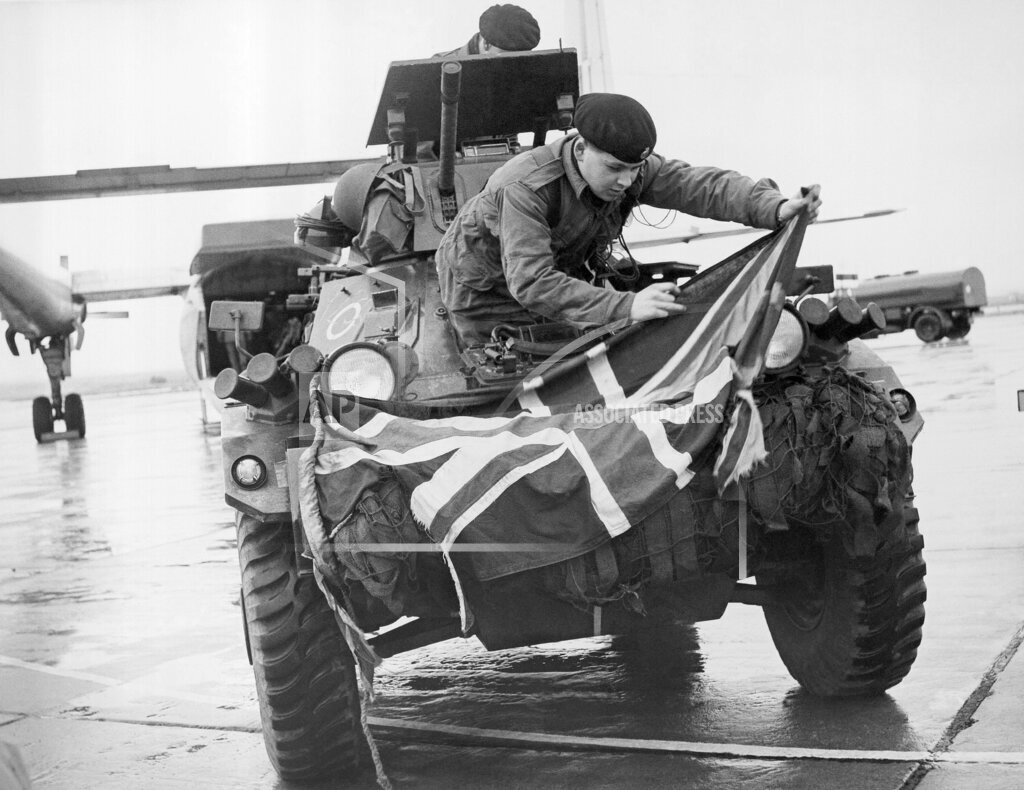
The plan to send a NATO peace force to Cyprus gained some favor in Washington today, but President Johnson was still deferring approval until a series of difficult questions is resolved. Officials reported some movement toward general agreement in the Administration, which could lead to a carefully qualified public endorsement in the next few days of a British proposal for such a force. Britain has suggested that the Cyprus peace force be provided by major powers of the North Atlantic Treaty Organization — the United States, Italy, France and West Germany — along with her own troops. Firm acceptance would first be necessary by the Cyprus negotiators in London. The refusal of President Makarios of Cyprus to endorse the operation remains its principal weakness, in Washington’s view. The Administration does not wish to be involved in a military project opposed by the island’s government.
The Senate began debate on the Administration’s tax bill today with a heavy majority apparently favoring its passage. The measure, approved by the House last September, calls for rate reductions and structural revisions to give taxpayers $11.6 billion in annual relief. The cuts would be fully effective on income in 1965. Well over half of them would apply to income received this year. Administration leaders hope to steer the bill through the Senate by the end of next week, and prospects for success are regarded as good. A conference committee will then seek to adjust differences between House and Senate versions in time for Congress to complete action by the end of February.
The House Rules Committee cleared the civil rights bill today for floor debate. The House will take up the bill tomorrow and vote on it by February 11. The vote to send the bill to the floor was 11 to 4, with all five Republicans and 6 of the 10 Democrats voting for it. Thus, Representative Howard W. Smith, chairman of the Rules Committee, kept the pledge that he made in December when he announced that hearings would begin on January 9 and conclude before the end of the month. The Virginia Democrat, who regards this civil rights bill as the worst — because it goes further — of all those he has steadfastly opposed, said he would not let the hearings drag on simply to obstruct the bill.
When he made this pledge, he was well aware that a majority of the committee would move to take the bill away from him and send it to the floor if Southern witnesses sought to prolong the hearings beyond 10 days. The hearings lasted nine days. The committee voted to allow ten hours for general debate. This was less than had been expected. Mr. Smith explained that the comparatively short time for general debate would allow more for amendments under the five‐minute rule.
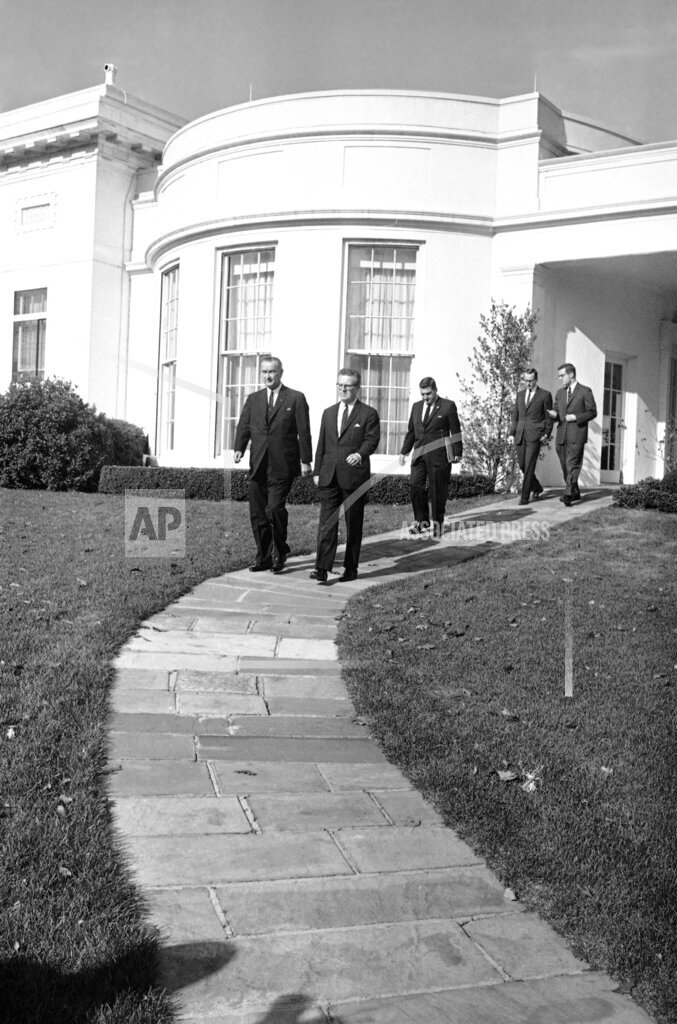
President Johnson sent to Congress today a proposal to increase job opportunities by making some employers pay double for overtime work. He also asked Congress to extend the minimum wage and overtime pay protection of the Fair Labor Standards Act to 735,000 workers not included now, and to extend the act’s overtime provisions to 1,881,000 workers covered by other clauses but exempted from the overtime section. The draft bills are intended to carry out general proposals first made by the President on January 8 in his State of the Union Message. The theory behind providing machinery for increasing the overtime pay penalty is that some employers would rather pay the time‐and‐one‐half penalty now provided by the law than incur the costs in Social Security and fringe benefits that accompany the hiring of more workers.
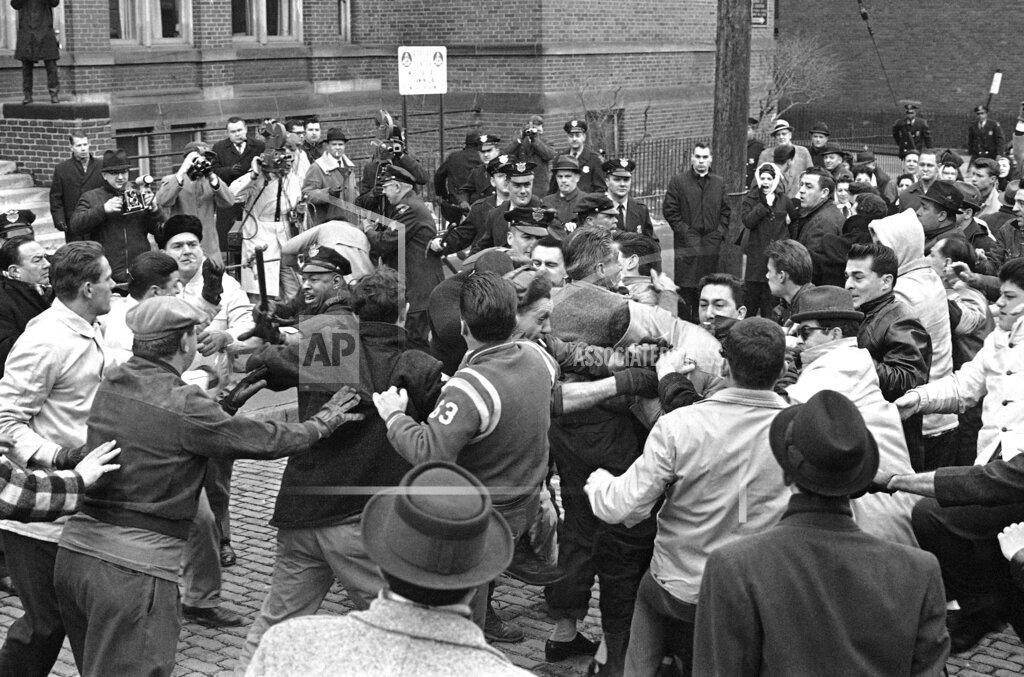
Integrationists called off scheduled picketing at the Murray Hill Public School in Cleveland, Ohio today, averting a threat of massive violence from an unruly crowd of more than 400 white persons, mostly young men. All morning the crowd had milled about on the street in front of the school in the “Little Italy” district on the city’s East Side. The men beat up two Black men and four photographers; hurled eggs, grapefruit and bottles; tore down a police rope barrier, and smashed windows in at least three cars driven by Blacks. Several youths were armed with clubs or baseball bats. “They’d be crazy to picket,” Police Inspector Jerry Rademaker said. He had 46 uniformed men and 26 plainclothes men striving to keep the demonstrators in check. The police had to use their clubs. A 17‐year‐old boy, his face and light topcoat smeared with blood, was taken to a hospital with a head wound he said had been made by a policeman’s stick. Someone else said the youth had been hit by a thrown bottle.
Atlanta’s racial crisis eased today as Blacks decided to limit anti-segregation demonstrations at downtown restaurants. Their leaders approved the temporary policy pending preparation of a counter-proposal to Mayor Ivan Allen’s call for a 30‐day cooling-off period. The release of all but 43 of 154 demonstrators, held in jail since early this week on charges of disturbing the peace, also contributed to the relaxation of tension. Eleven were fined $33 each and given 30‐day suspended sentences. The penalty of another was doubled because it was his second offense. The others each posted $15 collateral. The voluntary restricting of demonstrations was a retreat for the more militant faction headed by the Student Nonviolent Coordinating Committee. It had favored continuing mass street protests, but apparently could not win the support of other groups.
The Atomic Energy Commission disclosed today that “substantial increases” had been made in the explosive power of the thermonuclear warheads of the Polaris, Minuteman and Titan long‐range missiles. The commission also reported that significant progress had been made in developing weapons that are “cleaner,” and thus produce less radioactive fallout, that are more reliable, that are more invulnerable to enemy defenses and that are better protected against unauthorized use. The progress in atomic‐weapons development during the last year was described in unusually full detail in the commission’s annual report to Congress. In effect, the report was the first public evaluation of the results of the atmospheric test series in 1962 — a series ordered with some reluctance by the Kennedy Administration after the Soviet Union had resumed atomic testing. The commission reported that the test series of 36 explosions in the Pacific was “highly successful” in testing the performance of existing weapons and in developing new weapons.
The Soviet Union launched two scientific satellites, Elektron I and Elektron II, from a single rocket, placing each into a different orbit. According to the announcement by the Soviet news agency, TASS, Elektron I ranged from 252 miles to 4,410 miles above the Earth, while Elektron II had an oblong orbit with a perigee of 285 miles and an apogee of 42,352 miles.
Ranger 6 was launched by the United States from Cape Kennedy at 10:49 a.m., on a mission to carry television cameras equipped to take 3,000 detailed photographs of the lunar surface before its expected crash-landing on the Moon. Like the rest of the Ranger probes, it was designed to transmit high-resolution photographs of the lunar terrain during the final minutes of flight until impacting the surface. The spacecraft carried six television vidicon cameras — two wide-angle (channel F, cameras A and B) and four narrow-angle (channel P) — to accomplish these objectives. The cameras were arranged in two separate chains, or channels, each self-contained with separate power supplies, timers, and transmitters so as to afford the greatest reliability and probability of obtaining high-quality television pictures. No other experiments were carried on the spacecraft. Due to a failure of the camera system, no images were returned.
Early on the morning of January 31, the command was sent to fire the midcourse correction engine, which performed flawlessly and set the probe on an impact course with the Sea of Tranquility. On February 2, JPL technicians prepared for the final phase of the mission. Ranger 6 began its descent and trajectory calculations determined that impact would occur close to the intended area. With the probe’s angle suitable for taking images, the order was given to turn on the camera with 13 minutes and 10 seconds until impact. After an initial warm-up phase, the command to power them on was sent. However, no imagery or any sign of camera operation appeared. Two more commands were sent to turn on the camera, but still, nothing happened even though all other systems continued to operate normally. At 01:24 AM, impact with the Moon occurred and telemetry transmission from Ranger 6 ceased. The mission was over and for the 12th time in a row, a U.S. attempt to send a probe to the Moon had malfunctioned. Even worse, it had occurred one week before NASA officials were planning to announce to Congress their projected US$5.3 billion budget for FY 1965, a good deal of it related to crewed and uncrewed lunar missions. NASA attempted to put a positive spin on the mission by noting that, aside from the cameras, Ranger 6 and its Atlas-Agena booster had both functioned “extremely well”.
The orientation of the spacecraft to the surface during descent was correct, but no video signal was received and no camera data obtained. A review board determined the most likely cause of failure was due to an arc-over in the TV power system when it inadvertently turned on for 67 seconds approximately 2 minutes after launch during the period of booster-engine separation.
The United States Senate Subcommittee on Monopolies begins hearings on baseball.
Dow Jones Industrial Average: 783.44 (+0.84).
Born:
Otis Smith, NBA shooting guard and small forward (Denver Nuggets, Golden State Warriors, Orlando Magic), in Jacksonville, Florida.
Curtis Kitchen, NBA power forward (Seattle SuperSonics), in Cape Coral, Florida.
Hipólito Peña, Dominican MLB pitcher (Pittsburgh Pirates, New York Yankees), in Fantino, Dominican Republic.
Leon Seals, NFL defensive end (Buffalo Bills, Philadelphia Eagles), in New Orleans, Louisiana.
Stanley Scott, NFL defensive end (Miami Dolphins), in Tampa, Florida.
Craig Rutledge, NFL defensive back (Los Angeles Rams), in Upland, California.

 History Diaries