The Italians sent ten bombers to raid La Garriaga, in Catalonia, Spain, and bombed the town yesterday and today, although Republican troops are already gone. The raid caused 13 civilian casualties; one local, five refugees and seven children. Bombing La Garriga’s train station means getting north will be much harder for fleeing Republicans. Nationalist troops will occupy La Garriga on 1 February.
Despite unusually bad weather, the Nationalists are said to have advanced several miles today in Northern Catalonia along the roads from Solsona to Berga and from Manresa to Vich. Santa Maria de Olo was captured and both Moya and Llinas del Valles were reported surrounded this evening. While the region below Puigcerda and extending eastward to the coast is being gradually conquered, General Franco’s forces moving up the coast toward the French border have progressed more than thirty miles above Barcelona.
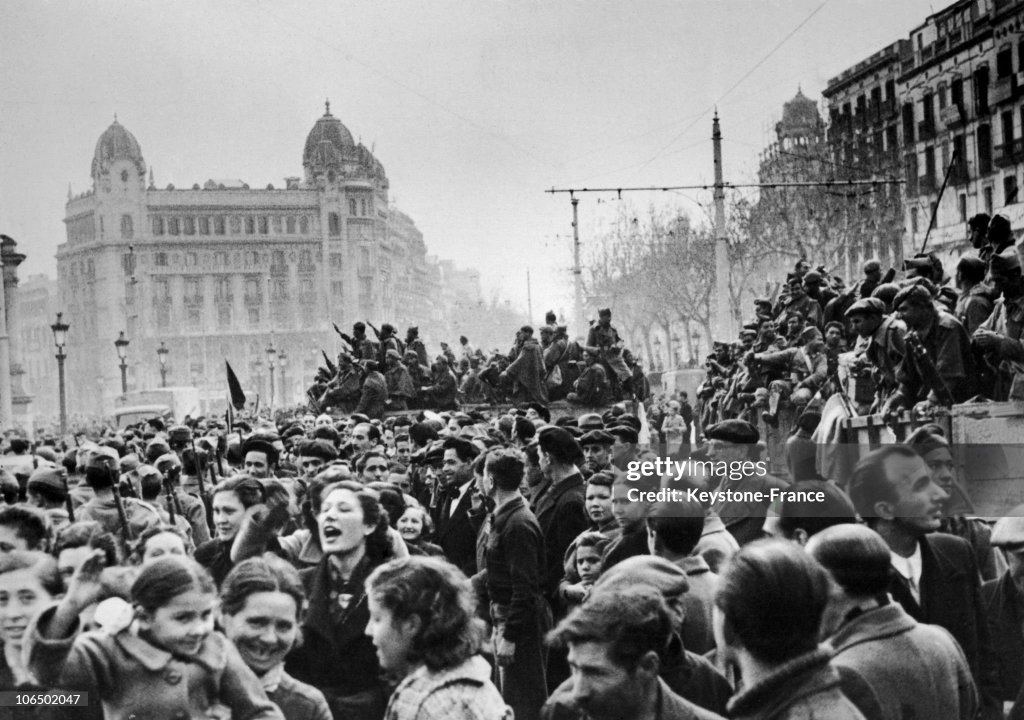
Barcelona returns to normal after its fall in the Spanish Civil War and public services are restored. Although the herculean task of cleaning up Barcelona confronts its newly installed municipal government, the city’s external appearance already shows noticeable improvement. Street cars, electricity, gas, water and all other public services are functioning normally. The newspaper Vanguardia, which under the Republican regime had been confiscated and published as a Socialist organ, already has been. returned to its owners and it has resumed its traditionally conservative policy. Determined efforts are being made to restore normal business activity. The Nationalists have put millions of Burgos pesetas into circulation. They have authorized the exchange of Burgos pesetas for pre-war pesetas at face value. The expansive Plaza Catalunya was packed this morning with thousands eager to attend an open-air mass held there. All hotels are serving meals, but rooms are scarce.
The Insurgent high command reported that its troops pushing northward from Barcelona today had reached the foot of the Sierra de Montseny, thirty miles above the fallen government capital. Military dispatches said the Insurgents had thrust to the mountain base after having captured La Garriga, six miles north of Granollers on the Barcelona-Vich highway. Picking their way through the mountainous country on both sides of the Llobregat and Cardoner Rivers, the Insurgents occupied a number of towns and villages. The rapidly advancing Insurgents said three international brigades, apparently newly organized by the government, had offered some resistance along the Granollers-San Celoni Road but failed to halt the army.
Twelve Spanish Government armed trawlers sought shelter at Port Vendres, France, today. They arrived from Las Rosas Bay, where they had gone in retreat from the Rebels’ northward progress. Early today there were rumors that a Rebel fleet was steaming up the coast from Barcelona, and the trawlers left, presumably in preference to facing an unequal fight against cruisers and destroyers. On their arrival at Port Vendres, French naval authorities boarded them and dismounted vital gun parts. The trawlers are now anchored between two French destroyers. News from the Loyalist authorities in Catalonia continues to be scarce, but it is learned through diplomatic channels that there was a Cabinet meeting in Figueras this afternoon at which the government decided to establish or attempt to establish a last defense line. It would run along the Ter River south of Rosas Bay to Gerona and above Vich to the northwest.
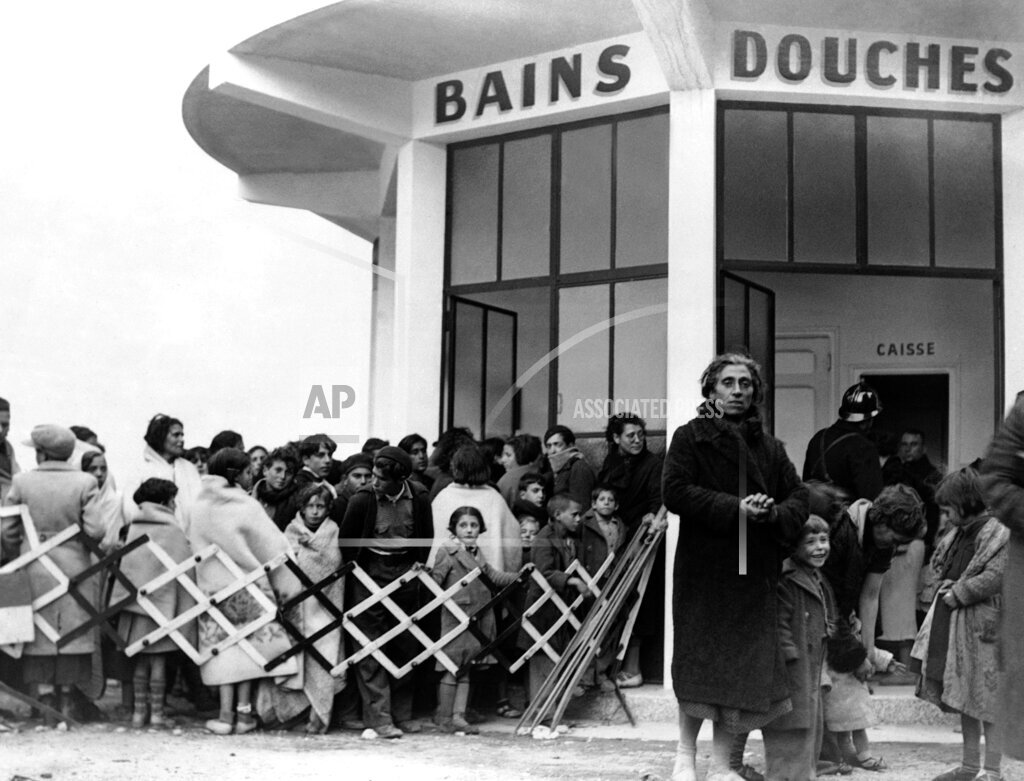
The French Government rushed additional troops to the Pyrenees border today to enforce its order to turn back all Spanish Government soldiers among the flood of refugees streaming into France. French and Spanish Government authorities appeared to be winning a slow battle in their frantic fight to restore some semblance of order in the border zone, where 40,000 refugees were reported to have fled into France since the surrender of Barcelona Wednesday. Of these, French officials said at least 10,000 were soldiers from the Government army who joined the great mass of bewildered, destitute civilians. The number of French troops on the frontier endeavoring to hold the tide of defeated Spanish soldiers was estimated at 7,000, of whom 3,000 were brought up today. The toughest problem faced by the French troops was what to do with 1,000 government militiamen who surrendered their arms in mountain passes near Prats de Mollo but refused bluntly to return to Spain, even at gunpoint.
At Perthus and Cerbere, Mobile Guards turned back a few hundred militiamen, but the same men trudged stolidly into the mountains and turned up later at other points. At most places the fighting men received twenty-four-hour permits, but thousands of the passes expired and the men still remained in France. The Paris order to send them back into Spain stood, but could not be enforced. Spanish carabineros at their side of the Perthus Pass accomplished the herculean task of clearing one road lane for the movement of foodstuffs into Spain. An estimated 15,000 to 25,000 refugees entered France today alone, and the end of the flood was not in sight. Refugees reported Insurgent planes machine-gunned one main road leading to the border. They said many women and children were killed. Unconfirmed reports on the border said panic in Government Spain’s shrinking area of Catalonia was spreading to government officials. Foreign Minister Julio Alvirez del Vayo was said to have commanded Government troops to guard the frontier to prevent public officials from trying to flee into France.
Production of the French Morane-Saulnier 406 single-seat fighter begins. With an 806 hp Hispano-Suiza 12 Y 12-cylinder V liquid-cooled engine it has a top speed of 302 mph and carries 1x20mm gun and 2 machine guns.
In an atmosphere scarcely less tense than on that historic Sunday, Feb. 20 of last year, when Chancellor Adolf Hitler proclaimed before the Reichstag the right of self-determination of 10,000,000 Germans living in two States adjacent to Germany, the Chancellor will appear before the first Great German Reichstag tomorrow night to map his program for Year VII of the National Socialist regime. Although only he himself knows the full contents of his speech — and at that it is subject to alteration up to the very moment of its delivery — advance information put out in semi-official quarters is that it will be neither sensational nor violent and will disappoint but also comfort the world. All such terms are relative, however, depending on the expectations, or rather fears, entertained. In this connection it will be recalled that last February’s speech was also found to be less sensational than had been expected, because Herr Hitler did not then and there proclaim the imminent absorption of Austria and the Sudetenland, and only a few fully understood the full implications of the little and oft-omitted word “two” in reference to the States for whose Germans he demanded “self-determination.”
Tomorrow’s speech will be especially interesting because a vague feeling of uncertainty in German quarters is caused by the fact that as far as is known Premier Benito Mussolini has up to now refused to reveal his definite objectives even to his axis partner, thus preventing the formulation of a joint program. This is also adduced as an explanation of why the rumor that Count Galeazzo Ciano, Italian Foreign Minister, would attend the Reichstag session is not going to materialize. For this reason, it is held wholly possible that Herr Hitler will not at this moment commit himself too far.
Britain predicts world crisis, but no war.
Sir Stafford Cripps appeals his ouster from the British Labor Party.
Arab delegates reach London for a conference on Palestine.
Austrian offices close, and its ministries are distributed throughout the Reich.
Egypt plans to tear down current Cairo bazaars and rebuild.
Far-reaching implications of the defeat of President Roosevelt on the relief appropriation in both houses of Congress occupied the attention of official Washington today. That the President has lost control of Congress, despite its overwhelming Democratic majority in both branches, was asserted by the Republicans and conservative Democrats and only feebly denied by the New Dealers. Among the politicians the incident is interpreted as an augury of still more signal reverses for the President yet to come. Not only will the President, it is now conceived in the light of his repudiation on the relief legislation, be unable to obtain acceptance of the remaining social and economic innovation on his program, but will be compelled to acquiesce in a radical modification of New Deal institutions.
Hard upon this defeat suffered by the President came the disclosure today that he has failed in his effort to snuff out the investigation of un-American activities by the Dies committee of the House which brought Secretary of Labor Perkins, Attorney General Murphy, then governor of Michigan, and other New Dealers under fire for their radical leanings. Mr. Roosevelt undertook to put an end to the Dies committee by causing the House to refuse it a new appropriation, its previous appropriation of $25,000 having been exhausted. Today it transpired that the House leaders have agreed on an appropriation of $100,000 to continue the life of the Dies committee another year. There are numerous other pieces of evidence of the President’s loss of control of congress. When Representative J. Parnell Thomas (R-New Jersey) moved the impeachment of Secretary Perkins last week the Democratic leaders in the House thought at first they would squelch the proceedings with a motion to table.
Gangster George Weinberg, who was set to testify against Tammany leader James Hines, commits suicide. Weinberg, on whom District Attorney Thomas E. Dewey placed much of his hope of convicting James J. “Jimmy” Hines, Tammany district leader, of conspiracy to protect policy racketeers in New York, outwitted Dewey’s guards and shot himself to death today. Weinberg had been in Dewey’s protective custody since last September, when the first trial of Hines on the conspiracy charge was thrown out of court on a technicality by Supreme Court Justice Ferdinand Pecora, who was politically allied with Tammany. Dewey had planned to put Weinberg on the witness stand this week. Weinberg killed himself in a White Planes hideout, where he and two other prosecution witnesses in the Hines case were under guard of six of Dewey’s detectives. The other two witnesses are Richard “Dixie” Davis, former attorney for Arthur (Dutch Schultz) Flegenheimer, organizer of the policy ring, and Harry Schoenhaus, Schultz’s bookkeeper. The three were co-defendants with Hines. They had pleaded guilty and turned state’s evidence.
Weinberg left the dinner table in the hideout, took a detective’s revolver from a secret pocket of his overcoat which was hanging in a hallway, went to a second-floor bathroom, stood before a mirror, and fired one shot into his temple. He was taken to a hospital a few minutes after the shooting and died an hour and a half later without regaining consciousness. The suicide of Weinberg today was a blow to Dewey’s case against Hines which went to trial again last Monday. The prosecutor said tonight, however, that the testimony given by Weinberg in three-and-a-half days on the stand in the first trial would be read into the record of the present trial. He remarked that it would not be so effective as having his witness in court. Weinberg’s suicide was attributed by Dewey to worry over his physical condition, his future and his wife and two children. Weinberg’s friends in the underworld said he killed himself because he did not want to testify against Hines again and because he knew his life was in danger whether he went free for helping Dewey or to prison under a light sentence.
Charges that Senior Judge Martin T. Manton of the United States Circuit Court of Appeals, or corporations owned or controlled by him, received more than $400,000 from individuals or concerns acting for parties interested in matters handled by that court were sent by District Attorney Thomas E. Dewey yesterday to Representative Hatton W. Sumners of Texas, chairman of the House Judiciary Committee. This committee normally handles the initial stages of impeachment proceedings against Federal judges. “If, upon the foregoing facts, the House of Representatives should assume jurisdiction of this matter,” Mr. Dewey wrote, “I am prepared to present evidence before your committee in support thereof.” The House Judiciary Committee, after investigating charges against a federal judge, reports to the House, with recommendations. If the House adopts a recommendation for an impeachment, formal charges are sent to the Senate, which tries the case and renders a verdict. An impeachment verdict requires a two-thirds vote of the Senate.
Boston University stresses the value of dance as exercise.
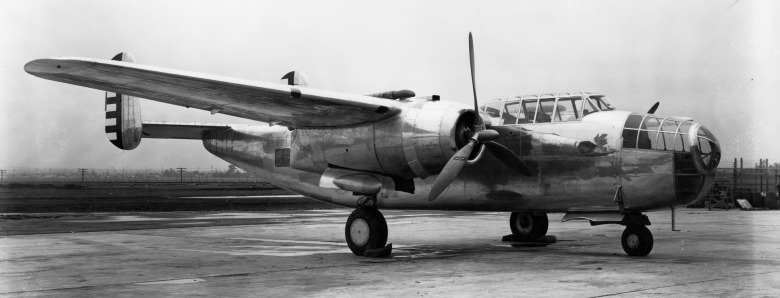
The NA-40 prototype aircraft took its first flight; it was judged underpowered and unstable. The aircraft will be redesigned and eventually emerge as the B-25 Mitchell medium bomber. In March 1939, North American delivered the substantially redesigned and improved NA-40 (as NA-40B) to the United States Army Air Corps for evaluation. It was in competition with other manufacturers’ designs produced – the Bell had not been built – Douglas 7B, Stearman XA-21, and the Martin Model 167F but failed to win orders. The aircraft was originally intended to be an attack bomber for export to the United Kingdom and France, both of which had a pressing requirement for such aircraft in the early stages of World War II.
Despite the loss of the 7B in an accident injuring a French observer in January, the French had ordered the 7B and a revised version (as the DB-7). Unfortunately, the NA-40B was destroyed in a crash on 11 April 1939 while undergoing testing. Although the crash was not considered due to a fault with the aircraft design, the U.S. Army ordered the DB-7 as the A-20 Havoc. The Air Corps issued a specification for a medium bomber in March 1939 that was capable of carrying a payload of 2,400 lb (1,100 kg) over 1,200 miles (1,900 km) at 300 mph (480 km/h). NAA used the NA-40B design to develop the NA-62, which competed for the medium bomber contract. No YB-25 was available for prototype service tests. In September 1939, the Air Corps ordered the NA-62 into production as the B-25, along with the other new Air Corps medium bomber, the Martin B-26 Marauder, “off the drawing board”
Glenn Cunningham wins the Boston mile race for the fifth year.
In the Indian Congressional elections, radical leader Subhas Chandra Bose defeats Gandhi’s candidate and becomes president for a second term. Congress delegates vote against Bose’s proposal of independence from Britain in six months and endorse Gandhi’s nonviolence program. Because of lack of support, Bose will resign on 29 April.
Japanese military authorities reported today their forces killed 1,190 Chinese guerrillas in sixty-five engagements in the Hankow area the first ten days of this month and took twenty-four prisoners. Japanese losses were fixed at forty-one killed and ninety-two wounded.
The Japanese-owned paper Mainichi reported today that the Chinese Reformed government of Nanking soon would issue regulations prohibiting the export of gold, silver, and copper without special permits. The newspaper said an order would also be issued forbidding “groundless rumors concerning central China finances.”
Born:
Germaine Greer, Australian feminist and author (“Female Eunuch”), in Melbourne, Victoria, Australia.
Bobby Bolin, MLB pitcher (San Francisco Giants, Milwaukee Brewers, Boston Red Sox), in Hickory Grove, South Carolina (d. 2023).
 History Diaries