The siege by the Israeli Army of the city of Suez, in Egypt, ended at noon local time. Israeli troops withdrew, clearing the way for the 20,000 troops of the Egyptian 3rd Army to return home. The Egyptian troops had been trapped since October behind enemy lines on the east bank of the Suez Canal after having retaken part of the Sinai Peninsula early in the Yom Kippur War. The Israeli army lifted its siege of Suez city and evacuated a large surrounding area, handing it over to United Nations troops. Five hours later the area was transferred back to Egyptian armed forces who lost it. last October. The Israelis thus freed the supply lines of the Egyptian Third Army on the eastern bank of the Suez Canal.
Three months after the October war, the Palestinian Arabs on the West Bank of the Jordan River and in the Gaza Strip speak more openly against Israeli occupation than at any time since they were conquered six and a half years ago. Although Palestinians voice more hope than before about an end to occupation, they show no greater will to resist Israel.
The Soviet Union conducted its first long‐range tests of a new intercontinental missile with multiple warheads last Friday and Saturday, the Defense Department announced today. The chief Pentagon spokesman Jerry W. Friedhelm, described the test firings of the SS‐19, an intercontinental ballistic missile comparable in size to the United States Air Force’s Minuteman, as a significant milestone in the Soviet program to develop multiple warheads that can be directed to separate targets. These warheads are known as MIRV’s, for multiple independently targetable re‐entry vehicles. But it remains the assessment of the Defense Department, Mr. Friedheim said, that the Soviet Union will not have a missile force with such warheads in operation before 1976.
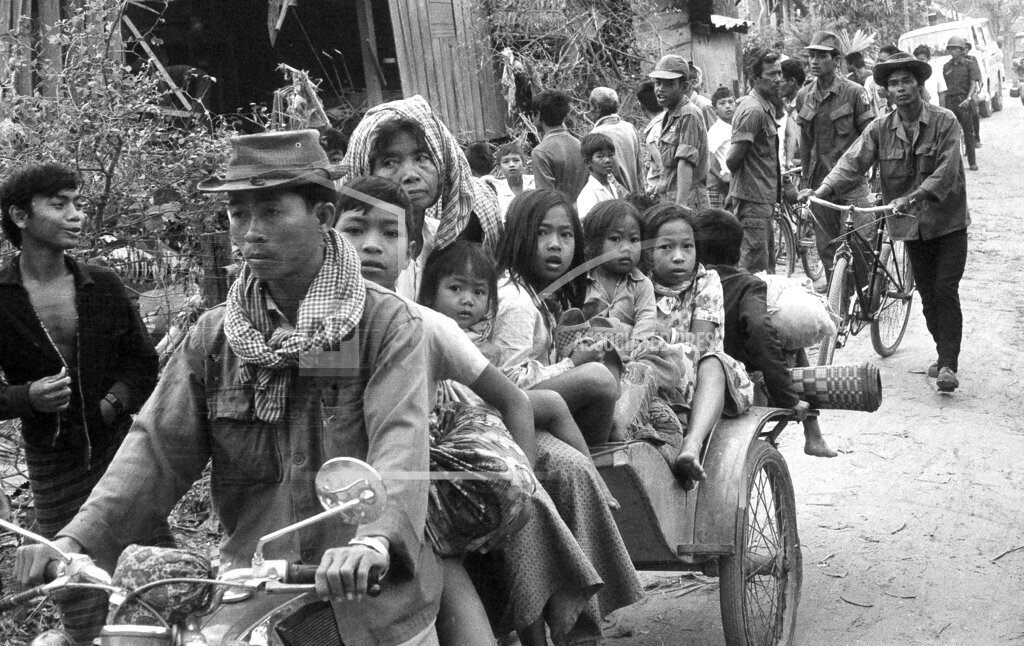
Insurgent gunners bombarded Phnom Penh for the fourth day today, hitting the capital, a refugee camp and an area near Pochentong airport with artillery, rockets and recoilless‐rifle fire. Five persons were reported killed and 28 wounded, bringing the casualties reported in the four days of attacks to 89 killed and 220 wounded. Meanwhile, a government infantry column supported by 54 armored personnel carriers reportedly advanced 700 yards in heavy fighting against rebel positions south of Phnom Penh. The soldiers were trying to push back guerrilla artillery units firing on the city. Beginning at dawn today the Communist‐led guerrillas fired 20 artillery rounds into the crowded southwest section of Phnom Penh.
On the west side of the city, an artillery attack on a refugee camp reportedly killed two persons. A child was killed by recoilless‐rifle fire on the western fringe of Phnom Penh, and a man was killed by a rocket that exploded near the Pochentong market. Government troops trying to advance against two rebel dugouts six miles south of Phnom Penh ran into heavy resistance. Reports from the Field said that 8 Government soldiers were killed, 15 wounded and 3 were missing. Premier Long Boret, speaking for President Lon Nol, appealed to residents of Phnom Penh not to leave their homes to escape the artillery attacks. “Moving around during the artillery attacks only results in more casualties and provides the enemy a chance to infiltrate the city,” he said. Hundreds have moved in with relatives in the central or northern sections of the city in the last four days. The Premier denounced looters of evacuated homes. “The proper authorities have been ordered to apprehend these people,” he said.
Indonesia’s President Suharto took complete control of the Asian nation’s internal security agency, ASPRI, dismissing the four Indonesian Army generals who operated the agency. Indonesia’s President Suharto disbanded his personal corps of four generals and took over the nation’s main internal security body in what was seen as an attempt to strengthen his personal power. Dissolving the post of special assistants (ASPRI) apparently was designed to meet growing criticism of the powerful aides gathered around Suharto. ASPRI men were one of the prime targets of recent student demonstrations in Jakarta during the visit by Japanese Prime Minister Kakuei Tanaka.
The 1974 Federal Territory of Kuala Lumpur Agreement was signed, separating the Malaysian national capital, Kuala Lumpur, from the jurisdiction of the state of Selangor and placing the capital under the jurisdiction of the national government as a Federal Territory. The agreement was signed by the head of state of Malaysia, the Yang di-Pertuan Agong Tuanku Abdul Halim Muadzam Shah and by the Sultan of Selangor, Salahuddin Abdul Aziz ibni Almarhum.
Cyprus President Archbishop Makarios granted amnesty to the followers of General George Grivas in honor of his bitter enemy and former comrade-in-arms who directed a guerrilla struggle to unite Cyprus with Greece. General Grivas died Sunday of a heart attack at the age of 75. The government declared three days of mourning along with the amnesty, which included freedom for about 100 jailed guerrillas. The rebels promptly announced a cease-fire.
British police charged an unemployed man, John James O’Brien, 23, with the bludgeon murder of royal biographer James Pope-Hennessy. The 57-year-old writer-official biographer of the late Queen Mary and chronicler of the Victorian and Edwardian periods of England-died in a hospital Friday after being attacked in his West London apartment. He had been working on a biography of the late Sir Noel Coward.
Roman grocers staged a one-day shutdown, complaining that the government’s rigid price controls eat up their profits. About 14,000 small neighborhood groceries closed but about 100 supermarkets and numerous food stands stayed open. The grocers say that because of government controls some wholesale prices they must pay are higher than prices they are allowed to charge their customers.
U.S. Air Force Sergeant Larry D. Pruitt, 25, of Birmingham, Alabama, was sentenced by a court-martial in England to four months’ hard labor, fined $600 and given a bad-conduct discharge for disobeying orders to cut his hair. A jury of four officers at the U.S. air base in Alconbury, England, found him guilty of eight counts of disobeying orders and violating regulations because of his long hair. Pruitt, who plans to appeal, had pleaded innocent to the charges and his lawyer argued that the haircut rules violated the First Amendment of the Constitution.
The Indian army took complete control of Ahmedabad, capital of the western state of Gujarat, after 18 days of food riots left 42 persons dead. Troops moved into the city of nearly 2 million amid continued looting, burning and other violence over food shortages and rising prices, enforcing an indefinite curfew. The political affairs committee of the federal cabinet in New Delhi discussed the situation and there was speculation that direct rule from the capital might be imposed.
Bolivia’s President Hugo Banzer, claiming that an international conspiracy threatened to topple his government and replace it with a leftist regime, placed Bolivia under a state of siege. President Banzer placed the South American nation under a state of siege after a group of 12,000 peasants, some of whom were armed, had blocked roads near Cochabamba between the heavily populated cities of the north and the farmlands of the south and the east. The peasants had been protesting the doubling of the costs of basic staple foods. The rebellion was suppressed two days later and the nation’s highways were reopened.
A bus crash near the Peruvian town of Jauja drowned 35 people after the vehicle collided with another vehicle and fell into the Mantaro River. Only six people of the 41 on board survived.
The United States’ foreign trade showed a record surplus of exports over imports in December and completed 1973 with a large and unexpected surplus of nearly $1.7-billion, the Commerce Department reported, bringing the trade balance up from a record deficit of almost $6.4-billion in 1972. The main reason for the reversal, according to economists, was the sizable devaluation of the dollar’s exchange rate against nearly all the other leading currencies that began in late 1971 and reached its culmination in the summer of 1973.
A Soviet trade official offered to sell wheat to the United States to help replenish grain. stocks that have been diminished by heavy exports over the last two years. Vladimir S. Alkhimov, a visiting Deputy Minister of Foreign Trade, said there would be “no problem” after last year’s bumper Soviet grain crop to help tide Americans over until the 1974 harvest.
Former Nixon campaign scheduling director Herbert Porter pleaded guilty to being involved in the Watergate cover-up. Prosecutor Richard Ben-Veniste revealed that Porter lied to the FBI during the early stages of the Watergate investigation. Judge William Bryant will review Porter’s background further before deciding on a sentence.
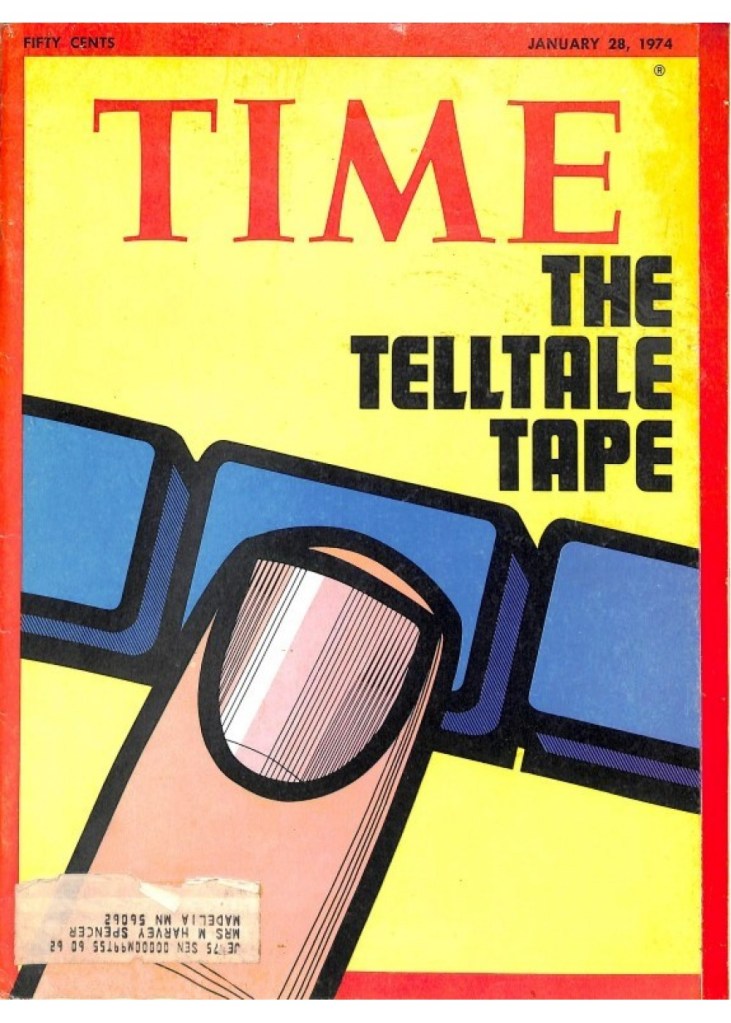
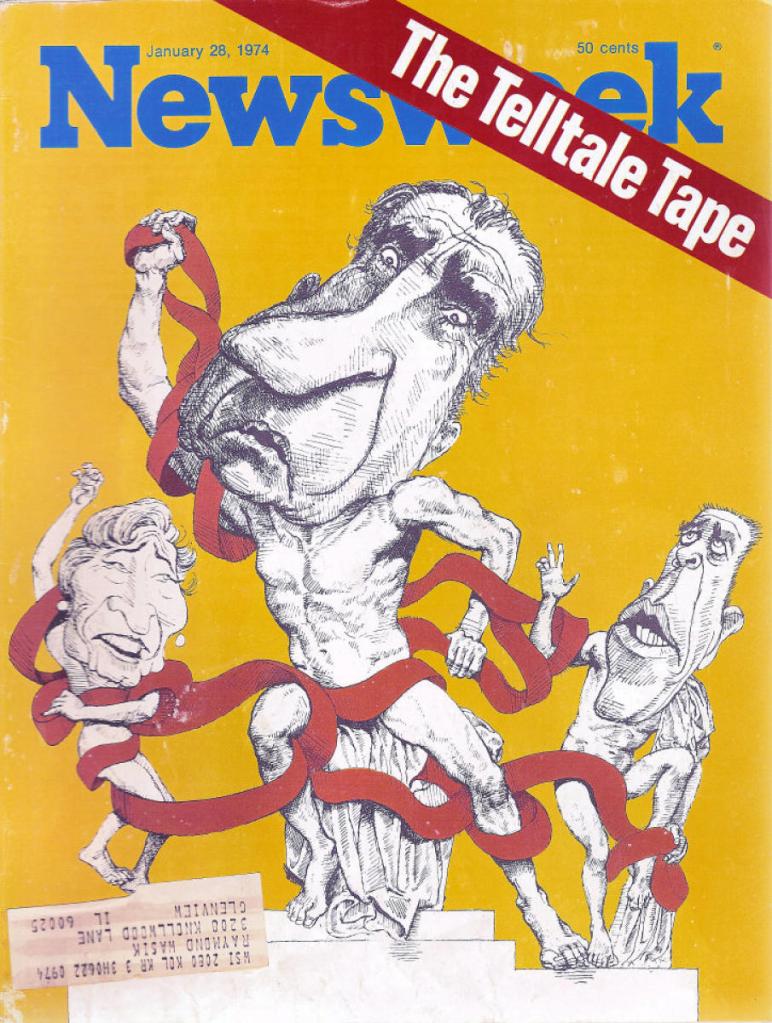
White House aide Stephen Bull appeared before the grand jury which is investigating the 18-minute tape erasure. Bull testified that he has no idea how the tape was erased and insisted that he’s not the one responsible for the erasures. Questioned about the internal White House probe into the 18-minute erasure, Bull stated that no such investigation was in progress at the White House, to his knowledge.
Senate Watergate Committee chairman Sam Ervin postponed his committee’s hearings at the request of the U.S. attorney in New York. The trial of Maurice Stans and John Mitchell could be prejudiced by the hearings. Senator Lowell Weicker said that he believes Watergate hearings are unlikely to continue in the future, but chief counsel Sam Dash insisted that the investigation is proceeding normally and hearings will once again take place. The committee has encountered difficulty enforcing subpoenas, including one for President Nixon’s friend, Bebe Rebozo.
Republican members of the House Judiciary Committee have reached informal agreement that President Nixon could not be impeached for criminal acts of subordinates without evidence of his personal knowledge or direction. The consensus was reported by Representative Edward Hutchinson of Michigan, the ranking Republican on the committee, after an early morning caucus with Albert E. Jenner, minority counsel to the impeachment staff.
A former White House official said that White House speechwriters and political aides listened to the Watergate tapes or read transcripts from them. Speech writer John Andrews said that he quit his job because of the Watergate policy in the White House. Assistant press secretary Gerald Warren refused to comment about who had access to the tapes.
Lawyer Frank DeMarco conceded that the deed which is on file pertaining to President Nixon’s gift of his vice-presidential papers to the National Archive is a copy, but DeMarco insisted that the date on the deed is unimportant.
President Nixon is at Camp David, Maryland, working on his state of the union speech. Today at the White House, Mrs. Nixon entertained the wives of religious broadcasters at a luncheon, and spoke with a CBS reporter about the President. Mrs. Nixon said that the President sleeps well, but he doesn’t sleep long hours. Questioned about other rumors regarding President Nixon’s restless nights, she stated that her husband is in good health.
William E. Simon, the Federal energy administrator, told the Senate that his office would act this week to give homeowners in the Northeast more equitable treatment in the prices they pay for heating oil. At the same time, Mike Mansfield, the Senate majority leader, joined six other Senators in a widening movement to repeal the newly enacted shift to year-round daylight saving time.
An aircraft flying to Owatonna, Minnesota, for an inspection of law enforcement facilities crashed, killing all four on board. The Chief of Police of Thief River Falls was killed, along with two city council members and the pilot.
Tornadoes and wind storms swept across the South, damaging scores of homes, mobile homes, factories and stores. At least nine persons were injured but no deaths were reported. The storms broke out in northeast Texas and moved eastward across Louisiana, Arkansas, Mississippi, Tennessee and Alabama. Heavy rains accompanied the winds and a flash flood watch was posted in parts of Mississippi and Alabama.
Crash tests show that 1974 model cars in general are no more damage resistant than last year’s models. And in some cases, they are worse, the Insurance Institute for Highway Safety said. The institute has tested seven U.S. models for damage in front, rear and side crashes at various low speeds since 1969. The poorest performer this year was the Plymouth Fury, which suffered $119.75 damage in the 5-m.p.h. front-into-barrier test. The Fury suffered the greatest damage in other barrier crash tests also. Cars damaged least were the AMC Gremlin and the Chevrolet Impala, with no damage at all in either the front or rear crashes at 5 m.p.h.
The Hall of Fame Special Veterans Committee selects Sam Thompson, Jim Bottomley, and umpire Jocko Conlan.
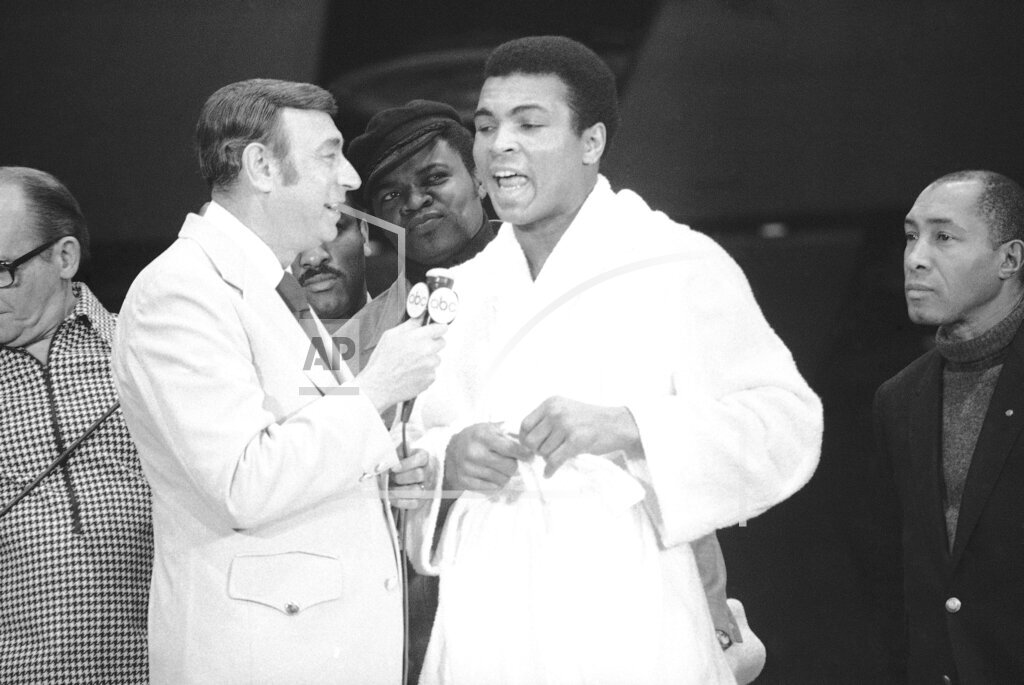
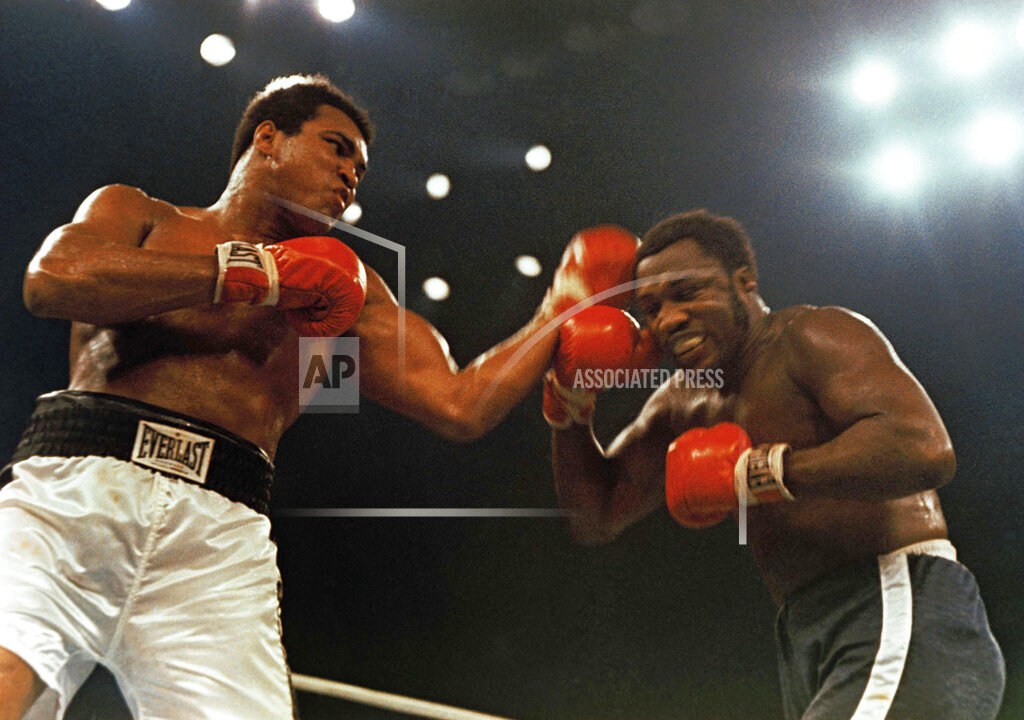
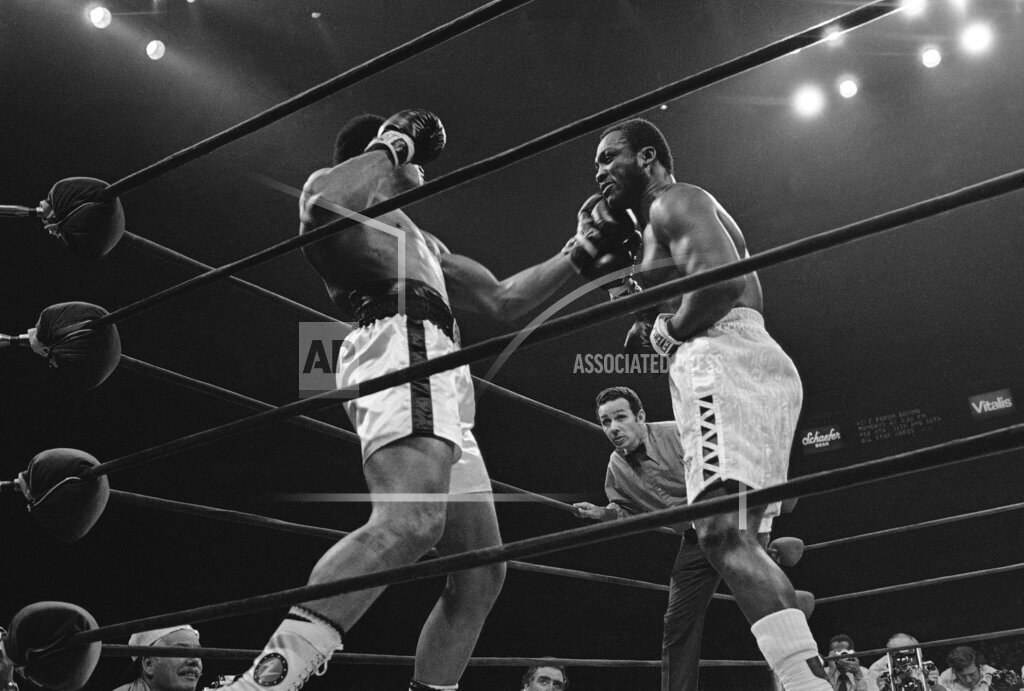
The second of the three Muhammad Ali–Joe Frazier bouts took place at Madison Square Garden in New York City on Monday, January 28, 1974. Ali, a slight favorite to win, was named the victor by a unanimous decision in 12 rounds. Ali was aggressive right from the start. At the end of round two, Frazier, a notoriously slow starter in fights, was hurt by an Ali right hand and was in significant trouble. Referee Tony Perez stepped in between the two fighters having mistakenly thought he heard the bell. The interruption allowed Frazier precious seconds to recover and he was able to finish the round on his feet when the action resumed. Ali employed markedly different tactics from the first fight. Ali came up with a new tactic, a half-hook half-upper cut coming from both sides. These punches resulted in a higher percentage of punches landed versus straight punches that frequently missed Frazier’s bobbing head. As in the first fight, Ali also didn’t allow Frazier to work inside, tying up the shorter fighter by holding him behind the neck with his left hand while keeping Frazier’s vaunted left tied up with the other. This pattern of Ali punching in flurries followed by clinching dominated most of the fight. Ali won a close but unanimous decision.
Dow Jones Industrial Average: 853.01 (-6.38, -0.74%).
Born:
Magglio Ordóñez, Venezuelan MLB rightfielder (2007 American League batting champion; All-Star, 1999-2001, 2003, 2006, 2007; Chicago White Sox, Detroit Tigers), in Caracas, Venezuela.
Jermaine Dye, MLB right fielder (World Series Champions-White Sox (MVP), 2005; All-Star, 2000, 2006; Atlanta Braves, Kansas City Royals, Oakland A’s, Chicago White Sox), in Oakland, California.
Óscar Henríquez, Venezuelan MLB pitcher (Houston Astros, Florida Marlins, Detroit Tigers), in La Guaira, Venezuela.
Tony Delk, NBA point guard and shooting guard (Charlotte Hornets, Golden State Warriors, Sacramento Kings, Phoenix Suns, Boston Celtics, Dallas Mavericks, Atlanta Hawks, Detroit Pistons), in Covington, Kentucky.
Zack Bronson, NFL safety (San Francisco 49ers), in Jasper, Texas.
Derrick Mayes, NFL wide receiver (Green Bay Packers, Seattle Seahawks), in Indianapolis, Indiana.
Kari Traa, Norwegian freestyle skier (2002 Olympic gold medalist in the mogul skiing event), in Voss, Norway.
Davana Medina, American figure competitor (IFBB champion 2003, 2004 and 2005), in Ponce, Puerto Rico.
Ramsey Nasr, Dutch poet and actor; in Rotterdam, Netherlands.
Died:
Ed Allen, 76, American jazz trumpeter and cornetist.
Dillon Anderson, 67, American lawyer and former U.S. National Security Advisor to President Dwight Eisenhower, 1955 to 1956
Oswald Cornwallis, 79, English Royal Navy Captain and first-class cricketer.
 History Diaries