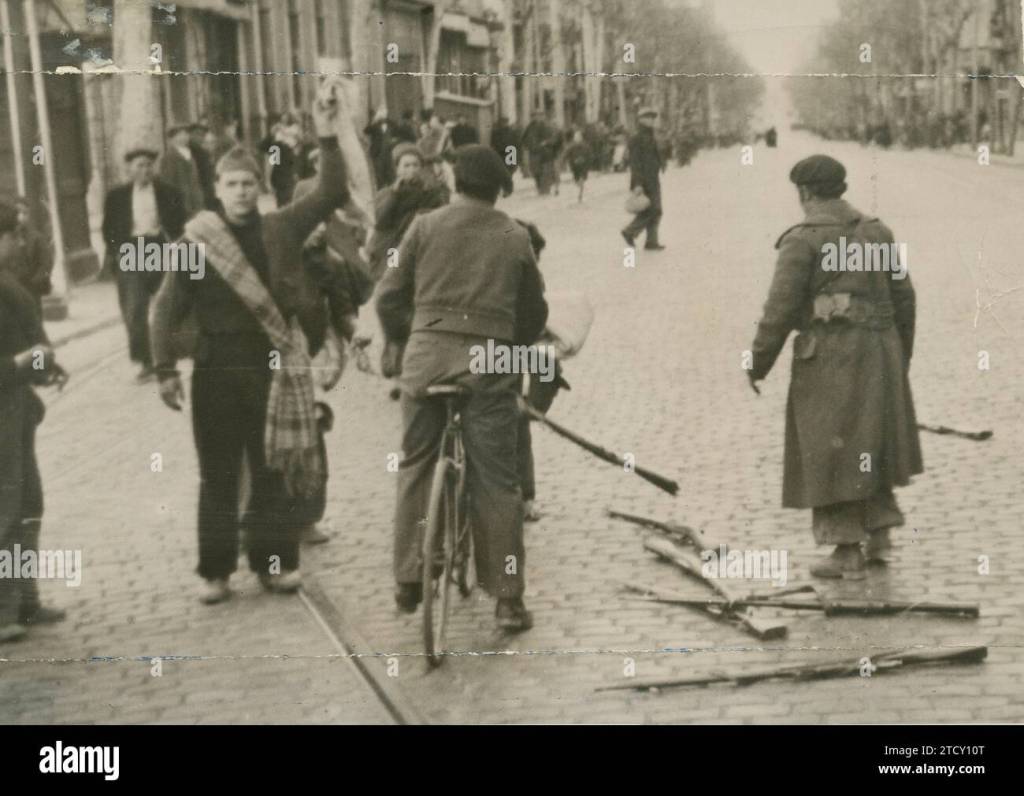
Industrial towns Badalona and Sabadell fall to Spanish rebels without a fight. Sabadell and Badalona, large industrial towns north of Barcelona, were. occupied today by the Nationalists (Insurgents) almost without the firing of a shot. Generalissimo Francisco Franco’s advance is now simply a matter of occupying abandoned towns. All resistance appears to have collapsed. General Juan Yagüe’s Moroccan troops continued their advance this afternoon, occupying Nataro, fifteen miles along the coast north of Barcelona. General José Solchaga’s Navarrese are now outside Caldas de Montbuy, fifteen miles directly north of Barcelona. Prisoners taken are reported to total 5,000, with eighty pieces of artillery, 2,000 machine guns, 15,000,000 liters of gasoline and medical supplies worth $80,000 captured. The Republican retreat is believed to be developing into a complete rout. General Franco is now moving the bulk of his troops northward out of Barcelona, which is now a safe rear guard for his quickly advancing front line.
Throughout last night minor shooting continued in outlying suburbs, but this morning apparently not a single sniper was left in Barcelona. Small quick-firing guns and machine guns were placed on street corners. Orders were given to open all shutters to admit a maximum of light to the streets. The electric supply barely functioned, and the dimly lit city presented an uncanny spectacle as civilians and soldiers thronged the streets, dancing along and winding in and out among sleeping troops and mules.
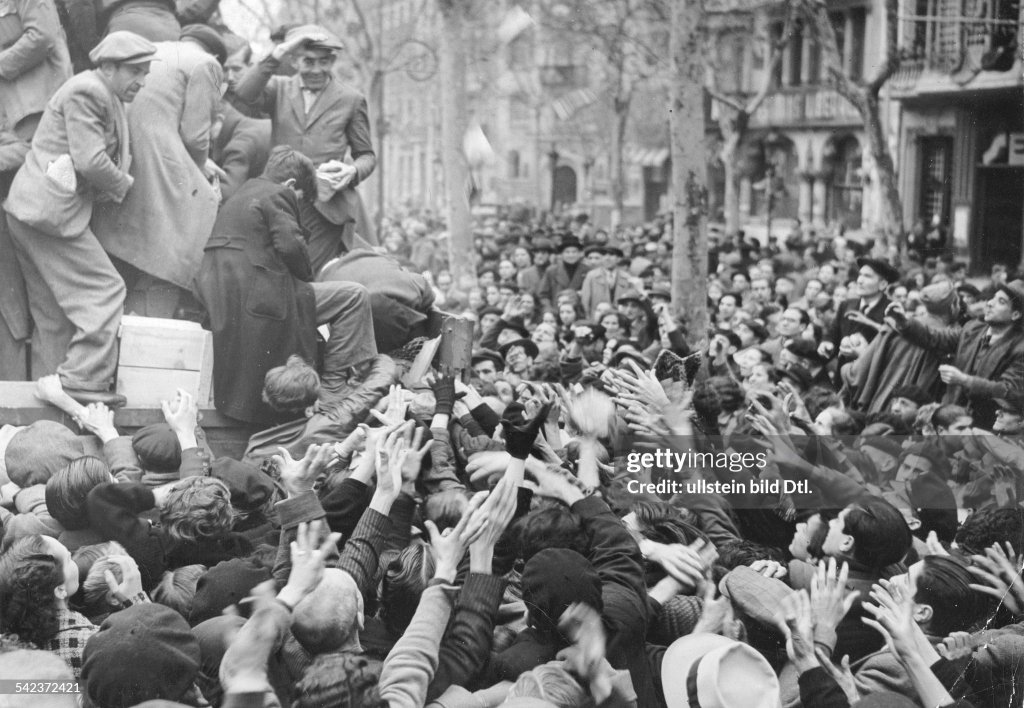
Food lines in Barcelona are nearly one mile long. Thousands of Barcelona’s war-weary and hungry population feasted tonight on bread and milk as Generalissimo Francisco Franco’s rebel trucks brought food to replenish the city’s empty cupboards. A huge task faced the Insurgent conquerors of desolate Barcelona. They must feed an estimated 1,500,000 persons who have been living on meager rations. Crowds surged against the Iron doors of supply centers this noon while workers rationed out bread, condensed milk, and some meat. Lines of men, women, and children waited with pans, plates, and sacks to be handed what, for many, was the first substantial meal in weeks.
Some of the lines were seven blocks long. They were policed by members of a special insurgent corps of 18,000 men which swung into action to restore discipline. The blue uniformed corps of women workers, Franco’s Auxilio Social, were distributing the food twice daily, first between noon and 1 p. m. and again between 6 and 7 p. m. Rebels asserted the food problem was somewhat simplified by crowds which broke open stores of supplies hidden by the retreating government. Enough was found, they said, to feed several thousand persons. Insurgent officers said the crowds learned of the cache a few hours before the city was occupied and seized it.
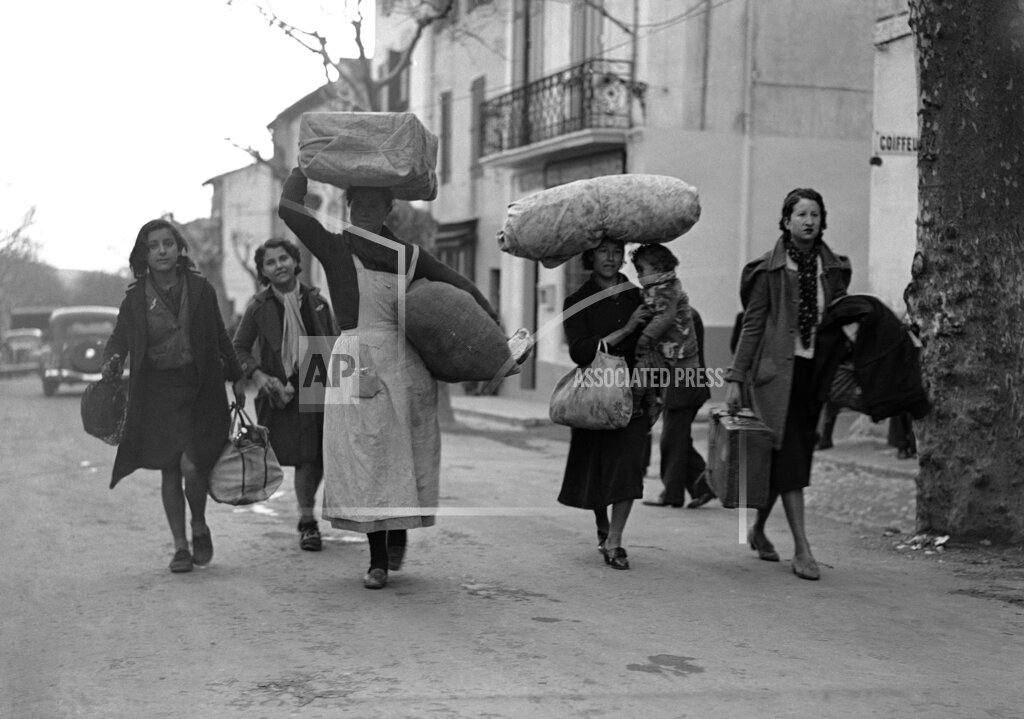
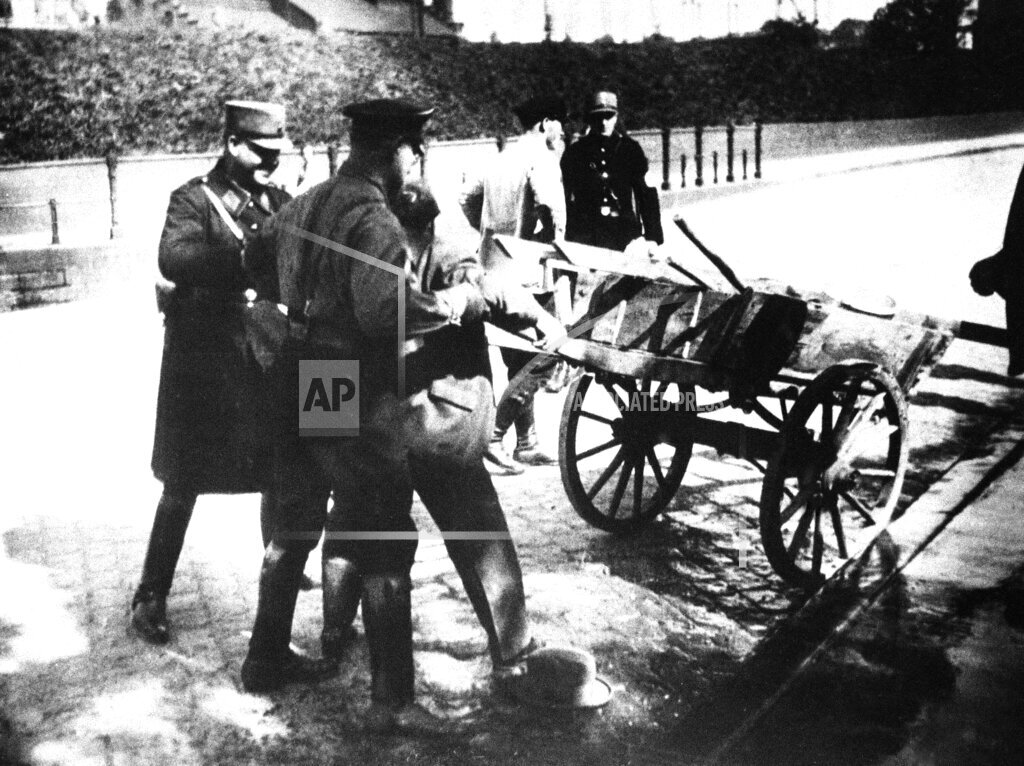
Premier Negrin was found at Figueras, where he was trying to overcome chaotic conditions. It was said the Loyalist army was re-forming on a new line, but its ability to continue fighting depended on material from outside. It was believed at least 250,000 refugees were trying to reach the French frontier.
A special correspondent who penetrated the Loyalist corner of Catalonia told of vast disorganization, making defense almost impossible, and of starvation in the southern part of the Republic, indicating the war was near its end.
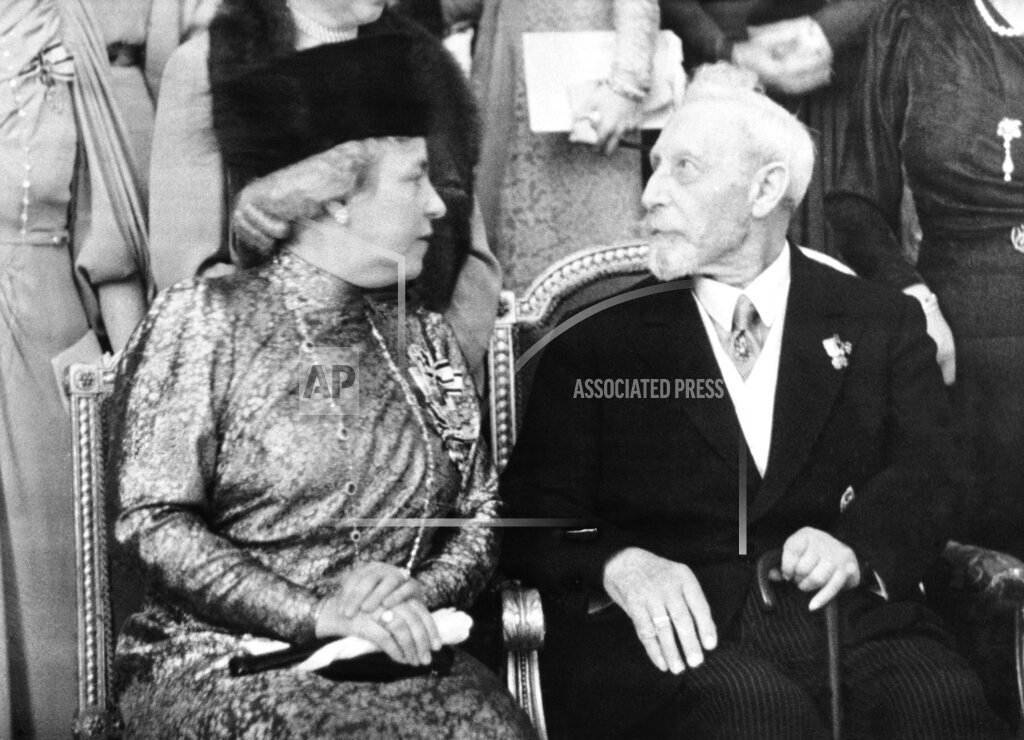
The exiled King and Queen of Spain attend a church service in Rome to celebrate the fall of Barcelona. Former King Alfonso and former Queen Victoria made a gesture in favor of the Franco government by attending a victory service in Rome. Rumors of monarchical restoration followed. Italians continued to celebrate the victory and to agitate against France.
The League of Nations will help 2,000 Spanish children move to France.
Reichsführer Adolf Hitler today congratulated General Francisco Franco, Spanish rebel commander in chief, on the capture of Barcelona. He telegraphed: “I send you my heartiest congratulations on the brilliant success with which the national Spanish army under your leadership has met in the freeing of Barcelona. I confidently hope an early victorious ending of the war will bring peace to the Spanish people and open a new epoch of happy development for the Spanish nation.”
A German newspaper asks the United States to set a good example and accept 100,000 Jewish refugees.
Ribbentrop repeats Germany’s Danzig proposals in Warsaw. Poland rejects the German annexation of Danzig and will not join the anti-Comintern Pact. Hitler’s reaction will be to prepare for war.
Former Kaiser Wilhelm II, Germany’s one-time “all highest,” wearing a dazzling white uniform with gold braid, celebrated his eightieth birthday with a gala dinner tonight in his home in exile in the Netherlands. Hitler ordered no mention of the occasion was to be made in the German press.
Adolf Hitler ordered Plan Z, the expansion of the German Navy.
Britain and France pledged a £8,000,000 loan and a £4,000,000 gift for Czechoslovakia in an attempt to save the country from falling apart.
The U.S. Senate votes on WPA cuts. The Senate upholds the WPA cuts, 47–46. President Roosevelt is stunned by the defeat. A Senate coalition of Democrats and Republicans completed today the revolt of Congress against Administration advice in appropriation of relief funds by approving, 47 to 46, the sum of $725,000,000 voted by the House to finance WPA from February 1 until June 30. President Roosevelt asked for $875,000,000. The vote took by surprise Administration leaders in the Senate, who controlled both the time and the circumstances of the roll-call. Senator Barkley had been confident of a majority of three to five votes. At least one member of the economy group had privately conceded defeat two hours before the roll-call. The switch of any vote would have changed the result, but in its circumstances today’s vote had the potential elements of a historic precedent, with twenty-six Democrats joining twenty Republicans and one Farmer-Laborite to vote down forty-one Democrats supported by two Republicans, one Progressive, one Farmer-Laborite and one Independent on a straight question of Administration authority.
The vote came by unanimous consent at 3 P.M. on the specific question of adopting an amendment by Senator McKellar to insert in the bill the appropriation figure of $875,000,000. Defeat of that amendment had no immediate effect on the probable. work relief program, as the Senate soon thereafter adopted another. amendment requiring that no more than 150,000 of about 3,000,000 relief workers be dismissed prior to April 1, and there was a definite understanding that if more funds. should be needed before June 30 the President might request them. The importance of the vote lay in the fact that it reflected a growing restlessness among Senators resulting from six years of virtual domination of government spending by the President, together with the bitter aftermath of the series of unsuccessful attempts last November to “purge” the Senate of members who heretofore opposed the White House. The victory for the coalition, led by Senators Byrnes, Harrison and Adams — and assisted openly by Vice President Garner — also gave the economy group an obvious advantage in the impending struggle over the legislation to guide the future relief policies of the Federal Government.
President Franklin Roosevelt announces approval of the sale of warplanes to France. President Roosevelt announced today that he had approved the purchase in this country of an undesignated number of modern battle planes for France.
Following this announcement there were indications tonight that a searching Senate inquiry into the entire foreign policy of the Roosevelt Administration would develop. There was a strong intimation at the Capitol that the French mission had had access to military aviation secrets at the instance of the President over the heads of the Army and Navy. Senators, disturbed recently by suspicions within the Military Affairs Committee that the present foreign policy was directed toward active participation on the side of France in any European crisis, planned to study carefully the reasons behind these developments:
- Mr. Roosevelt’s statement that the Cabinet had given the “go ahead” signal for the French contract, and his added statement that he desired the American factories to execute the order to give work to idle men.
- Reports of a serious conflict between the President and officer heads of the army and navy over the “facilities” extended to the French, which were understood to include access to army aviation secrets, and inspection of a new Douglas light bomber that was being tested by the manufacturer for possible sale to the government.
- A letter from the President to Speaker Bankhead asking for an immediate appropriation of $50,000,000 to build nearly 600 planes for the American Army, also for the purpose of keeping idle factories busy.
- A closed hearing by the Senate Military Affairs Committee of Secretary Morgenthau, Secretary Woodring and General Malin Craig, Chief of Staff, on the presence of Paul Chemidlin, representative of the French Air Ministry, in the Douglas bomber when it crashed. near Los Angeles Monday.
- The announcement by Representative Vinson of Georgia, chairman of the House Naval Affairs Committee, that he had “invited” Charles Edison, Assistant Secretary of the Navy, to tell the committee next Tuesday whether or not the Administration intends to fortify the island of Guam and to what extent.
It was learned on good authority that overtures were made direct to the White House for permission for the French mission to inspect and ride in the new bomber; that General Craig as Chief of Staff resisted the request, and that the President then gave the permission through Secretary Morgenthau as Chief of Civilian Procurement. French Embassy attachés refused tonight to discuss the matter, and General Craig could not be reached at his Fort Myer quarters.
The Lockheed XP-38 fighter made its maiden flight. The flight lasted just 24 minutes but the prototype was damaged on landing. First Lieutenant Benjamin Scovill Kelsey, Air Corps, United States Army, made the first flight of the prototype Lockheed XP-38 Lightning, serial number 37-457, at March Field, Riverside County, California. This was a short flight. Immediately after takeoff, Kelsey felt severe vibrations in the airframe. Three of four flap support rods had failed, leaving the flaps unusable. Returning to March Field, Kelsey landed at a very high speed with a 18° nose up angle. The tail dragged on the runway. Damage was minor and the problem was quickly solved.
The prototype XP-38 was damaged beyond repair when, on approach to Mitchel Field, New York, 11 February 1939, both engines failed to accelerate from idle due to carburetor icing. Unable to maintain altitude, Lieutenant Kelsey crash landed on a golf course and was unhurt.
Testing continued with thirteen YP-38A pre-production aircraft and was quickly placed in full production. The P-38 Lightning was one of the most successful combat aircraft of World War II. By the end of the war, Lockheed had built 10,037 Lightnings.
Rear Admiral Arthur B. Cook says that Pearl Harbor is inadequate as the sole Pacific base.
Secretary of State Cordell Hull asserts actions are being taken to improve the relationship with Mexico.
Two receive the death penalty under a new, stricter kidnapping law.
The Euthanasia Society drafts mercy killing legislation for consideration in New York.
The World Fair will boast 50 penguins from the south polar regions.
On the eve of their strike, radio performers agree to negotiate.
John Henry Lewis requests a rematch with Joe Louis.
Boxer Joe Louis considers exhibition tours.
Jimmy Foxx signs a contract with the Red Sox. The salary estimate is $30,000. His goal is to become the highest-paid player in baseball.
A guard is placed on the home of exiled Bolshevik Leon Trotsky in Mexico City.
U.S. aid is rushed to Chilean earthquake victims.
Chileans feel new earthquake tremors.
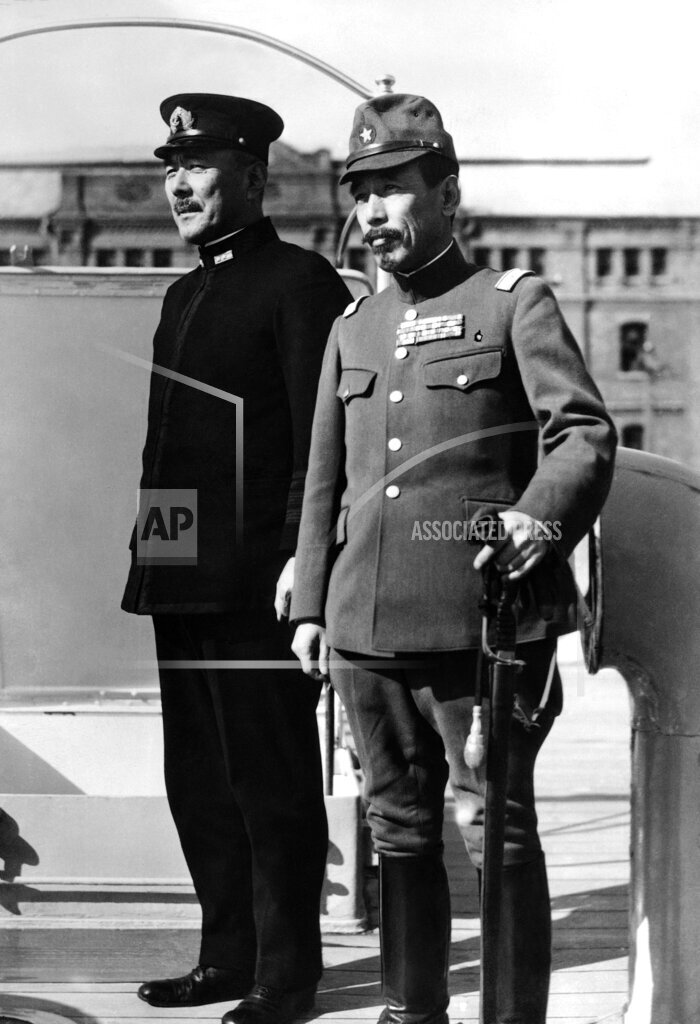
Chinese Marshal Wu Pei-Fu accepts a “puppet post” that aims to unite Japanese governments in conquered Nanking and Peiping. Marshal Wu Pei-fu, who was China’s most powerful military leader fifteen years ago, was reported by the Japanese today to have accepted the presidency of a new regime under which the Japanese-sponsored governments in conquered China would be united. Japanese reports from Nanking said Marshal Wu had accepted the post after a conference in Peking of Chinese chieftains of the Peking and Nanking Japanese sponsored governments. The new regime, merging these two puppet governments, would be called the “central China pacification commission.” Japanese reports from Peking said Marshal Wu expressed readiness to end a twelve-year retirement from politics “to serve China.” The Nanking report said Wu intended to establish headquarters in Kaifeng, Honan province.
Chinese guerrilla forces reported today they had defeated 1,000 Japanese and Manchukuoan troops at Sinlo, on the Peking-Hankow railway, 150 miles south of Peking.
Dow Jones Industrial Average: 138.9 (+2.48).
Born:
Mike Hill, American golfer (3 PGA; PGA 18 Senior titles), in Jackson, Michigan.
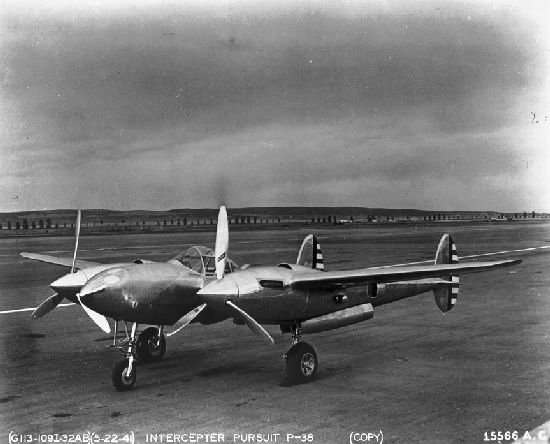
One of the great warbirds of the Second World War flies for the first time on this day in 1939.
 History Diaries