
France establishes diplomatic relations with Communist China. France and China announced simultaneously in Paris and Beijing that “The Government of the People’s Republic of China and the Government of the French Republic have decided in mutual agreement to establish diplomatic relations. For this purpose, the two Governments have agreed to exchange ambassadors within three months.” France, however, declined to sever diplomatic relations with Taiwan. The French Foreign Ministry had notified U.S. Ambassador Charles Bohlen of its intent on January 15, but the French and Chinese governments avoided any official statement for 12 days, despite the administration’s protest.
France’s recognition of the Communist regime was the first by any major power since the Korean war began nearly 14 years ago. The step was hailed by Gaullists as an example of France’s independence and as a move toward closer relations with another great independent power. Government circles saw the recognition as a vital step in pursuit of President de GaulIe’s policy of negotiating a settlement to secure the independence and unity of South Vietnam and other states of the Indo-Chinese peninsula. For the moment the President has established a “two Chinas” policy. Kao Shih‐ming, the Chinese Nationalist chargé d’affaires, after vehemently protesting the recognition at the French Foreign Ministry, made it known that there would be no immediate break in diplomatic relations between Taipei and Paris.
A French official asserted that in negotiating the terms of recognition France made no commitment on China’s representation in the United Nations. This may have induced the Chinese Nationalists to continue relations with France, Western diplomats believed. They predicted that it would be difficult for France, after having recognized the Communist regime, to withhold support for Peking’s claim to United Nations membership. There have been a number of reports in diplomatic circles that France’s former colonies in Africa, now independent states, would follow her example and recognize Peking. Of thirteen states, including Malagasy, only two, Senegal and Mali, now recognize the Communist Government.
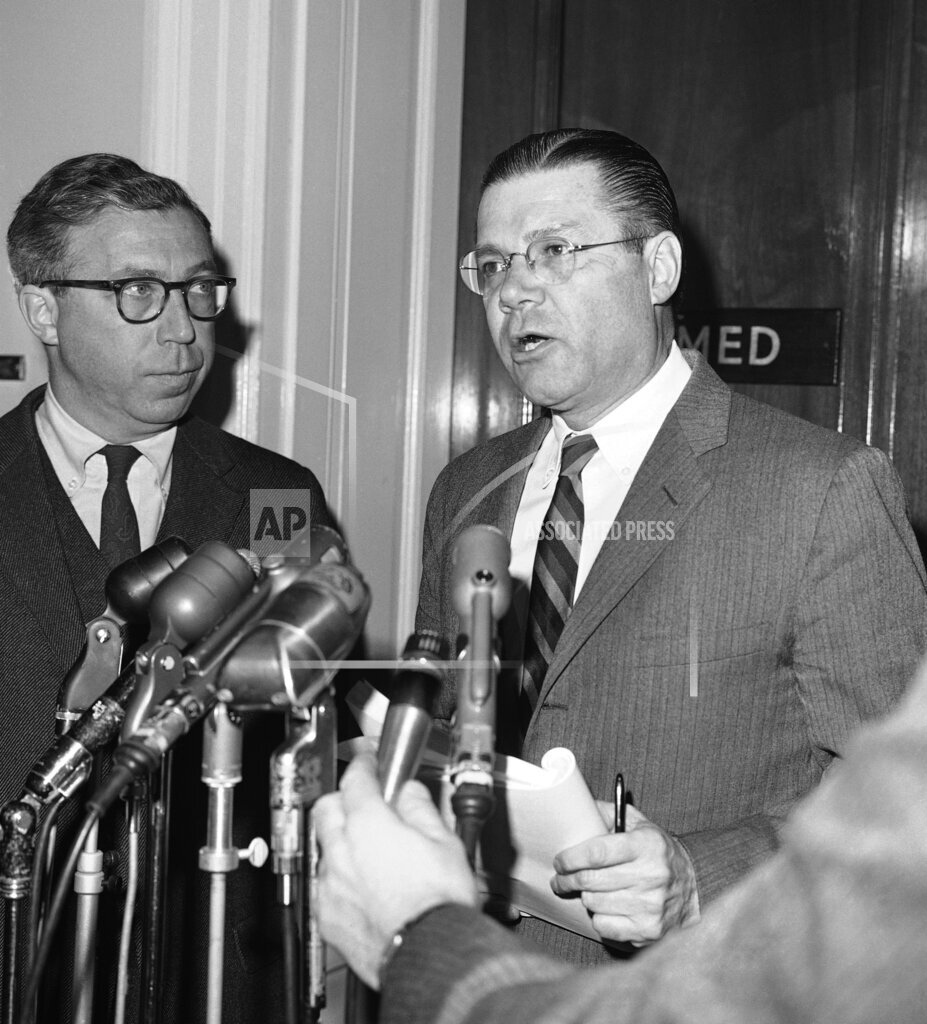
Defense Secretary McNamara appears before the House Armed Services Committee in a closed session (his testimony is made public on 18 February) and insists that the “bulk of the U.S. armed forces in Vietnam can be expected to leave by the end of 1965” but that “the survival of an independent government in South Vietnam is so important to the security of southeast Asia and to the free world that I can conceive of no alternative other than to take all necessary measures with our capability to prevent a Communist victory.”
The situation in South Vietnam “continues grave,” McNamara said today. After the coup that installed a new Government in South Vietnam last fall, the Secretary said, Communist Viet Cong activities increased — “and I must report that they have made considerable progress since the coup.” The Secretary presented his assessment of this and other foreign developments affecting the nation’s military requirements as he gave the House Armed Services Committee a review of the worldwide military situation as it affects the United States. Mr. McNamara testified in closed session, but the committee gave out a censored version of his opening statement. The review is given every year by the Secretary of Defense.
An American soldier was killed today when a Communist land mine exploded under his jeep. Three Vietnamese soldiers riding with him were injured. The American’s name was withheld pending notification of his family. A United States military spokesman said the American and the three Vietnamese were taking part in an operation against the Viet Cong, the Communist guerrillas near Huế, about 400 miles north of here. Press reports in Saigon said the Viet Cong had announced that they would release all prisoners of war February 13, the lunar New Year and Vietnam’s most important holiday. The Saigon Government has not announced how many of its soldiers are prisoners and has declined to comment on the reports.
Twenty‐four deaths from cholera were reported in Saigon hospitals yesterday and almost 600 new cases were admitted, the official Vietnam Press news agency reported today. Medical sources believe 3,000 will die in the epidemic during the next few weeks.
A delegation of top‐ranking North Vietnamese Communists left Hanoi today by air for the Soviet Union for talks that are expected to center on the Communist‐bloc rift. The delegation is led by Lê Duẩn, First Secretary of the Central Committee of the Workers (Communist) party, and includes Lê Đức Thọ and Hoàng Văn Hoan, members of the Politburo. The Hanoi radio said the delegation would “exchange views with a delegation of the Communist party of the Soviet Union on problems of common concern for the two parties.” North Vietnam has sided with Communist China on major ideological issues dividing Peking and Moscow, but it, has sought to keep on friendly terms with the Russians.
Secretary of Defense Robert S. McNamara introduced today a new term, “damage‐limiting strategy.” He said it was the basis of United States military policy. As outlined by Mr. McNamara, “damage‐limiting strategy” provides a powerful military force, adequately protected against attack and able to deal enemy forces a destructive blow. It includes a civil defense. In substance, this program calls for forces powerful enough to destroy the national societies and war‐making capabilities of the Soviet Union, Communist China and their allies, singly or in combination. But it recognizes that the nuclear powers, the United States and the Soviet Union, “would do enormous damage to both sides.”
The Administration, meanwhile, disclosed significant progress in developing satellites able to detect Soviet missiles as they are launched. It reported also the “outstanding success” of two research satellites to develop techniques for monitoring nuclear tests in space. The Defense Secretary discussed in unusual detail the strategic premises underlying the Administration’s $51.2 billion military spending program as he testified in closed session before the House Armed Services Committee. The committee released a 160‐page statement by the Secretary as he began his annual “military posture” presentation in closed session. The statement included a lengthy discussion of the dependability of strategic weapons. It thus supported an earlier denial of allegations that ballistic missiles were not dependable. On the contrary, Secretary McNamara testified, “we can predict the results of a missile attack with greater confidence than those of a bomber attack.”
President Julius K. Nyerere of Tanganyika called today for an emergency meeting of African states this week to discuss what he termed the “grave danger” caused by East Africa’s army revolts. The President’s plea came at the end of a day in which Tanganyika put a number of the country’s labor leaders and political figures under detention, banned two newspapers and put off the visit of Premier Chou En‐lai of Communist China. Mr. Nyerere’s appeal was contained in a message to heads of 36 independent African nations.
At least 2,000 guerrillas are operating in Kwilu Province in the Congo, diplomatic sources now believe. The rebels are apparently better organized than they were though earlier to be. The guerrillas are led by Pierre Mulele, an associate of the jailed Congolese secessionist, Antoine Gizenga. He was Mr. Gizenga’s envoy in Cairo and returned last summer from Communist China, where he spent a year and a half in exile. A rebel band killed Miss Irene Ferrel, an American Baptist missionary, with a poisoned arrow last week and seriously wounded her associate, Miss Ruth B. Hege. The incident occurred at the Mangungu mission station in Kwilu, about 500 miles southeast of Leopoldville.
Two persons were reported killed in Libya today and 17 injured when the police fired on demonstrators who tried to storm a police station at Zavia, 30 miles west of Tripoli. Six policemen were reported injured in the incident. Two men were killed in a similar clash at Jemel, near the Tunisian frontier, reports said. The demonstrators were protesting against the killing of two students in rioting in Benghazi the week before last, and the death of a third three days ago from injuries said to have been inflicted by the police. The Benghazi clash developed during demonstrations in support of conference of Arab heads of state in Cairo earlier this month. About 20 youths and teachers were injured.
Officials in Washington were cool today to a British suggestion that the United States and other members of the North Atlantic Treaty Organization send troops to help maintain order in Cyprus. But the door was left open for further consideration. Tomorrow, at the Pentagon, United States military leaders will begin consultations on the idea with a British mission led by Lieutenant General Geoffrey H. Baker, vice chief of the General Staff. This will be one of two American‐British consultations on a wide range of problems affecting world security, with emphasis on Cyprus and East Africa.
U.S. Senator Margaret Chase Smith of Maine, announced her candidacy for the Republican presidential nomination, becoming “the first woman to be taken seriously for the White House”. Smith would run in the New Hampshire and Illinois primaries before dropping out of the campaign, and would earn 27 delegates to the GOP convention. Sounding like a woman on the verge of saying no, Senator Margaret Chase Smith of Maine today said yes — she would run for President. The arguments against her candidacy she called “far more impelling” than those for it. “So, because of these impelling reasons against my running,” she said, pausing dramatically, “I have decided that I shall enter the New Hampshire Presidential preferential primary and the Illinois primary.” Her announcement was greeted by the applause and sympathetic laughter of several hundred women and a scattering of men attending a luncheon of the Women’s National Press Club at the Mayflower Hotel.
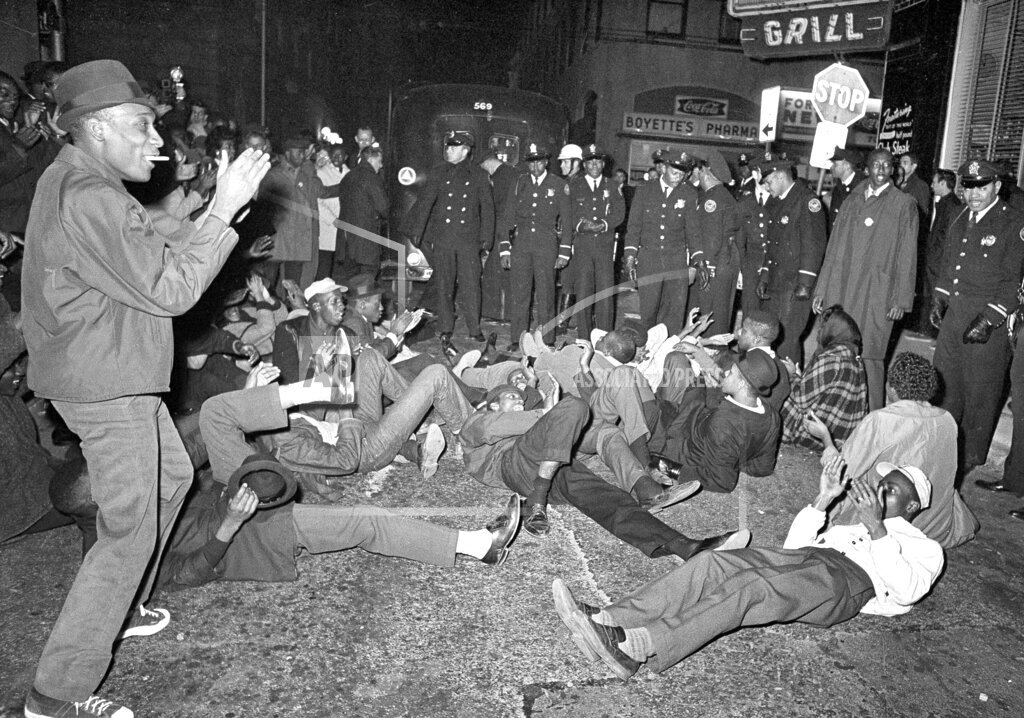
Integrationists linked arms and threw themselves to the street in downtown Atlanta tonight, and the police, holding back surly crowds, arrested them in droves. At midnight the police said 116 persons, both whites and Blacks, had been arrested in three demonstrations today. This included 20 persons who prostrated themselves tonight in front of the city jail and shouted, “We want to go to jail.” All 116 were charged with disorderly conduct. Their bond was fixed at $50 each. None would give his name and thus could not be bonded out.
Forty-seven of the arrests were made late tonight, when pickets marching around Leb’s, a segregated restaurant, the chief target in three days of demonstrations, fell limp to the pavement. They lay on the street in a long line. Policemen had to pick them up and carry them to patrol wagons. Some of the pickets struggled fiercely. It took four police officers to get one of them into a wagon. About 1,000 spectators, most of them white, gathered at the corners of the block where the demonstrations occurred. The police would let them get no nearer to the demonstrators. The crowd joined in the uproar, shouting at the policemen: “What are your blackjacks for?”
The mass arrests began when the demonstrators, who were kept moving around the block by the police, began slowing down and bunching up in a narrow street. When the police moved in to make arrests, someone yelled, “Let’s go to jail.” There was a spontaneous rush toward a patrol wagon, which was quickly filled. Then a leader of the demonstration cried, “No, no, if we’re going to jail. let them take us.” “If we’re going to jail,” someone else yelled, “let’s go fighting.” They locked arms and fell to the pavement. Policemen jumped among them, struggling to get them separated and into the wagons.
President Johnson set before Congress today an election‐year housing program aimed at meeting the shelter needs of the poor and the living needs of the suburbs. In a special message on housing — his first confined to a single subject — Mr. Johnson proposed new approaches to the problems of financing decent homes for low‐income families. His major innovations centered, however, upon plans to help developers and local governments provide adequate public facilities in new suburban communities and new major subdivisions of existing communities. More orderly and farsighted development of these suburban areas is essential, the President said, if they are to house a growing population that will require construction of two million new homes annually by 1970.
The U.S. Federal Aviation Administration announced the three competing designs submitted to it by airplane manufacturers for a supersonic passenger airliner. Boeing’s proposal, the Boeing 733, proposed to carry 150 passengers at a speed of Mach 2.7; Lockheed Corporation offered the Lockheed L-2000 that would carry 218 passengers at Mach 3.0; and North American Aviation presented the North American NAC-60 to take 167 passengers at Mach 2.65.
Queen Frederika of Greece came to the White House today for the second time in two months. It was in vivid contrast to her last visit—laughter after a time of sorrow. The Queen lunched with President and Mrs. Johnson and more than 100 other guests. The luncheon, enlivened by songs and gay banter, was an unusually large midday gathering at the White House. It followed a press conference at the Greek Embassy held by the Queen, who had arrived here last night from New York City for a three‐day unofficial visit. As dusk fell, the Queen went to the Georgetown home of Mrs. John F. Kennedy, behind whom she had marched from the White House to St. Matthew’s Cathedral two months ago in the funeral procession for the assassinated President. The day after President Kennedy was buried, Frederika was the first of foreign dignitaries to visit his grave. She left a laurel wreath.
A plain human goof postponed today an attempt to launch the world’s most powerful known rocket. Members of the House space subcommittee were among a large group of Washington officials on hand to see the two-stage, 16‐story Saturn 1 take off. But the countdown stopped abruptly with an hour and 40 minutes to go. The blockhouse crew found that liquid oxygen would not flow through a line that had to be used then. Two hours of troubleshooting indicated that the line was blocked by an aluminum stopper. It had been inserted two or three days ago in a routine check of pressure in the line. Lieutenant Colonel Rocko Petrone, manager at Cape Kennedy for the Saturn and Apollo moon programs, admitted it all in a refreshingly candid news conference. The launching attempt was postponed until Wednesday morning at 10 A.M., Eastern standard time
Mary Whitehouse and her friend Norah Buckland launched the “Clean Up TV” (CUTV) campaign against Great Britain’s television networks in a meeting attended by 2,000 supporters. They would attract 2,000 supporters to their organizational meeting at the Birmingham Town Hall. Along with their husbands, they would create the National Viewers’ and Listeners’ Association (now Mediawatch-UK). Mrs. Whitehouse was an art teacher in the town of Madeley, Shropshire, and had been assigned to teach sex education to students; she was appalled at the values that the schoolchildren were learning from BBC and ITV programming, and became a social activist.
Dow Jones Industrial Average: 785.34 (+2.30).
Born:
Bridget Fonda, American film and television actress (“Scandal”, “Single White Female”), to actor Peter Fonda and his wife Susan Fonda, in Los Angeles, California.
Woody Austin, American golfer (PGA Championship 2007 runner-up; 4 PGA Tour titles), in Tampa, Florida.
Jack Haley, NBA power forward and center (Chicago Bulls, New Jersey Nets, Los Angeles Lakers, San Antonio Spurs), in Long Beach, California (d. 2015).
Jeff Drost, NFL defensive tackle (Green Bay Packers), in San Angelo, Texas.
Inga Thompson, American Road Race Bicyclist (Olympics, 1984-21st, 1988-8th, 1992-26th), in Reno, Nevada.
Migi Drummond, English pop drummer (Curiosity Killed the Cat – “Down to Earth”), in Strawberry Hill, Middlesex, England, United Kingdom.
Died:
Norman Z. McLeod, 65, American film director.
Waite Phillips, 81, American oil executive and philanthropist.





 History Diaries