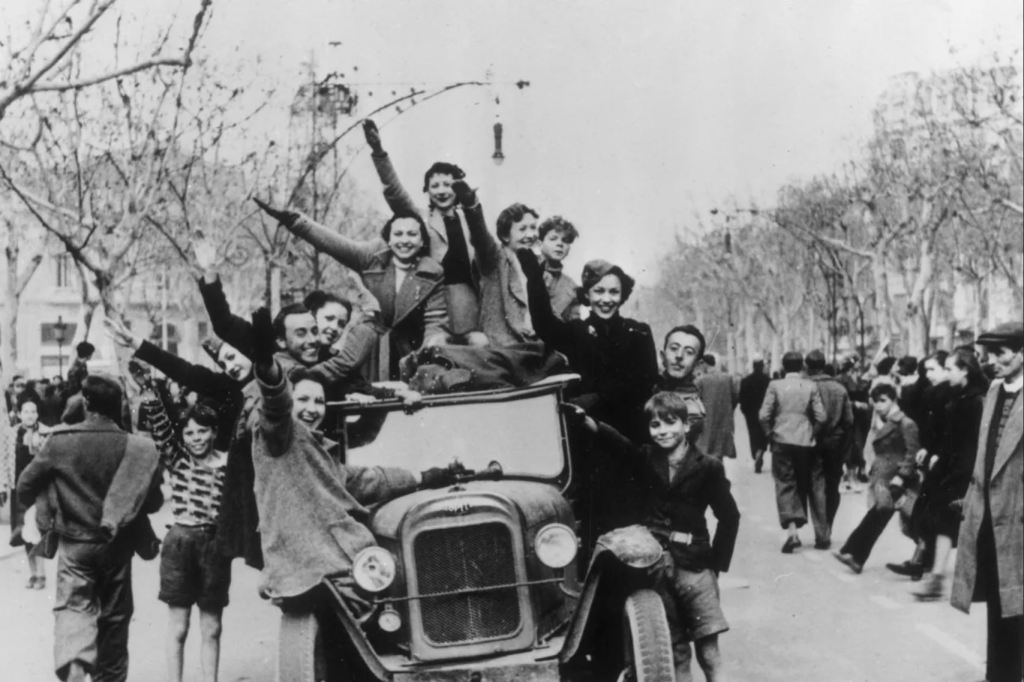
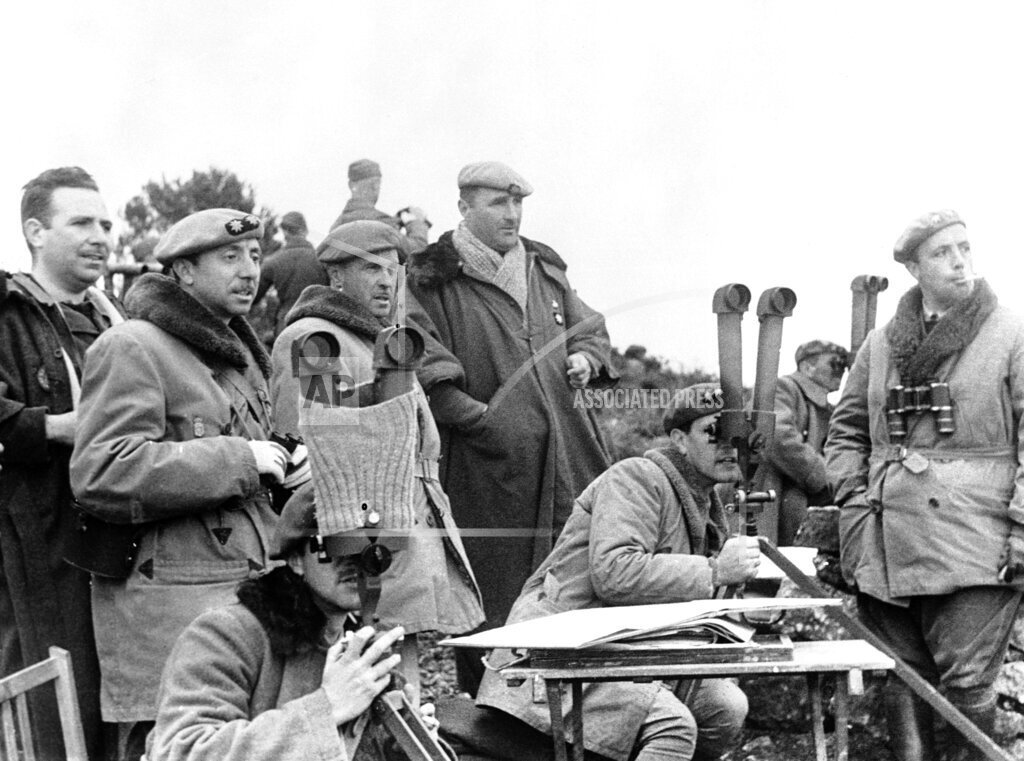
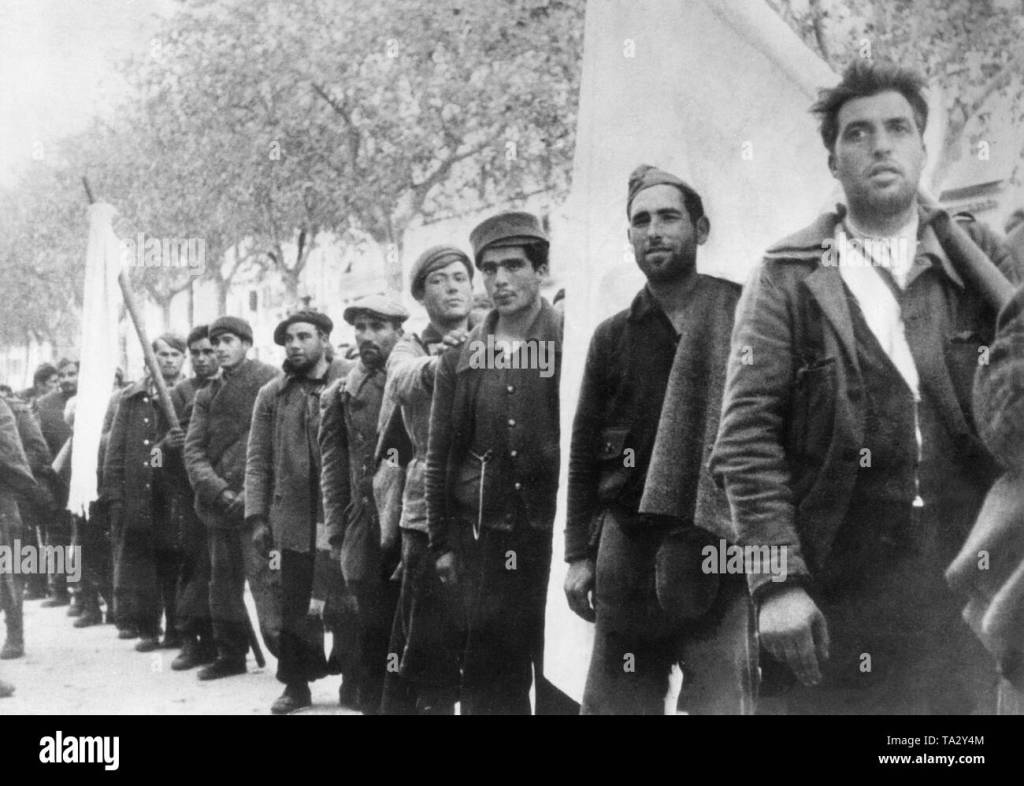
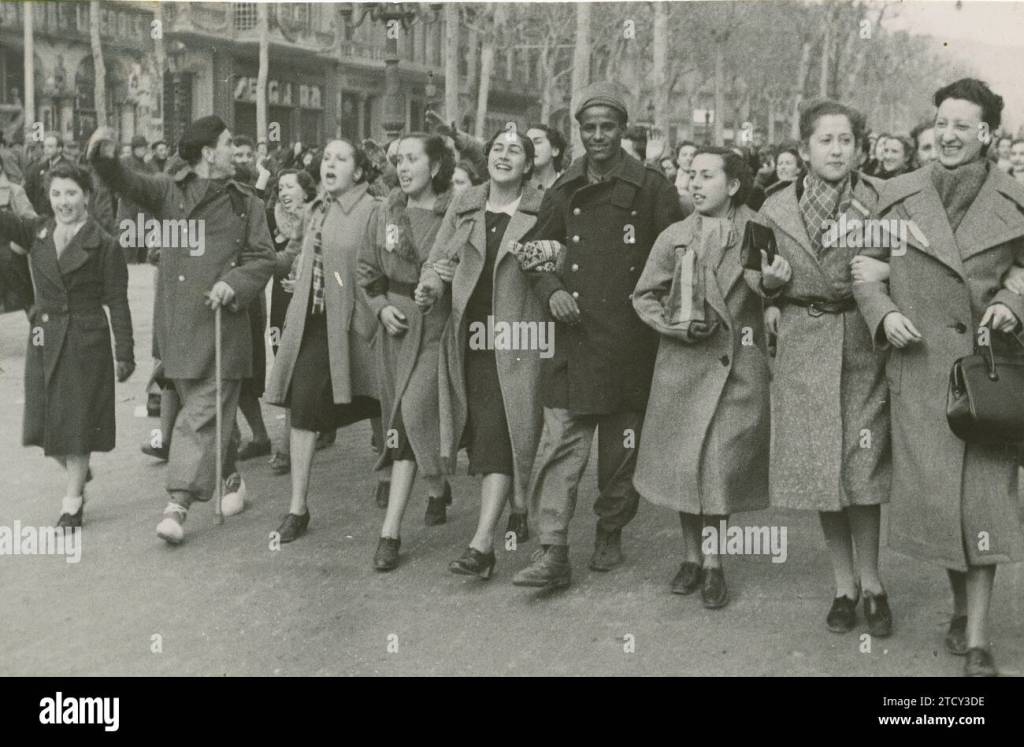
Barcelona falls without a significant fight. With Italian assistance, General Franco’s forces capture Barcelona, leading to the end of all Loyalist resistance. Over the next few weeks, Spanish Republican resistance collapses and Franco’s forces will secure Catalonia, as over 200,000 Republicans crossed over the border to France, where they were disarmed. Nationalist troops march through the streets of Barcelona. The Catalonia offensive is halted briefly, meaning many civilians who have fled north towards France have no advancing troops at their backs. But the German Condor Legion and Italian Aviazione Legionaria continue their campaign from the air, bombing towns and roads on the 160-kilometer hike to the French border.
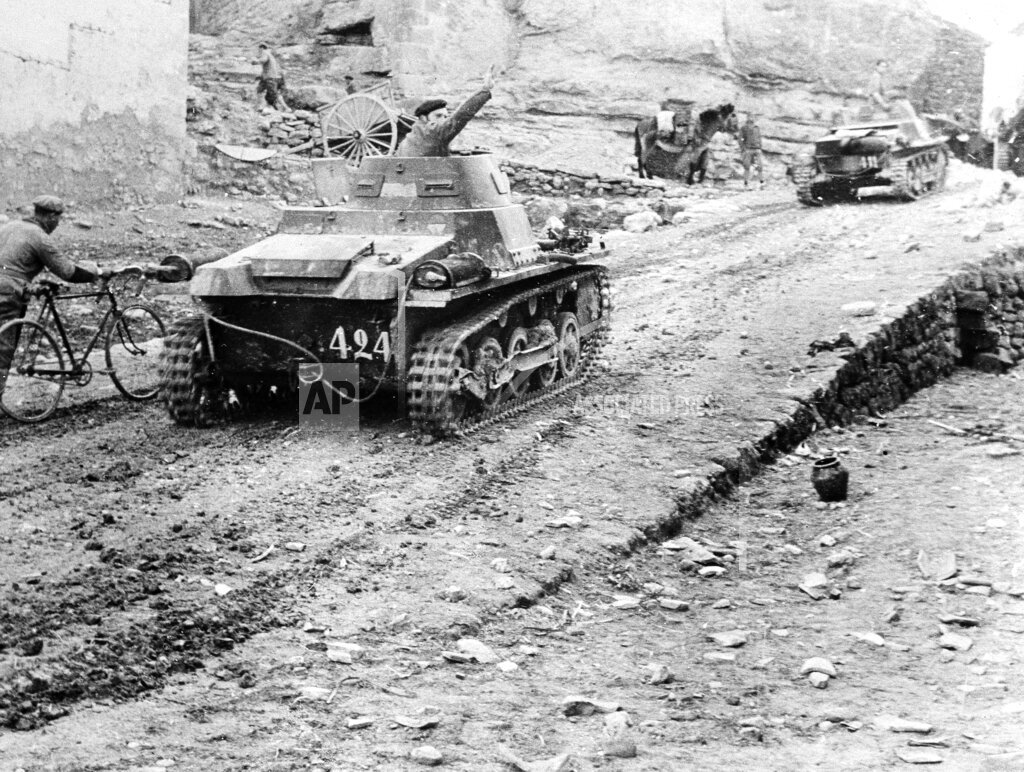
The final movement against the city was carried out from two sides, the west and the north. On the west General Juan Yagüe’s Moroccan troops, who had been waiting with ill-concealed impatience on the right bank of the Llobregat River, received their orders at dawn. Three divisions pushed across the river and spread over the country toward the industrial suburb of Sans and the grim fortress-crowned hill of Montjuich, which dominates the harbor area. A few trial rounds fired at Republican (Loyalist) positions brought no reply. It soon became evident that the Republicans had given up all serious hope of defending the city. The Nationalist advance was methodical, although uneven. In certain parts long stretches of road were covered without difficulty. In others isolated machine-gun nests would hold up whole battalions for an hour. But the Republican military machine had broken down. Most of these nuclei of resistance consisted of groups of machine gunners, clinging grimly to their weapons long after the country behind them had been evacuated. Nationalist infantry, carrying their flags before them, moved ahead, preceded by tanks. Gradually they reduced each center of resistance, thus allowing the main body to push on.
The Republican government had attempted to organize a defense of Barcelona this month, ordering the general mobilization of all men to forty-five and militarized all the industry. Nevertheless, the successive defensive lines (L1, L2, L3) fell, the Republican forces were outnumbered six to one, and the Nationalist air force bombed Barcelona every day (40 times between 21 and 25 January). It became clear that the defense of the city was impossible. On 22 January Solchaga and Yagüe had reached the Llobregat only a few miles west of Barcelona, Muñoz Grandes and Garcia Valiño attacked Sabadell and Terrassa, and Gambara advanced to Badalona. The chief of staff of the Republican Army, Rojo told the Republican prime minister Negrín that the front had ceased to exist so the government abandoned Barcelona after releasing most of its prisoners. A large part of the Barcelona population fled from the city as well. On 24 January Garcia Valiño occupied Manresa, and on 25 January the Nationalist vanguard occupied the Tibidabo in the outskirts of Barcelona. The Nationalists finally occupied Barcelona on 26 January and there were five days of looting by General Yagüe’s Regulares and extrajudicial killings (paseos).
With the fall of Catalonia, the Republic lost the second largest city of the country, the Catalan war industry and a large part of its army (more than 200,000 soldiers). On 2 February Azaña resigned and on 27 February France and the United Kingdom formally recognized the Francoist government. Further military resistance became impossible and the war was lost for the Republic, despite the fact that 30% of Spain was still under Republican control after the offensive and Prime Minister Juan Negrín insisted that the Republic could continue to resist.
Americans leaving Spain reach France safely on the light cruiser USS Omaha (CL-4).
Some refugees from Barcelona turn back, as shells make roads to the north impassable.
Italian Premier Benito Mussolini sees foes “biting dust” and projects a “new Europe.” Exultantly addressing a cheering crowd of scores of thousands, gathered outside the Palazzo Venezia to celebrate the fall of Barcelona, Premier Benito Mussolini indicated quite clearly this evening that the march of the Italian legionaries would not end in the capital of Catalonia. He did not say whether the next objective would be Spain or elsewhere, but the crowd’s guess, which found expression in shouts of “We want Corsica. We want Tunisia!” showed the direction in which Italian political thought is trending. “Our enemies are biting the dust,” shouted Signor Mussolini and his voice was almost drowned out by applause. “Their motto was ‘No paseran,’ but we did pass and I tell you we will continue to do so.” This sally was greeted with enormous delight by the crowd, which continued to demonstrate outside the windows for almost a half hour, obliging Signor Mussolini repeatedly to return to the balcony in acknowledgment.
French Premier Édouard Daladier announces that the hour of peril nears. Premier Daladier told a cheering Chamber of Deputies tonight that France “will let no one touch her territorial integrity or her colonial empire or her free communications.” Speaking earlier in the day before a meeting of his Radical Socialist followers, M. Daladier declared that France and Britain had agreed on the “necessary measures” to counter any Italian refusal to withdraw from Spanish territory at the end of the war, The Associated Press reported. “As I have said elsewhere,” he continued, “she will not concede a single acre or concede a single right. In saying that I am measuring the full gravity of my words and the gravity of the circumstances. “But there are times when for a people who are proud of their freedom there can be no question of measuring sacrifice, when sacrifice is necessary, for the maintenance of their integrity and their honor. “With the hour of peril approaching,” M. Daladier said that there was more even than that material empire to defend; there was that ideal that France had defended in other times and was ready to defend again in a world that had enlisted under the banner of force. He warned that the Italian-French problem was “racing towards a climax.”
It was noted that Premier Daladier made a pointed reference to the United States. “At this moment France turns her thoughts particularly toward the great Anglo-Saxon nations which have given us their words to be at our side,” he said. “Britain’s friendship is very precious to us and we think of the United States, whose President addressed words to us which touched us deeply.” He did not specify what speech or message of President Roosevelt to which he referred.
The Reich Press hails Barcelona’s fall.
Britain is invincible, states the British Home Secretary, Sir Samuel Hoare.
Turkey gets a new Cabinet. Refik Saydam replaces Jelal Bayar as Prime Minister.
Leaders of the two factions into which the U.S. Senate has been divided over the question of how much money the Works Progress Administration shall spend from February 1 to June 30, the end of the fiscal year, agreed late this afternoon to vote at 3 o’clock tomorrow afternoon on whether the appropriation shall be $875,000,000 or $725,000,000. The Senate looks upon the question of which sum shall prevail as of less importance than the direct test of strength between one group, led by Senator Barkley, the Democratic floor leader, which believes the Congress should follow the President’s advice on relief, and another marshaled by Senators Byrnes and Adams, under the direction of Vice President Garner, which insists that some check be made on Federal expenditures as a gesture toward economy.
Few were willing to make a public forecast tonight as to which way the vote would go. Both factions expressed confidence, even though each conceded the margin of victory would be small. Senator Barkley said he expected to have five or six votes to spare. Senator Byrnes said this was wrong. Mr. Barkley appeared fully confident of his ground, however, since it was he who asked unanimous consent to set a definite time for a vote, after he had placed speaker after speaker on the floor for two days in an open move to hold off a decision.
The House Judiciary Committee agreed today in executive session to investigate the deportation cases which form the basis of charges by Representative Thomas of New Jersey aimed at the impeachment of Secretary Perkins, James L. Houghteling, Commissioner of Immigration, and Gerard D. Reilly, solicitor of the Department of Labor. Mr. Thomas had asserted that the three had been guilty of neglect to enforce the immigration laws. Chairman Sumners said after the meeting that individual members of the committee would make “some investigations” of their own before deciding whether to report out the Thomas resolution, which must be acted upon by the House before an impeachment proceeding can be instituted. The committee members, he went on, would look into the cases of Harry Bridges, West Coast CIO leader, and Joseph Strecker, whose deportation case is pending in the United States Supreme Court.
Motion picture financer Jules Brulatour claims to have accidentally shot himself in the neck. Police are attempting to confirm the likelihood of the scenario.
The CIO suspends Homer Martin as president of the UAW. Homer Martin in Detroit accuses the CIO chiefs of seeking to take charge of the United Auto Workers.
The Conference on Cause and Cure of War recommends changes in the U.S. Neutrality Act, 296–5.
The position of the United States in the Far East could be stabilized and assured for the foreseeable future by the establishment of a powerful advanced fleet base at Guam comparable to the British base at Singapore, Rear Admiral Arthur J. Hepburn told the House Naval Affairs Committee today. The admiral, who was chairman of the board appointed by the Navy Department to make recommendations for the extension of existing bases to care for the enlarged navy authorized at the last session of Congress, was reflecting a school of thought prevalent among many naval officers. They believe, according to some officers, that the navy, sooner or later, may be called upon to enforce American demands for nondiscriminatory treatment in Asia or elsewhere in the world. These implications were made clear in the Hepburn board’s report some weeks ago. Naval experts in their line of duty must obviously try to prepare in advance for the demands public policy is likely to put on them, officers here say.
The Institute of Aeronautical Sciences meets. U.S. air science lags as compared to Europe.
Seven hundred events are listed for the World Fair.
Secretary of State Cordell Hull says the State Department is actively seeking a friendly solution of the Mexican problems.
The La Follette committee asks for a federal ban on hiring of strike-breaking agencies.
U.S. Attorney General Murphy insists that he held sit-downs unlawful in 1937 as well as now.
Forty State Attorneys General oppose the Roosevelt proposal to tax securities as hearing starts.
President Franklin Roosevelt approved atomic research efforts in the U.S. This is not yet bomb-related.
The Boeing Model 314 Clipper is given permission by the Civil Aeronautics Authority to be used for commercial service by Pan American Airways.
Filming begins on film adaptation of “Gone with the Wind.”
Brazilian police arrest Plinio Salgado, the chief of the banned fascist Integralista party, who has been in hiding in Sao Paulo.
With martial law in effect, with an inadequate number of relief and medical workers, and with the grave danger of pestilence sweeping through the area in South Central Chile that was devastated by Tuesday’s earthquake, the number of dead was estimated high in the thousands today and the injured at many thousands more. From the welter of confusing reports of the staggering loss of life and property caused by one of the worst disasters in the history of South America, it was impossible to obtain even an approximate reckoning of the number of dead, injured and homeless. The number of the dead was placed at 10,000 and the injured at 20,000 in Chillán alone, a city of 50,000, fifty miles inland from Concepción, that was virtually wiped off the map. Another estimate was that 10,000 had been killed in the area between Talca and Temuco. Many communities in the six Chilean provinces where the earthquake spread havoc have yet to be heard from.
United States assistance rushed to the victims of the earthquake in Chile.
France rejects the Japanese nominee for ambassador, an action seen as a political snub. The French Government has refused to agree to the appointment of Masayuki Tani as Ambassador to Paris, succeeding Yotaro Sugimura, who is at Tokyo seriously ill. The Japanese Government has decided not to appoint an ambassador in the meantime, leaving the Paris Embassy in charge of Katsutaro Miyakaki, the counselor. This is the first time that France has declined to approve of a proposed Japanese Ambassador, and only the second time in Japan’s history that a Japanese nominee has been rejected by a foreign government. The earlier occasion was the Chinese Government’s refusal to accept Tokikichi Obata, who had been active in Peiping as Counselor of Legation at the time the twenty-one demands were presented.
Mr. Tani’s name was submitted to Paris fifty days ago. The French Government evidently had wished the Japanese Government to understand by its silence that Mr. Tani was not acceptable, for it delayed giving its answer. Eventually, as Japan pressed for a reply, Foreign Minister Hachiro Arita was informed that France considered that Mr. Tani’s attitude toward France had not been cooperative while he was representing Japan as Minister at Large at Shanghai.
Japan plans to return concessions to China after a “new order” is established.
Dow Jones Industrial Average: 136.42 (-4.3).
Born:
Scott Glenn, American actor (“The Right Stuff”, “The Hunt for Red October”, “Daredevil”), in Pittsburgh, Pennsylvania.
Marshall Leib [Leibovitz], American pop singer (Teddy Bears – “To Know Him is to Love Him”), and record producer, in Los Angeles, California (d. 2002).
Ben McGee, NFL defensive end (Pro Bowl, 1966, 1968; Pittsburgh Steelers), in Starkville, Mississippi.
Joe Rutgens, NFL defensive tackle (Pro Bowl, 1963, 1965: Washington Redskins), in Cedar Point, Illinois.
Naval Construction:
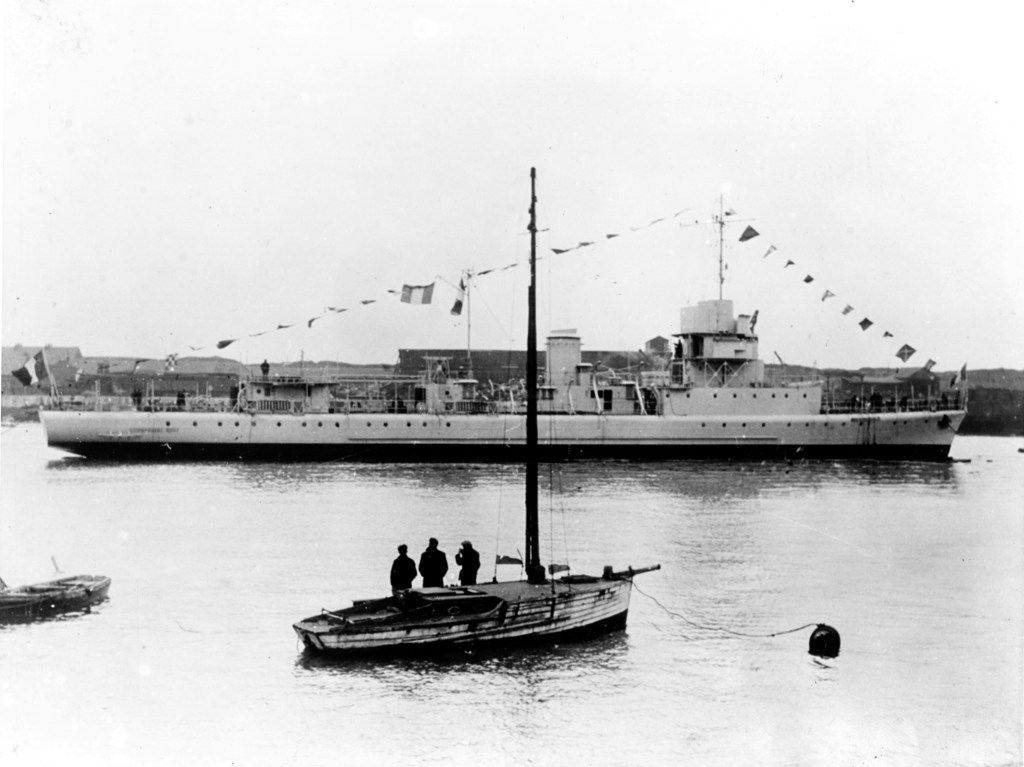
The Marine Nationale (French Navy) Elan-class minesweeper Commandant Bory is launched by At. & Ch de France (Dunkirk, France).



 History Diaries