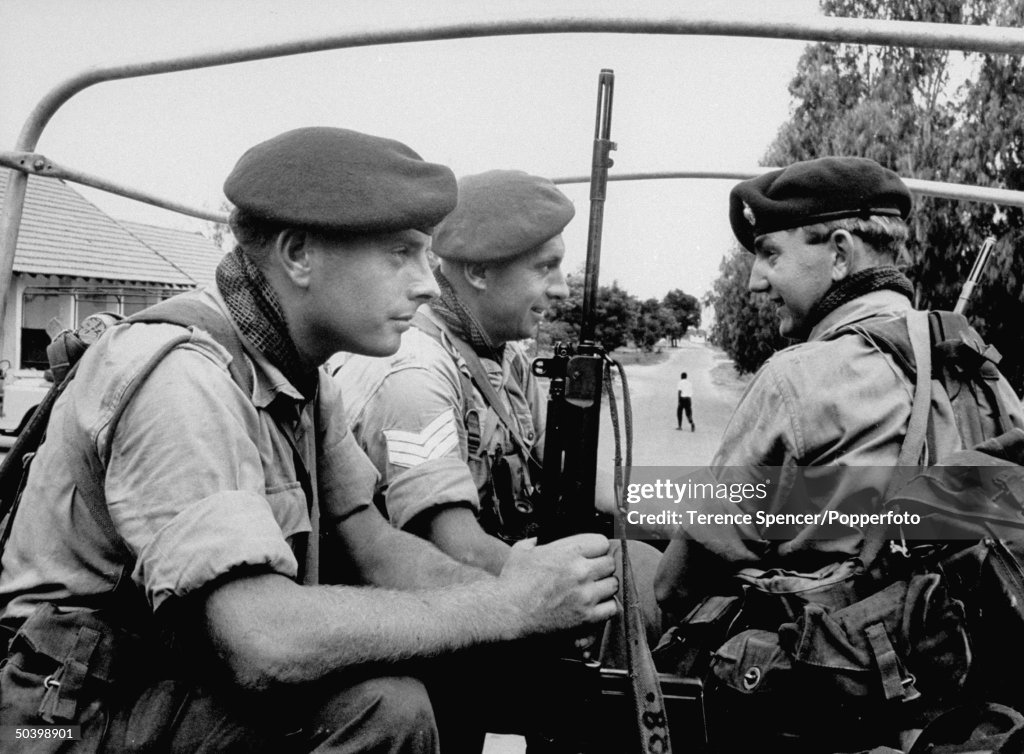
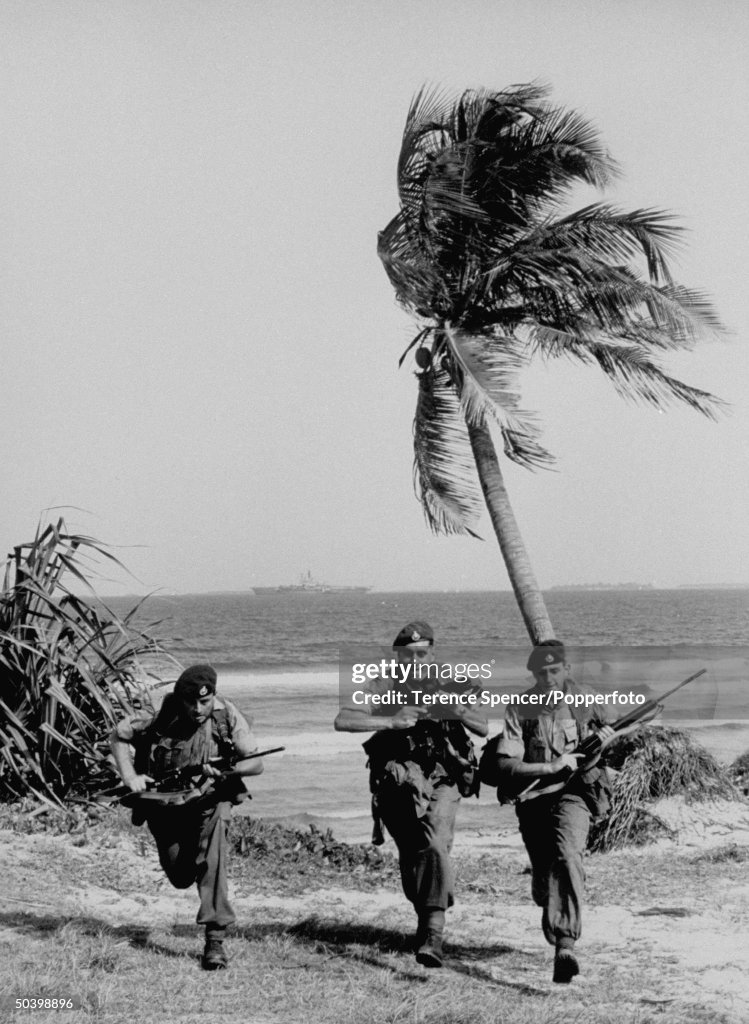
For the second time in a week, British troops intervened to stop mutinies in East Africa. In addition to a second mutiny in Tanganyika, similar mutinies by national troops against British officers took place in Kenya and Uganda. Tanganyika’s President Julius Nyerere disarmed his troops. The aircraft carrier HMS Centaur landed troops at Tanganyika from the 45 Commando unit of the Royal Marines and provided air cover, while the destroyer HMS Cambrian made a “gunfire demonstration”; within 40 minutes, rebels at the Colito base surrendered, and within 24 hours, the amphibious force had secured the island, “an area the size of the UK, with a population of 6 million, for the cost of only four rebels killed and seven wounded.”
The United States made important concessions today toward the settlement of its dispute with Panama and the restoration of normal relations. Washington agreed for the first time to accept a specific mention of the Panama Canal among the issues to be reviewed and reconsidered in the direct negotiations that are expected with the Panamanian Government. They were in line with President Johnson’s promise at an impromptu news conference earlier in the day that the United States would do its part in seeking a reasoned settlement of its differences with Panama. The concessions also led to powerful pressures on the Panamanian delegates by inter-American mediators to match Washington’s goodwill.
The South Vietnamese Government’s campaign to enlist military support of the long dissident Hòa Hảo religious sect has encountered potentially serious difficulties in the Mekong Delta town of Vị Thanh. Vietnamese and United States officials have disclosed that Hòa Hảo and regular army troops clashed in a street brawl earlier this month in Vị Thanh, capital of Chương Thiện province, about 100 miles southwest of Saigon. One civilian was killed, a national policeman and a regular army soldier were wounded and others were bruised. Military police were rushed into the area and some of the troops involved in the fracas were sent to outlying stations. Some officials tended to discount the brawl as the usual rivalry of military units, but others attached more importance to it because of the historical antagonism between Hòa Hảo and regular government forces.
The South Vietnamese Government has formally rejected the proposed new French Ambassador and clamped down on imports from France in a double‐barreled diplomatic rebuff to President de Gaulle. The actions were taken in retaliation against his support for a neutral Vietnam and impending French diplomatic recognition of Communist China. South Vietnam’s military junta has been irritated by what it considers interference by President de Gaulle in Vietnamese affairs while it is engaged in a war against Communist guerrillas with massive United States support. United States officials have been carefully watching French attempts to regain influence in the Indochinese peninsula. They fear that any rise in neutralist sentiment fanned by the French would impair the war effort.
The most immediate irritant to the South Vietnamese was a report last weekend by the French news agency that General de Gaulle’s “program” for Vietnam called for a cease-fire, the withdrawal of outside interference in Vietnam and eventual reunification of the country. Such a program has been rejected repeatedly by United States officials. Many Vietnamese believe that such a program would lead eventually to a Communist takeover in South Vietnam. Publication of the report led to demands in the press that South Vietnam sever relations with France. On Wednesday the Council of Notables, the highest civilian advisory body to government, called for suspending relations with Paris.
Officials are studying reports that Soviet submarines have been sighted six or seven times in the last few weeks off the southern tip of Vietnam. The reports have come from peasants in the area, and officials are not discounting the possibility that the sightings may only have been whales or large fish. But according to some reports, lights were seen on the objects just before they submerged. Communist‐made arms, ammunition and supplies have been reaching Viet Cong guerrillas in this area in large quantities in recent months, and it is speculated some of these supplies must be coming by sea. The southern tip of Vietnam is mostly ringed by dense mangrove swamps and forests and is almost impossible to patrol effectively. Almost all the area is controlled by the Viet Cong, making government patrols more difficult and dangerous.
Prince Norodom Sihanouk, Cambodia’s Chief of State, and President Diosdado Macapagal announced today that Cambodia has accepted a Philippine formula for settlement of Cambodia’s dispute with the United States. “Both voiced confidence that the early implementation will bring about the restoration of normal friendly relations between the two countries,” the two leaders said. The statement was issued on the departure of Prince Sihanouk for Jakarta after a three-day visit to Manila. The issues involved chiefly Cambodia’s rejection of United States aid and Prince Sihanouk’s “neutrality” policy. The United States previously had announced its acceptance of the Philippine proposal.
A French mission designed to assuage Chinese Nationalist hostility over France’s coming recognition of Communist China apparently has failed. President de Gaulle sent General Zinovi Pechkoff, an octogenarian soldier‐diplomat, to Taipei to assure Generalissimo Chiang Kai‐shek that ties would remain firm despite the recognition action and to avert any rupture in diplomatic relations. The attitude of the Nationalist mission here indicated that General Pechkoff’s mission had been a failure. The Russian-born officer returned Thursday. An announcement of French recognition of the Government in Peking is expected Monday or Tuesday.
The Pechkoff mission reflected greater French concern with Nationalist feelings than had been apparent in official comment here. The mission was disclosed when French politicians, including two former Premiers, expressed concern over the effect of recognition on France’s allies, particularly the United States. Antoine Pinay, a former Premier, said that France should have sought her allies’ agreement even though recognition was “inevitable.” René Pleven, another former Premier, writing in his newspaper in Brittany, said the Government seemed to be putting economic considerations ahead of ideological or moral issues. “It would have been more reasonable and more reassuring,” Mr. Pleven said, “if France had discussed this instead of giving in to individual impulses that threaten to destroy more than they produce.”
President Johnson said today that he thought there was a good deal of concern throughout the world over France’s plan to establish diplomatic relations with Communist China. The President, answering questions at an impromptu news conference, was reluctant to engage the French in public controversy. He said the United States had made known its concern, implied that the French had ignored Washington’s view and remarked that the final decision was rightfully France’s. Mr. Johnson was equally reluctant to criticize Britain’s sale of buses to Cuba despite United States objections. He chose words of hope instead of recrimination in discussing the chances for further agreements with the Soviet Union.
Students have been demonstrating sporadically since January 16 in the oil‐rich desert kingdom of Libya, according to reports reaching Washington. At least two students have been and several dozen injured in clashes with the police. Demonstrations broke out for the second day in Tripoli Saturday, Ausa, the Italian news agency, reported. The police were reported to have used tear gas to restore order. The principal aim of the demonstrations appears to be to display solidarity with the pan-Arabism preached by President Gamal Abdel Nasser of the United Arab Republic, which borders Libya on the east. But as the demonstrations spread, they also appear to have taken on the tinge of a protest against the conservatism of the regime of 75‐year‐old King Idris I.
European refugees from the southwestern Congo said tonight that the revolt of Communist‐led guerrillas in Kwilu Province had spread into two neighboring provinces. The rebel bands, armed with machetes, poisoned arrows, homemade bombs and a few guns, were reported to be trying to wipe out all authority of the Central Congolese Government in the area 400 miles southeast of Leopoldville, the nation’s capital. The refugees said that the guerrillas had been joined by a number of African villagers and that they held Kwilu and the neighboring provinces of Kwango and Kasai in a grip of terror. The revolt is led by Pierre Mulele, 34‐year‐old former Congolese Education Minister and pro‐Peking colleague of Antoine Gizenga, the Congolese separatist whom the central Government is holding in prison. The Government has said that captured documents link Mr. Mulele with Communist China.
General Christophe Soglo stepped aside as President of Dahomey (now Benin) and appointed former prime minister Sourou-Migan Apithy as the new head of state. Apithy, a former prime minister and vice-president, would serve until November 29, 1965.
Voters in Accra and the northern regions voted overwhelmingly in favor of making Ghana a one‐party state, according to government figures announced today. The voting, which took place yesterday, marked the first phase in a nationwide referendum. Voters in other regions of Ghana will go to the polls next Tuesday and Friday. The referendum is on proposals that would make the ruling Convention People’s party the only lawful party in the country and give President Kwame Nkrumah power to dismiss Supreme and High Court judges at his discretion.
In Indonesia, Serbuni trade unionists occupied the Unilever factory in Surabaya, but were evicted by police.
Pope Paul VI issued a motu proprio, on his own initiative, titled Sacrosanctum Concilum, elaborating on what portions of the Roman Catholic mass could be conducted in a language other than Latin.
President Johnson laid before Congress this week, in two long messages, a daring economic program. All over Washington, and elsewhere, people were asking: “Will it work?” If it works, the results will be little short of spectacular. The nation’s rate of economic growth would speed up from last year’s 5 percent to above 8 percent, beginning in the last half of this year. For the year as a whole, the gross national product would rise by 6.5 percent to about $623 billion. The number of jobless, hovering around 4 million for six years, would decline by 500,000 by the end of 1964 and would decline further in 1965. The general price stability that has characterized the economy for five years would be maintained. There would be no new surge of inflation.
The deficit in the budget would be cut in half in the next fiscal year, from $10 billion to $4.9 billion, and the deficit would be eliminated altogether by the 1967 fiscal year. The Federal budget would be held a little below the level of the current fiscal year, despite several billion dollars of increases in the general field of human needs — education, health, housing and training or manpower. The deficit in the nation’s balance of international payments would continue to decline and the gold loss be reduced further. Finally, everyone’s taxes would be cut.
The heart of the program remains the same as it was under President Kennedy — the $11 billion tax cut. This, as the Administration sees it, is the true worker of wonders. If enacted by March 1, a good possibility, it will add about $8 billion in take‐home pay to consumers this year and will reduce corporate tax liabilities by $1.5 billion. Slowly at first, but with more and more impact as time goes on, this “release” of funds will begin to work in the whole performance of the economy. As consumers spend their additional money, business operations will rise. That will mean more jobs and the need for more investment in plant and equipment, which means still more demand and more jobs.
[Ed: Reasonable ideas, later echoed in large part by Ronald Reagan. And largely wrecked in the 1960s by two factors. First, the rapid growth of social spending. And Second: Vietnam.]
President Johnson said today that he had said what he had to say about the Baker case. This seemed to rule out any further elaboration from the President of his relations with Robert G. Baker, the former Secretary of the Senate Democratic majority, whose financial activities and alleged influence peddling are under investigation in the Senate. Mr. Baker, often described as a Johnson protégé, was secretary of the majority when Mr. Johnson was Democratic majority leader. Under persistent questioning at a news conference in his office today, Mr. Johnson said he did not know the difference between a gift of a miniature TV set and a gift of a stereophonic phonograph. The President referred to a miniature television set that Senator Barry Goldwater received from his staff and a stereophonic phonograph that the President acknowledged receiving from Mr. Baker. “I am a little amused when you talk about the stereo and the miniature television,” Mr. Johnson said. “I don’t know what the difference is, but I guess there is some difference.”
Black demonstrators and Ku Klux Klansmen clashed briefly tonight at a motel near a restaurant where a United Nations human rights panel had just dined. The police quickly broke up fistfights that erupted when a line of robed and hooded Klansmen filed between ranks of demonstrators at the Downtown Motel, on West Peachtree Street. There were no arrests reported. Some 200 demonstrators, including a few whites, had marched to the motel shortly after 9:30 P.M., after having traded taunts for three hours with the Klansmen at a downtown intersection. The confrontation at the motel was kept under control by 45 policemen. The human rights panel had dined with Mayor Ivan Allen Jr., after a day of studying the city’s race relations. At the downtown intersection earlier, the police had maintained order among the demonstrators and Klansmen for several hours whenever a clash threatened.
“The old K.K.K. ain’t what it used to be,” chanted the integrationist demonstrators as white‐robed Klansmen passed through their ranks. “K.K.K. must go!” others shouted. Some of the demonstrators, including a handful of whites, slipped among the Klansmen and marched with them along the sidewalks. At one point three hooded Klansmen led a strange procession up the west side of Luckie Street to shouted cadence. The Klansmen were followed by three Black youths and then by Police Sgt. B. F. Marler, flanked by two patrolmen. Other Black demonstrators and Klansmen brought up the rear. Lester Maddox, an Atlanta restaurant operator, who is a Citizens’ Council leader and was an unsuccessful segregationist candidate for lieutenant governor, harangued the demonstrators. Then he walked across the street and sought to persuade a group of Klansmen to move in on the Blacks.
Byron De La Beckwith, a 43-year‐old racial extremist with a love for guns, goes on trial Monday for the fatal shooting of a Black integration leader. The fertilizer salesman and Citizens Council member from Greenwood is said by his jailers to be confident he will be acquitted of murdering Medgar W. Evers. Mr. Evers, state field secretary of the National Association for the Advancement of Colored People, was shot in the back by a hidden rifleman last June 12. Beckwith, according to those who have talked with him recently, has lost none of the optimism he displayed some weeks ago when he asked that he be allowed to have his gun collection with him in jail. “I might need it mighty bad when I get out,” he wrote Robert Gilfoy, then the Hinds County sheriff. The request was denied.
Beckwith’s trial will open at 9 A.M. Central standard time in the Hinds County Circuit Court. The first step will be the selection of a jury from a special group of 200 men, some of whom are Blacks. This is expected to take several days. Judge Leon Hendrick, who will try the case, drew the names from a box filled with the names of hundreds of male voters selected at random by the County Board of Supervisors. William Waller, the Circuit District Attorney, has said he will ask the jury to do what no other panel is believed to have done in the state’ s history — order the execution of a white for the murder of a Black.
The United States launched the Echo 2 satellite, a rigid mylar and aluminum balloon, into orbit. Once it achieved an altitude of 800 miles (1,300 km), the balloon emerged from the nose of the Thor-Agena B rocket and expanded to a diameter of 135 feet (41 m). By an agreement with the Soviet Union on August 1, 1963, NASA kept the Soviet space agency apprised of launch status and orbital elements, and the two nations conducted “cooperative experiments” in sending signals off of Echo 2 and tracking the satellite. At nearly 130,000 cubic feet (almost 37,000 cubic meters), Echo 2 was the largest man-made object ever placed into orbit. It was also the first man-made object that could be seen directly by billions of people, since its orbit took it over most of the world’s nations and it was visible to the naked eye. After almost five and a half years, Echo 2’s orbit would decay and it would be destroyed upon atmospheric re-entry on June 7, 1969.
Comedian and actor Bill Cosby marries Camille Olivia Hanks.
The West German game show “Einer wird beginnen” (German for “One will win”), popular in the 1960s and 1980s, began on television on Norddeutscher Rundfunk. The quiz show was unique in that its eight contestants were drawn from eight European nations, and were assisted by interpreters as needed. The show’s initials, “EWC”, coincided with Europäische Wirtschaftsgemeinschaft, the German name for the European Economic Community.
Dale Wasserman’s stage play “One Flew Over the Cuckoo’s Nest”, adapted from the novel by Ken Kesey, starring Kirk Douglas, Ed Ames; Joan Tetzel, and Gene Wilder, closes at Cort Theatre, NYC, after 82 performances.
The Beatles get their first US #1 single, “I Want to Hold your Hand” (Cashbox).
On a chilly day in Milwaukee’s County Stadium, Henry Aaron and Eddie Mathews both signed their contracts with the Braves for 1964. Mathewson took a slight pay cut from 1963, dropping from $62,500 to $57,500 and Aaron signed on for $62,000 a large increase from his $53,000 in 1963. At the time, the pair ranked third in home runs by teammates, with 692. Only Babe Ruth/Lou Gehrig and Duke Snider/Gil Hodges were ahead of them.
Born:
Billy Andrade, American golfer (4 PGA Tour wins), born in Bristol, Rhode Island.
Bob Sweeney, American NHL center (Boston Bruins, Buffalo Sabres, New York Islanders, Calgary Flames), in Concord, Massachusetts.
Mario Roberge, Canadian NHL left wing (Montreal Canadiens), in Quebec City, Quebec, Canada.
Allen Pinkett, NFL running back (Houston Oilers), in Washington, District of Columbia.
Victor Morris, NFL linebacker (Miami Dolphins), in Boynton Beach, Florida.
Tim Kempton, NBA power forward (Los Angeles Clippers, Charlotte Hornets, Denver Nuggets, Phoenix Suns, Cleveland Cavaliers, Atlanta Hawks, San Antonio Spurs, Orlando Magic, Toronto Raptors), in Jamaica, New York.
Francisco Meléndez, Puerto Rican MLB pinch hitter and first baseman (Philadelphia Phillies, San Francisco Giants, Baltimore Orioles), in Rio Piedras, Puerto Rico.

 History Diaries