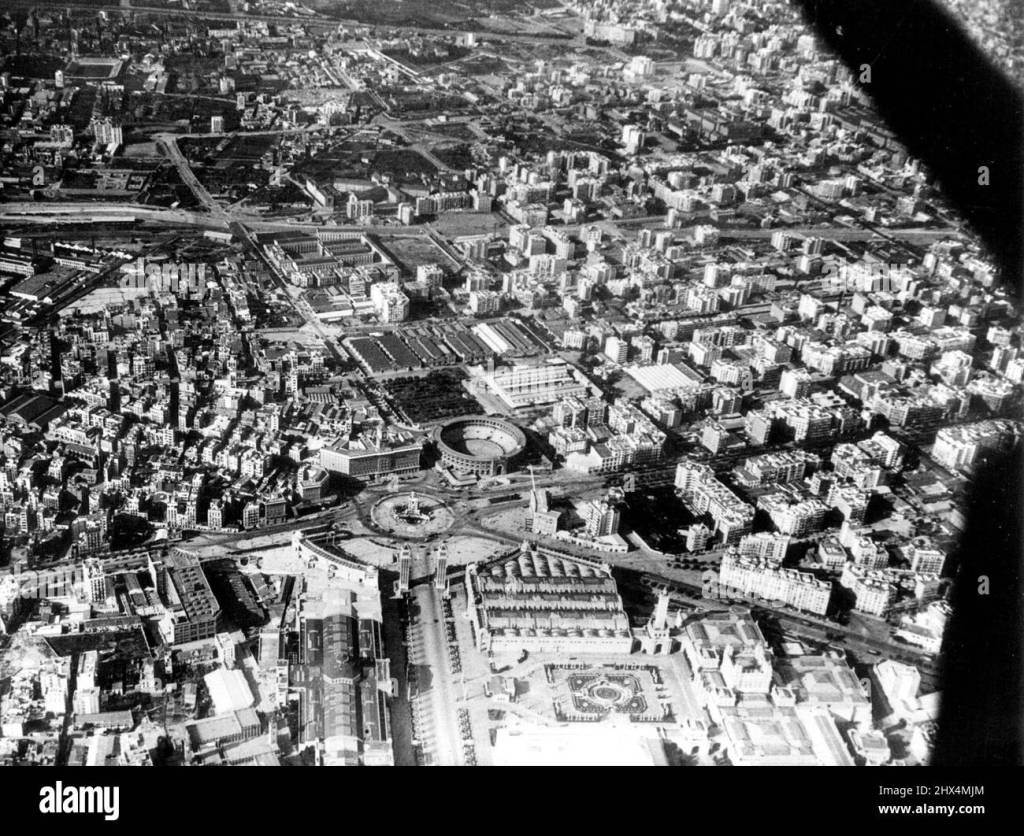
Barcelona yesterday was placed under martial law and all civilians not engaged in war activities were advised to leave. There were reports in Hendaye that the government was planning a swift flight and some members had left. General Franco’s forces broke through the city’s inner defense line by capturing Martorell and crossing the Llobregat River north of that city. They also closed in on Manresa and along the seashore approached within nine-and-one-half miles of their objective. Air raids were continuous.
Although it is not confirmed in the official communiqué, Martorell is said to have fallen after Navarrese troops under General Solchaga, advancing from Sadurni, joined forces with a mixed Spanish and Italian corps coming down from Igualada. Martorell is at the fork of the main Barcelona-Igualada-Manresa Road. To send provisions and munitions from Barcelona to the Republican forces in the northern regions between Manresa and Puigcerda, just east of Andorra, it will now be necessary to use secondary roads passing through Sabadell and Tarrasa or above Granollers.
Most Americans preferred to remain in the city although the cruiser USS Omaha has been sent to their relief.
A letter is written by former Secretary of State Stimson, advocating lifting of the embargo on sale of armament to the Spanish Loyalist regime, recognized as the true government of Spain by our government.
Indications of a bitter final defense of Barcelona grew today as the government ordered all civilians unable to help to leave the capital. Many feared they would be put to death if captured by the rebels, and they preferred to die fighting. Able bodied civilians, including women, worked on fortifications and dug trenches. The severe strain of a month of uncertainty, deepened by three days of virtually continuous air raids, was shown clearly by the drawn, anxious appearance of Barcelona’s citizenry. A constant shriek of warning sirens was mingled with the sound of anti-aircraft batteries. Army trucks, ambulances, and war machines dashed through the streets. Civilians fleeing the city packed their belongings and moved along streets where harried women were bundling records from public offices into available conveyances, or where clerks were preparing to leave offices. Refugees moved toward roads leading to the north, some carrying bundles or homemade knapsacks, some riding in crude peasant carts with whatever treasured possessions and food they were able to pack.
The Republican government decides to abandon Barcelona as the capital and heads for Figueres Castle, and most of Barcelona’s political prisoners are released. Much of the population of the city is now fleeing north towards France, and the men on the frontline have either been killed or have retreated from advancing Nationalists. The aircraft overhead are still bombing Barcelona ten times per day.
France reinforces guards at the Spanish border as anxiety increases.
In Paris it was understood that France was finding Berlin the less aggressive end of the Rome-Berlin axis and that Chancellor Hitler would endeavor to keep Premier Mussolini from making trouble in the Mediterranean. Foreign Minister Bonnet was expected in his speech in the Chamber of Deputies today to be firm with Italy’s ambitions.
Prime Minister Chamberlain announces the introduction of National Service and says, “It is a project that must make us prepared for war.”
In Manchester two IRA women were arrested on possession of explosives. Items seized included one barrel of potassium chlorate, two Mills bombs, 49 sticks of gelignite, and 10 electric detonators. Sir Dawson Bates, then Northern Ireland Minister of Home Affairs, revealed the existence of an “execution list of NI officials” (which had been seized in Belfast) to the British press.
Germany, angered by “incessant agitation against the Third Reich,” boycotts U.S. films.
Her Royal Highness Maria Francesca Anna Romana Princess Royal of Savoy marries His Royal Highness Louis Charles Marie Léopold Robert Prince de Bourbon de Parme in the Paolina Chapel, Royal Palace of the Quirinale, Rome.
A behind-the-scenes struggle for votes reminiscent of the court packing battle in 1937 and the reorganization bill fight in 1938, was underway today as the Senate prepared to begin debate tomorrow on the 725-million-dollar deficiency relief appropriation measure. The relief controversy will bring the first test vote in the Senate on the deficit spending policy embraced by President Roosevelt in his annual message three weeks ago. On one side, seeking to boost the appropriation to the full 875 million dollars as demanded by Mr. Roosevelt, are the administration forces, aided and abetted by the C.I.O., labor’s so-called nonpartisan league; the United States conference of mayors, the communist-dominated Workers’ Alliance, and various other pressure groups.
On the other side, seeking to retain the 150 million cut voted by the House of Representatives, is a coalition of economy minded Democrats and Republicans under the active leadership of Senator Pat Harrison (D-Mississippi), and Senator James F. Byrnes (D-South Carolina). Victorious in the Appropriations Committee by a vote of 17 to 7, the economy advocates are confident of final victory. The administration leaders are far less confident. Senator Alben W. Barkley (D-Kentucky), the majority leader, said there was only a chance to increase the appropriation.
The need for a national health program based on cooperation between the Federal and State governments, and calling for ultimate medical-aid expenditures of possibly $850,000,000 annually after ten years, was put before Congress today by President Roosevelt. The President transmitted with a brief message a report and recommendations on national health prepared by his Interdepartmental Committee to Coordinate Health and Welfare Activities. He did not urge outright adoption of the program, but commended it to Congress “for careful study.” Inasmuch as the essence of the program was Federal-State cooperation, he said, “Federal legislation necessarily precedes, for it indicates the assistance which may be made available to the States in a cooperative program for the nation’s health.” While conceding that the ultimate expenditures proposed by the committee were considerable, he reasoned that it would be a sound investment, and predicted that increased health expenditures would operate to reduce costs of relief. As for the States, the committee recommended that they finance their participation in the program by taxes and insurance contributions from potential beneficiaries. The Federal Government would then make grants-in-aid.
The Senate this afternoon confirmed the appointment of Harry L. Hopkins, former relief administrator and chief spender of the Roosevelt Administration, as secretary of commerce. The vote was 58 to 27. The vote followed a three-day Senate debate in which both Hopkins and President Roosevelt were condemned by Republicans and some Democrats for playing politics with human misery. Administration yes-men defended Hopkins as a great humanitarian and benefactor of the human race. Senator Matthew M. Neely (D-West Virginia), who controls the WPA relief organization in his state, said that Hopkins had been inspired by a holy enthusiasm comparable to that of St. Paul, Father Damien, and St. Francis of Assisi, and had performed a greater service for humanity than any man since George Washington.
Of the 23 Republicans in the Senate, only Gerald P. Nye and Lynn Frazier, both radicals, voted for Hopkins’ confirmation. Five Democrats — Walter F. George of Georgia, Peter G. Gerry of Rhode Island, Rush Holt of West Virginia, William H. King of Utah, and Frederick Van Nuys of Indiana — voted against confirmation, as did Senator Henrik Shipstead (F.-L.-Minnesota). The size of the vote by which the appointment was confirmed was not in any sense an indication of the Senate’s regard for Hopkins, nor a vindication of his record while spending 9 billion dollars for relief. This was made clear as one Democrat after another took the floor to explain that in voting to confirm he was not condoning the political activities of Hopkins and the WPA. They took the position that the President should be permitted to select the members of his own official family.
President Franklin Roosevelt supports modified anti-lynching legislation.
The second James Hines trial begins. Hines is accused of using Tammany influence to protect gangsters. The first trial had ended abruptly with a mistrial declared by Tammany-friendly Judge Pecora.
The Bituminous Coal Commission warns Congress to cut coal losses by establishing minimum prices for soft coal; $37 million is lost annually.
A Curtiss Hawk 75A pursuit plane, one of 100 being constructed for the French Government, has “substantially exceeded all known speed records” with a free dive of more than 575 miles an hour, it was announced today. The speed mark was established yesterday while the ship was undergoing acceptance tests, officials of the Curtiss Aeroplane Division of the Curtiss Wright Corporation said. The tests were made by H. Lloyd Child, chief test pilot of the Buffalo Curtiss plant, who said he “felt no ill effects and did not realize” that the speed was presumably the fastest man has ever traveled.” National Aeronautic Association officials said that no Federation Aeronautique Internationale records “even approached this speed.” The speed of the dive was so great that the marker on the recording airspeed indicator exceeded the instrument’s range and moved off the paper on which the graph of the dive was recorded.
Safe in port, the five men and five women survivors of the Imperial Airways flying boat Cavalier tonight told thrilling stories of more than ten hours of horror after their plane crashed and sank, leaving them clinging to life belts 300 miles from shore. The rescue ship, the oil tanker Esso Baytown, buffeted by high seas and icy winds for thirty hours after picking up the survivors, docked about 5:30 p.m. Eastern Standard Time and both the rescued and the rescuers were acclaimed by welcoming crowds as heroes. The rescuers told how a song the survivors sang led them to the ten in the water. Warmed by their miraculous escape from death-death that claimed three of the thirteen passengers and crew that started from New York for Bermuda last Saturday-they recounted how they had triumphed over the ocean, darkness, cold, exhaustion, and sharks that were attracted to their helpless circle.
Astronomers trace the origin of the Crab Nebula to the explosion of a powerful star.
Physicians believe that the rare but fatal Cushing’s Disease is caused by too many hormones.
The United Daughters of the Confederacy end their protest over the selection of Englishwoman Vivien Leigh as Scarlett O’Hara in “Gone with the Wind.”
An earthquake estimated at 8.3 hits Concepción, Chile. Between twenty-eight and thirty thousand people die. Five cities, including Chillán, and many towns are destroyed.
Chile names a female envoy to Central America. Gabriela Mistral is the first female to hold such a position.
Japanese are reinforcing their Mongolian garrisons, possibly in preparation for the long-expected offensive against the vast area to the north of China proper which leads, through the Outer Mongolian state, to the Soviet Union. Fresh troops, it became known today, are arriving daily at Paotow, terminus of the Peking-Suiyuan Railway, and at Pailingmiao, the westernmost Japanese bases in Inner Mongolia. Claiming he had repulsed exploratory attacks by the Japanese, General Fu Tso-yi, chairman of the Suiyuan provincial government and commander-in-chief of the Chinese northern army, reported to Chungking that his defenses were ready.
The Chinese concern is to protect their munitions route from the Mongolian town of Urga across the Gobi desert. The Japanese grasp on Inner Mongolia now is along the railway from Peking through Nankow pass to Kalgan, a city of 80,000 population, Tatung, Kweihua, and Paotow. The surrounding area, with an estimated half-million population, is nominally under Japanese control, with 10,000 Japanese civilians following the army in an effort to take over rich coal, iron, and wool industries. The Japanese Kwantung Army clique, which controls Manchukuo, is playing a leading role. Foreign military observers believe the Japanese hope to use Inner Mongolia as a major base for an offensive against the Russian-influenced Outer Mongolia — with a Japanese-controlled Mongolian buffer state adjoining the Soviet Union as the ultimate objective. The Japanese already have established three governments in the area, with the Mongol Prince Teh heading a federated government at Kalgan.
Japanese in the Hankow area today occupied Kingshan, about 75 miles northwest of the fallen Chinese capital. A second Japanese column was still trying to capture Tienmen, approximately 55 miles west of Hankow.
Over one million cases of malaria have been reported in Fukien province, China.
Dow Jones Industrial Average: 141.32 (-5.44).
Born:
Ray Elliott, Irish rock and jazz saxophonist, flutist, and keyboard player (Them), in Belfast, Northern Ireland (d. 1993).
Jerry Traynham, AFL halfback (Denver Broncos), in Sacramento, California.
Naval Construction:
The Royal Navy destroyer depot ship HMS Hecla (F 20), name ship of her class of 2, is laid down by the John Brown Shipbuilding & Engineering Company Ltd. (Clydebank, Scotland).




 History Diaries