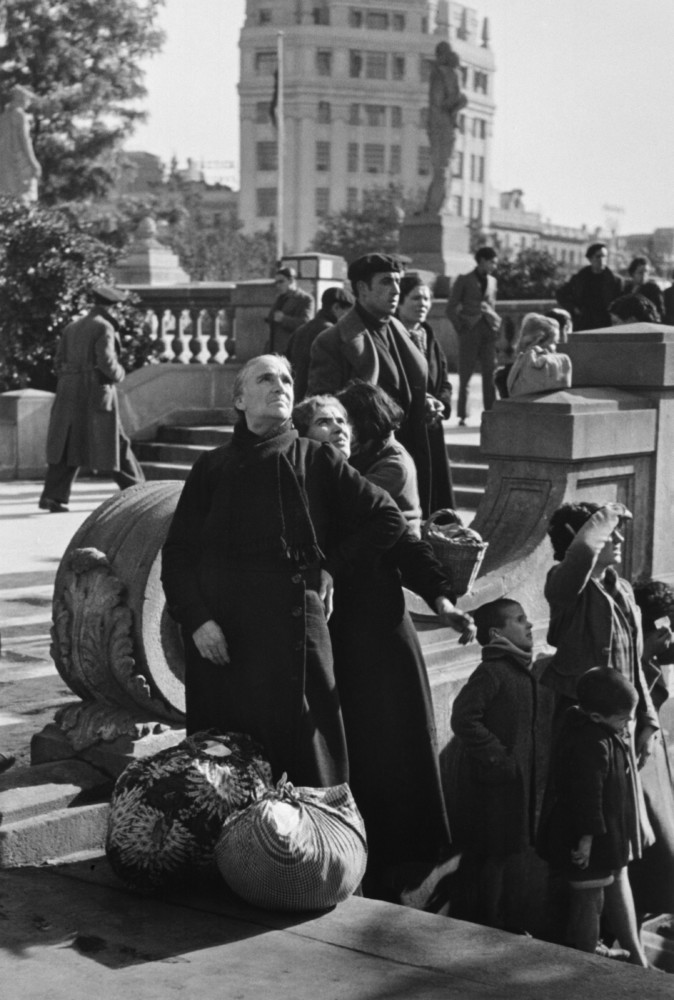
Barcelona is again the target of air raids. The Nationalist counteroffensive in Valsequillo is five days old, and they have taken all 500 square kilometers the Republicans have taken over the month. The Nationalists take the strategic town of Peraleda del Zaucejo, on the Extremadura/Andalucia border. The only other town the Republicans hold falls only three days later. The Republicans have lost almost 6,000 men by this time, for no gain at all.
General Solchaga and General Yagüe’s Nationalist troops reached the Llobregat River, just a few kilometers west of Barcelona, Generals Muñoz Grandes and Garcia Valiño attacked Sabadell and Terrassa, and General Gambara advances to Badalona. Barcelona is now surrounded by the Nationalists and the three lines of defense set up around Barcelona, composed of all men aged 18 -45, with all the city’s industry militarized, cannot save the city. Prime Minister Negrín gets a call from the head of the Republican Army, General Rojo, to tell him that the frontline around Barcelona has been completely shattered.
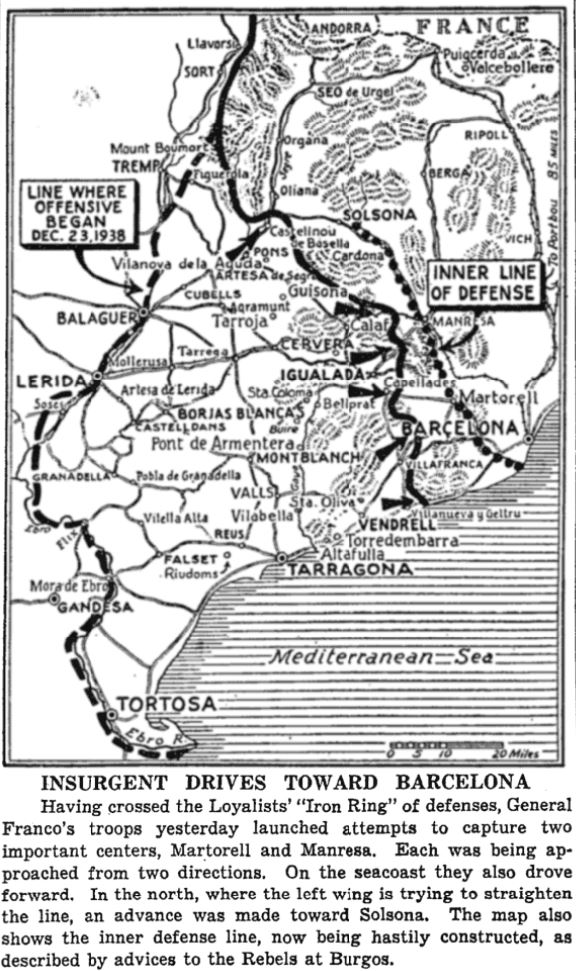
Barcelona’s last line of defense tonight appeared to be crumbling after the capture by Generalissimo Francisco Franco’s troops of San Saturnino, a strategic highway junction fifteen miles due west, and Sitges, formerly a fashionable summer resort on the coast about eighteen miles southwest of Catalonia’s capital. Sitges was recaptured and the Insurgents driven back almost to Villanueva y Geltru, a distance of four miles, according to highly doubtful reports from Barcelona. Igualada, an industrial center some thirty miles northwest of Barcelona on the road to Lérida, was finally occupied by the Nationalists (Insurgents) this morning on the completion of an encircling maneuver by two army corps requiring three days.
Generalissimo Franco’s “win the war” offensive is being carried through its fifth week without giving the Republicans (Loyalists) the slightest respite. In the last few days, the Nationalists have captured Vendrell, Villafranca, Villanueva, Igualada, and Sitges, thus speeding up the drive’s final phase and obliging the Republicans to withdraw behind their last defense line. This line runs from Solsona, in the north, via Cardona to Manresa, whence it follows the course. of the Llobregat River to the sea. Generalissimo Franco’s troops are now approaching the trenches just outside Barcelona. The entire Tarragona province is now in Generalissimo Franco’s hands. His forces operating on the southern Catalan front today pushed further toward Barcelona from Villafranca, which was taken yesterday, to occupy San Quintin de Mediona and San Pedro de Riudevitiles besides San Saturnino. General José Solchaga’s Navarrese division and General Juan Yagüe’s Moroccan Army Corps may strike to the northeast together along the railroad to Martorell where they could cut the main. highway leading through Manresa to Solsona and Berga. San Saturnino is only about seven miles from Martorell.
In the central and northern sectors of Catalonia this morning General Garcia Valino began advancing to the northeast and by early afternoon was reported within five miles of Manresa while. General José Moscardo was reported less than ten miles west of Solsona. Generalissimo Franco has managed to keep the battlefront in a flexible state all the way up to the Pyrenees and he has been able to attack whenever it best suited his convenience as well as wherever he thought it would be easiest to penetrate the enemy lines. His positions tonight above Villafranca and close to Barcelona on the west will enable him to attack the main arteries running up to the French frontier by which the Republican forces in Northern Catalonia are provisioned. General Moscardo continued to progress today in the sector between Pons and Solsona, occupying villages in an advance to a depth. of five miles.
These operations are expected very shortly to isolate the Seo de Urgel zone. The road to Seo de Urgel was cut in several places in the upper Segre River sector, according to a midnight communiqué. In Southern Catalonia the forces advancing along the coast from Villaneuva today passed Sitges and proceeded north, it was announced. Sitges before the war was Barcelona’s most popular bathing beach and summer playground. It has several luxury hotels and many fine homes and cottages. The Nationalist authorities said that more than 40,000 prisoners had been taken since the Catalonia offensive started, not including 2,300 taken today. It was also said that when the band of the Republican Campesino Brigade was captured in a village taken today it began to play the “Royal March,” which has been revived as the national anthem in the Franco zone. General Garcia Valino finally made possible the occupation of Igualada by a corps of mixed Spanish and Italian troops when he conquered all the villages and dominating heights north of the town. The Legionnaires subsequently captured a number of villages before joining forces with some of General Solchaga’s Navarrese in the village of Vallbona. Altogether more than 150 towns and villages are said to have been occupied during the last three days in Catalonia’s most densely populated sector. General Garcia Valino moved northward to attack Manresa, where Loyola composed his book of spiritual exercises 400 years ago. With this evening’s occupation of Rajadell on the railway line from Calaf, General Garcia Valino was just five miles west of Manresa.
Barcelona residents are asked to stop work for a week and aid in defense of the city.
The League of Nations will transport 200 paintings in danger of harm from the Spanish civil war.
The visit to Yugoslavia of Count Galeazzo Ciano, Italian Foreign Minister, is likely to have more fundamentally important results than would appear from the fact that it has not brought forth a new treaty. The visit was concluded tonight after Count Ciano dined with Regent Prince Paul and a limited number of guests. During the day he went shooting on the royal preserves near here. Premier Milan Stojadinović was present with the party and it was made possible for him and Count Ciano to inform the Regent of the principal results achieved during their three days of secluded conference at Belje. It is understood that one important result of the visit will be Hungary’s abandonment of all revisionist claims against Yugoslavia and a visit by Count István Csáky, the Hungarian Foreign Minister. This will be the first visit of a Hungarian statesman to this country since the World War. The purpose will be the signing of a treaty of friendship between the two countries.
In Rome, Premier Benito Mussolini in a public speech, bluntly warned France that Italy would not be budged from its determination to achieve the aims of the Fascist Empire in the Mediterranean and North Africa, ridiculed the opposition of the democracies, and gave winning the Spanish war by insurgents as one of Italy’s objectives.
The French deputy protests the British “invasion” of Minquiers Islands.
The Nazi party converts the army from a nonpolitical independent party into the political arm of the National Socialist regime.
London hears that Italian planes are bulletproof.
In Vauxhall an arrest was made in connection with the IRA S-Plan Southwark explosion.
The “lax and lazy” continue to be punished under strict Soviet labor laws.
Russia observes the 15th anniversary of Lenin’s death.
The moderate influence of the Reichsbank president is praised; his removal causes concern worldwide.
Approximately 110 Jews freed from concentration camps arrive in Vienna.
The atom nucleus is seen as a boon to cancer treatments, as radiation is expected to complement x-rays in cancer care, according to British doctor C.D. Ellis.
A plea is made to allow professional tennis players to participate in the Wimbledon tournament.
By listening for the sound of their cries – they were in fact singing – Esso Baytown rescued six passengers and four members of the crew of the Imperial Airways seaplane Cavalier, who had clung together on the water for ten hours.[] The United States Navy gunboat USS Erie (PG-50) transferred a doctor to Esso Baytown but because of the high seas and darkness had to discontinue the search for any other survivors.The ten survivors were taken to New York, arriving on 23 January 1939; the other three people aboard were lost.
Snatched from the sea after it had claimed three of their number, ten survivors of the lost Imperial Airways flying boat Cavalier, which sank after a forced landing halfway to Bermuda, were en route to New York today aboard the Esso Baytown, the tanker that picked them up after nearly ten hours in the choppy waters of the Gulf Stream clinging to a makeshift raft fashioned from rubber life preservers tied together. The Esso Baytown, a tanker owned by the Standard Oil Company of New Jersey, was bound for Baytown, Texas, from Boston when she went to the rescue of the passengers and crew of the Cavalier, which sank ten minutes after iced carburetors in all four engines forced her down from the clouds to the ocean. Captain Frank Spurr, master of the tanker, put his ship about after the rescue and headed for New York, normally about twenty-four hours’ sailing time from the scene of the disaster. Headwinds of gale force and heavy seas cut down the speed of the Esso Baytown and added to the suffering of the survivors, who all were suffering from shock and exposure. It was announced that the ship could not reach New York until sometime tomorrow afternoon. Captain Spurr advised his office that all the survivors were in good enough condition to travel by automobile but were in need of clothing.
President Roosevelt was expected to send a special message to Congress tomorrow urging legislation for a huge, long-range health improvement program. The plan would provide for expenditures of up to $850,000,000 annually from Federal and State funds up to 1949; it has been a controversial issue ever since it was recommended last June by the President’s Interdepartmental Committee on Health and Welfare.
Senate leaders last night set the stage for confirmation of Harry L. Hopkins as Secretary of Commerce and a swift showdown on President Roosevelt’s demands for restoration of $150,000,000 slashed from his $875,000,000 emergency WPA relief bill.
A compromise anti-lynching proposal, designed to head off prolonged Congressional controversy over this subject, was understood today to have the tacit approval of President Roosevelt. The President was reported to be eager to prevent a repetition of the Senate filibuster of last year which not only killed anti-lynching legislation for the session but also interrupted Senate business. The compromise, reported to have originated with Vice President Garner, would provide for an investigation of all lynchings by the Federal Bureau of Investigation and a public report to Congress of the findings. There were indications, however, that the compromise might not be acceptable to the Southern Senators who participated in last year’s filibuster. Senator Connally of Texas, a leader of the group, said that he could not approve it. He said he was not averse to investigation by the FBI, but viewed the compromise as an “entering wedge” for later, more stringent legislation.
Representative Wadsworth of New York was appointed to head a special committee of eleven Republican Congressmen to investigate national defense needs and examine the Administration’s armament proposals. A clear definition of the United States’ foreign policy was slated as one of the major objectives.
Radio stars continued on the job yesterday and last night despite a strike vote taken in Hollywood Saturday night and in New York and Chicago previously. Commercial sponsors, meanwhile, moved to intervene in the wage dispute between actors and advertising agencies.
A United Auto Workers meeting of the Plymouth Local 51 in Detroit disintegrates into fistfights between supporters of UAW President Homer Martin and his communist opponents. Hardly had the “battle for the microphone” begun when about 300 policemen who had been stationed. in classrooms and in an alley poured into the aisles and made short work of the combatants, pushing them off the stage. When the melee was over a score or more men had suffered slight injuries, bruised cheeks, black eyes and abrasions. The police intervention, however, failed to ensure an orderly meeting. In the midst of a great din a resolution was read by F. J. (Pat) McCartney, a Martin follower, who announced that it had been adopted although scarcely more than a few words were audible in the crowded hall. The resolution backed Mr. Martin in suspending fifteen members of the union’s executive board. Later the anti-Martin forces asserted that the resolution had no standing and charged that it had been presented with the assistance of the police, alleged to favor the Martin group. The Plymouth meeting was one of a series of meetings held here today which indicated how great was the cleavage in the ranks of the auto workers’ union.
The uranium atom was first split at Columbia University.
Stanley D. Embick, U.S. Army Deputy Chief of Staff, retires and is replaced by George Marshall, who retains him on his staff.
Aquatic Park, near Fisherman’s Wharf, in San Francisco is dedicated. Mayor Rossi presides at the ceremonies, attended by a crowd of 7,000 people.
Gate receipts for Sonja Henie’s ice skating shows total $1 million.
China’s victory over Japan by the end of this year was predicted today by Dr. Sun Fo, head of the Legislative Yuan, in an interview. He is the son of Sun Yat-sen, founder of the Chinese Republic. Radiating optimism, Dr. Sun declared: “Japan is rapidly nearing the stage where she will simply be unable to go on and be unable to marshal resources and manpower for continuing the struggle. Seventy percent of her military strength is already exhausted. “Our prospects are progressively brighter. We fight on with growing confidence, new unity and new strength. The expulsion of Wang Ching-wei, who from the very start of the war has been a defeatist and a hindrance to our fullest resistance, was a salutary development. The wavering elements having been purged, the government has now achieved a new solidarity.” Dr. Sun said there was no question that China’s economic and financial resources were sufficient to continue the war to victory. He called the new Japanese Cabinet a “council of desperation.” “The Japanese militarists,” he continued, “are preparing to wreck Japan’s capitalist structure. Collapse and ruin will follow, perhaps revolution.”
Japanese spokesmen reported today that their planes had bombed Yenan, in Northern Shensi Province, destroying the Communist party’s headquarters, the Eighth Route Army’s headquarters and Yenan University. Planes also were said to have attacked Weinan, in Central Shensi on the Lung-Hai Railway, halfway between Tungkwan and Sian, seriously damaging the headquarters of the Chinese First Division, warehouses, the railway station and tracks. Other Japanese fliers raided Pakhoi, in Southwestern Kwangtung Province, near French Indo-China, and Watlam, in Southern Kwangsi Province, northeast of Pakhoi. Japanese dispatches said barracks were destroyed and Chinese troops were machine-gunned in the Pakhoi attack while barracks were bombed in the Watlam operation.
The raid on Pakhoi was seen as a possible prelude to the long-threatened landing of Japanese soldiers there in an effort to cut off munition imports said to be flowing from French Indo-China. Some foreign observers, however, held that the Japanese were delaying efforts to land forces because they were hopeful of undermining Chinese solidarity through negotiations with Generals Li Tsung-jen and Pai Chung-hsi, the Kwangsi leaders. It is believed they might consider a compromise with the Japanese under a threat to invade their province. Chinese reported that guerrillas had begun a series of attacks throughout the Amoy area. Chinese dispatches also said severe fighting continued northwest of Hankow, with the Japanese still unable to advance. After a two-day battle, Chinese reported their forces had repulsed a Japanese column from Paotow, Western Suiyuan, which was attempting to advance into Northwestern China.
Born:
J.C. Tremblay, Canadian NHL and WHA defenseman (NHL Champions, Stanley Cup-Canadiens, 1965, 1966, 1968, 1969, 1970; WHA Champions, Avco Cup-Nordiques, 1977; NHL All Star, 1959, 1965, 1967-1969, 1971, 1972; NHL: Montreal Canadiens, WHA: Quebec Nordiques), in Bagotville, Quebec, Canada (d. 1994).
Bob Reynolds, NFL tackle (Pro Bowl, 1966, 1968, 1969; St. Louis Cardinals, New England Patriots), in Nashville, Tennessee (d. 1996).
Charley Fuller, AFL halfback (Oakland Raiders), in Vicksburg, Mississippi (d. 2001).
Shinichi “Sonny” Chiba [Sadaho Maeda], Japanese martial artist and actor (“The Street Fighter”; “Kill Bill: Volume 1”), in Fukuoka, Japan (d. 2021).
 History Diaries