The U.S. Joint Chiefs of Staff sent a classified memorandum to U.S. Defense Secretary Robert S. McNamara, urging an expansion of U.S. involvement in the Vietnam War, advocating heavy bombing of North Vietnam, and deployment of troops in South Vietnam for an eventual invasion of the North. The U.S. Joint Chiefs of Staff inform Defense Secretary McNamara that “we are wholly in favor of executing the covert actions against North Vietnam… We believe, however, that it would be idle to conclude that these efforts will have a decisive effect on the Communist determination to support the insurgency; and it is our view that we must therefore be prepared fully to undertake a much higher level of activity…” Among their recommendations are “aerial bombing of key North Vietnam targets” and “commit[ment of] additional U.S. forces, as necessary, in support of the combat action within South Vietnam.”
The South Vietnamese Defense Ministry reported today that 31 Viet Cong guerrillas and two Self‐Defense Corps members had been killed in two encounters. A Defense Ministry spokesman said a company of corpsmen clashed with guerrillas yesterday in the southern part of the country and killed 27 guerrillas. Two corpsmen were reported wounded. Early today the guerrillas mined a village council building 12 miles southwest of Saigon. The spokesman said four guerrillas and two corpsmen were killed and eight corpsmen were wounded.
The cholera epidemic in South Vietnam has spread to 12 provinces of the populous and embattled Mekong Delta, taking about 300 or more lives, medical sources said today. The United States foreign aid mission announced that it was ordering seven million doses of vaccine and was stationing eight doctors and nurses in a Saigon hospital, where cholera patients were arriving every few minutes. The United States Navy has brought in a six‐man team of cholera specialists from a base in Taiwan to help the Vietnamese authorities combat the disease in Saigon, which has suffered the worst outbreak.
The French Government pushed its expanding foreign policy today toward new objectives in Latin America and in Southeast Asia. The office of President de Gaulle announced that he would visit Brazil as the guest of President João Goulart. The visit will probably take place during the latter part of this year. In March the French President will pay a state visit to Mexico. After a Cabinet meeting this morning, a spokesman said the Government intended to pursue active diplomatic and trade policies in Southeast Asia. These are coupled with the coming French recognition of the Chinese Communist Government.
Secretary of State Dean Rusk expressed fear today that the rupture of relations between the United States and Panama increased the danger of Communist sabotage of the Panama Canal. Mr. Rusk raised the point as one reason that Washington wanted a peaceful and friendly settlement of the dispute as soon as possible. The Secretary discussed the subject at a meeting with the Inter‐American Peace Committee of the Organization of American States. His remarks were not made public but persons present disclosed the substance of the talks. One aspect of the present crisis the Secretary emphasized was that the possibility of sabotage of the canal was of grave concern to the security of the entire hemisphere as well as to the United States.
The French believe that the first moves in their campaign to reassert their presence in Southeast Asia have been successful. According to one source, they feel that in Saigon and Hanoi, the capitals of South and North Vietnam, France now casts a longer shadow because of her approach to the Peking regime. It is also felt that the French offer of aid to Cambodia, small though it was, has shown Southeast Asia that another country besides the United States is interested in the region’s welfare.
South Vietnam’s Council of Notables, the highest civilian advisory body to the ruling military junta, urged the suspension of relations with France because of a reported French proposal for settlement of the war against the Communist guerrillas.
Indonesia and Malaysia have agreed to a ceasefire in their undeclared border and to new three‐power talks with the Philippines soon to seek a final solution of the Malaysia crisis. The agreement was announced today by Attorney General Robert F. Kennedy of the United States and President Sukarno of Indonesia. It came at the end of their second round of talks on the bitter dispute over the new British-sponsored Federation of Malaysia. The three‐power meeting will bring together the foreign ministers of the three chief nations in the dispute. Mr. Kennedy said that he hoped it would lead to a new summit conference of President Sukarno; the Prime, Minister of Malaysia, Prince Abdul Rahman, and President Diosdado Macapagal of the Philippines. The agreement to stop the undeclared guerrilla war along the Borneo border between Indonesia and Malaysia and return to the conference table marked a victory for the 38-year-old Attorney General’s mission to the Far East.
Premier Fidel Castro of Cuba has given his long‐withheld approval to the treaty banning all but underground nuclear tests. In exchange he is getting increased Soviet aid for Cuba. This development came as Castro expressed his support for the Soviet Union in the ideological dispute with Communist China. The Peking regime has denounced the nuclear treaty. Cuba’s decision to support the Soviet Union in this dispute was made clear here early today in a joint Soviet‐Cuban communiqué on the Cuban leader’s visit to the Soviet Union.
Secretary of State Dean Rusk said last night that countries that were supplying Cuba with goods vital to her economy were harming the Western Hemisphere’s defenses against Communism. Mr. Rusk said the United States could not accept the contention that trade with Cuba was the same as trade with any offer Communist country. The comments were made in a speech at the 75th anniversary celebration of Barnard College at the Waldorf‐Astoria Hotel. The celebration was held in honor of Queen Frederika of Greece. Fourteen college presidents and 1,500 Barnard alumnae attended. Mr. Rusk said Cuba continued to encourage and to engage in subversive activities in the Western Hemisphere.
Preparations for last week’s pro‐Communist revolution in Zanzibar began quietly in Cuba late in 1961, when a Zanzibari political office was established in Havana. They reached their peak with the arrival six weeks ago of a Cuban chargé d’affaires in Dar es Salaam, Tanganyika. The detailed story of Cuba’s involvement in the Zanzibar revolt and Cuban activities in connection with the training of East African and South African guerrillas and other African groups has been pieced together from reliable reports that became available today. In addition to tracing the Cuban strategy in preparing for the revolution in Zanzibar, which lies off Tanganyika, the information, which comes from many quarters, discloses that several hundred African “students” are being trained in Cuba. The training is said to include guerrilla warfare tactics.
Tanganyikan President Julius K. Nyerere reappeared in public today and toured a capital of Dar es Salaam battered and stunned by Monday’s army mutiny. The mutiny left 17 persons dead and at least 100 injured. Few cheers greeted the 42‐year‐old President. Saddened eyes met him as he tried to reassure the victims of day‐long rioting, looting and killing in the city’s Indian and Arab quarters. Shattered glass still covered the sidewalks outside several boarded‐up shops. “Everything is all right.” Dr. Nyerere kept saying during the three‐and‐a‐half‐hour tour. At one point a group of African children started to flee at the sight of the President’s motorcade of four official cars and two motorcycle policemen. Dr. Nyerere got out to calm them. “Why are you running away?” he said. “There is nothing to be afraid of.”
Dr. Nyerere stopped before several African housing projects rising in the city, as if to seek reassurance. Many fear that neither the President nor the country will ever be the same again. For an entire day the mutineers were the supreme power in Tanganyika. They seized Dar es Salaam to demand more pay and to protest the fact that officers still led them. two years after Tanganyika attained independence from Britain. The soldiers forced the Government to give them more money, and they forced their 35 British officers to flee the country. So far, no one has been disciplined. “They can break out of their barracks again at any moment and seize power at will.” one Tanganyikan said tonight.
Kenneth Kaunda was inaugurated as the first Prime Minister of Northern Rhodesia, now Zambia. At 39 years of age, he is the youngest Premier in the British Commonwealth. Full results of this week’s general election, the first in the now‐self‐governing British protectorate on the bases of “one man, one vote,” are not expected until tomorrow or Friday but Mr. Kaunda’s United National Independence party already has virtually eliminated all African opposition. Of the 75 Parliamentary seats at stake, Mr. Kaunda’s supporters have 47 and Harry Nkumbula’s African National Congress has two. Although Mr. Kaunda’s success with the Africans seems almost complete, his attempts to woo Northern Rhodesia’s 75,000 whites have failed. Whites voted this week on a special roll with Asians to elect 10 representatives of their own.
U.S. President Lyndon B. Johnson and Canada’s Prime Minister Lester B. Pearson signed an agreement at the White House, establishing the jointly-operated Roosevelt Campobello International Park at the former summer home of the late President Franklin Roosevelt in New Brunswick. Agreements were signed in the White House on a multimillion‐dollar power and flood control development for the Columbia River Basin in the Pacific Northwest and for making an international park at the summer home of President Franklin D. Roosevelt on Campobello Island, New Brunswick, off the Canadian East Coast. President Johnson and Prime Minister Lester B. Pearson presided at the exchange of notes this morning to implement a treaty for cooperative source development on the Columbia River. This afternoon they signed an intergovernmental agreement to establish Roosevelt Campobello International Park.
Lal Bahadur Shastri, the candidate of Indian moderates and conservatives to succeed to the post of Prime Minister, joined the Cabinet of the ailing Jawaharlal Nehru tonight as Minister Without Portfolio. The appointment is regarded as tantamount to a Deputy Prime Ministership and as indicating for the first time Mr. Nehru’s choice of a political heir. It is also regarded as a sharp defeat for the extreme leftists in Mr. Nehru’s Congress party. The faction headed by former Defense Minister V. K. Krishna Menon has sought for the last week to head off the nomination favored by the mass of the party.
Dr. Edward Teller said today that “I am pretty well convinced the Russians have all our secrets and I am even afraid they have the secrets we are going to discover in the next two years.” The physicist gave his opinion as a reason for less secrecy in Government research. “Our industry and our citizens don’t have those secrets,” he told a special House committee studying the Government’s $15 billion‐a‐year research effort. Dr. Teller said that in general he thought it an exaggeration to say private industry and the economy were suffering because the Pentagon was keeping important scientific discoveries secret. But he said that the practice had been to keep a secret label on a development unless it could be proven beyond a doubt that making it public would not harm the national interest. “I think the burden of proof should be on the other side,” he said.
In its first public violation of the 1959 requirement for all aircraft operating from the aircraft carrier Minas Gerais to belong to the Brazilian Air Force, the Brazilian Navy steamed Minas Gerais into Guanabara Bay at Rio de Janeiro with four navy T-28 Trojan trainers on her flight deck.
President Johnson’s request for an immediate reduction to 14 per cent in the income‐tax withholding rate was unanimously approved today by the Senate Finance Committee. The committee amended the Administration’s $11 billion tax reduction and reform bill to provide for the full cut in withholding a week after the measure was enacted. The present rate is 18 per cent. It applies to the taxpayer’s wage or salary after deductions of $600 in personal exemptions for himself and each dependent. The reduction would give the country’s wage and salary earners an increase of $800 million a month in take‐home pay. The new rate would apply to all pay checks received more than seven days after the bill became law. Present indications are that the measure, passed by the House last September 25, will reach the White House by mid‐March.
A Senate Judiciary subcommittee came to grips today with a series of questions arising from the grave and delicate issue of Presidential succession and inability. Would the American people accept the automatic succession of a Democratic President by a Republican who happened to be the presiding officer of a Republican‐controlled House of Representatives? To prevent this frustration of the electorate, would Congress invoke its untouched constitutional prerogative to order a special election? And even if the House Speaker were a Democrat, should he be expected to surrender the position it took him 40 years to acquire to substitute for a few weeks or months for a President who was physically or mentally unable to discharge his duties?
These were only some of the more obvious questions. Four members of the subcommittee testified today on the problem and suggested some solutions. But no two agreed on details. Three senators did agree that the nation should never be without a Vice President, even if the President and his elected running mate died in office. There should be a constitutional amendment, they agreed.
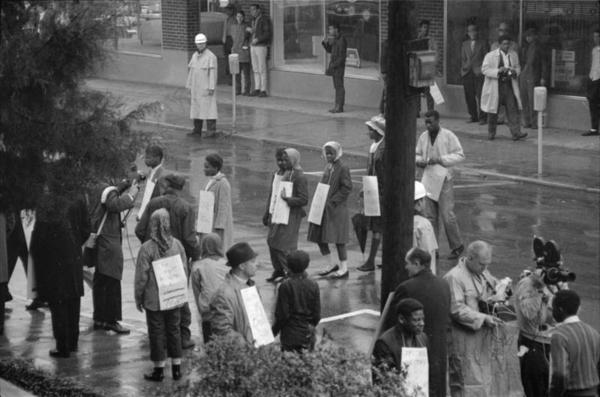
Today is “Freedom Day” in Hattiesburg, Mississippi. A cold rain is falling. Fifty African Americans, mostly students plus a few adults, plus thirty of the northern clergy, picket the Forrest County courthouse. Some carry signs with SNCC’s new slogan, “One Man One Vote.” Close to 100 Black adults are lined up at the building to register, their numbers dwarfing all previous attempts.
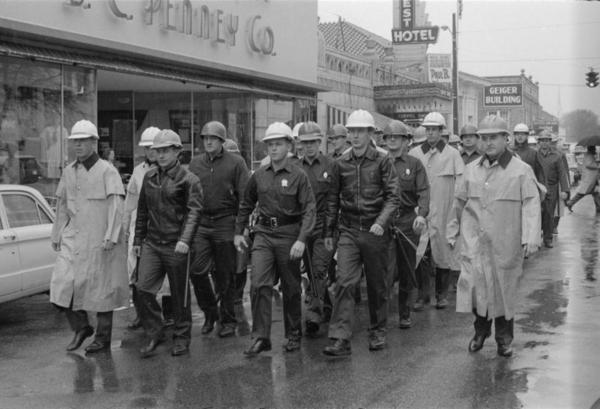
A phalanx of cops and volunteer “auxiliary police” in helmets and rain slickers, guns on their hips, clubs in their hands, march down the middle of Main Street towards the protesters. Using a bullhorn, they issue their order: “This is the Hattiesburg Police Department. We’re ordering you to disperse. Clear the sidewalk!” The pickets hold the line. No one leaves. The cops threaten again. The pickets hold. SNCC leader Bob Moses is arrested for “Disturbing the Peace” when he tries to escort an elderly Black woman into the courthouse to register. But none of the pickets are arrested. For the first time in living memory, an inter-racial civil rights demonstration in Mississippi is not suppressed. As it becomes clear there won’t be a mass jailing, more people join the picket line, swelling it to over 200 who by the end of the day are massed on the courthouse steps singing freedom songs.
Eleven Black parents asked the United States District Court today to force immediate and total racial desegregation of all Iberville Parish (county) public schools. The National Association for the Advancement of Colored People filed suit in behalf of the parents, seeking a preliminary injunction against the parish school board. The parents sought integration of all levels of all public schools. If immediate action could not be granted, they asked the court to order the board to submit a total desegregation plan in less than a year. They asked the court to reject any plan that would provide for grade‐a‐year desegregation. Plaquemine, Louisiana, the parish seat, was the scene of racial violence this fall during an intense civil rights drive sponsored by the Congress for Racial Equality.
The Senate investigation into the affairs of Robert G. Baker continues to turn up disquieting revelations. But it is not pursuing them as unflinchingly as the best interests of the American people demand. Congress now has no code of ethics to guide its members on possible conflicts of interest between their private business pursuits and their duties as legislators. The time has come‐if it is not already long overdue‐when this difficult and delicate subject demands the fullest exploration, consideration and then action. When our new President publicly disclosed that his wife had divested herself of control over her television enterprises, the nation applauded. Now it has been testified that an insurance man who had sold Mr. Johnson a large amount of life insurance while he was the Senate majority leader made him a present of a valuable stereo set. This the White House denies, asserting Mr. Johnson believed the set was a gift from his longtime protégé, Mr. Baker. The same insurance agent has testified that he paid $1,200 for advertising on a TV station controlled by the Johnson family. He added that he later sold the rights to an advertiser for $160. On this whole alleged episode there was no comment from the White House.
The candidacy of Lieutenant Colonel John H. Glenn Jr. has already generated considerable excitement among Ohio voters and politicians. But early indications are that the astronaut will face a difficult battle to win a Senate seat if he does get the Democratic nomination. Colonel Glenn’s victory here Monday in blocking the Democratic party’s endorsement of Senator Stephen M. Young for renomination clearly indicates the space hero’s popularity in his native state. But Ohio voters are generally conservative and independent. Talks with them here today made it clear that there remained some question as to how well Colonel Glenn would be able to translate his popularity votes. Interviews with citizens in this capital city turned up many persons who believed the colonel had tarnished his image by plunging into politics. There was also sharp criticism from voters and newspapers who questioned whether he was qualified for the job.
A defense attorney in the jury‐tampering trial of James R. Hoffa and five other men charged in court today that Government agents had both defense attorneys and the defendants under surveillance. The lawyer, Jacques M. Schiffer of New York City, also said he was convinced that his telephone was tapped. The charges brought a sharp denial from James F. Neal of the Justice Department’s Criminal Division, one of the prosecution lawyers. “The Government states categorically, without any reservation, that no phone is being tapped and that no counsel or defendant is being surveilled,” Mr. Neal said. “I don’t believe it,” Mr. Schiffer retorted.
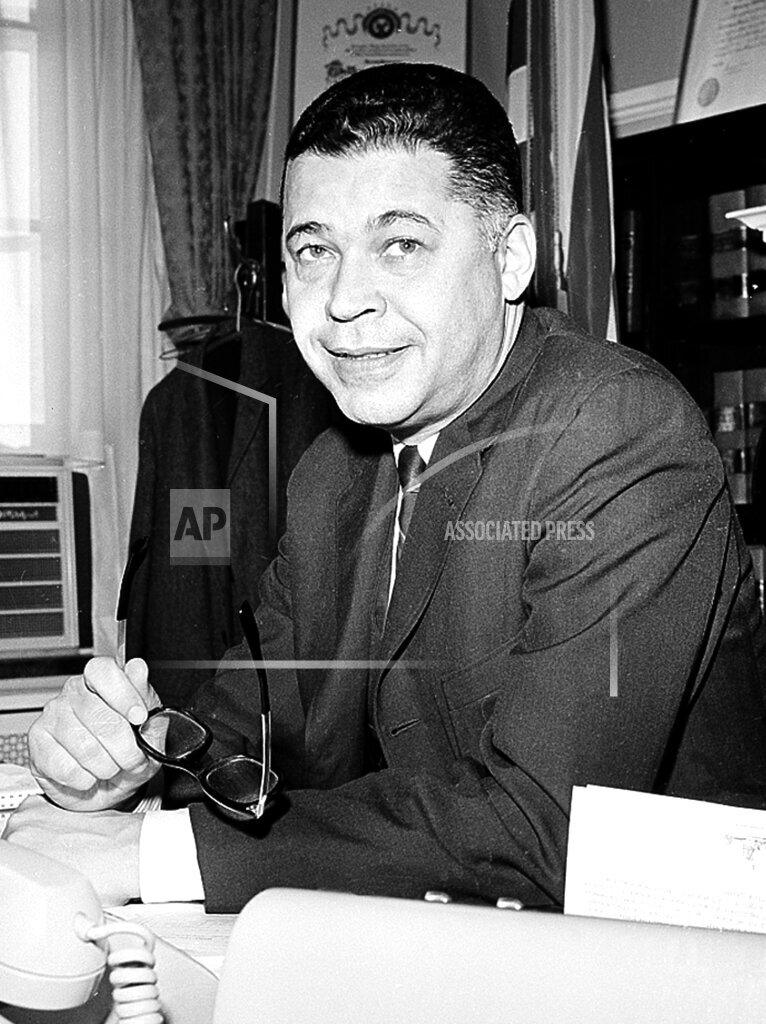
The House and Senate paid tribute today to Edward R. Murrow, the retiring director of the United States Information Agency. At the same time, there were expressions of confidence in both houses that Carl T. Rowan would do well as a replacement for the former broadcasting personality. Mr. Murrow’s resignation effective Monday, and Mr. Rowan’s appointment were announced yesterday by the White House. Mr. Murrow said he could not give the job the attention it demanded. He is recuperating from a lung cancer operation. In the Senate, Hubert H. Humphrey of Minnesota, the Democratic whip, credited Mr. Murrow with turning the information agency into a major force for molding world opinion.
President Johnson tonight extended an open invitation for the world’s young people, particularly those behind the Iron Curtain, to come see the sights of America’s past and learn the fallacy behind “the demagogue’s dingy slogans.” Mr. Johnson spoke at the dedication of the Smithsonian Institution’s $36 million Museum of History and Technology, with exhibits tracing the cultural and technological development of the United States. The museum will be opened to the public tomorrow. “I hope every school child who visits this capital, every foreign visitor who comes to this first city, and every doubter who hesitates before the onrush of tomorrow, will spend time in this museum,” Mr. Johnson said.
World’s largest cheese (15,723 kg) manufactured in Wisconsin for New York’s World Fair.
Dow Jones Industrial Average: 781.31 (+4.87).
Born:
Nigel Benn, British world super-middleweight boxing champion (1992 to 1996); in Ilford, England, United Kingdom.
Wayne Kirby, MLB outfielder (Cleveland Indians, Los Angeles Dodgers, New York Mets), in Williamsburg, Virginia
Stojko Vrankovic, Croatian NBA center (Boston Celtics, Minnesota Timberwolves, Los Angeles Clippers), in Drniš, Croatia, Yugoslavia.
Derrick Shepard, NFL wide receiver and punt returner (Washington Redskins, New Orleans Saints, Dallas Cowboys), in Odessa, Texas (d. 1999).
Tony Robinson, NFL quarterback (Washington Redskins), in Monticello, Florida.
Chris Pacheco, NFL nose tackle (Los Angeles Rams), in Los Angeles, California.
Chris Matau, NFL guard (Los Angeles Rams), in Torrance, California.
Larry Joyner, NFL linebacker (Houston Oilers), in Memphis, Tennessee.
Joe Dudek, NFL running abck (Denver Broncos), in Boston, Massachusetts.
Scott Shaunessy, NHL defenseman and left wing (Quebec Nordiques), in Newport, Rhode Island.
Maria Ellingsen, Icelandic actress (Katrina-“Santa Barbara”), in Reykjavik, Iceland
Died:
Marc Blitzstein, 58, American composer, was robbed and fatally beaten while on vacation in Martinique, after attempting a sexual encounter with a merchant sailor the previous evening; Blitzstein was able to make his way to the public square and taken to a hospital and asked the U.S. vice-consul to inform his family and the press that he had been injured in an auto accident, then died of a ruptured liver.
José Ramón Guizado, 65, President of Panama for 13 days in 1955 after the assassination of President José Antonio Remón Cantera; Guizado served two years in prison after being convicted of complicity in the murder of President Remón, then exonerated and released.




 History Diaries