An insurgent force estimated to number 2,000 men reportedly withdrew from positions eight miles northwest of Phnom Penh today as Government troops advanced on them from four directions. More than 5,000 Government soldiers aided by armored personnel carriers and air strikes were said to have participated in the operation. Reports from the field said that resistance was light and that most of the insurgent troops had withdrawn to the west. Government soldiers were reportedly pursuing them.
Casualties were not immediately given, but reports from the field said that bodies of insurgent soldiers were scattered over the area, that air strikes had devastated hamlets and that army jeeps were hauling off captured weapons. Government troops were said to have found three rocket launchers improvised from bamboo six miles northwest of Phnom Penh. Insurgents have been firing Soviet‐made 122‐mm. rockets into Phnom Penh almost daily. The rocket attacks have killed 45 persons and wounded nearly 150 since December 23. The government operation was reportedly carried out by the Cambodian Army’s First Division, sweeping in from the northeast, the 28th Independent Brigade driving from the south, and troops of the Seventh Division and the 13th Brigade moving in from the north and south to try to cut off the escaping rebels.
Arab nations may soon lift their oil embargo against the United States. Secretary of State Henry Kissinger allegedly received assurances to that effect from Arab countries. Kissinger called the failure to end the embargo “highly inappropriate” and noted that the U.S. has no legal obligation to enforce the Mideast peace agreement.
Arab oil ministers had no comment on Kissinger’s statement, though President Sadat of Egypt hinted at ending the embargo. U.S. oil executives stated that the end of the embargo won’t by itself solve the energy crisis, and the increase in Arab oil imports is unlikely to be dramatic.
The Egyptian‐Israeli agreement on the separation of forces on the Suez front has split the Palestinian guerrilla movement and led to a challenge to Yasser Arafat’s leadership. According to Arab sources in Cairo, Mr. Arafat, who heads the Palestine Liberation Organization the overall guerrilla group, as well as Al Fatah, the largest commando organization, is trying to stop the growing hostility toward the accord from turning into a conflict between the Palestinians and the Egyptian Government. The sources said the situation was expected to render more difficult efforts of Egypt’s President, Anwar el‐Sadat, to persuade the Palestinians to attend the next stage of the Middle East peace negotiations in Geneva. The Palestine Liberation Organization’s weekly paper voices strong criticism of the agreement in an editorial slated for publication tomorrow.
Palestinian students, including those belonging to Al Fatah itself, have called for a strike at Lebanese universities tomorrow against the Egyptian‐Israeli disengagement agreement, which student circular has described as a serious blow to the Palestinian cause. Prominent elements within the Palestine Liberation Organization have not only condemned the disengagement agreement but also defied Mr. Arafat’s efforts at coordination with Cairo. The representative of the Marxist Popular Front for the Liberation of Palestine on the Palestine Liberation Organization’s executive committee has said that the committee never approved the establishment of a coordination committee with Egypt. He was commenting on a report in Cairo’s Al Ahram Sunday that said such a committee was formed after Mr. Arafat had met with President Sadat in the Upper Nile town of Aswan. Remarks made by President Sadat during his tour of the Arab states have been used against Mr. Arafat. During his stopover in the Persian Gulf emirate of Abu Dhabi, President Sadat said that Mr. Arafat was with him in Aswan when he signed the disengagement agreement in the presence of Secretary of State Kissinger.
The Israeli parliament approved the Mideast disengagement plan. Prime Minister Golda Meir won a major victory for her party, but opposition leader Menachem Begin called the agreement terribly one-sided. Foreign minister Abba Eban defended the agreement, stating that it offers Israel a good line of defense along with many other advantages. The withdrawal of troops will begin Friday.
Violence erupted in Northern Ireland’s provincial assembly today as militant Protestants demonstrated at the first session attended by the new Protestant‐Catholic coalition. The police were called in, and one by one, 18 demonstrators were carried out of the chamber in what had been advertised as a day of “direct action.” Five policemen were injured. In the outburst members bowled down their speaker and grabbed the mace, symbol of the Parliament’s authority. It took eight security men to remove the Rev. Ian Paisley, organizer of the demonstration. One of his colleagues struggled furiously and sent a policeman of the Royal Ulster Constabulary staggering against the Speaker’s chair. More than 400 policemen, supported by the military police and British Army armored cars, were on duty outside the Assembly building at Stormont, in the Belfast suburbs. However, the protest was confined to the Assembly chamber.
Among the protesters were members of the Unionist party, which dominated the Ulster Parliament for half a century until Britain removed the Government and assumed direct rule in 1972. Brian Faulkner, who heads the new executive, or government, resigned his leadership of the party earlier this month after failing to win approval for his acceptance of power-sharing. Protestants share power with Roman Catholics in the executive for the first time in Northern Ireland’s half century as a British province. Earlier meetings of the Assembly have also been broken up., Mr. Paisley has threatened to repeat the performance tomorrow. His aim is to make the government and Assembly unworkable and to force abandonment of power‐sharing, in the belief that it is a stage on the road to unification of Northern Ireland with the Irish Republic. “This isn’t democracy,” Mr. Paisley said later in complaining that his arm had been almost broken by policemen. “Our protest was constitutional, but we were met with jackboot fascism.”
The official Soviet news agency Tass responded with unusual dispatch to writer Alexander Solzhenitsyn’s latest interview with Western newsmen, saying it showed once again his “pathological hatred” for the Soviet Union and its people. Tass commentator Yuri Kornilov said the writer’s statements were “further evidence showing into what depth of moral degradation this anti-Sovietist has slipped.” In the interview Monday, Solzhenitsyn said his fellow citizens should stop cooperating with “the lie” on which he said the Soviet state is based.
Greek university students announced the formation of a committee to press demands for political and academic freedoms as many students boycotted classes. Student leaders threatened troubles worse than last November’s rioting, in which at least 13 persons were killed, unless the government meets their demands. Greek university students boycotted classes today to press demands for political and academic freedom. They also demanded an end to what they called the “sale of Greece to the Americans.” Student leaders threatened that unless the Government satisfied their demands, there would be trouble worse than the riots in November, in which at least 13 people were killed and 150 injured. Those demonstrations also set the stage for the overthrow of President George Papadopoulos a week later.
Interrogation of persons arrested during last week’s anti-Japanese riots in Indonesia has revealed an attempt to overthrow President Suharto and change the constitution, according to Suharto’s personal assistant for special affairs, Major General Ali Murtopo. He said the riots during the visit of Japanese Prime Minister Kakuei Tanaka were “clearly an act of subversion and treason.” Seven hundred and seventy-five persons, many of them students, were arrested during and after the riots, in which police and troops killed 11 persons.
President Suharto of Indonesia issued Decree No. 25/74, banning the import of foreign-made automobiles, and encouraging the sale of Indonesian-made pickup trucks and minibuses by exempting those vehicles from the luxury goods tax.
About 50,000 workers were on strike in Bolivia to protest the doubling of the price of six basic food items and a 15% increase in bus fares. The military government said it doubled the prices on such items as flour, rice, sugar and coffee to stem smuggling to neighboring countries, where the foods bring a higher price. About 35,000 miners, the nation’s most powerful labor group, are demanding more than the $20-a-month pay hike the government ordered to offset the price increases. Also striking are 14,000 industrial workers from about 100 plants in La Paz.
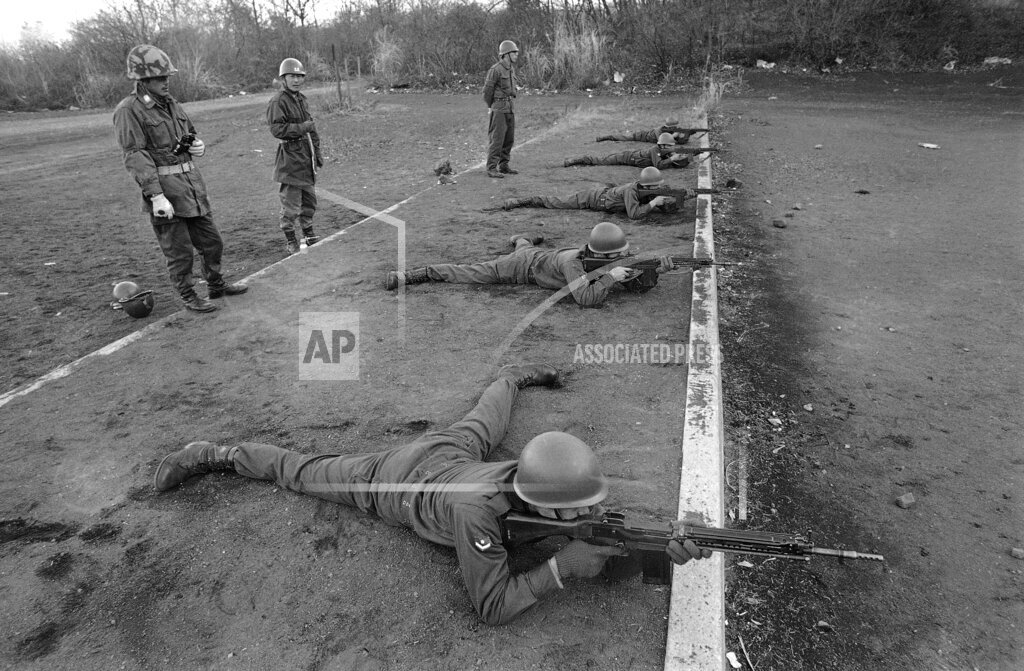
Argentine police exchanged gunfire with demonstrators in the center of Buenos Aires when the leftists protested stiffer penalties the government says it will bring against guerrillas. The mob ran through the street, scattering leaflets signed by two guerrilla organizations — the People’s Revolutionary Army and the Liberation Armed Forces. Police used tear gas and rubber bullets. Demonstrators sniped at them from a building, police said.
A hijacked Colombian airliner, carrying 12 passengers and a crew of five, returned to Barranquilla, Colombia, after spending nearly 14 hours at Havana airport. The hijacker, a left-wing extremist in his mid-20s, said he was protesting Colombian and Latin American oppression, according to a Swiss Embassy official in Havana. As Cuba and Colombia have no diplomatic relations and have signed no bilateral hijacking treaty, it is unlikely that the hijacker will be extradited. All passengers were reported in good condition.
A Zulu politician marched at the head of 5,000 striking textile workers to a struck cotton mill in Durban and negotiated a new wage agreement that might end South Africa’s worst strike in a year. Barney Dladla, minister of community affairs in the Kwazulu community, spent more than three hours with the management of the Frame textile group, which owns five of the 11 struck mills.
Senator Barry Goldwater said today that Watergate would cost every Republican candidate a “disastrous” 10 percent of the total vote this year. The only way President Nixon can help the situation, the Arizona Republican hinted, is by resigning. Senator Goldwater did not urge Mr. Nixon to resign. And he emphasized that he had not seen evidence of wrongdoing that, by itself, warranted either resignation or impeachment. But, as a political matter, he said, unless some sort of “magic” soon redeems the Nixon Presidency, “it’s going to be goddamned tough for any Republican to get re‐elected, including myself, and I look in pretty good shape.” “I can sense a strong feeling right here on the Hill — and you’re going to see it more and more as weeks go on — that many Republican members of Congress would like to run this year without Mr. Nixon,” he declared.
Mr. Goldwater’s analysis, in two interviews, marked his sharpest warning to the Nixon White House in nearly a year in which the Senator has sent up varying signals on the Watergate affair. One close associate of the Senator said that he thought the Arizona conservative, who was the Republican Presidential nominee in 1964, was close to a final break with Mr. Nixon. Senator Goldwater emphasized, for example, in an interview with The Associated Press, that “we have a good man in the Vice President, and there would be no transition problem at all. “I can see nothing wrong with Ford becoming President if Mr. Nixon resigns or steps aside,” Senator Goldwater said. “He’s a guy that’s Mr. Clean. He’s an All-American boy. Everybody likes him.”
President Nixon is ignoring rising demands that he resign, is determined “not to be consumed for another year” by Watergate and fully intends to serve out the three years remaining in his term, Ronald L. Ziegler, his press secretary, said today. Mr. Ziegler, in a rare appearance, before White House reporters, said that Mr. Nixon intended to be so busily engaged in running the government over the weeks ahead that he would be able to move off the defensive on Watergate and related matters. “That is what he is determined to do,” Mr. Ziegler said. “He is determined not to become consumed for another year by the Watergate matter. He fully intends to complete his three years in office, and is not entertaining at all the subject of resignation.
Special Prosecutor Leon Jaworski asked permission today from the United States District Court to turn over to the Internal Revenue Service information on possible illegal corporate campaign contributions. The purpose of this, he said in, a motion filed with Chief Judge John J. Sirica, is to assist the revenue service “in its investigation of possible tax liabilities of individuals, corporations and political committees or organizations.” Two earlier similar requests by the former special prosecutor; Archibald Cox, came to light today. The earlier requests involved evidence developed by the two original Watergate grand juries, and the latest involved the third grand jury, which was sworn in January 7. Both earlier requests were granted.
The Senate continued oil hearings. Executives denied making windfall profits from the fuel shortage. Gulf president Z.D. Bonner revealed the amount of taxes paid by Gulf for one year, and noted that oil companies must pay taxes in each country in which they operate. Though most Senators were critical, Senate Finance Committee chairman Russell Long said that he sympathizes with the industry somewhat and stated that even stopping all profits of oil companies would not solve the energy crisis. Senate leaders hope to vote on an emergency energy bill this week, but the bill has been stalled by the windfall profits controversy.
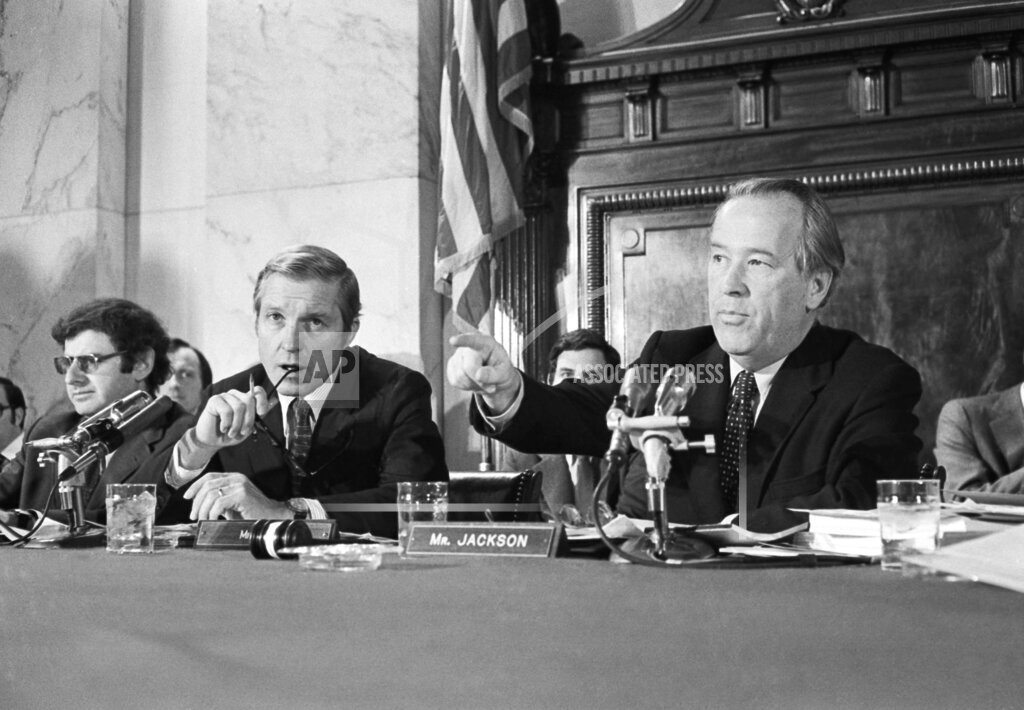
The seven largest oil companies operating in the United States increased their profits 46 percent in the first nine months of 1973, at a time when their prices were rising sharply, although they sold only 6 percent more of their products than the year before, a Senate hearing was told today. The figures, compiled by the staff of the Senate Permanent Subcommittee on Investigations, were presented by its chairman, Senator Henry M. Jackson, Democrat of Washington, on the second day of its hearings into the energy crisis.
A Senate committee chaired by George McGovern opened hearings to determine the effects of the energy crisis on the poor and elderly. McGovern and Jacob Javits will push for legislation to help the disadvantaged.
The government must enforce the July, 1975, deadline requiring coal-burning power plants to clean up the air. Environmental Protection Agency deputy administrator John Quarles warned of criminal charges if compliance isn’t met.
The first annual “National March for Life” rally took place in Washington, D.C., on the steps of the U.S. Capitol on the one-year anniversary of the U.S. Supreme Court decision in Roe v. Wade, legalizing abortion nationwide. The rally was organized by activist Nellie Gray, who coined the term “pro-life”. Police estimated the crowd to be more than 6,000 protestors.
Consumer prices continued to rise strongly in December and finished the year with the largest annual increase since the immediate aftermath of World War II, the Labor Department said today. The rise in the Consumer Price Index for December was five-tenths of 1 percent after adjusting for normal seasonal changes in some prices, actually a little less than in most recent months. But the national index rise was still a large increase by historical standards.
Timothy Kerley, who almost became the 28th victim of a sex, torture and murder ring, told a pretrial hearing in Houston that Dean Corll, the ring’s leader, had begged a companion to kill him — and that the companion did. Elmer Wayne Henley, 17, accused of six of the 27 murders of boys committed by the ring, will be tried in one of the slayings. He told police he killed Corll, 33, last August 8 at a party that had turned into a sex orgy. Kerley, 20, said Henley shot Corll to prevent Corll from sexually assaulting him, Kerley.
Attorneys for billionaire Howard Hughes sought dismissal of an indictment charging him with stock manipulation and conspiracy in his purchase of Airwest Airlines. The lawyers said in a motion filed in federal court in Reno that the indictment lacked sufficient facts to constitute an offense against the United States and the federal court lacked jurisdiction. A summons was issued for Hughes to appear in court Friday but federal officials said they had been unable to serve it. Hughes is outside the United States, apparently in the Bahamas.
Governor Tom McCall revised flood damage figures for Oregon to $58.4 million and boosted to 17 the number of counties for which he is seeking federal disaster relief funds. Idaho Governor Cecil D. Andrus has asked for disaster designation for northern Idaho. He estimated damage at more than $50 million and said 10,000 persons had been made homeless.
Five architectural firms and 19 persons, including the brother of Kansas Governor Robert Docking, were indicted in Topeka on bribery conspiracy charges relating to fundraising for Docking’s 1972 campaign. A Shawnee County grand jury returned two indictments. One accuses the firms and 18 persons of conspiring to pump money into Docking’s campaign in return for a contract for expansion of the University of Kansas Medical Center. Among the 18 was George R. Docking, who was chairman of his brother’s campaign. The second indictment accuses Richard L. Malloy, Docking’s former patronage aide, of accepting a bribe.
The “buddy system” might save the lives of thousands of persons who put off calling a doctor when they experience heart attack symptoms, according to a Rochester, New York, physician. Dr. William A. Greene told an American Heart Association science writers’ seminar in Marco Island, Florida, that some people procrastinated — and reached the hospital too late — because they could not “tolerate the helplessness entailed with the interruption of ongoing activities and being sick.” Having a designated “buddy, such as a spouse or co-worker, call the doctor would relieve many of their psychological block, he said. Of 750,000 heart attack deaths each year, about 400,000 occur within one hour and the person never reaches a hospital.
“Inability to be firm is, to my mind, the commonest problem of parents in America today,” says Dr. Benjamin Spock. And who is to blame for the “brattiness”? Spock himself, the world’s most famous baby doctor, along with the “child psychiatrists, psychologists, teachers, social workers and pediatricians,” he confessed in an article for Redbook magazine. “We didn’t know until too late how our know-it-all attitude was undermining the self-assurance of parents,” wrote Spock, whose famed “Baby and Child Care” has sold over 22 million copies in dozens of languages. The doctor concludes that submissiveness only encourages children to be more difficult, which “makes the parent increasingly resentful… until this finally explodes in a display of anger.”
Nike, Inc. was granted a U.S. trademark number 72414177 for its iconic logo, “The Swoosh”, after having applied on January 31, 1972. Nike had first used the mark on its shoes on June 18, 1971.
Dow Jones Industrial Average: 863.47 (+8.84, +1.03%).
Born:
Joseph Muscat, Prime Minister of Malta 2013-2020; in Pietà
Sami Helenius, Finnish NHL defenseman (Calgary Flames, Tampa Bay Lightning, Colorado Avalanche, Dallas Stars, Chicago Blackhawks), in Jokela, Finland.
Crystal Robinson, WNBA forward (New York Liberty, Washington Mystics), in Atoka, Oklahoma.
Stephanie Rottier, Dutch tennis player (1995 semi Prague), in Sint-Niklaas, Belgium.
Tony DeBlois, blind American autistic savant and musician, profiled in the 1997 film “Journey of the Heart”; in El Paso, Texas.
Annette Frier, German actress and comedian; in Cologne, West Germany.
Died:
Antanas Sniečkus, 71, First Secretary of the Communist Party of Lithuania and the de facto leader of the Lithuanian Soviet Socialist Republic after overseeing the annexation of Lithuania to the Soviet Union.
Leon Lontoc, 64, Filipino-American character actor (“The Ugly American”; Henry-“Burke’s Law”), and restaurateur.
 History Diaries