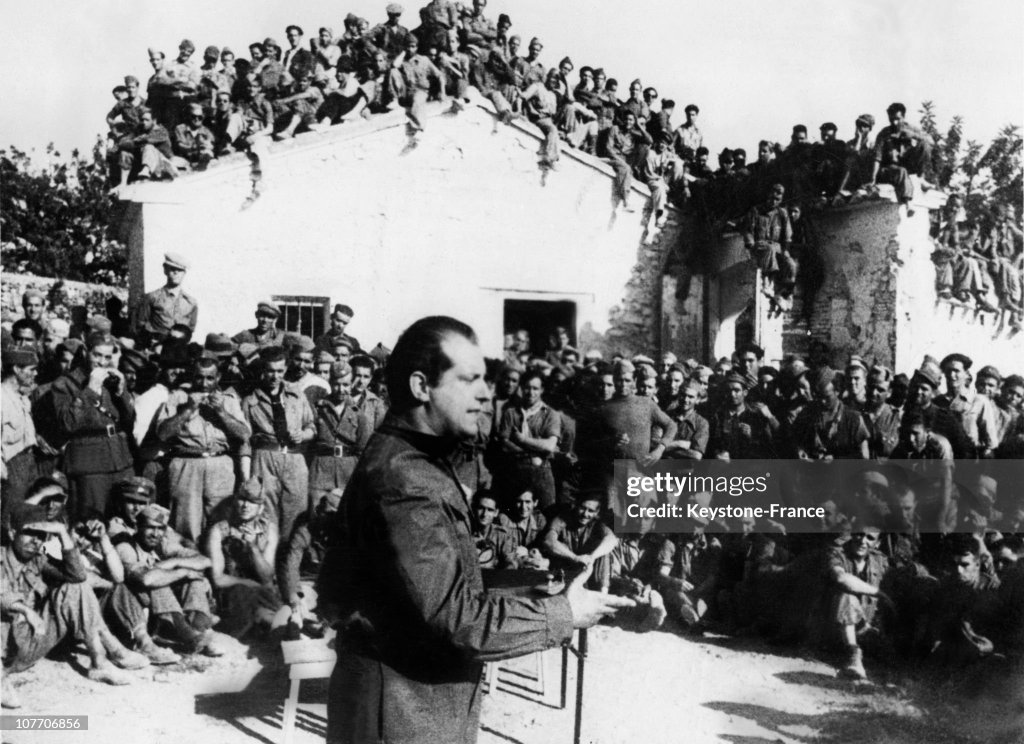
Generalissimo Francisco Franco’s troops today marched up one of Catalonia’s principal roads from Vendrell, which they captured yesterday, to take the equally important town of Villafranca del Panades, twenty-five miles west and south of Barcelona. They also advanced northeastward along the coast road from Vendrell to conquer Villanueva y Geltru, which is the same distance from Barcelona. In the central and northern sectors of Catalonia the Nationalist (Rebel) advance was retarded somewhat by poor weather, but Igualada, in the center, was passed more than three miles to the southeast by mixed Spanish and Italian legionary forces, which cut the main Lérida-Barcelona highway in the Noya Valley. The Rebels reported driving two miles beyond Villafranca, putting them within twenty-three miles of Barcelona, The Associated Press reported. Villafranca, Villanueva and Igualada were key points in the government’s defense line. In the north General Garcia Valino’s troops, driving northeastward from Pons, captured first Tiurana and then Castellnou de Basella, an Important communication center at a fork on the road to Seo de Urgel and Puigcerda from Artesa de Segre and Solsona.
Barcelona’s main line of defense, the so-called front belt, already has been pierced at various points, and General Franco’s staff officers say these hastily prepared fortifications definitely did not deserve the extravagant descriptions given of them. Although Igualada la not yet occupied, because of its dangerous position in a “cup” dominated by surrounding heights, the Nationalists have taken possession of La Pobla de Claramunt, three and a half miles to the southeast of the Lérida-Barcelona highway. After the capture of Vendrell, Villafranca, and Villanueva, the forces In Southern Catalonia under General José Solchaga and General Juan Yagüe now must wait until General Franco’s four army corps operating in the central and northern sectors make further progress toward Manresa, Solsona and Berga — or, in other words, toward cutting Barcelona’s communications with France. The battlefront now runs almost in a straight line northwest from Villanueva to Villafranca, Igualada, Calaf, Castellnou and Tirvia to Alos on the French frontier. More than twenty villages were reported captured today in the sector between Villanueva and Igualada. East of the line running between Igualada and Calaf important progress was made by the Nationalists toward Manresa, the villages of Conet, Espelt, Odena, Salavinera and San Martin being occupied. Besides La Pobla de Claramunt, the villages of Mombuy and Carme were taken south of Igualada. Between Calaf and Pons the villages of Taltabull, Vexfret, Palavuet and Monconell fell into General Franco’s hands. In the southern sector the town of Arbos, on the river of the same name, was perhaps the most important of those captured between Vendrell and Villafranca, which, like Villanueva, has a normal population of 8,000 to 10,000. More than 1,500 Republican (Loyalist) prisoners were reported taken in Catalonia today. Despite poor weather in Estremadura the Nationalists reported today they had captured 300 prisoners and buried 100 enemy dead after having repulsed Republican attacks.
It is now Barcelona that is fighting for its separate existence. Igualada, an important defense point thirty miles to the northwest, already hopelessly compromised yesterday, has fallen, but even more serious today was a swift Rebel push to Villafranca del Panades. The time has come when the Government army must make its final stand for Barcelona. Its morale is still high; fresh troops and some materiel are here. Either the drive will be halted in the next few days or the city will be lost. If it is lost, the fight will continue north of Barcelona, it is asserted, and if the rest of Catalonia is lost the war will go on in the central zone. And the Loyalists say that if they lose that it will go on underground, but it will go on.
Today marks the first of four days of successive bombing in Barcelona by Nationalist aircraft, with ten flyovers bringing bombs into the streets. After almost three years of war, Barcelona is weary, despite being far from the front until now. The Nationalists are fast advancing through Catalonia, with little or no resistance.
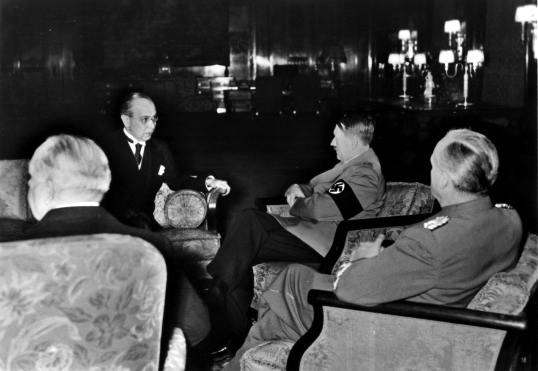
Czechoslovakian foreign minister František Chvalkovský visited Adolf Hitler in Berlin, Germany; Hitler demanded Czechoslovakia to decrease the size of its military, to hand over a large portion of its gold reserves to be stored in Germany, and to begin excluding Jews in society.
Hitler tells Chvalkovský, “We are going to destroy the Jews — they are not going to get away with what they did on November 9, 1918. The day of reckoning has come.”
Britain sees the dismissal of the Reichsbank president as a bad portent.
The brown-shirted Nazi Storm Troopers were today charged by Chancellor Adolf Hitler with “the defense education and training” of all German men over 17 who are not in military service or who do not receive this “education” through their connection with some other party organization such as the Hitler Elite Guard or the National Socialist Flying Corps. Particularly significant is the definite identification of the Brownshirts — the party’s original fighting troops — with the regular defense forces. Comment accompanying the publication of the decree says that the move was undertaken at the request of Colonel General Walther von Brauchitsch, Commander in Chief of the army. All the members of the three branches of the fighting forces will automatically become affiliated with “SA (Stormtrooper) defense or military sports” when they have completed their compulsory military training. All men who are fit for military service are likewise obligated to participate in these “sports,” whether recently released from the army or not. The membership of the Storm Troops at present is approximately 800,000 and some 300,000 youths annually complete military training.
German Reich propaganda minister Goebbels today blames the Jews for the attitude of the U.S.
German bonds are weak in the market after Schacht’s ouster as Reichsbank president.
Finland prepares to host the 1940 Olympics, budgeting $7.5 million.
A Soviet Labor Discipline Line Law sends executives who fail to discharge truant workers to jail.
The Senate Appropriations Committee decided by a vote of 17 to 7 today to recommend to the Senate the sum of $725,000,000 voted by the House for the Federal work relief program during the remainder of the current fiscal year, instead of the $875,000,000 President Roosevelt asked. Senator Adams, chairman of the subcommittee which studied the relief problem, was persuaded by the wide margin the full Appropriations Committee gave to the slash to believe that the Senate would sustain the cut when the matter is brought to the floor on Monday. Previously, he had expressed some doubt that the Senate would concur in the committee’s recommendations, but he said today that several unnamed Senators changed their minds during the discussions in the committee room, and he hoped that the same percentage would apply to the entire membership of the Senate.
Senator Burke (D-Nebraska) told the National Labor Relations Board today that it had produced “a condition approaching industrial anarchy.” In a letter to Chairman J. Warren Madden of the board, he said: “The matter is so serious that corrective action must be taken before irreparable damage is done.” The letter was in reply to one by Mr. Madden criticizing earlier attacks by the Senator. “Your recent public letter to me reads like a labor board decision,” the Senator wrote. “It shows the same studied effort to build up a ‘background’ of prejudice against your intended victim, a practice for which you have been recently soundly rebuked by the courts. You are highly critical because I have consistently urged an independent investigation of your activities. You greatly prefer to investigate yourself. Your anxiety in that respect is readily understandable. However, the experience of Congress in permitting WPA and other agencies to investigate themselves has not been such as to recommend that procedure.”
The Undersecretary of the Treasury says the administration is changing from relief focus to economic recovery.
The battle that is coming in the House and the Senate over the bill establishing a chain of naval, air and other bases recommended by the Hepburn board will be a sharply fought one but nonpartisan, according to all the expectations. The New Deal for the first time will not be under fire for the reason that the $65,000,000 bill did not originate in the White House or any New Deal department or agency. That the dispute will be nonpartisan was made clear today by Representative Melvin J. Maas, of Minnesota, ranking Republican member of the House Committee on Naval affairs. “When the bill to establish the bases recommended by the Hepburn board goes to the floor,” he said, “there will undoubtedly be considerable opposition to its passage, but it will not be partisan in nature. This is in no sense of the word a partisan matter. It did not originate in the White House, nor fc: that matter in the Navy Department. The proposal to establish these bases, every one of them more or less vital to the defense of the continental United States, the Panama Canal and our outlying possessions, originated in the House Committee on Naval Affairs, when we wrote into the 1938 Naval Expansion Bill a clause directing the Navy Department to investigate and report to Congress upon the ‘need for purposes of national defense of additional submarine, destroyer, mine and naval air bases on the coasts of the United States, its territories and possessions.”
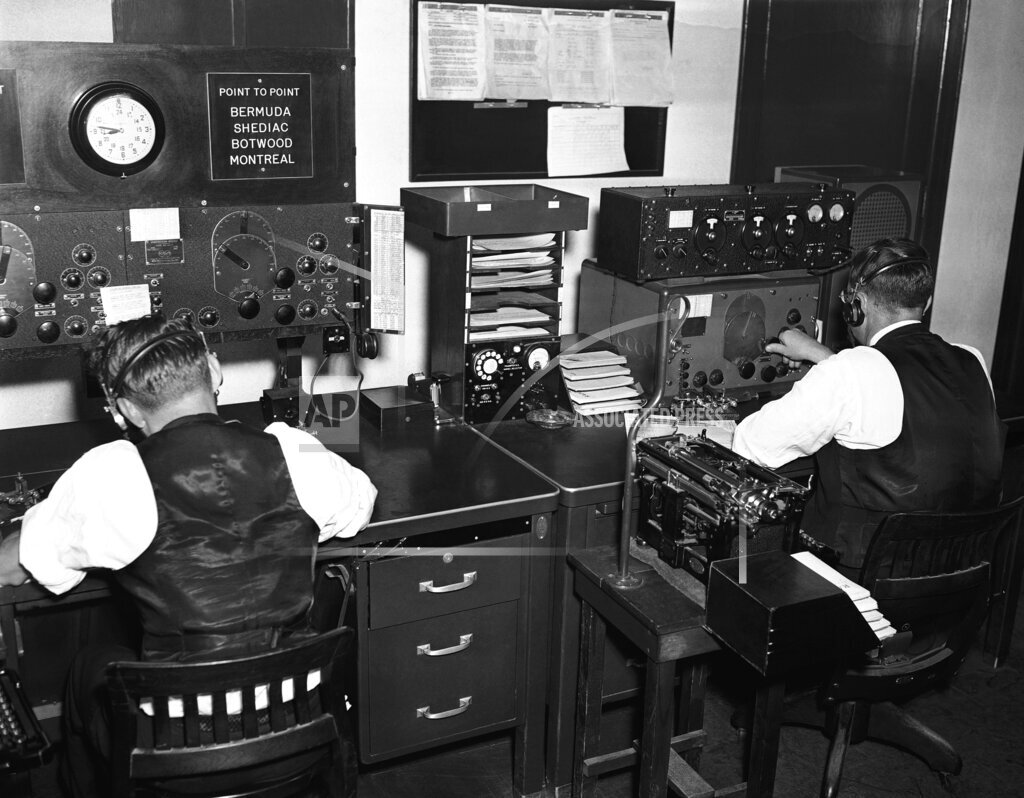
The Imperial Airways seaplane “Cavalier” is forced down in stormy seas off Cape May, New Jersey. Ships are converging on the area to hunt for survivors. Cavalier left the Port Washington Seaplane Airport in Port Washington, on Long Island, New York, at 10:38 bound for Bermuda.[1] At 12:23 p.m. the flying boat sent the message “Running into bad weather. May have to earth,” which referred to earthing the aerial; this was followed by another message at 12:27, “Still in bad weather. Severe Static.” Port Washington tried to call the Cavalier for the next 15 minutes but did not get a reply. At 12:57 Cavalier broadcast an SOS message followed at 12:59 by “All engines failing through ice. Altitude 1,500 ft [457 m]. Forced landing in a few minutes.” Another message eight minutes later said she was still flying but on two engines; four minutes after that came a series of messages to say that she had had to come down in the sea. The last message, at 13:13, was the single word, “Sinking.”
As soon as it was realized at Port Washington that Cavalier was going to land in the sea, Port Washington requested a Pan American World Airways Sikorsky S-42 flying boat from Hamilton, Bermuda, to go to her assistance. The United States Coast Guard sent a flying boat from Long Island to Cavalier’s last known position but it did not find her. A United States Army Air Corps Boeing B-17 Flying Fortress heavy bomber made a sortie from Langley Field in Virginia to search for Cavalier but had to return before midnight without success. Other aircraft also tried in vain to find the Cavalier. The commercial tanker Esso Baytown was the first to arrive at the scene of the accident and reported at 23:25 that she had sighted wreckage and had lowered her lifeboats.
The British Air Ministry’s Inspector of Accidents reported that the accident had been caused by icing in the carburetors of all four engines. This caused a full loss of power in the inboard engines and partial loss in the outer; the commander of the Cavalier had reported icing problems prior to ditching. The inspector recommended that extra heating of carburetors and of the incoming air be provided and that a temperature indicator be installed. He also advised that passengers should be instructed in the fastening of lifebelts and the location of emergency exits and recommended the provision of extra life-saving equipment like rafts and pyrotechnic signals and that passengers should fasten safety belts at take-off and alighting.
Former Secretary of State Henry L. Stimson has written to Secretary of State Cordell Hull urging the lifting of the embargo on arms, ammunition and implements of war against Spain and requesting that Mr. Hull communicate his views to President Roosevelt and urge that some action be taken. The letter was written late this week and has been taken under careful consideration by Mr. Hull. This much was learned today, although the State Department would say no more than that Colonel Stimson as in correspondence with Mr. Hull. The text of the letter was not made available for publication. The former Secretary of State wrote from his home in Huntington, Long Island, where he is recuperating from an attack of influenza. Except for his illness, he explained, he would have written at greater length and given reasons in detail to support his views. Only recently he took a public position in favor of the application of economic pressure against Japan as the aggressor in China.
George Kaufman and Moss Hart’s play “American Way” premieres on Broadway in NYC.
Paramount Studios cancels its contract with actor George Raft after nearly seven years when he refuses a role.
U.S. female Figure Skating championship won by Joan Tozzer.
U.S. male Figure Skating championship won by Robin Lee.
Mexican oil goes to fuel Italian ships after the oil is refined in Houston, Texas, duty free.
Brazil announces its five-year plan: $30 million will be spent annually on public works and defense.
General Chiang Kai-shek is appointed chairman of the People’s Political Council, replacing the ousted Wang Ching-wei.
Chinese military reports today said the Japanese had been checked in South China despite their intensified offensives. They reported a renewed Japanese effort to cross the West River near Samshui, twenty miles west of Canton, had been repulsed. The Chinese simultaneously drove a wedge into the sector, preventing the joining of Japanese forces near Samshui and others operating along| the Canton Railway north of Samshui, the reports said. Reports from Pakhoi, in Southwestern Kwangtung Province, near French Indo-China, said Japanese warships had shelled Chinese defenses along the coast yesterday but that land batteries had prevented landings by the invaders. About 120 miles southwest of Shanghai the Chinese were reported to have recaptured Fuyang, twenty miles southwest of Hangchow, and Yuhang, fifteen miles west of Hangchow. These had been points of deepest Japanese penetration in that sector since Hangchow fell December 24, 1937. Chinese also were reported to have recaptured Changching, in North Chekiang Province.
The Japanese War Minister Lieutenant General Itagaki tells his government that China still puts up “formidable resistance.” The main body of the Japanese expeditionary force will remain in China for some time, General Seishiro Itagaki, the war minister, informed the Diet today in a speech in which his accounts of Japanese victories were balanced by admissions that the Chinese were still putting up a formidable resistance. The members of the Diet had received maps, and the war minister, spreading a map on the rostrum, lectured like a professor on last year’s campaigns. Future developments, according to General Itagaki, will consist of continued efforts to crush Generalissimo Chiang Kai-shek, not by direct attack but by cutting arms supply routes while simultaneously increasing the security of occupied areas by destroying guerrillas. At the same time Japan’s watch on the Soviet frontier will not be relaxed.
The highlights of the speech were the following points:
- The Chinese have lost 2,000,000 men, and it is impossible for them immediately to reconstruct their land and air forces.
- The Chinese still have in the field 1,000,000 men, including 300,000 of the central army, 170,000 preparing for guerrilla attacks on the north bank of the Yangtze River, 200,000 Cantonese in North Kwangtung, 150,000 in Kwangsi and smaller bodies in Szechwan and Yunnan, a total of 210 divisions, of which eighty-five belong in the central army.
- Communist power in the Northwest will increase, and the “Red” areas will extend guerrilla warfare, so the Japanese campaigns there will be intensified.
- The occupied areas, except the principal cities and major communication routes, are infested by bandits operating under Chiang Kai-shek or the Communists. The Japanese troops are fighting these, but greater efforts must be made. China’s worst month last year was between late March and the end of April when 123,000 Chinese bodies were left on battlefields. The capture of Canton took ten days and cost the Chinese 6,370 dead.
Dow Jones Industrial Average: 146.76 (-2.35).
Born:
Norm Bass, MLB pitcher (Kansas City A’s), and AFL defensive back (Denver Broncos), in Laurel, Mississippi.
Tom Stith, NBA small forward (New York Knicks), in Greenville County, Virginia (d. 2010).
Chuck Osborne, NBA power forward (Syracuse Nationals), in Flat Gap, Kentucky (d. 1979).
Mary Ellen McAnally, American poet (“Dance of the Zygotes”), in Vandalia, Illinois.


 History Diaries