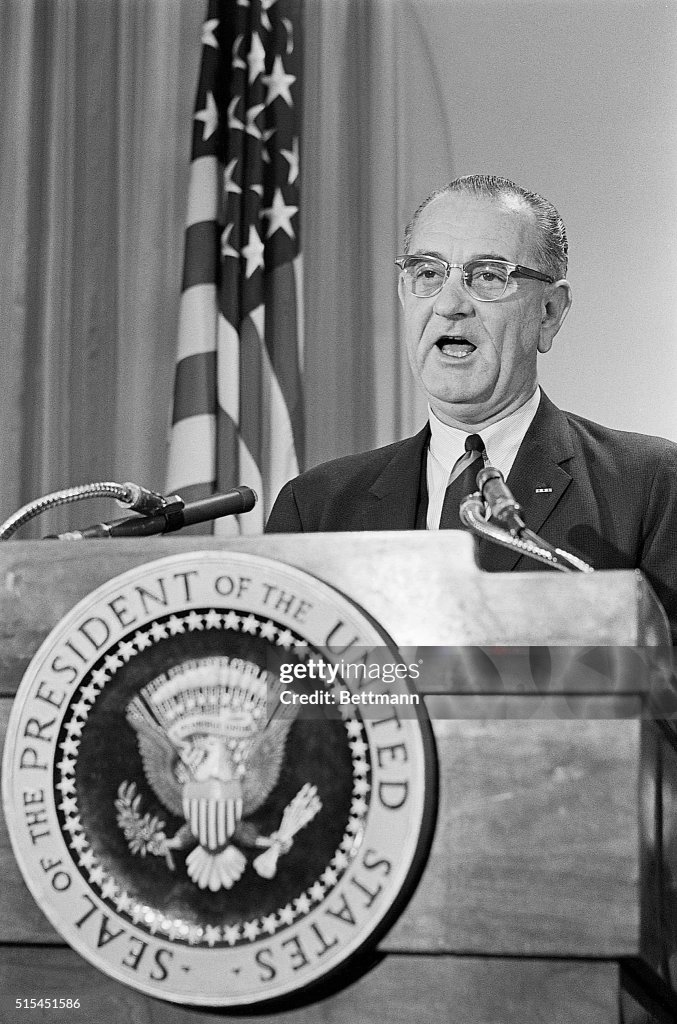
President Johnson offered today to negotiate with the Soviet Union a “verified freeze” of the numbers and types of vehicles, mainly long‐range bombers and missiles, to deliver strategic nuclear weapons. This was the major new idea in a five‐point United States list of possible agreements presented at the resumption of the 17-nation disarmament conference. The list was in a message from the President that was read to the conference by William C. Foster, director of the United States Disarmament Agency. President Johnson told the meeting: “There is only one item on the agenda of this conference — it is the leading item on the agenda of mankind — and that one item is peace.” Having in mind the treaty signed last year for a partial ban on atomic testing, the President said the conference had led to “more concrete and effective results” than any similar meetings in modern history
The freeze would cover “offensive and defensive vehicles.” Mr. Foster did not attempt to define them or to draw the line between strategic and tactical delivery systems. The American view, it is understood, is that the sites and purposes of weapons would be a decisive factor in determining whether they were strategic. Soviet missiles in Cuba, for example, would be considered strategic whatever their range because they would be close enough to threaten the United States. Similarly, observers here assumed, American Polaris‐firing submarines would be strategic weapons in waters from which the missiles could reach the Communists European land mass.
The idea of a freeze of nuclear‐delivery vehicles is implicit in the first stage of a disarmament plan submitted by the United States in April, 1962. By offering to negotiate it separately, the United States emphasized its hope for limited agreements during the necessarily slow negotiations for general and complete disagreement. The easier, friendly atmosphere that has found its way into East‐West relations since the signing of the test ban treaty last August marked the new session, the 157th since the conference began in March, 1962. Eighteen states originally made up the Disarmament Committee, and the only discordant note today was France’s empty chair, marking President de Gaulle’s continuing boycott of the conference. Semyon K. Tsarapkin, the Soviet negotiator, spoke after Mr. Foster, but did not reply to President Johnson’s proposals. This was not unexpected, because delegates at initial sessions speak from prepared speeches.
Panama is considering charges of “economic aggression” against the United States in the event that it persists in its suspension of aid programs. This became known as Panama’s new delegate to the Organization of American States left for Washington today with a mandate “not to yield one step” in the quest for a revised treaty on the Panama Canal. Despite public threats that Panama would take the problem to the United Nations General Assembly, the delegate, Dr. Miguel J. Moreno Jr., was known to plan a final attempt to seek a solution through the Inter‐American Peace Committee. Members of the five‐nation committee, an agency of the Organization of American States, are looking to an early meeting with President Johnson. It is now expected that Dr. Moreno will raise the issue of economic aggression when he confers with the peace team, probably tomorrow morning.
President Roberto F. Chiari was advised yesterday that since Panama had severed diplomatic relations, the United States had discontinued a number of new Alliance for Progress projects, involving schools, roads and housing. United States officials contend that economic aid to Panama has been suspended not as a political matter but for purely practical reasons because United States administering personnel have left Panama. The Panamanian Government fears that the suspension of aid will result in large‐scale unemployment and heighten the country’s already simmering political and social ferment. Some officials here are convinced that extremist elements, including rightists, Communists and pro‐Castro leaders of the student movement, would exploit the popular discontent to incite an overthrow of the Chiari Government.
All United States military personnel have been ordered to stay out of Saigon, except on official business, because of a cholera epidemic in the capital. About 50 Vietnamese have died of cholera. Health authorities said today that the outbreak “has the characteristics of a dangerous epidemic.” No American cases have been reported. Health officials suspect that the disease has reached epidemic proportions in other parts of South Vietnam.
In a broadcast to a still tense nation, President Julius K. Nyerere tonight condemned the mutiny by the Tanganyikan Army as a “disgrace.” The President, whose whereabouts during yesterday’s mutiny was a mystery, called on everyone to remain calm. His statement came at the end of a day in which the army’s rebellion against its white officers spread inland and panic seized this capital on the coast of the Indian Ocean. “My hope is that we shall never see such a disgrace repeated in Tanganyika,” the President said. His voice was noticeably strained. Until tonight the President had not been heard from since hundreds of African troops seized Dar es Salaam in a day of violence, looting and killings. The death toll was put at 17 and the total of injured at 100.
The troops were incensed over the amount of their pay and the fact that British officers still commanded them two years after Tanganyika achieved independence from Britain. Mr. Nyerere repeatedly sought to combat the idea that the mutiny was the beginning of an attempt to overthrow the Government. “Some people went around spreading rumors and claimed that I was no longer here, that my ministers were no longer here and that there was no Government,” he said. “Such rumors make a little trouble seem to be much bigger than it really is.” The President appeared to be reading from a prepared text.
The capital of Dar Es Salaam had awaited Mr. Nyerere’s statement for hours after learning that he was safe. But he spoke for only three minutes and his words left uncertainty on whether the mutiny had altered the strength of the presidency. Mr. Nyerere referred to the mutiny as “some trouble,” called the killing a “sad story” and expressed his condolences for the dead. It was what he did not say that caused apprehension. He did not explain why he had remained silent for two days while jeering mobs had terrorized the city’s Indian and Arab quarters, plundering shops, smashing windows and wrecking cars.
President Léon M’ba of Gabon dissolved the African nation’s legislature as an “economy measure”. The Assembly of 67 deputies was elected in 1961 for five years. Gabon, which borders the Congo, became an independent country within the French community in August, 1960.
The Chinese Nationalist Government warned tonight that it was determined to resist any effort by France to extend diplomatic recognition to the Chinese Communists on a “two Chinas” basis. The Foreign Affairs Ministry indicated that the government would break relations with France if she established diplomatic ties with Communist China. France has suggested, in exchanges through diplomatic channels with the United States and other Western allies, that she would prefer to deal with both the Nationalist authorities on Taiwan and with the Peking regime. Taipei issued its first formal declaration on the anticipated change in France’s policy on China after Washington announced last night that it had been notified of the French decision.
The dispute between the United States and Cambodia appeared tonight to be near a settlement on the basis of a compromise formula advanced by the Philippines. Officials said that the text of the Philippine proposal had been received in Washington and that it seemed to be generally acceptable to the United States. It has been worked out by Modesto Farolan, Manila’s Ambassador to South Vietnam. However, it was said, the final agreement will have to await the return to Phnom Penh of Prince Norodom Sihanouk, the Cambodian chief of state, so that he and Ambassador Philip D. Sprouse can work out the details. It was assumed that both the United States and Cambodia would then simultaneously announce a normalization of their relations, which have been in an uncertain status since last November.
The Soviet Union and Cuba have concluded a trade agreement that will assure the “long-range development of the Cuban economy,” Premier Khrushchev announced tonight. He said that the agreement would guarantee Cuba against the “fluctuations of sugar prices in the world market and against economic sabotage by American monopolists.” He made the statement at a Kremlin reception honoring Premier Fidel Castro. It appears likely, observers said, that Dr. Castro has paid for the continued or increased economic assistance by making some kind of promise to give political support to the Soviet Union in its ideological dispute with the Chinese Communists. This was suggested, Western diplomats felt, by a passage in Mr. Khrushchev’s speech in which he thanked the Cuban visitor for his political support. “We highly appreciate the support given by the Cuban people and their government to the policy of our party and our government,” Mr. Khrushchev said.
Two leaders of Zanzibar’s revolutionary Government denied today reports that Cuba or any other nation was involved in the revolution that overthrew the island’s Arab Government last week. Foreign Minister Abdul Rahman Mohammed Babu and Vice President Abdullah Kassim Hanga, who arrived here yesterday for talks with members of the Kenya Cabinet, issued a statement before leaving today to return home. “We wish to state categorically the revolution in Zanzibar is purely a Zanzibar affair, led and carried out by the Zanzibar people themselves,” the statement said.
Hans Krüger, West Germany’s Minister for Displaced Persons, Refugees and War Victims since October 17, was placed on administrative leave by Chancellor Ludwig Erhard after the weekly news magazine Der Spiegel revealed that Krüger had been a Nazi war criminal. As the Reich’s administrator for the town of Chojnice in German-occupied Poland during World War II, Krüger had overseen the execution of local residents; by February 7, he would be replaced.
President Johnson sent Congress today a $97.9 billion budget that marked the end of a long period of rising expenses for the nation’s security. Despite a general policy of austerity, the budget called for increases totaling several billion dollars in numerous Government programs, particularly those centered on education, health and manpower, including the “war on poverty.” The President told Congress that these expanded programs were possible in the fiscal year 1965, within an over‐all budget total slightly below that of the current fiscal year, for two main reasons. One reason is that combined expenditures for defense and space will decline by $500 million instead of rising by more than $3 billion, as in each of the last three years. The second reason, Mr. Johnson said, is that the Government expects big savings in two sectors of the budget. One is the cost of farm programs. The other is an offset to spending through the sale to private investors of nearly $2.5 billion in government financial assets acquired in the past, chiefly mortgages.
President Johnson’s $3.4 billion foreign aid estimate today was the smallest such budget request since the Government started financing Europe’s postwar reconstruction in the Marshall Plan 16 years ago. The amount was $1.5 billion under President Kennedy’s original estimate for the current fiscal year. Congress cut that new‐money figure to $3 billion, but reappropriations of unexpended funds brought this year’s total to $3.7 billion. The estimate for the fiscal year beginning July 1 included $2.4 billion for various forms of economic assistance and $1 billion for military aid. The latter amount was assigned for the first time to the Defense Department budget, “reflecting a new emphasis on closer coordination between this program and the department’s other regular missions.” President Johnson explained in his message that the $2.4 billion assigned to the Agency for International Development was designed to help the less developed nations in their critical struggle for political independence and economic betterment.
The budget estimated receipts during the fiscal year 1965, beginning next July 1, at $93 billion. This means a deficit estimated at $4.9 billion, compared with one of $10 billion in the current fiscal year. The proposed tax cut will affect receipts in both fiscal years but in neither year are receipts expected to decline. This is because of the expected economic stimulus from the tax cut, with a result of higher taxable incomes and profits. Secretary of the Treasury Douglas Dillon disclosed that the estimate of receipts for the new year was based on an expected surge of the nation’s economy amounting to $13 billion to $14 billion a quarter in the annual rate of the gross national product, starting in mid-1964 and lasting through mid-1965. This is an exceptionally high rate of growth in the nation’s output of goods and services, amounting to better than 8 per cent a year. If it is not realized, receipts will fall short of the estimates.
The Administration outlined today its previously announced plans for reduced military spending. However, it also disclosed plans to install new nuclear-armed intercontinental ballistic missiles of great range and versatility. The new ICBM’s, known as the Minuteman 2, will cover more targets and achieve greater distances than the existing Minuteman, whose range is estimated at 6,300 miles. The Minuteman 2 is believed to have a range of nearly 9,000 miles, which would bring China into its target area from a West Coast installation. The liquid‐fueled Atlas, however, already possesses such a distance capability, although it is not so easy to handle as the solidfueled Minuteman. So enthusiastic were Air Force leaders with the new missile that they sought to add 150 Minuteman 2 launching sites to the 950 Minuteman ICBMs already planned. The Administration approved 50.
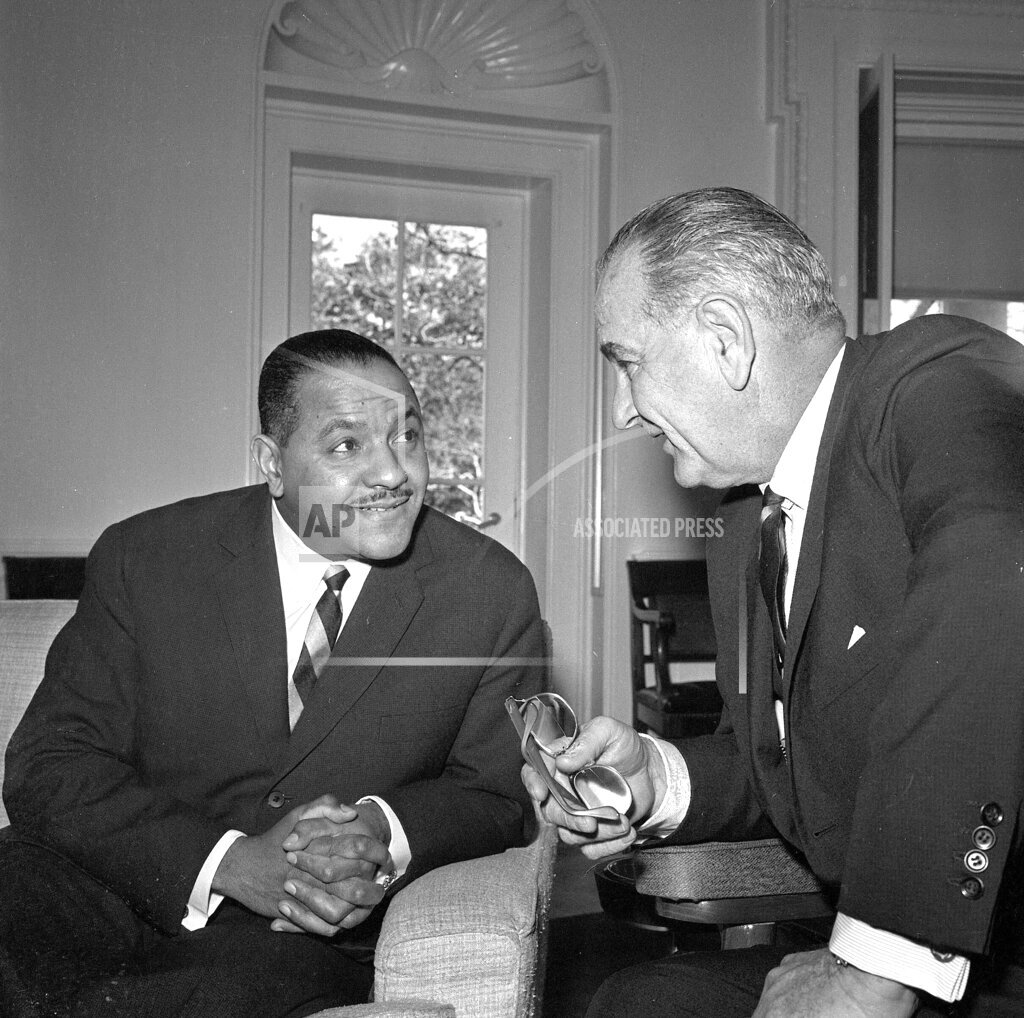
Carl Rowan named director of the U.S. Information Agency. President Johnson announced today that Edward R. Murrow had resigned as director of the United States Information Agency. Mr. Johnson said he would name Carl T. Rowan, a blunt and controversial former newspaperman, to succeed Mr. Murrow, who has been in ill health. Mr. Rowan, now the United States Ambassador to Finland and once an Assistant Secretary of State, will hold one of the highest Government offices ever occupied by a Black.
The Senate Finance Committee rejected today a proposal for special income tax credits on the educational costs of college students. The plan was offered by Senator Abraham A. Ribicoff as an amendment to the Administration’s $11 billion tax reduction and reform bill. Although the amendment was defeated, 10 to 7, its supporters were encouraged by the close vote. Mr., Ribicoff, a Connecticut Democrat, who was Secretary of Health, Education and Welfare in the first two years of the Kennedy Administration, promised to take the issue to the Senate floor. He said the prospects were “excellent” for approval of the amendment when the Senate considered the big tax bill, probably early next month. If the Ribicoff plan becomes law, parents and others who finance the education of college students would be entitled to $750 million a year in tax relief.
The Senate committee investigating Bobby Baker’s financial shenanigans discloses a stereo-hi fi set presented to President Johnson by the broker who sold him a $200,000 life insurance policy. Baker, Johnson’s one-time protege, was secretary of the Senate majority until forced to resign by revelations of his money-making proclivities beyond the scope of his political job. Don B. Reynolds, head of a Washington insurance firm, testifies he also had to buy time on a Johnson radio station.
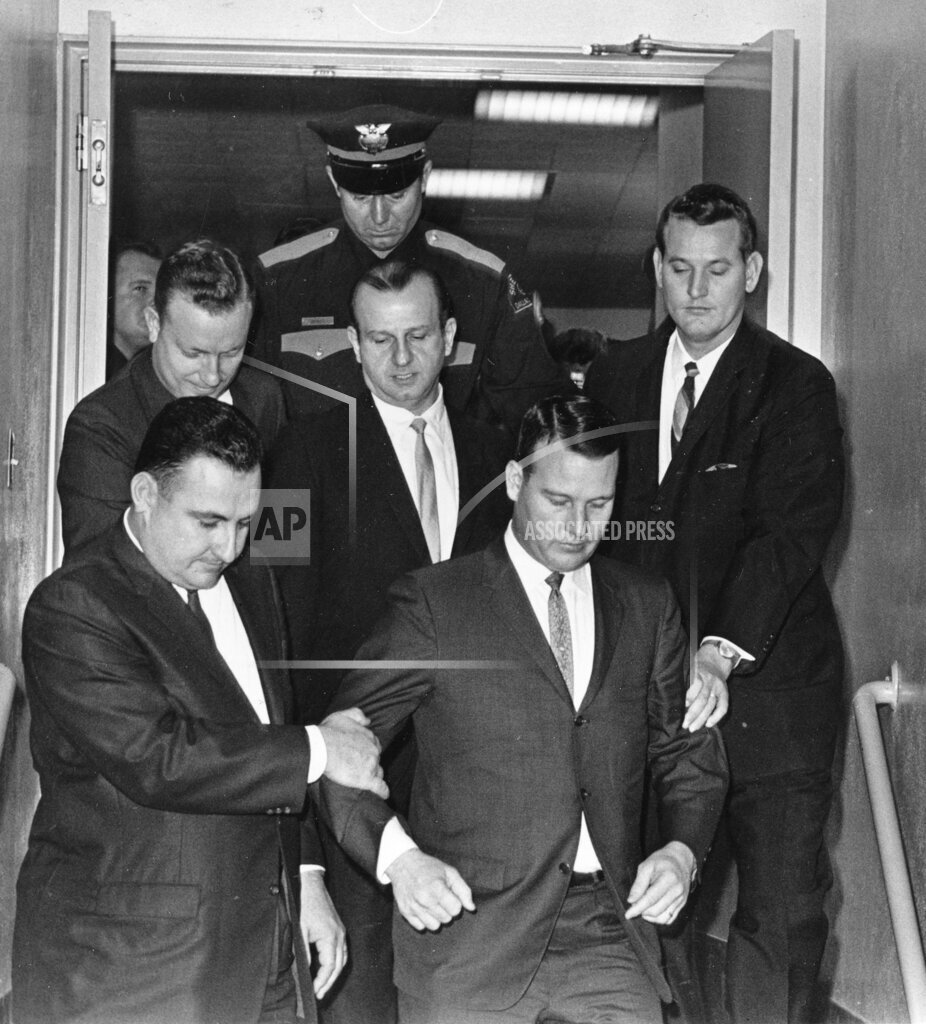
Jack Ruby denied today that he had ever met Lee H. Oswald before killing him. Ruby spoke distraughtly as he appeared at a bail hearing, which ended when his attorneys withdrew their request that he be released on bond. At an impromptu news conference Ruby also denied that he went to Cuba five years ago to sell supplies to the Government of Fidel Castro. He said he went there early in 1959 for a brief vacation. His plan to export goods to Cuba collapsed earlier for lack of financing, he explained. He termed details of his trip, as presented by the prosecution, “fabrications.”
Relay 2, a communication satellite designed to serve for years in relaying radio, television pictures, and television signals between four continents, is launched successfully from Cape Kennedy, Florida, and goes into orbit three hours later. Its first television transmission between continents is scheduled today, when Japanese and American officials are to exchange greetings via the satellite.
Six jurors are accepted by defense lawyers and the prosecution at the Chattanooga trial of James R. Hoffa, teamster union boss, on charges of jury tampering. The judge orders six other veniremen awaiting questioning locked up for the night with the six tentatively accepted. The defense announces emphatically that Hoffa will take the witness stand in his defense.
Dow Jones Industrial Average: 776.44 (+3.41).
Born:
Dalton Hilliard, NFL running back (Pro Bowl, 1989; New Orleans Saints), in Patterson, Louisiana.
Reggie Rogers, NFL defensive end (Detroit Lions, Buffalo Bills, Tampa Bay Buccaneers), in Sacramento, California (d. 2013).
Craig Coxe, NHL left wing (Vancouver Canucks, Calgary Flames, St. Louis Blues, San Jose Sharks), in Chula Vista, California.
John LeBlanc, Canadian NHL right wing (Vancouver Canucks, Edmonton Oilers, Winnipeg Jets), in Campbellton, New Brunswick, Canada.
Died:
Joseph Schildkraut, 67, Austrian-born American stage and film actor, winner of 1937 Academy Award for Best Supporting Actor award in 1937 for “The Life of Emile Zola”.
The Last Gasp Before the British Invasion.
 History Diaries