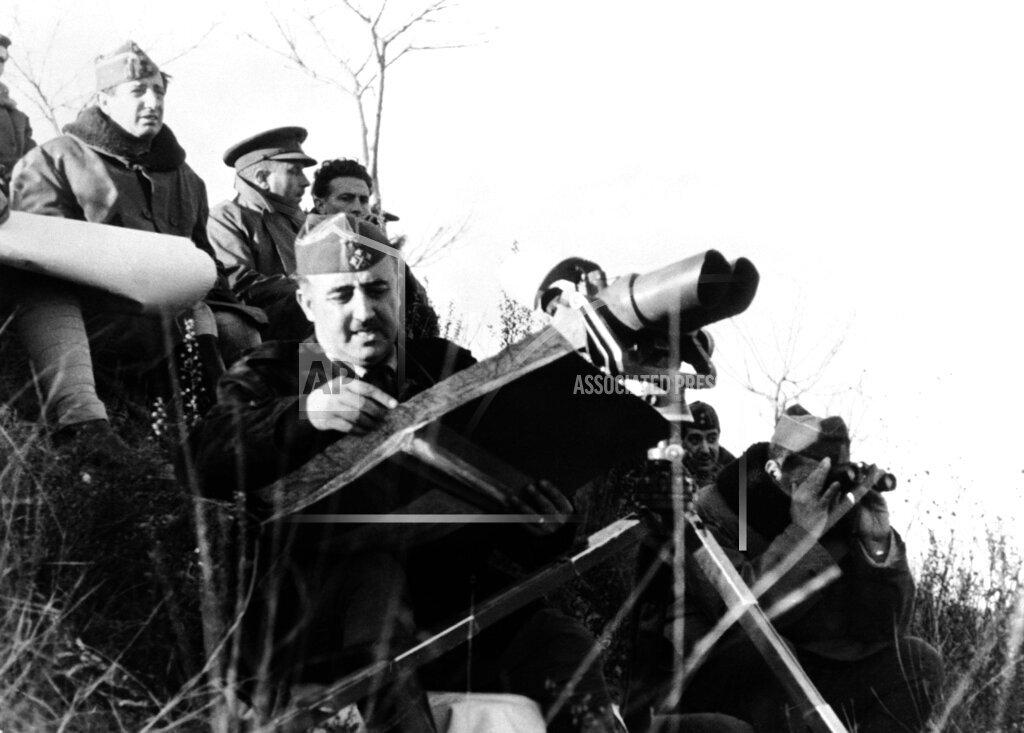
Spanish rebel warships shelled Catalonian coastal defenses northeast of Tarragona today and searched the sea for transports reported carrying 12,000 fresh soldiers to the defense of Barcelona. Three gunboats of the rebel blockade steamed back and forth across the route which would have to be followed by troop ships in any transfer of manpower from the southern part of government Spain to the government’s seaport capital.
The fate of the transports said to be skirting General Francisco Franco’s 110-mile-long Mediterranean coast line with the vanguard of 60,000 reinforcements from the Madrid front remained in doubt. Franco’s troops proceeded slowly with their Barcelona drive. Rebel headquarters announced the capture of Montfalco which is on the natural pathway leading from Cervera east ward to the capital, on the center of the line Franco started rolling across Catalonia on December 23. Battle lines were being drawn in that sector. Catalonia’s retreating. militiamen were reported in government dispatches to be taking a stand before Igualada, which is twenty-eight air miles west of Barcelona on the Cervera-Barcelona highway.
Northwest of Igualada, the rebels claimed a ten-mile advance from Cervera toward Manresa. The rebels were said to be within sixteen miles of Manresa which is twenty-five miles northwest of Barcelona. The rebels professed to have discovered the location of the government’s “mystery” fortification. Saragossa dispatches asserted the loyalist “Maginot” line starts at the Mediterranean town of Villanueva, about twenty-five miles southwest of Barcelona. From there it runs north to Villafranca, then leans slightly to the northwest back of Igualada. The northern end of the line loses itself in the mountains around Solsona, twenty-seven miles northwest of Igualada.
Repeated rebel air attacks today menaced two trucks of the Society of Friends (Quakers) bringing eighty children from a colony near Manresa which lies in the path of advancing rebel armies. The children and their supervisors were forced to run for cover in ditches. The trucks were damaged slightly in the attack. A wounded woman, a boy with a shrapnel wound in his back, and other injured persons were taken into Manresa. Eighty-eight Americans, former members of the International Brigades, arrived in Barcelona from the Valencia area today with the expectation of being evacuated to France shortly. The veterans came in two freighters escorted by loyalist planes, submarines, and warships. This will virtually complete the withdrawal of all American fighters from Spain.
Before its capture, Tarragona was damaged less than might have been expected except in the harbor area, according to official reports received in Burgos. The cathedral and many churches suffered little external damage. Their interiors, however, were stripped of decorations, images, and other art treasures. In virtually all the towns and villages occupied so far, the inhabitants describe how only a short time before the Republicans’ (Loyalists’) evacuation everyone was ordered to bring all the crucifixes and sacred images they possessed to the main square, where huge bonfires were made. Judicial inquiries have been opened in more than 250 towns and villages captured so far by the Nationalist authorities into charges that there were summary executions by extremists of hundreds of priests and churchgoers during the civil war.
According to evidence officials say they have, 76 priests and 8 women — including two more than 60 years old — were among 766 slain in only 36 of 221 towns and villages in the Province of Lérida. In Tortosa, 70 percent of the Catholic clergy were reported killed. An official note broadcast by the Minister of the Interior today says the Republicans broadcast an “absolute lie” to counteract the effect of “the Generalissimo’s generous and forgiving message to Catalans” following the fall of Tarragona. Barcelona’s propaganda agencies, it says, sent out “an entirely fictitious massacre of women and children by Italian legionnaires after the capture of Santa Coloma.” The Minister continued: “This is a monstrous invention which could only be conceived by the real authors of innumerable and horrible crimes which the Nationalists (Rebels) still discover as they enter newly conquered towns and villages in Catalonia. “The truth is that, although judicial investigation of crimes committed in these towns has already begun, not a single execution in punishment for them has yet been carried out.” All the villagers who remained in Santa Coloma when captured categorically denied the story of a massacre and volunteered to testify that Republican troops carried out a large number of executions just before evacuating the town.
Italians are accused of bombings in Spain. The League of Nations receives a request for civilian aid.
Rumors suggest that German Propaganda Minister Joseph Goebbels may receive the new post as chief Nazi district leader.
Hjalmar Schacht has his last meeting with George Rublee in Berlin.
Count Galeazzo Ciano, Italy’s Foreign Minister, arrived here this morning and was received by Premier Milan Stoyadinovitch and the Italian Minister to Yugoslavia. An honor guard of the Yugoslav Sokol organization and deputations of peasants in national costume were also present at the railroad station. After the presentation of bread and salt in accordance with Serbian custom by the local Mayor, Count Ciano and M. Stoyadinovitch drove off for a hunt at Belje, where they shot a number of stags.
The Norwegian government laid claim to one million square miles of Antarctic territory from 20 degrees West Longitude to 45 degrees East Longitude, the region between Coats Land and Enderby Land. This claim represented 20 percent of the entire Antarctic coast.
A Mexican envoy to Germany denies any secret purpose to the trip.
Talks are delayed on Jewish refugees in Germany. Hitler is not available to discuss concessions.
The S-Plan attacks continue. In Tralee, County Kerry a small bomb concealed in a tobacco tin exploded in the yard of Hawneys Hotel. Francis Chamberlain, the British Prime Minister’s only son, had been staying there during a shooting holiday. The police discovered the bomb but it went off before it could be defused.
Late tonight terrorists made their first attempt at railroad sabotage. A heavy piece of iron was tossed from a bridge on the outskirts of London through the roof of a crowded coach of the London-Sheffield express. The train had just emerged from a tunnel when the missile hurtled into the car, endangering the passengers. An investigation was started at once. An anonymous letter to Scotland Yard contained a threat to blow up the Hendon aerodrome, which serves London. A large number of police searched there for hours under the glare of floodlights. Increased guards were posted at railroad stations, public service plants, vital spots along the coast, and radio stations. All guards were armed.
At Brixton prison in London, where eight Irish suspects arrested yesterday were held, the guard was increased also. Authorities feared an attempt by sympathizers to release the prisoners. Seven other prisoners are held in Manchester.
The prototype of the Yugoslavian IK-3 fighter crashed near Zemun airfield in Yugoslavia, killing the pilot, Captain Pokorni.
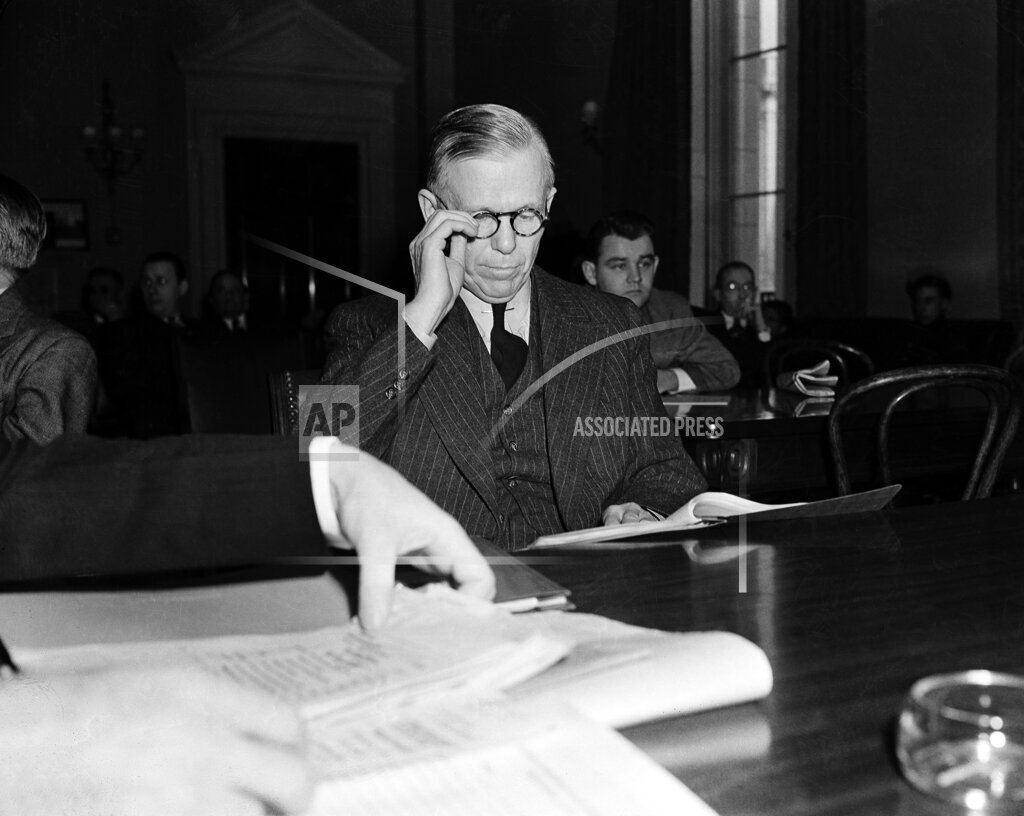
U.S. Senate foes of Harry Hopkins question him for five hours about his inability to stamp out partisan actions in the WPA program. When Harry L. Hopkins, President Roosevelt’s nominee for secretary of commerce, was assailed in the Senate today for using relief funds for political purposes, only one member rose to defend him. That was President Roosevelt’s “Dear Alben” Barkley, the Democratic leader, for whom the WPA in Kentucky was converted into a political machine, according to the report of the Sheppard Committee on Campaign Expenditures. Barkley interrupted Senator Rush D. Holt (D-West Virginia) to deny that he had consented to the coercion or intimidation of relief workers. “I do not want the reputation which I have built up for thirty years to be shattered by the senator or anybody else,” Barkley protested.
Holt reviewed the testimony before the Commerce Committee, in which Hopkins confessed that the WPA political activity in Kentucky and Pennsylvania was reprehensible. “It is all right to repent now,” Holt said. “The election is over and the WPA was not such a good thing Mr. Hopkins wants to be secretary of commerce, so he comes in here with his hypocritical, sanctimonious repentance and says he wouldn’t do it again.” Holt also referred to Hopkins’ denial that he uttered the statement. “We will spend and spend, tax and tax, elect and elect.” “His denial that he made that statement is worth about as much as his denial that there was any politics in the WPA,” Holt said. Senator Josiah W. Bailey (D-North Carolina), chairman of the Commerce Committee, announced that he would not vote on the question of confirming Hopkins because of personal differences, but he submitted an individual report condemning Hopkins’ political activities while administering the WPA. He said the political activities of Aubrey Williams, Hopkins’ assistant, who became head of the National Youth Administration, were an outrage.
The U.S. House of Representatives authorizes 3,000 new Army airplanes.
Senate economy advocates gave signs of weakening today in their previously announced determination to hold the relief appropriation down to 725 million dollars voted by the House. There were indications that some sort of compromise would be accepted by the appropriations subcommittee considering the relief measure and that it would represent a partial surrender to President Roosevelt’s demands for an appropriation of 875 million dollars to finance the WPA from February 7 to June 30. The house lopped 150 million dollars from the amount requested by the President.
Some senators said that the “heat” from the White House, the United States conference of mayors and various pressure groups, combined with the cold weather accompanying a heavy snowstorm in Washington, had operated upon the emotions of the subcommittee members. Mr. Roosevelt has declared that the 150-million-dollar reduction will mean the discharge of more than 1,000,000 WPA workers by the first of June, and even though they don’t accept his figures, the senators declare, they will be held responsible for any discharges that may be necessary. A compromise that was gaining favor called for the appropriation of enough money to run the WPA for two months from February 7, during which time an investigation could be made to determine the amount needed for the remainder of the fiscal year. The house defeated such a Republican plan.
President Franklin Roosevelt backs a fortification plan for Guam. A bill authorizing and directing the navy to proceed with the construction of twelve of the principal naval aviation and submarine bases recommended by the Naval Board, of which Rear Admiral Arthur J. Hepburn is the president, was introduced in the House and Senate today. Chairman Vinson of the House Committee on Naval Affairs said that the measure was an “Administration bill” and added that the committee would act speedily to expedite construction. Public hearings, he announced, would begin on Wednesday. The bill authorizes an expenditure of $65,000,000, of which about $21,000,000 is for aircraft and the remainder for starting work on the bases, all but three of them in the Pacific. For Guam, one of the bases named, Mr. Vinson said the Navy Department requested $5,000,000. Approved by the Budget Bureau several days ago, the bill went to the White House early this week, then to the Naval Affairs Committees of the Senate and House yesterday afternoon and to the government printer late today. The projects covered by the bill, Mr. Vinson said, had Administration and naval approval.
The Federal Communications Commission bans “super power” broadcasting.
A new anti-lynching measure is introduced in the U.S. Senate. Like those before it, its prospects of becoming law are thought to be slim.
Birth control advocate Margaret Sanger declares peace will exist only after countries match their birth rate with available resources.
Two groups merge to form the Birth Control Federation of America.
Throughout this week, Actors Equity and other unions representing movie stars, musicians, and stage performers meet and vote to support a strike against radio sponsors.
The National Institute of Arts and Letters presents an award to poet Robert Frost.
Ernest Hausen of Wisconsin sets chicken-plucking record of 4.4 seconds.
The Chilean Nazi party changes its name to the Popular Socialist Vanguard. They shun Hitlerism.
Half of Canada’s government is expected to resign if the suggestion is made to send troops abroad.
The Canadian government in Ottawa is urged to take in a fair quota of refugees from Europe.
The U.S. ambassador to China sees no end in sight to the Sino-Japanese war.
Fortification of the Island of Guam by the United States would endanger American-Japanese friendship, Rear Admiral Masao Kanazawa, navy spokesman, asserted today. He said that the Japanese navy would regard the fortification of any American islands in the western Pacific not only as an unfriendly gesture, but as the adoption of an aggressive policy toward Japan by the United States. “That would be just like placing American guns against Japan’s gate,” Kanazawa said, and added that Japan regards such fortifications as unnecessary and a thing which would irritate the Japanese people. The building of American airplane and submarine bases in the western Pacific islands would be nothing but establishment of advance bases for a long distance attack against Japan particularly, Kanazawa maintained.
Dow Jones Industrial Average: 149.47 (+0.48).
Born:
Phil Everly, American rock and roll singer-guitarist (The Everly Brothers – “Bye, Bye Love”; “Wake Up Little Susie”; “When Will I Be Loved”), in Chicago, Illinois (d. 2014).
Catherine McArdle Kelleher, American political scientist involved in national and international security policy, in Boston, Massachusetts (d. 2023).
Naval Construction:
The Royal Navy Net-class boom defense vessel HMS Bownet (Z 90) is launched by the Blyth Shipbuilding & Drydock Co. Ltd. (Blyth, U.K.).
The Royal Navy Dragonfly-class river gunboat HMS Grasshopper (T 85) is launched by Thornycroft (Southampton, U.K.).
The Kriegsmarine (German Navy) motor torpedo boat T10 is launched by F. Schichau yard (Elbing, Germany).
The Royal Navy “K”-class destroyer HMS Kelvin (F 37) is launched by the Fairfield Shipbuilding & Engineering Co. (Govan, Scotland).
The Royal Navy “K”-class destroyer HMS Kipling (F 91) is launched by Yarrow Shipbuilders Ltd. (Scotstoun, Scotland).
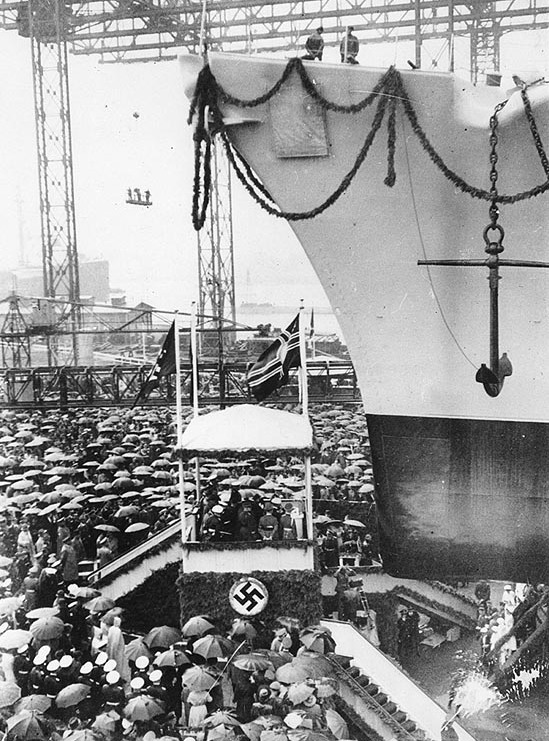
The Kriegsmarine (German Navy) Admiral Hipper-class heavy cruiser Seydlitz is launched by Deutsche Schiff- und Maschinenbau, Bremen. She is never completed, as work is stopped in 1940 when she is 95% complete; her conversion to an aircraft carrier (renamed Weser) beginning in March 1942 also is never completed. Towed to Königsberg and scuttled there in 1945.




[Ed: The building is still there, and it’s still a Bank of America.]


 History Diaries