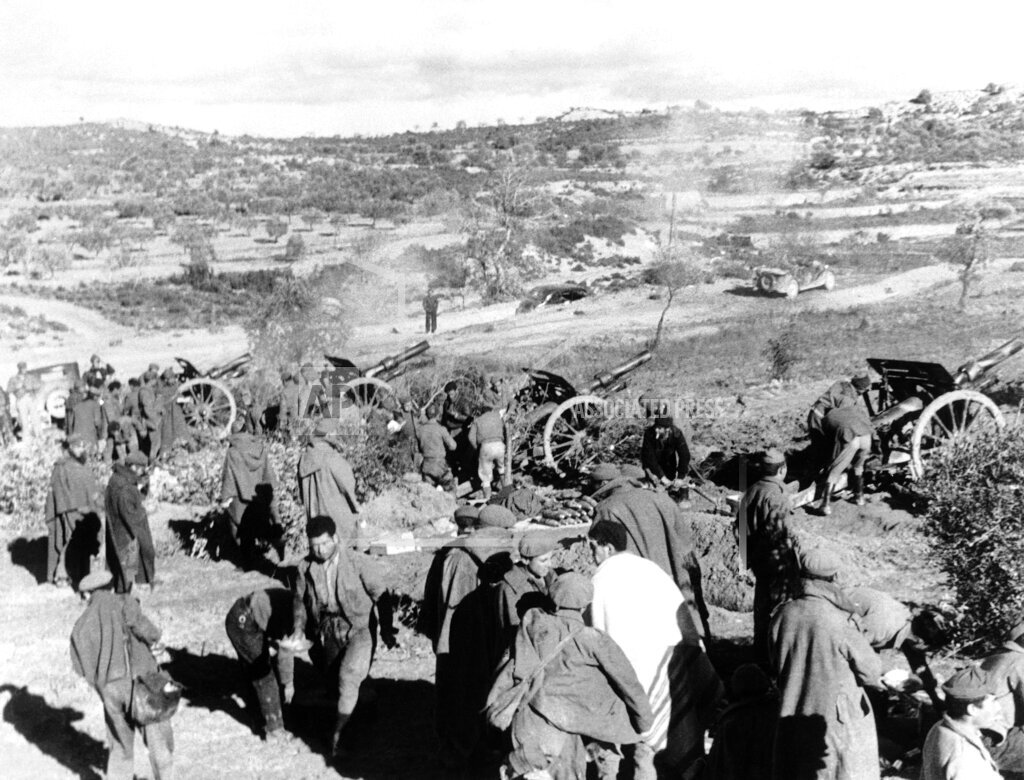
Spanish rebels enter Pons, on the road to France. The Madrid command is rushing 60,000 fresh troops to reinforce the battered Catalonian army, it was reported tonight. Twelve thousand troops have been moved by highway and railway to Valencia and there have boarded ships to skirt the rebels’ wedge to the sea at Castellon. The remaining 48,000 men are being assembled for the perilous transfer to Barcelona. Anticipating such a move, General Francisco Franco already had moved the rebel fleet, led by the crack cruiser Canarias, to blockade positions off the Catalonian coastline between Tarragona and Barcelona. Franco also has increased his air patrol of coastal waters.
Recent reports have estimated that Barcelona, after its recent call for new military classes, has 400,000 men available for service. The Madrid reinforcement will increase the number to 460,000. General Franco has been using 300,000 men on the Catalonian front, and it has been estimated that he can bring the number up to 500,000. By the capture of Pons today, the rebels in their drive to conquer Barcelona won partial control over another main highway. Pons is seventy-five miles northwest of Barcelona and only fifty-five miles south of the French frontier. The road from Pons runs northward to Seo de Urgel, a strong loyalist defense point, and then eastward to Puigcerda, which is opposite the French town of Bourg-Madame.
Rebel legionnaires crossed the Segre River north of Pons yesterday. Today another column advanced up the road from Artesa. The rebels stormed the town from both sides and gained possession. The heaviest fighting of the day was along the mountainous front from Pons to the tiny republic of Andorra which is northwest of Seo de Urgel. Aviation was used plentifully. In the central sector, the rebels reported they captured the villages of Cal Llorens and Cal Llante and were within four miles of Igualada, an important highway junction only twenty-eight miles northwest of Barcelona.
On the southern end of the Catalonian line, the rebels made their first crossing of the Gaya River east of Tarragona and captured the villages of Altafulla and Vespella on the east bank. They drove within six miles of Vendrell. Shells from three warships offshore aided the rebel infantry attack. Although the rebels hold Pons, Barcelona has two alternative highway connections with Puigcerda, which is a point of entry for supplies from France. At Basella, a few miles north of Pons, a road branching eastward runs through Solsona and Manresa to Barcelona. There is also a direct road from Barcelona to Ripoll and Puigcerda. There is a road connecting Manresa and Ripoll. Seo de Urgel and Manresa now are major objectives of the rebel northern army.
The loyalists, far surpassed in mechanical equipment by General Francisco Franco’s artillery, tanks and warplanes, now are digging into strong mountain positions on a line from Seo de Urgel southward through Solsona, Igualada, and Vendrell. It is believed that a rebel victory will be followed by a restoration of the monarchy in Spain. The rebel regime has restored the exiled King Alfonso’s rights and recently he ended his long separation from Queen Victoria.
The cabinet of Premier Édouard Daladier today decided to stake its life on a continued hands-off policy in Spain rather than risk the wrath of Great Britain. and the possible loss of her support. After the close of foreign affairs debate, which will start tomorrow in the Chamber of Deputies, Daladier plans to demand a vote of confidence on his Spanish policy — in the face of heavy communist, Socialist, and some center opposition. Foreign Minister Georges Bonnet was reported to have told the cabinet. that British friendship would cool if France permitted arms to cross the border to the Barcelona armies. As a result, the border will be kept closed.
Nearly 80 French vessels practice war maneuvers in the Strait of Gibraltar.
The Italian foreign minister attempts to establish a Rome-Budapest-Belgrade triangle as newspapers warn of war in the spring.
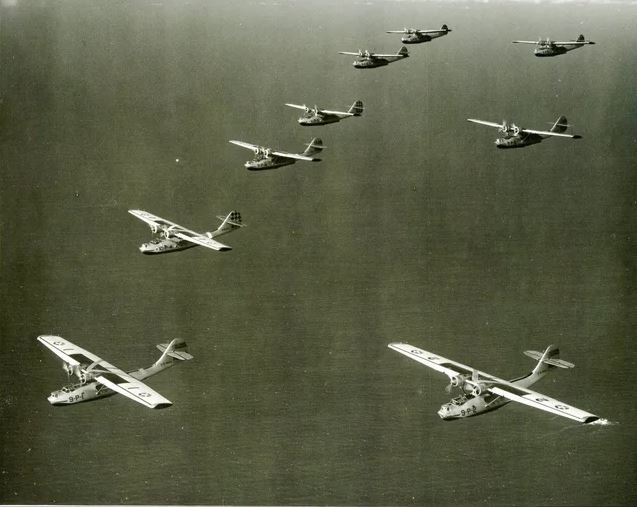
The first of Britain’s 200 Lockheed bombers leaves the United States for delivery.
A convention of Arab delegates meets in England. The Egyptian premier stays home because of the unsettled outlook in the Mediterranean.
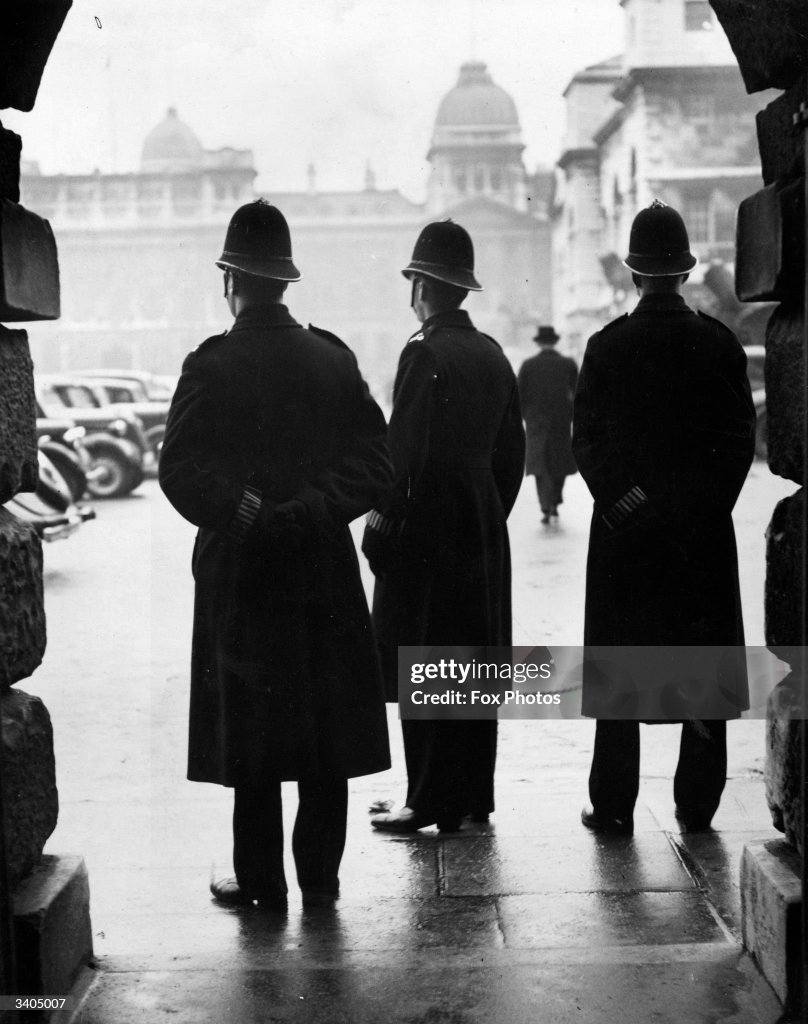
Britain is on high alert after nine bombings. The Irish Republican Army is suspected. The Times reported a total of nine explosions designed to “cripple electricity services” since 16 January. 14 arrests were made in connection with the attacks; 7 in Manchester and 7 in London. Each of the men was charged under Section 4 of the Explosive Substances Act 1883. Eight 1cwt barrels of potassium chlorate, a large quantity of powdered charcoal, and 40 sticks of gelignite were uncovered.
Census work begins in Russia. No questions are asked about religion or social class.
The Reich requires medical students to take a class on race science.
A bill to repeal the Wagner Labor Relations Act and to substitute a new labor law setting up a board with restricted powers was introduced in the U.S. House of Representatives today by Representative C. Arthur Anderson (D-Missouri). The proposal gained strong support from a number of Democrats and almost the entire Republican minority. Representative Anderson’s proposed substitute law would shear from the labor board its power of “judge and jury” and leave it with the power of investigator and prosecutor. A majority of the labor committee, to which the Anderson bill was referred, expressed themselves in favor of a drastic modification of the present law. They resent the failure of Senator Robert F. Wagner (D-New York) thus far to fulfill his pledge, made in his campaign for reelection last November, to move for amendments to the act.
Several said they feared that Senator Wagner was delaying action in order that a late start may prevent definite action at this session. The house committee will not wait for Senator Wagner to start the ball rolling, members said, but will act quickly in order that the Wagner Act may be altered before adjournment. An inquiry into the behavior of the labor board also is contemplated by the committee. Members of the board have been accused of extreme partisanship for John Lewis’ CIO. Under the provisions of the Anderson bill the labor board may make inquiry and hold hearings in its investigations and then file complaints for violation of the law with the United States District Court, wherein the cases will be decided. The district courts then may make such orders as are necessary for settlement of a dispute.
The House and Senate voice no objections over President Franklin Roosevelt’s wish to speed up defense programs.
Chief of the U.S. Army Air Corps, Major General H.H. “Hap” Arnold, told the House Military Committee that an unspecified “emergency” made completion of President Roosevelt’s $300 million air corps expansion program vital. He would not discuss the nature of the emergency in open session.
President Franklin Roosevelt says he knows of no request for funds to fortify Guam as a naval base.
Legislators consider a shorter wait period between a marriage application and the date of the wedding.
Felix Frankfurter is unanimously confirmed as Supreme Court Justice. Frank Murphy is confirmed as Attorney General, 78–7.
Actors’ groups support the radio strike. Strikers refuse to accept that advertising firms, rather than agencies, hire them.
The establishment of a bipartisan board for WPA relief programs is backed.
Farmers protest the current milk pact with dealers and producers.
President Roosevelt seeks to end tax immunity through legislation.
A new drug, Sulfapyridine, is hailed as the cure for pneumonia.
Edward G. Barrow is selected as the new president of the New York Yankees.
“Barber of Seville” is performed at the Metropolitan Opera House.
Louis Armstrong and his orchestra play “Jeepers Creepers” on a Decca recording in New York.
Baseball star Mel Ott breaks his finger in a home mishap.
China asks the League of Nations for economic sanctions against Japan for its military aggression.
Traffic has been suspended along the railway across Southwest Shansi province in China as a result of fierce fighting and intensified guerrilla attacks. Shansi province is in North Central China. It was occupied by the Japanese months ago. Chinese spokesmen reported the recapture of Wensi in the south central part of the province. They said attacks on the important towns of Hungtung and Kiehsu, farther north, were under way. They reported the Japanese have withdrawn from Fenglingtu, on the Yellow River’s north bank, to Tungkwan, across Shansi’s southern border. Chinese also reported the recapture of Tungyumen in the center of Shansi’s western border.
A successful Japanese air raid on the Shensi provincial capital, Sian, an important western city on the long overland supply route to the Soviet Union, was reported today by Japanese military officials. The raiders were said to have destroyed government buildings, barracks of the Eighth Chinese army — former communist forces — and the headquarters of three Chinese divisions.
Alarmed over the possibility of Japanese invasion, Australia has adopted a $250,000,000, three-year preparedness program. The commonwealth government has decided to spend more than $11 annually for each man, woman and child in its population of just under 7,000,000, on defense. Australians, fearing an attack from the north for a long time, were jolted last October when Japan landed 30,000 men at Bias Bay in South China in her campaign against Canton.
If forces completely equipped with artillery, tanks, and airplanes could be landed 1,800 miles from their Japanese bases, Australians said, there wasn’t much reason why they could not come 3,000 miles farther south. Included in the defense program are plans to construct two more destroyers and twelve of the 40 knot motor torpedo boats which Great Britain recently adopted for her navy. Expansion of the Australian air force to 212 first line fighting planes also is planned. According to “The Statesman’s Yearbook for 1938,” Australia now has four destroyers. The commonwealth’s navy also includes four cruisers, one seaplane carrier, and two minesweepers. Its air force now numbers approximately 100 planes.
Dow Jones Industrial Average: 148.99 (+0.06).
Born:
Myron Pottios, NFL linebacker (Pro Bowl, 1961, 1963, 1964; Pittsburgh Steelers, Los Angeles Rams, Washington Redskins), in Van Voorhis, Pennsylvania.
Chuck Hamilton, Canadian NHL left wing (Montreal Canadiens, St. Louis Blues), in Kirkland Lake, Ontario, Canada (d. 2023).
Bo Gritz, American army officer and political candidate, searched for MIAs in Laos, in Enid, Oklahoma.
Bernard Glassman, American Zen Buddhist roshi (Zen Center of New York), in Brighton Beach, New York (d. 2018).
Naval Construction:
The Royal Navy M 1-class minelayer M 3 (M 53) is laid down by George Philip & Sons Ltd. (Dartmouth, U.K.).







 History Diaries