Panama began a sweeping reappraisal of her international strategy today in the dispute with the United States. The issue was whether Panama would continue to use the good offices of the Inter‐American Peace Committee or would choose a less conciliatory course. The five-nation committee, an agency of the Organization of American States, spent three days here this week. It worked out an agreement to renew relations between the countries. But the accord collapsed over the issue of whether Washington had committed itself to renegotiate the 60‐year‐old treaty governing the Panama Canal. Panama, charging Washington with having reneged, completed the break in relations yesterday.
High Panamanian sources said today that unless the Peace Committee could find a way out of the deadlock in the next few days, Panama was likely to approach the Council of the Organization of American States. In the O.A.S. Panama might revive her charge of January 10, that the United States committed aggression in using troops to repel Panamanian crowds rioting along the border of the Canal Zone. The crowds were protesting the ejection of Panamanian students who had demanded that their flag be hoisted alongside the United States flag at Balboa High School.
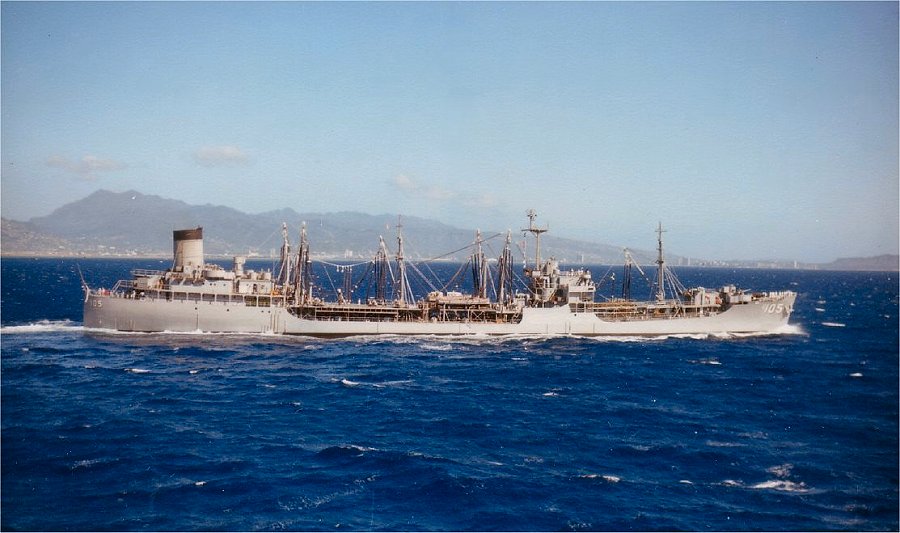
The U.S. Navy guided missile light cruiser USS Providence (CLG-6), flagship of the 7th Fleet, arrives at Saigon, South Vietnam on what Washington describes as a “goodwill mission.” In addition to underlining U.S. support for South Vietnam, the action is also designed to show U.S. commitment to all powers in the Far East.
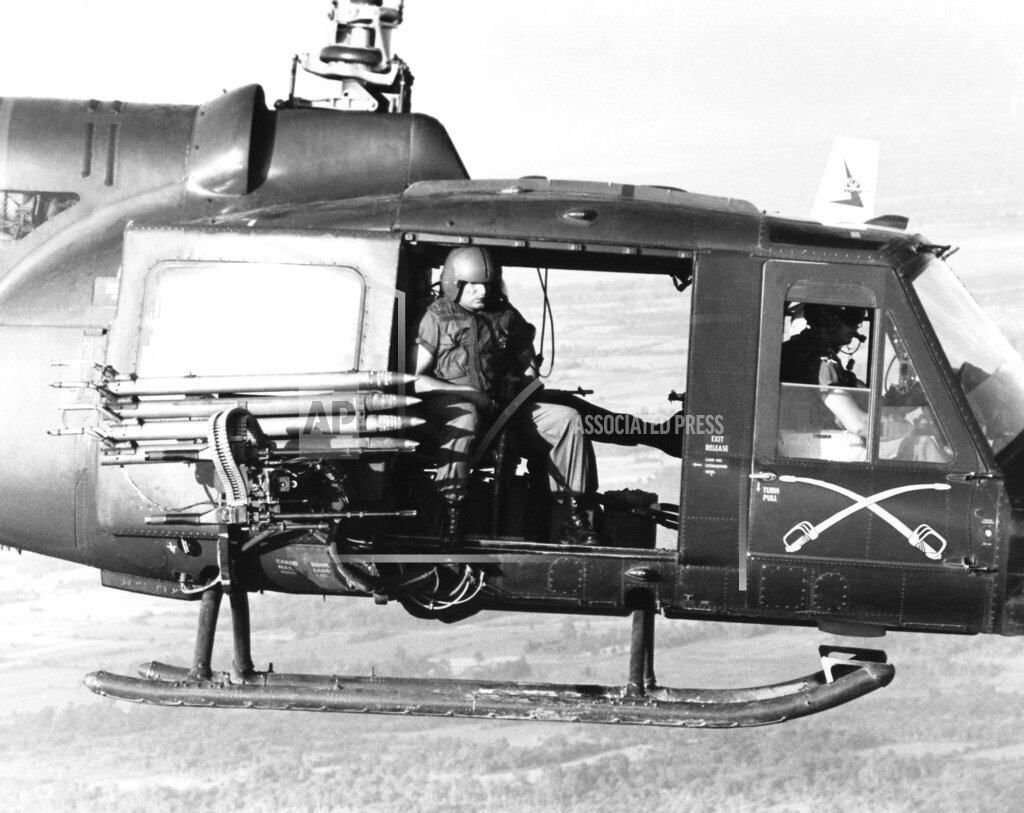
Two more Americans, a Vietnamese, and a British observer were reportedly killed today when their helicopter was shot down by Viet Cong gunners over the Mekong Delta. They were among six men aboard the rocket‐armed UH-1A that cruised along the shoreline in support of a Vietnamese landing. Eyewitnesses said Communist fire apparently knocked off the tail rotor. The helicopter fell a mile out in the South China Sea. Other helicopters fished out the American copilot and a gunner, apparently unhurt. No bodies were recovered. Confirmation of the loss of the two American crewmen would increase to 101 the roll of United States combat fatalities and to 175 the deaths from all causes since the United States stepped up its military assistance against the Communist rebels two years ago.
A persistent battle was reported at dusk at the tip of Kiến Hòa province, part of a 100‐square‐mile area that government forces hoped to clear of communist training camps and supply depots within a few days. In the center of the province a Vietnamese Ranger company broke out of a communist encirclement that threatened to destroy it last night.
Forty-two persons have died in South Vietnam within 10 days in a cholera epidemic in the Saigon area and in An Giang province along the Cambodian border, it was reported today. The reports said that in An Giang alone the disease had killed 32 persons.
A reporter detained for a time by the new revolutionary regime in Zanzibar says, “Zanzibar is on the verge of becoming the Cuba of Africa. Such an outcome appears to have been the real purpose behind the supposed African revolution that overthrew the island’s Arab minority Government last Sunday. Cuban‐trained African guerrillas planned and carried out the uprising to establish a Communist regime on Zanzibar, long a starting point for penetration of the heart of the African Continent. By most responsible accounts, African nationalists had little to do with it. They were used as camouflage, it is understood, behind which the guerrillas could operate.”
At least 2,000 “political suspects” are believed to have died since the revolution deposed Sultan Seyyid Jamshid bin Abdullah, the island’s hereditary Arab monarch. Most of the victims were Arabs. The death toll, it is feared, may prove to be 4,000 in a population of more than 300,000. “There has been a hellish massacre,” one Zanzibar resident said.
Testifying before the Senate Foreign Relations Committee last week, Secretary of State Dean Rusk said there was evidence that guerrillas trained in Cuba and Communist China had taken part in the Zanzibar uprising.
A French parliamentary mission left for China today to strengthen ties between the Communist regime there and President de Gaulle’s Government. Marie François-Benard, head of the group, said that Foreign Minister Maurice Couve de Murvile had given the mission “the green light.” Mr. Francois-Benard said he would do everything possible to exploit the thaw in relations between the two countries begun by signs of Paris’s coming recognition of the Peking regime. General de Gaulle’s decision to establish diplomatic relations with the Chinese Communists won generally favorable reaction in the French press, but there were some dissenters.
Observers in Tokyo expected the Chinese Communists to win considerable political advantage in their region as a result of General de Gaulle’s stand. The Chinese Nationalist Embassy predicted that if relations were established, Generalissimo Chiang Kai‐shek’s Government on Taiwan would break relations with France.
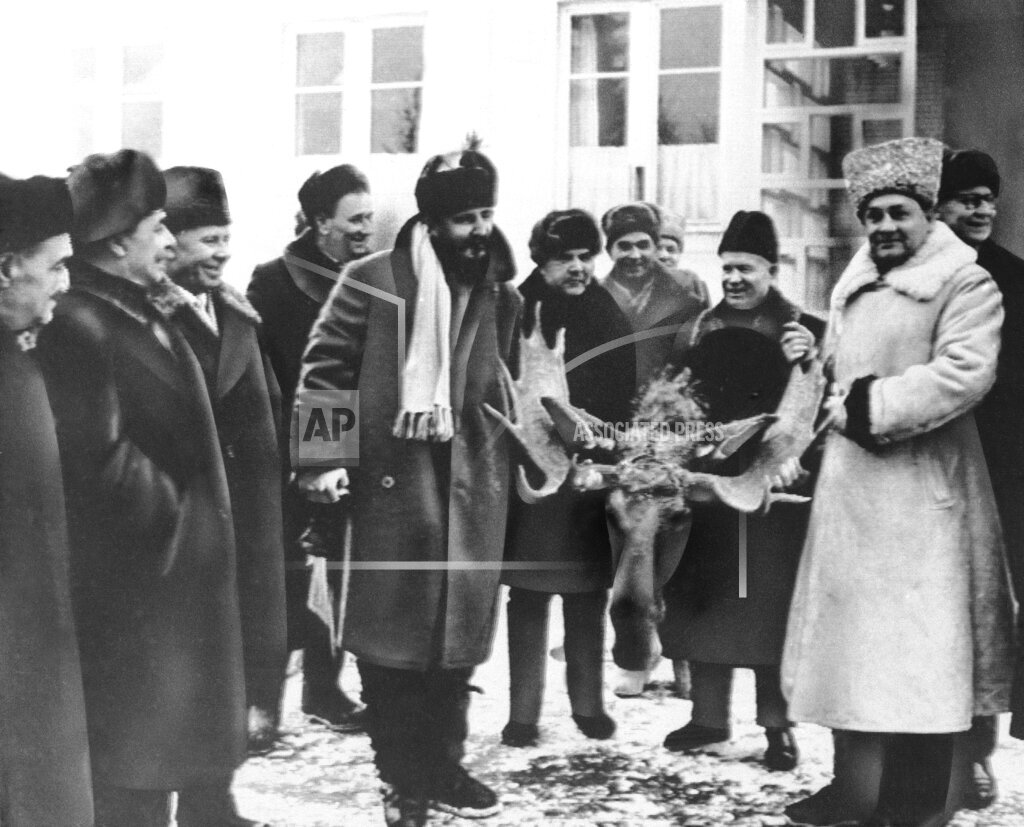
Premier Khrushchev brought his top military advisers to a conference with Premier Fidel Castro at a hunting lodge in the snow-covered woods outside Moscow today. What they talked about was not disclosed. Defense Minister Rodion Malinovsky and a Deputy Defense Minister, Marshal Andrei A. Grechko, were present at the talks. President Leonid I. Brezhnev was also there. The Cuban Premier returned to Moscow in the evening.
President Antonio Segni returned home today from a five‐day visit to the United States and extended thanks to the American people for the “warm reception” given to him and to Foreign Minister Giuseppe Saragat. In a statement at the airport, where he was met by Government leaders, Mr. Segni said his talks with President Johnson and other United States officials were conducted with “frankness.” Mr. Saragat said the United States and Italy would present new proposals at the Geneva disarmament conference and that the two countries had reached an accord on a reply to Soviet Premier Khrushchev’s year‐end proposal of a renunciation of force in territorial disputes. The reply, Mr. Segni said, would allow a full exploration of various roads toward peace.
An earthquake struck Taiwan, killing at least 40 people and injuring more than 200. The collapse of buildings in and around Tainan killed 32 people, and the tremors at Chiayi were exacerbated by a fire from overturned charcoal stoves.
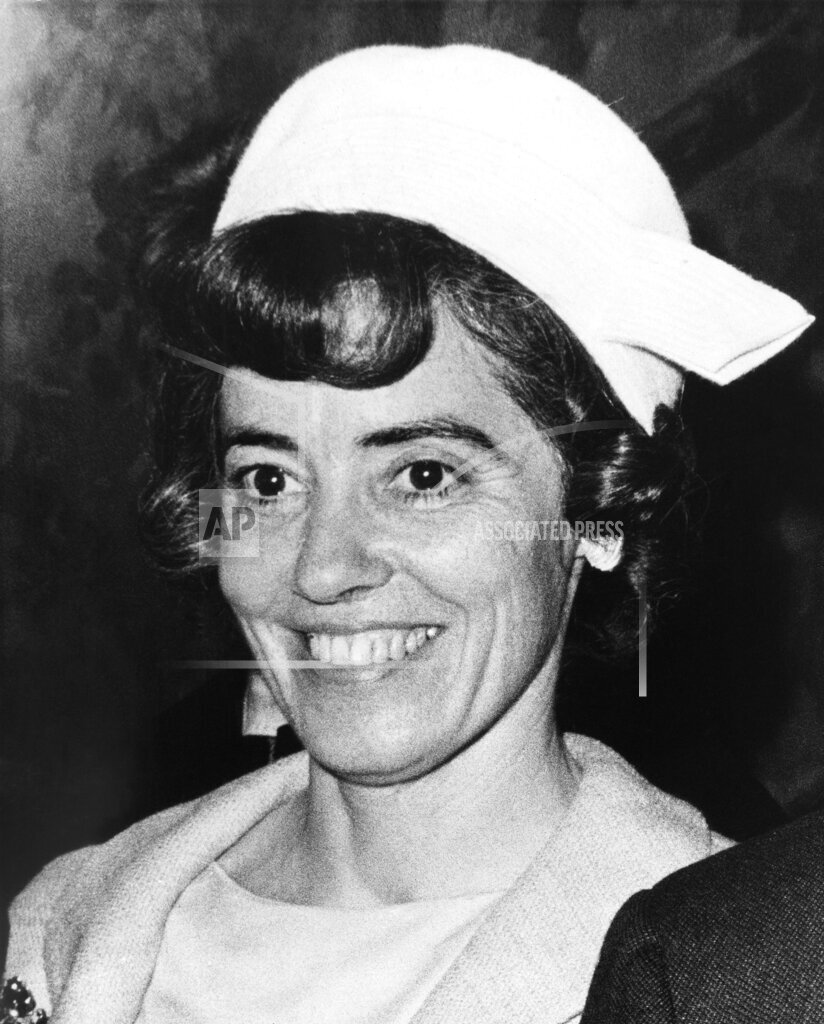
MS Empress of Australia, the world’s largest passenger ferry, was launched from the Cockatoo Island Dockyard in Sydney, and was christened by Catherine Sidney, the daughter of Australia’s Governor-General, William Sidney. Weighing more than 12,000 tons and 445 feet long, the Empress could carry 41 cars, 33 commercial trucks, and numerous shipping containers on its deck, and had room for 250 passengers.
U.S. President Lyndon Johnson’s Economic Report to Congress on Monday will say that the nation’s gross national product reached a rate of $600 billion in the final quarter of 1963, White House sources disclosed today. This rise, higher than expected, brought the gross national product for the whole year to $585 billion. The gross national product, which measures the nation’s output of goods and services, is the main measure of the economy’s overall performance. A rate of about $598 billion had been expected for the fourth quarter. This would have meant $584 billion for the whole year. The third‐quarter rate was $588.7 billion. The $585 billion for the year 1963 meant that the nation’s economy grew 5.4 percent that year. Allowing for a small increase in prices, the “real” growth was about 4 percent.
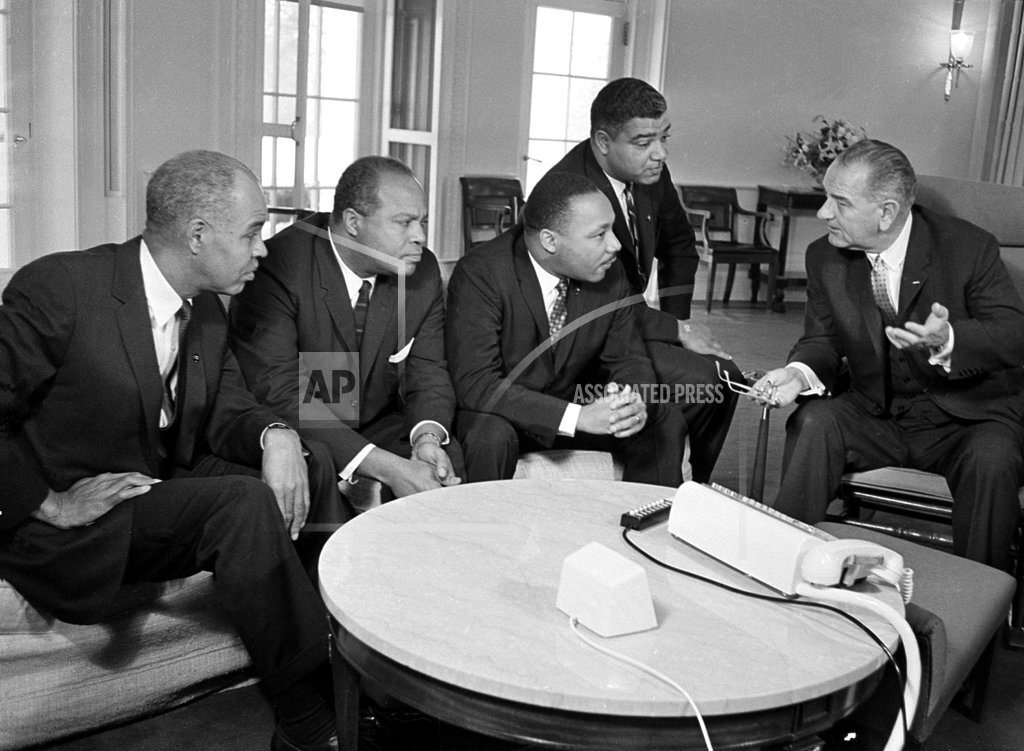
President Johnson was reported today to be hopeful that the civil‐rights bill would reach the floor of the House of Representatives by the end of the month. The bill is now before the House Rules Committee, which must clear it for floor action. The Senate will take up the omnibus bill after the House votes on it. President Johnson’s hopes for speedy House debate were reported by four Black leaders after a surprise hour‐and‐a‐half meeting at the White House.
The President discussed his campaign for civil rights and against poverty with the Rev. Dr. Martin Luther King Jr., head of the Southern Christian Leadership Conference; Roy Wilkins, executive director of the National Association for the Advancement of Colored People; Whitney Young, representing the National Urban League, and James Farmer, National Director of the Congress of Racial Equality.
The Black leaders were invited to the White House by telephone last night. They explained, after the meeting, that the President had asked them to consult with him and advise him in the future. They stressed also that in today’s meeting they had discussed chiefly the President’s pending message on his plans to cope with poverty in the nation. It was in that context that the civil rights measure came up for discussion, the Black leaders explained, and that the President had said he shared their hopes that the House of Representatives would get a chance to debate it on the floor before February.
In the three years of expansion that started in 1961, the real growth of the economy has totaled 16 percent. This is a far faster rate of growth than was achieved in the last half of the last decade, even allowing for the fact that 1961 was a year of recovery from recession. The United States growth rate is now on a parallel with that of Western Europe and, according to estimates of the Central Intelligence Agency, well ahead of that of the Soviet Union. The Administration estimate is that, if the tax cut is passed in the next month or two, growth in 1964 will be even faster than in 1963. A gross national product of slightly above $620 billion could then be expected for the year. This would mark a growth of 6.5 percent, or about 5 percent in “real” terms.
Civil rights organizations have joined in a campaign aimed at achieving greater gains for Blacks in Atlanta, Georgia than have been accomplished in the North. The drive threatens this relatively progressive Deep South city with the prospect of massive demonstrations and a serious racial crisis, which could fan Black unrest elsewhere. The more militant Black leaders concede that if negotiations and small, selective demonstrations fail, they are ready to invite incidents that would expand the conflict. Two incidents of this kind erupted tonight, resulting in the arrest of an estimated total of 65 demonstrators. The first incident took place at a Krystal Hamburger stand in the heart of the city. A youthful, biracial group of men and women belonging to the Student Nonviolent Coordinating Committee lined the sidewalk outside the restaurant this afternoon after robed, hooded members of the Ku Klux Klan had jammed the counter in an apparent move to prevent a sit-in demonstration.
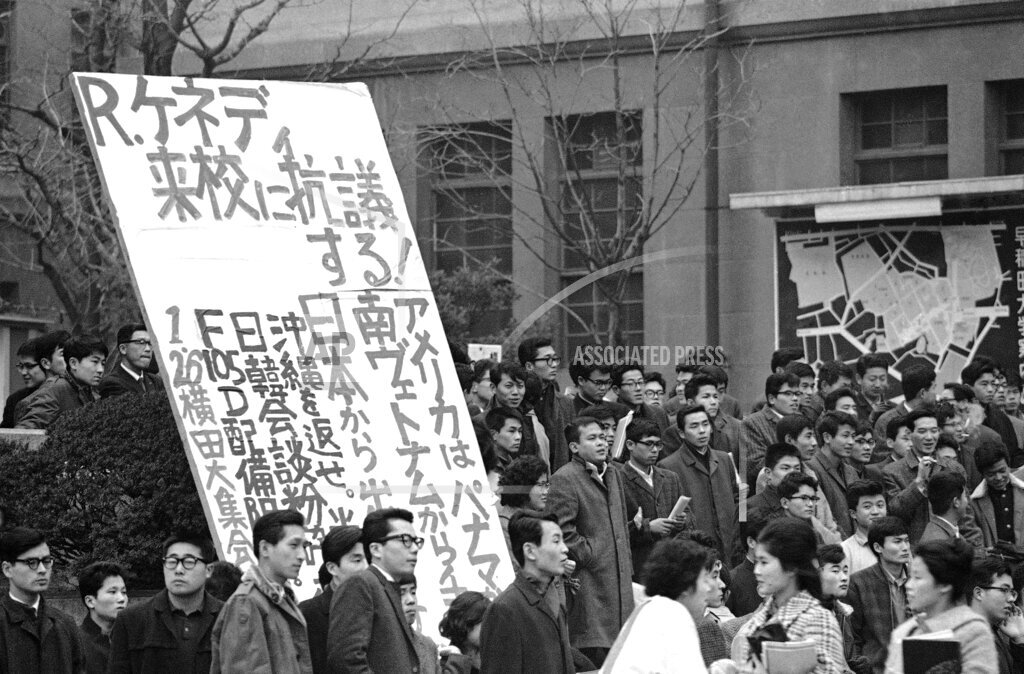
Attorney General Robert F. Kennedy will be called as a witness in James R. Hoffa’s jury‐tampering trial, which begins in Chattanooga Monday. Mr. Kennedy, a longtime foe of the Teamsters Union president, is in the Orient on a mission for President Johnson. Mr. Hoffa said yesterday that the Attorney General was behind all his problems. He said the Government had spent more than $50 million prosecuting him and trying to destroy his union. Harry Berke, Mr. Hoffa’s lawyer here, said Mr. Kennedy would be called but he declined to state for what reason.
Senator Barry Goldwater received a pledge from the manager of his Southern campaign today that he would deliver the votes of every Southern delegate to the Republican National Convention except one, that of Winthrop A. Rockefeller. Mr. Goldwater, making his first trip to the South since formally declaring his candidacy for the Republican Presidential nomination earlier this month, is still the commanding favorite of Southern Republicans. The Arizonan’s campaign strategists, however, are aware that the elevation of Lyndon B. Johnson to the Presidency raises serious questions about Mr. Goldwater’s so‐called “Southern strategy,” or the contention that, if nominated, he could carry many Southern states in November.
Former President Harry S. Truman today came out in support of Senator Stephen M. Young in his fight against Lieutenant Colonel John H. Glenn Jr. for the Democratic nomination for the Senate. Mr. Truman told Howard M. Metzenbaum, a supporter of Mr. Young, that he wanted “to see Steve Young go back as United States Senator from Ohio.” Mr. Truman’s statement was the latest in a series of indications that some political regulars were trying to rally support to Mr. Young, a stanch supporter of the Kennedy‐Johnson programs in Congress. Earlier today, Mayor Ralph Locher of Cleveland announced he would stand behind Mr. Young.
A scale model of the new, 16-acre World Trade Center was unveiled to the public at a press conference in New York City, hosted by the governors of New York and New Jersey (Nelson A. Rockefeller and Richard J. Hughes) and the mayors of New York City and Jersey City (Robert F. Wagner and Thomas J. Whelan). The most outstanding feature for the proposed complex, which would be located on the lower West Side of Manhattan, was its “twin towers” designed by architect Minoru Yamasaki, each 110 stories tall; with a 222-foot-tall transmitting tower on its roof, Tower One would be 1,472 feet high, replacing the Empire State Building as the tallest building in the world.
“Fabulous 208,” a weekly pop music magazine aimed at British teenagers, published its first issue. During its first two years, it was called “Fabulous,” and from 1975 until its demise in 1980, it was named “Fab 80.” Initially, each issue sold for one shilling and included 12 “pin-ups” of current rock stars.
The Beatles make their first appearance on U.S. Billboard Chart with single “I Want to Hold Your Hand” at #45
Born:
Jane Horrocks, English television actress (“Little Voice”, “Corpse Bride”, “Absolutely Fabulous”), in Rawtenstall, Lancashire, England, United Kingdom.
Michelle Fairley, Northern Irish television actress (Catelyn Stark-“Game of Thrones”), in Coleraine, County Londonderry, Northern Ireland, United Kingdom.
Brady Anderson, MLB outfielder (All-Star, 1992, 1996, 1997; Boston Red Sox, Baltimore Orioles, Cleveland Indians), in Silver Spring, Maryland.
Jenny Holliday, Australian softball pitcher (Olympic bronze, 1996), in Melbourne, Victoria, Australia.
Virgil Hill, American boxer (WBA light heavyweight title 1987, 97; IBF & lineal light heavyweight titles 1996-97; WBA cruiserweight title 2000-02, 2006-07), in Clinton, Missouri.
Daryle Smith, NFL tackle (Dallas Cowboys, Cleveland Browns, Philadelphia Eagles), in Hawkins County, Tennessee (d. 2010).
Brian Sisley, NFL defensive end (New York Giants), in Hot Springs, Arkansas (d. 2013).

 History Diaries