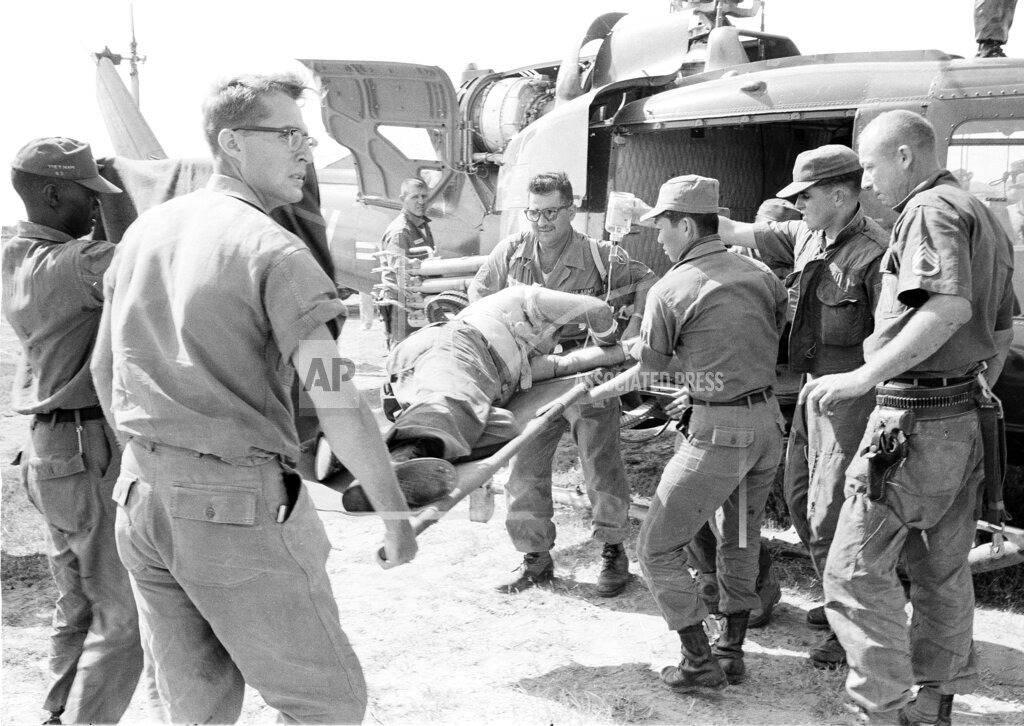
Five U.S. helicopter crewmen are killed and three are wounded while supporting a major ARVN attack on Communist bases in the Mekong Delta. Urgent appeals for blood were broadcast by the United States Armed Forces radio. Casualties poured into the Saigon airport from the opening engagements of a campaign expected to last several days. Communist ground fire killed one American 10 miles west of Cần Thơ, a river town 80 miles southwest of Saigon. He was an army private first class, the door gunner on an H-21 troop-carrying helicopter. The craft was not damaged. Downriver, a rocket-firing UH‐1A escort helicopter disintegrated in an explosion as it led an aerial strike against guerrilla foxholes. All four American crewmen were killed. It was one of the worst days of the war for the helicopters. Many were so damaged as to be temporarily grounded.
The toll of American combat deaths since the United States stepped up its military support of South Vietnam two years ago rose to 99. United States service deaths from all causes now total 173.
Students in Saigon stage two anti-French demonstrations protesting De Gaulle’s proposal to neutralize Vietnam. In Saigon, civil disorders spread. Students staged two anti‐French demonstrations and about 20 girls were injured in a riot at a textile plant where they and other workers went on strike last week. They seek a raise in pay, which now averages $12 to $18 a month. Fifty students handed out leaflets denouncing President de Gaulle’s proposal to neutralize Vietnam. Policemen, troops and marines broke up the demonstration. About 200 students later staged a three-and-a-half-hour sitdown strike at the French cultural mission. These were the latest in a series of student disorders, which had widely varied aims. The Saigon radio broadcast appeals to the youths to calm down.
Panama completed its break of diplomatic relations with the United States, ordering the closure of the U.S. Embassy in Panama City and directing all diplomatic personnel to leave. Panama completed her break of diplomatic relations with the United States today after inter‐American efforts to end the crisis came to a halt. The personnel of the United States Embassy immediately left the tense republic and moved with their dependents to the Canal Zone, which is controlled by the United States. Panama’s Foreign Minister, Fernández Galileo Solis, said he had sent the United States Embassy a request that all diplomatic personnel leave Panama “in due course.” The Foreign Minister said he expected American consular officials to remain in Panama and probably to operate the embassy.
There were strong indications, however, that the Panamanian Government intended the break to be temporary. The Government is asking that United States aid and Peace Corps activities continue. Also, President Roberto F. Chiari said American investors could feel assured that their investments were safe. President Chiari conferred this afternoon with Manuel Trucco of Chile, the last member of the Inter‐American Peace Committee remaining here. The President told him that the request to Costa Rica was due chiefly to Panama’s wish to preserve the continuity of the United States aid programs. Mr. Trucco said later that the Panamanian move could provide a “peaceful interlude” after which the Inter‐American Peace Committee could resume its effort to bring the countries together.
Premier Khrushchev said today that the Soviet Union was “siding with the people of Panama,” who “want to get rid of oppression by United States imperialists.” He ridiculed as “imperialist concoctions” American charges that Cuban and Communist agents had played a role in the Panamanian disorders a week ago. “It was not Comrade Castro who organized the events in Panama,” he said. “These events were the result of the predatory policy of United States imperialism.” In a speech delivered in the presence of Premier Fidel Castro of Cuba, who began a visit to the Soviet Union on Monday, Premier Khrushchev also defended his withdrawal of Soviet missiles from Cuba in an “understanding with the United States.” The Soviet leader declared that he had received a United States pledge that there would be no invasion of Cuba.
France will grant unconditional recognition soon to Communist China, authoritative sources reported tonight. The United States has been informed of General de Gaulle’s intention. A date for announcing the details of recognition has not been set, but it is expected before the end of the month. The Peking regime did not stipulate in its exchanges with General de Gaulle’s Government that France break off diplomatic relations with the Chinese Nationalist Government on Taiwan. This Communist concession apparently is the reason France is now moving rapidly toward recognition. All informants agreed that recognition is a personal policy of General de Gaulle. The initial reaction of France’s five partners in the European Economic Community was adverse. The French initiative was viewed by these Governments as a defiant challenge to the United States, whose diplomatic weight has been used, and still is being used, to halt recognition.
The United States, it is understood, is continuing to try through diplomatic channels to divert General de Gaulle from his course. It is conceded that there is little hope of success. French diplomats have asserted, in defense of recognition, that the road to pacification of the troubled nations of Southeast Asia lies through Peking and establishment of normal diplomatic relations. They concede that France will be obligated by the recognition to support the Communist regime’s entry into the United Nations. The Administration has been informed, not consulted, by the French.
Secretary of State Dean Rusk, after a talk with General de Gaulle on December 16, left convinced that there was nothing imminent about French recognition, although the general thought that sooner or later normal diplomatic relations would be established. Two days ago, a scant four weeks later, the United States was informed through diplomatic channels that France would recognize the Communist Government. Reaffirmation of France’s role as a great independent world power appears to diplomats to be the motive behind the move. They do not believe the motive can be an increase in trade, since Belgium, which does not recognize Peking, trades more with mainland China than the Netherlands. which does.
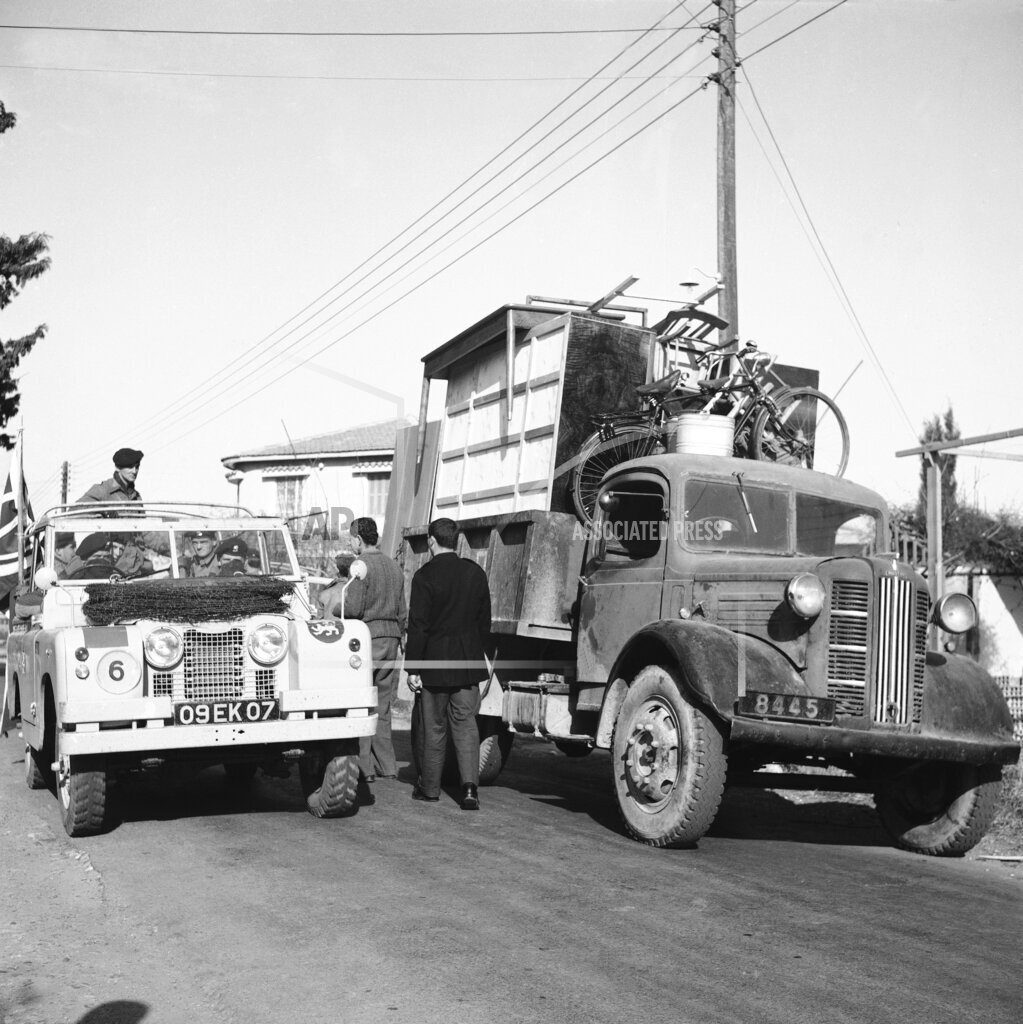
The conference in London on the Cyprus problem tottered on the verge of collapse tonight over the credentials of one of the principal delegates. The issue is whether Spyros Kyprianou, Foreign Minister of Cyprus, is representing the Cypriote Government or just the island’s Greek community. “Of course, I represent the Government.” Mr. Kyprianou said. “This was the decision of the Cyprus Council of Ministers.” “What Government?” asked Raouf Denktash, head of the Turkish Cypriote delegation. “There were no Turkish ministers at the Council meeting.” Dr. Fazil Kutchuk, Vice President of Cyprus and head of the Turkish community there, addressed a strongly worded telegram of complaint tonight to Duncan Sandys, British Commonwealth Relations Secretary. Mr. Sandys is chairman of the conference.
The agreement on the parley, Dr. Kutchuk declared, stated clearly that Britain, Greece and Turkey would be represented at the conference, along with delegations from the Greek and Turkish communities in Cyprus. The conference was meant to review the whole complicated package of constitutional and treaty arrangements by which Cyprus is governed and her status is protected by Britain, Greece and Turkey.
Attorney General Robert F. Kennedy declared today that he was encouraged by progress made in Tokyo toward settlement of the Malaysia‐Indonesia dispute. His comment followed meetings with President Sukarno of Indonesia at which he urged Mr. Sukarno to curb guerrilla raids into Sarawak and Sabah (North Borneo), the Malaysian territories bordering on Indonesian Borneo. Mr. Kennedy, acting as special envoy of President Johnson, spoke at a news conference after meeting this morning for the second time in two days with Mr. Sukarno, who has been vacationing in Japan. It was apparent from Mr. Kennedy’s remarks that he had not obtained firm assurance from Mr. Sukarno that the latter would cease to support the Indonesian Borneo raiders. But Mr. Kennedy plans to see President Sukarno again next Wednesday in the Indonesian capital of Jakarta.
A special plane took the United States Consul in Zanzibar, Frederick P. Picard 3rd, to nearby Tanganyika today after he had been ordered out of the country by the new revolutionary regime. Four American newsmen also were expelled. Mr. Picard had been accused by President Abeid Karume of having interfered in the internal affairs of this island off the east coast of Africa. The new regime imposed censorship on outgoing dispatches and tightened security measures. Mr. Picard was arrested last night during an argument with President Karume, who denounced the United States for failure to recognize his regime, which displaced the Arab sultanate last Sunday. Mr. Picard was marched out of the hotel with a gun at his back and put under house arrest. He was permitted to depart by chartered plane for Dar es Salaam, capital of Tanganyika.
Arab leaders wound up a conference in Cairo today with a formal expression of unity and anti-Zionism, but without disclosing any specific common plan to stop Israel from diverting the waters of the Jordan River. The final declaration of the Arab heads of state also did not mention a unified Arab military command, reported two days ago to have been agreed on in principle. An air of harmony prevailed at the meeting despite some predictions that it would break up over inter‐Arab rivalries and arguments.
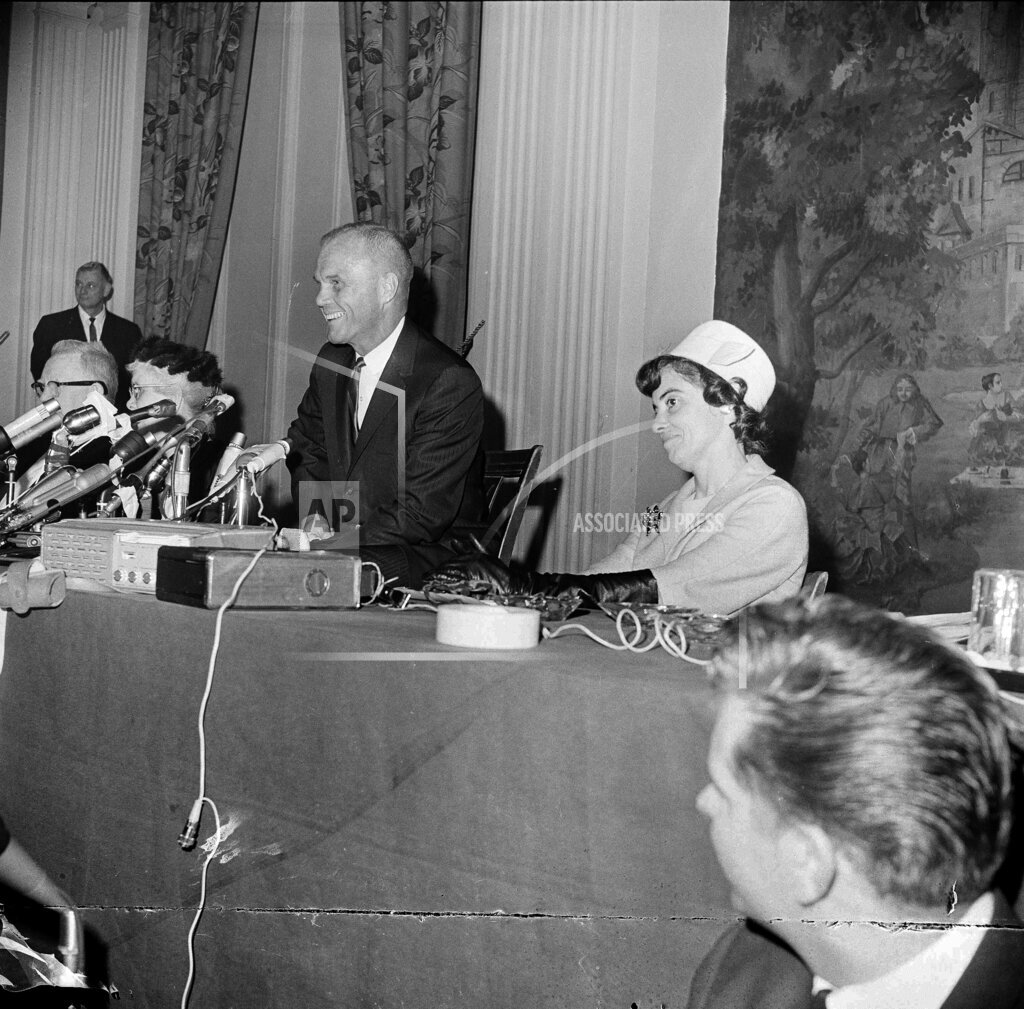
Lieutenant Colonel John H. Glenn Jr., the first American to orbit the earth, announced his candidacy for the Democratic Party nomination for U.S. Senator for Ohio, one day after resigning from the American space program. Glenn, the astronaut who hurtled to national fame as the first American to orbit the earth, announced today that he would seek Ohio’s Democratic nomination to the United States Senate. The 42‐year-old Marine Corps officer said he had decided to leave the nation’s space effort because he feared he would be too old to shoot for the moon by the time the Apollo lunar project was ready about eight years hence. He said he chose to shoot for the Senate, rather than enter business or take a staff job with the space program, because this course offered him the best opportunity to use his 22 years of military and space experience. He said he knew of no place he could better serve his country and state than in the Senate. The baldish astronaut, exuding charm and smiling radiantly, read his announcement and answered questions this morning at a crowded news conference in the grand ballroom of the Neil House here. He was accompanied by his parents, his wife and her parents. The family was swamped by newsmen, photographers and enthusiastic well‐wishers following the conference.
Senator Barry Goldwater carried his Presidential campaign into the South today and found warm Republican support. The big question on his mind was how conservative Democrats felt about him, with a Southern Democrat in the White House. The Arizonian had an enthusiastic reception, except for one heckler. Bobby Dunn, a 26‐year‐old college student, shouted as the Senator alighted from his chartered plane: “Goldwater go home! Have you got Robert Welsh in there?” Mr. Welsh is founder‐president of the ultraconservative John Birch Society.
Mr. Goldwater wasted no time in questioning President Johnson’s credentials as a Southerner. He said he did not think his popularity in the South “had changed a lot” with Mr. Johnson’s elevation to the White House. “I think we will have to wait and see how Southern he is,” he said of the President. He suggested that Mr. Johnson talked like a Southerner only while in the South. However, several Republican officials said privately that Mr. Goldwater’s previously strong position in North Carolina had suffered since Mr. Johnson became President. Since the South has been a major base of strength for Mr. Goldwater, his supporters fear that a change in this position may give impetus to “Goldwater can’t win” opposition in the party.
The Senate Tax Writing Committee hands the Johnson administration a major victory when it kills a House provision granting a 35 percent reduction in the capital gains tax. Senator Harry F. Byrd (D-Virginia), chairman of the Senate Finance Committee, expects the bill to be ready for floor action next week, possibly by Wednesday. The committee also grants department stores a tax saving estimated at 110 million dollars by revamping the treatment accorded sales on a revolving credit plan.
The U.S. Government contended before the U.S. Supreme Court today that a state with a long history of official segregation could not enforce racial discrimination at lunch counters or other such places of public accommodation. In those circumstances, the Justice Department said, the state is sufficiently involved to produce a violation of the 14th Amendment. The discrimination is not a purely private act outside the Constitution, the department said. These views were expressed in a long, significant brief filed with the Supreme Court this afternoon. The Justices, by a 5-to‐4 vote, asked on November 18 for this further government brief in five pending sit‐in cases. The result of the argument, if the Supreme Court accepted it, would be to outlaw trespass and other prosecutions of persons who demand equal service at lunch counters and other such places in the South.
The Justice Department did not argue that there was a constitutional right to service. This raised the possibility of a stalemate in which demonstrators would demand service without fear of arrest but the proprietor of a hotel or theater or restaurant would continue to refuse service. The moral drawn by the brief was that no Supreme Court decision could obviate the need for legislation to outlaw discrimination at places of public accommodation. Such a provision is the key section of the civil rights bill pending in Congress. “Congress alone can meet the present national crisis arising from the system of segregation,” the brief said, “by removing the fundamental injustice in places of public accommodation.”
The Miami Herald reports Senator George Smathers (D-Florida) turned a $9,000 investment into a $75,488 asset in a Florida land deal and that Robert G. Baker, onetime protege of President Johnson, shares his good fortune. The Herald says Baker put $1,500 into the deal and is coming out with $12,580. The newspaper says it developed its figures by researching hundreds of public documents in the booming Orange County area west of Cape Kennedy. Baker is under Senate investigation on charges of influence peddling.
Senators investigating the affairs of Robert G. Baker, resigned Senate majority secretary, vote to disclose information they have received about a $200,000 insurance policy issued on the life of President Johnson by a firm listing Baker as vice president. Senator B. Everett Jordan (D-North Carolina), chairman of the rules committee, says Senator George Smathers (D-Florida) has given the committee a full explanation of his interests in a Florida real estate development in which Baker shared.
The South Dakota House of Representatives approves a federal anti-poll tax amendment and sends it to the state Senate for a vote that will make it a part of the United States Constitution. South Dakota will be the required 38th state to approve the amendment.
Mrs. Blanche Morris, widow of a Chicago meat packer, is robbed in her Florida home of a $100,000 diamond necklace, a $92,000 ring, and other jewelry. The robbers lock Mrs. Morris, three women guests, and a houseman in a closet and escape. The guests also lose their jewelry.
The typical American worker on a factory production line earned $2.50 an hour in December for the first time in history. This level was reached seven years and a month after the average hourly wage first touched $2 in November, 1956. The increase from $1.50 an hour to $2 was achieved in a shorter time, one month less than six years. A rise of a cent an hour in average factory wages in December brought average weekly earnings to $102, also a record. The typical factory worker had slightly less than an hour of overtime a week that month.
A few more stocks advanced than declined yesterday in an aimless session on the New York Stock Exchange. Price changes were small in reduced but active trading. One broker called yesterday’s session a “pause for refreshment” at a high point on the slope. Market averages have been hovering near record highs since mid‐December.
Dow Jones Industrial Average: 775.69 (-0.44).
Born:
Michelle Obama [as Michelle LaVaughn Robinson], First Lady of the United States from 2009 to 2017, in Chicago, Illinois.
Andy Rourke British rock bassist (The Smiths – “This Charming Man”; “Ask”), in Manchester, England, United Kingdom (d. 2023).
Reggie Singletary, NFL guard, tackle, and defensive tackle (Philadelphia Eagles), in Whiteville, North Carolina.
Anthony Fields, NFL defensive back (Detroit Lions), in Mobile, Alabama.
Duffy Cobbs, NFL defensive back (New England Patriots), in Bad Kreuznach, Rhineland-Palatinate, Federal Republic of Germany.
Dave Brown, NFL linebacker (Philadelphia Eagles), in Dayton, Ohio.
Jeff Tabaka, American baseball pitcher (Pittsburgh Pirates, San Diego Padres, Houston Astros, Cincinnati Reds, St. Louis Cardinals), in Barberton, Ohio.
Died:
T. H. White, 57, English novelist known for “The Once and Future King” and “The Sword in the Stone”.



[The entire U.S. figure skating team, including coaches, had been lost in the crash of Sabena Flight 548 on approach to Brussels on February 15, 1961. Among the fatalities were nine-time U.S. ladies’ champion turned coach Maribel Vinson-Owen and her two daughters: reigning U.S. ladies’ champion Laurence Owen, age 16, and her 20-year-old sister, reigning U.S. pairs champion Maribel Owen. Both had won gold medals at the 1961 U.S. Figure Skating Championships in Colorado Springs just two weeks earlier. Laurence Owen appeared on the cover of the February 13 issue of Sports Illustrated just two days before her death. Within days of the tragedy, the U.S. Figure Skating Executive Committee established the 1961 U.S. Figure Skating Memorial Fund to honor the 18 team members and their entourage who died in the crash. The funds’ mission was to help rebuild the U.S. figure-skating program by providing financial support for promising young skaters. In March 1961, a benefit was held at Boston Garden to raise money for the fund. Among the fund’s first beneficiaries was 12-year-old Peggy Fleming, whose coach William Kipp had died in the crash. Fleming would go on to win the gold medal at the 1968 Winter Olympics.]
 History Diaries