On his own initiative, William Chapman Foster, the Director of the United States Arms Control and Disarmament Agency, made his first proposal to Soviet Ambassador Anatoly Dobrynin about the two nations negotiating limitations on their anti-ballistic missiles, a discussion that would lead to the 1972 ABM Treaty.
Frantic efforts to restore the agreement to settle the crisis in relations between Panama and the United States were being made today. The leader in the negotiations to salvage the accord, concluded yesterday morning, was Manuel Trucco of Chile, who remained here as representative of the Inter‐American Peace Committee. The four other members of the committee left for Washington last night convinced that Panama and the United States would proceed with plans to resume diplomatic relations and with talks to settle the crisis. The crisis arose last week with violent clashes over the United States failure to display the Panamanian flag at schools in the Canal Zone.
The conciliation plans seemed to be on the verge of collapse after Panama’s President, Roberto F. Chiari bowed to internal pressures and announced that before he would resume relations, he wanted public assurances that the Johnson Administration was willing to revise the Panama Canal Treaty.
By tonight the Panamanian Government had agreed in principle to let the Peace Committee continue to use its good offices as long as there was some “clarifying statement” from Washington. This seemed like a softening of the earlier demand that Washington assure Panama that a new treaty would emerge from the contemplated negotiations. Mr. Trucco said, after his second meeting with the President, that he was “somewhat more hopeful” that the original agreement between the countries could still be salvaged. The Panamanian Foreign Office dropped its announced request that the entire staff of the United States Embassy go home. This request was to be suspended pending the outcome of Mr. Trucco’s mediation effort. Panama’s Foreign Minister, Fernández Galileo Solis, also suspended his request that the Costa Rican Government take over Panama’s interests in the United States.
Washington’s policy in the Canal Zone should be “no give” where basic United States rights are concerned, Richard M. Nixon said tonight. The former Vice President said he would negotiate with the Government of Panama about the “little irritating things,” but would stand firm on the right of the United States to control the Canal Zone. “If the United States retreats one inch in this respect, we will have raised serious doubts about our bases throughout the world,” he said. The importance of standing firm is not just for selfish reasons, he added, but for the safety of the non-Communist world.
At the conclusion of a summit meeting in Cairo, the heads of state of 13 Arab nations announced that they would divert the three main tributaries of the Jordan River away from Israel, rather than to go to war or to allow the National Water Carrier of Israel to go into operation as planned. The Israeli project, for the increased use of the waters of the Jordan for agricultural and drinking water needs, had been announced on December 11, to go into operation in the summer. The crisis would finally be resolved on May 5 when the Arab nations dropped objections to Israel’s announcement of completion of the project.
The new government of Zanzibar arrested U.S. chargé d’affaires Frederick Picard and another American diplomat on orders of President Abeid Karume, as well as six correspondents associated with Time and Newsweek magazines, the New York Times, the New York Herald-Tribune, The Guardian (of Manchester) and The Globe and Mail (of Toronto). The group was released the next day and placed on a plane leaving the country. President Karume was reportedly upset after reading American newspaper reports about the coup.
Turkey declared today that she had no intention of withdrawing her military forces from Cyprus. Speaking in the second session of the conference here on the Cyprus problem, Feridun Cemal Erkin, the Turkish Foreign Minister, said Cyprus was strategically too important to Turkey for her to feel secure unless she had an army contingent permanently in that troubled island republic. Cyprus lies just south of Turkey. The northern coastline of Cyprus follows the bulging contour of Turkey’s coast, at points less than 50 miles away. Turkey has 600 soldiers in Cyprus under the treaty arrangements by which Cyprus achieved independence from Britain three and a half years ago.
On Christmas Day, three days after open warfare broke out between the Greek and Turkish communities in Cyprus, the Turkish soldiers intervened in the fighting. They took up positions on the northern edge of Nicosia and kept the Greek Cypriotes from closing a circle around the embattled Turkish community. The Turks also drove a small Greek Cypriote force out of a flour mill and thereby insured a supply of bread to the besieged Turkish community. By the next morning the Turkish troops were dug in on both sides of the road from Kyrenia, along which heavy equipment would have had to be moved in the event of an invasion from the Turkish mainland.
Tonight, with a tenuous ceasefire in effect in Cyprus, the Turkish troops continued to hold these vital positions. A company of the 900 Greek soldiers in Cyprus remains at Kykko Monastery, in control of another route into Nicosia. More than 2,500 British soldiers, some flown in from Britain and the others from the bases of Akrotiri and Dekelia, are patrolling the island and manning positions separating the Greek and Turkish Cypriote forces.
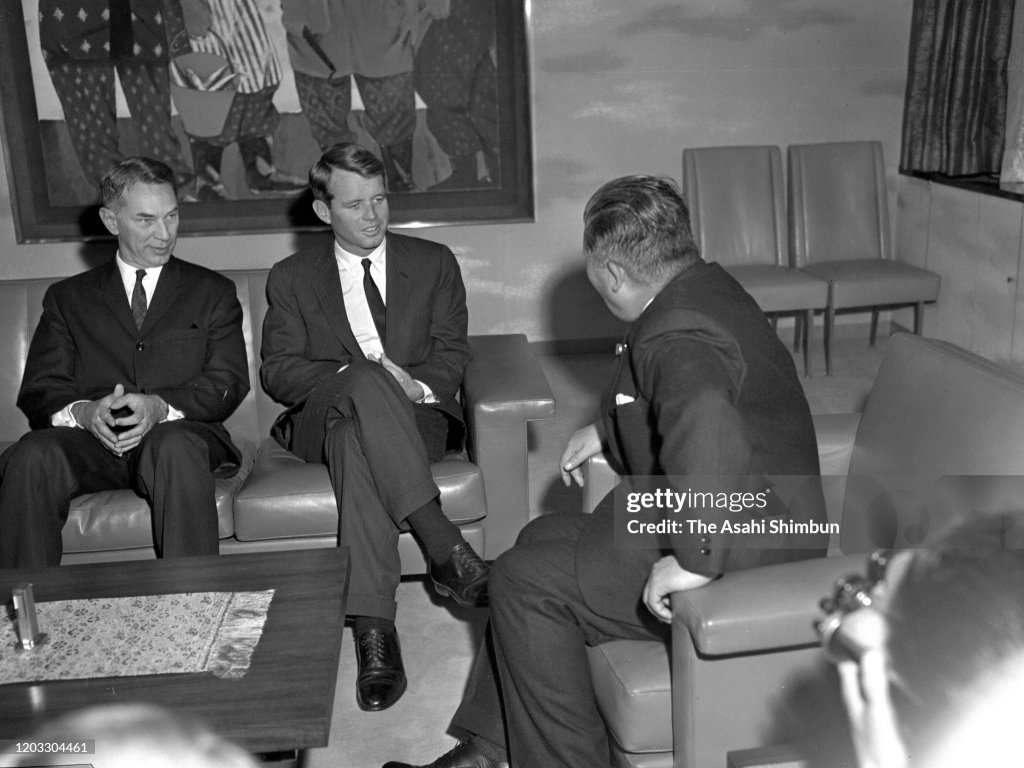
Attorney General Robert F. Kennedy, arriving here last night for talks with President Sukarno of Indonesia on the Malaysia crisis, said the dispute must be resolved “by Asian countries, not by outsiders.” But, he added, “we have in the United States a bond of friendship with Indonesia, and by expressing our concern that Indonesia, Malaysia and the other countries concerned settle their differences in a peaceful fashion, a major step forward would be accomplished, in our judgment.” Mr. Kennedy, who flew here from Washington on a special trouble‐shooting mission for President Johnson, began his talks with President Sukarno in midafternoon, Mr. Sukarno had arrived here Wednesday night. Mr. Kennedy was accompanied to the meeting, held in President Sukarno’s suite at the Imperial Hotel, by Edwin O. Reischauer, United States Ambassador to Japan.
President Kwame Nkrumah and Communist China’s Premier, Chou En‐lai, said today it was desirable to an “anti-imperialist conference” of African, Asian and Latin-American peoples. They made the declaration in a communiqué issued here after Mr. Chou’s departure for Mali after a five‐day visit to Ghana. The two leaders also considered that a conference of the world’s heads of government would be beneficial “if it could be convened for the purpose of signing an international convention prohibiting the development and use of all nuclear weapons and the complete destruction of existing nuclear weapons and their stockpiles.” They discussed the Chinese-Indian border dispute and expressed their determination to support peaceful efforts “aimed at bringing about direct Sino-Indian negotiations,” the communiqué said.
Nine newspapers here were closed today by Government order and 600 Saigon University students demonstrated for the closing of another, the daily Dan Chung (The People) Chanting students demanded suppression of Dan Chung because it suggested that one of their professors gave special treatment to Mrs. Ngô Đình Nhu’s 19‐year‐old daughter Ngô Đình Lệ Thủy, when she was a student at the university. Mrs. Ngô’s husband was the brother of President Ngô Đình Diệm. Both men were killed in the military revolt that overthrew the Diệm regime last November. The students, dispersed only after the Information Minister, Brigadier General Đỗ Mậu, said the government would consider their demand. The minister closed the nine other papers on charges that they violated internal security. Mrs. Ngô’s daughter, who passed her examinations last spring, is living in France with her mother.
Brazilian federal employees join in the rising tide of strikes as Brazil’s economic-political crisis deepens. A cut-off of public utilities leaves Rio de Janeiro in chaos. Troops are sent into the northeast area of the country after 12 persons are killed when laborers try to take over a mill in a gun battle. Marines guard the navy ministry after civilian workers walk out.
Members of the Senate Finance Committee indicate that they may be able to send the tax revision bill to the floor by February 1, as requested by President Johnson. The committee approves five of the last eight sections of the measure. It also doubles the 40-million-dollar increase in taxes imposed upon the oil industry in the House bill.
The Senate Finance Committee surprised oil and gas producers today by approving increases of about $80 million in their annual taxes. The action gave tax reformers their first major victory in the committee’s voting on the Administration’s $11 billion bill for tax reduction and reform. The panel, meeting mornings and afternoons to speed the measure to the floor, now expects to conclude the decision-making sessions next week. Thus, the completed text and accompanying report may be ready for Senate consideration by the end of this month. As passed by the House last September 25, the bill included a provision to raise about $40 million in new tax revenue from the oil and gas industry. The Finance Committee added a second provision estimated to yield an equal amount.
The controversy between Senator Barry Goldwater (R-Arizona) and Secretary of Defense Robert McNamara over the reliability of the nation’s missile defense will be investigated by the Senate Armed Forces Preparedness Subcommittee. The announcement is made by Senator John Stennis (D-Mississippi), chairman of the subcommittee, who says he has directed the staff to “update” and review at once the subcommittee’s information on the reliability of missiles.
Governor Nelson A. Rockefeller of New York, campaigning In New Hampshire, describes Senator Barry Goldwater (R-Arizona), his rival for the Republican Presidential nomination, as a “southern leader with a limited understanding of race prejudice as a factor in poverty and high relief costs.” The governor took as the basis for his attack a sentence in a speech prepared for delivery by Goldwater. The senator deleted the sentence from his speech.
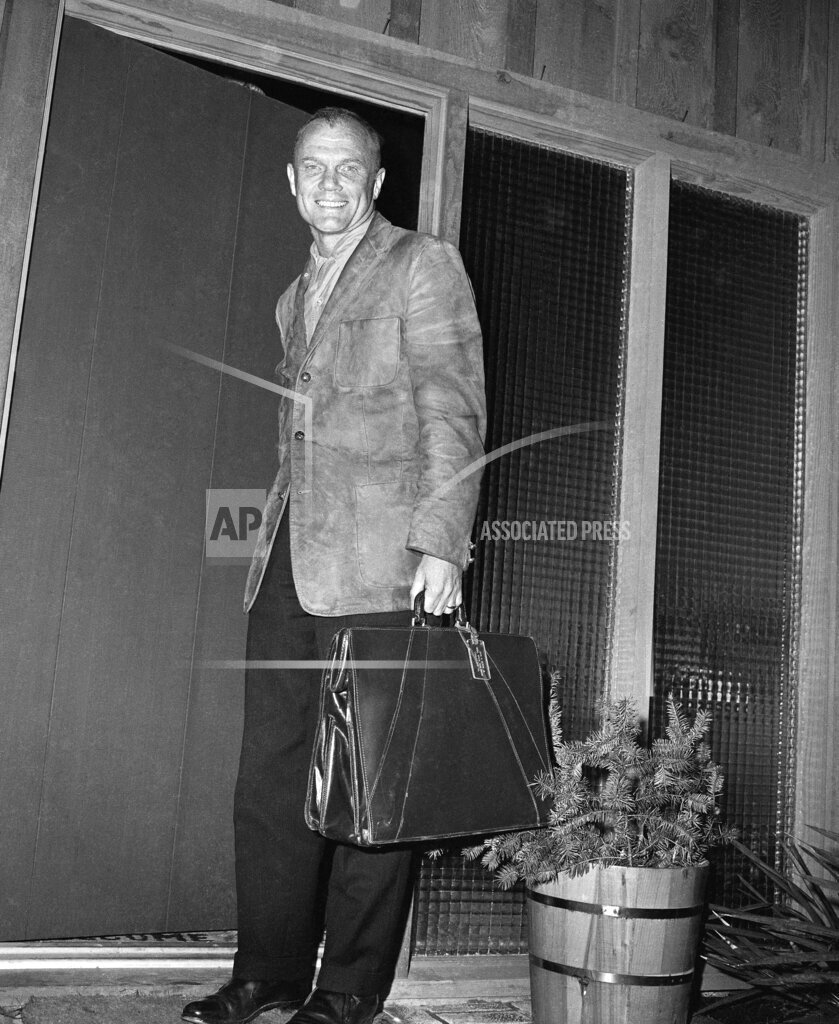
Astronaut John H. Glenn Jr. quits America’s space program to run for the United States Senate from Ohio on the Democratic ticket. He is expected to formally declare his candidacy today for the seat held by Senator Stephen M. Young of Cleveland, Glenn, 42, is from New Concord, Ohio.
Rep. Edwin E. Willis (D-Louisiana) brands the civil rights bill “the most drastic and far-reaching proposal and grab for power” ever reported by a congressional committee. He asserts that it is so full of unconstitutional provisions and federal invasions of states’ rights that it should be sent back to the House Judiciary Committee.
President Johnson has decided against any major overhaul of the administrative structure of the foreign aid program. One of his top Congressional spokesmen said today that the President had concluded that far more could be lost than might be gained by another administrative reorganization. As a result, he was reported to be thinking in terms of “refinement” of current administrative procedures rather than of “scuttling” the Agency for International Development. The President has yet to hear from the interdepartmental study group he appointed to consider revamping both the administrative organization and content of the foreign aid program. The group was instructed to report by January 15. Its failure to meet this deadline was laid to the Panama crisis and the preoccupation of several key members with that problem.
The group, headed by Under Secretary of State George W. Ball, was forced by mounting Congressional opposition to abandon alternate plans of scrapping the aid agency and to make a new start on its investigation. Although it is now without any deadline, its report must be completed in time for the President’s foreign aid message to Congress, later this month or early next month. A plan put forward by Mr. Ball as chairman of the group would have absorbed the various economic aid programs into the State Department, abolished the aid agency and terminated the positions of most of its 2,700 employes. Such staff experts as were retained would be under the direction of chiefs of State Department political divisions. An alternate approach would have parceled out various economic aid programs to six or seven Federal departments and agencies carrying on similar or related activities in the United States.
President Johnson proposed today a $115 million budget for the Peace Corps for the next fiscal year starting July 1. The request represents an increase of $19 million over the current year’s allotment of $96 million, and is designed to finance what corps officials describe as a “major expansion” of the program. About 7,000 corps volunteers and trainees are now serving overseas.
President Johnson has such a “shocking lead today” in the Presidential sweepstakes that professional pollsters “can’t believe it,” Louis Harris, former opinion surveyor for President Kennedy and now a syndicated newspaper columnist, said last night. Another opinion analyst, Samuel Lubell, said Mr. Johnson “looks very strong” and would probably stay that way at least until after the next Congressional session. “The big problem the Republicans have got is to wait for Johnson to offend somebody,” he said.
President Johnson today appointed Margaret K. Hickey, public affairs editor of The Ladies Home Journal, as chairman of the Citizens Advisory Council on the Status of Women. The council was established in November by President Kennedy “to assure effective and continuing leadership in advancing the status of women.”
Dr. Charles Dotter of the University of Oregon pioneered the science of interventional radiology by using x-rays to guide placement of instruments in what was also the first percutaneous transluminal angioplasty and the beginning of today’s minimally-invasive surgery. Dr. Dotter’s patient was an unidentified 83-year-old woman who had been admitted for gangrene of her three left toes and who had refused amputation; with the assistance of Dr. Melvin Judkins, Dr. Dotter inserted two Teflon catheters to guide the dilation of the patient’s narrowed left popliteal artery under local anesthesia and the patient soon “became ambulatory and her foot promptly healed.”
The greatest snowfall to hit north Texas in this century covers 120,000 square miles of the state and extends into Oklahoma. Fourteen inches of snow piled up in some areas, closing schools, caving in roofs, and snarling traffic. Fort Worth and Dallas both have record falls. The storm pushes through the southeastern corner of Oklahoma and drives eastward across Louisiana and Arkansas. Snow also falls in Mississippi, Alabama, eastern Tennessee, and north Georgia. Ten inches are expected in east Tennessee mountains.
The musical “Hello, Dolly!” starring Carol Channing as the widow Dolly Levi, began a successful Broadway run, opening in New York City’s St. James Theatre with the first of 2,844 performances.
American League owners vote 9-1 against Charlie Finley’s Louisville proposal. Finley is given an ultimatum to sign a lease in Kansas City or lose his franchise.
Dow Jones Industrial Average: 776.13 (+1.42).
Born:
Mark Collins, NFL cornerback and safety (NFL Champions, Super Bowl 21 and 25-Giants, 1986, 1990; New York Giants, Kansas City Chiefs, Green Bay Packers, Seattle Seahawks), in St. Louis, Missouri.
Darren Boyko, Canadian NHL centre (Winnipeg Jets), in Winnipeg, Manitoba, Canada.
Gail Graham, Canadian golfer (2 LPGA Tour titles), born in Vanderhoof, British Columbia, Canada.


 History Diaries