
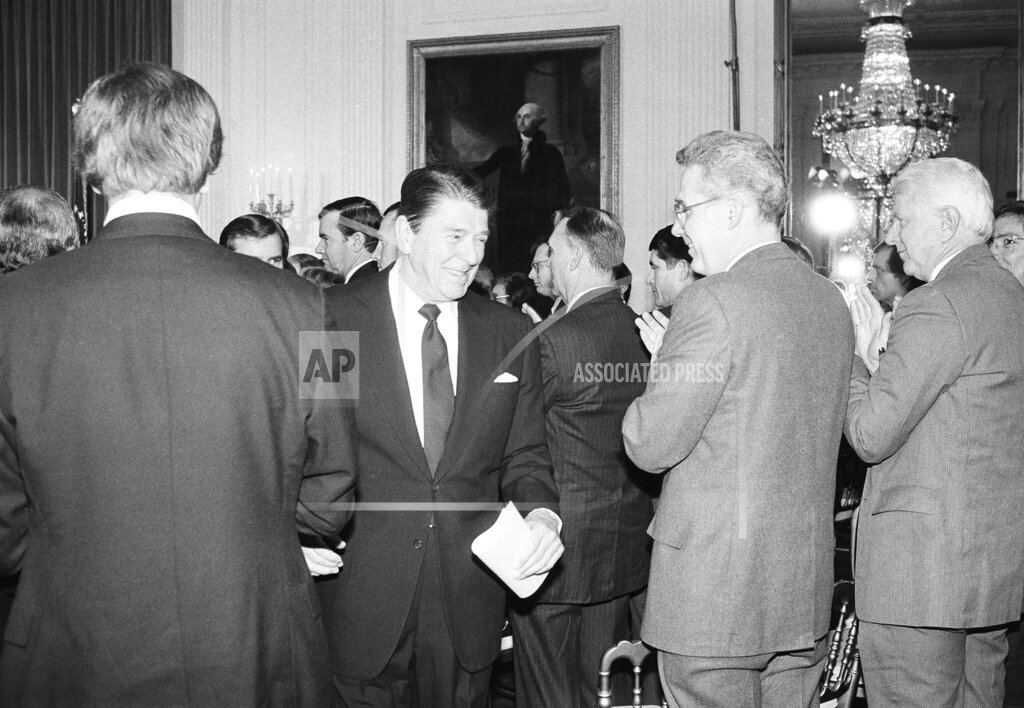
President Reagan gives a live address about U.S.-Soviet relations. By striking a tone of moderation toward the Soviet Union and urging a new effort for arms talks at a time when Soviet- American relations are extremely tense, President Reagan is apparently seeking to recast his image and take the offensive against both American political rivals and the Kremlin. The immediate reactions from Moscow and influential Democrats raise questions about whether the President’s effort will succeed unless it is followed up by more concrete initiatives. As the election year begins, Reagan strategists grudgingly acknowledge that Mr. Reagan faces a widespread impression here and in Western Europe that he has not tried hard enough to get arms agreements and that his policies and harsh criticism of the Soviet Union have produced a cold war mood of confrontation with Moscow.
Mr. Reagan signaled no change in his basic policies today and advanced no major new initiatives. But the conciliatory tone of his appeal for “a working relationship” with Moscow and his affirmation that “1984 is a year of opportunities for peace” were aimed at getting him off the political defensive and on what his political advisers call “the peace issue.” The economic and military growth of the United States in the last three years has been so strong that it “can now offer something in return” for any concessions the Soviet Union might offer in nuclear arms talks, President Reagan said. He called on the Russians to return to the negotiating table and join him in a “constructive working relationship.”
No sign that the Russians will return to nuclear arms talks soon was seen by Foreign Minister Claude Cheysson of France, who met in Stockholm with his Soviet counterpart, Andrei A. Gromyko.
A Soviet rocket powerful enough to launch a manned mission to Mars was photographed by the space shuttle Columbia in December, Britain’s Independent Television News claimed. The network said the computer-enhanced photo, shot over Soviet Kazakhstan, showed a 290-foot rocket estimated to be able to lift 180 tons, making it the most powerful booster ever built. An unnamed Pentagon official was quoted as saying: “It’s a live bird, ready to be launched.” There was no confirmation from Washington.
[Ed: They’ve overestimated the height. This has to be the Energia booster, just under 200 feet, that was to be used for the abortive Soviet Buran spaceplane.]
The United States so far has failed to work out a political settlement in Lebanon with Syria, Secretary of State George P. Shultz said. At a news conference in London, Mr. Shultz said, “As of now, it is not possible to report any real progress,” despite the talks that Donald Rumsfeld, the United States special envoy, held last week with President Hafez al-Assad of Syria.
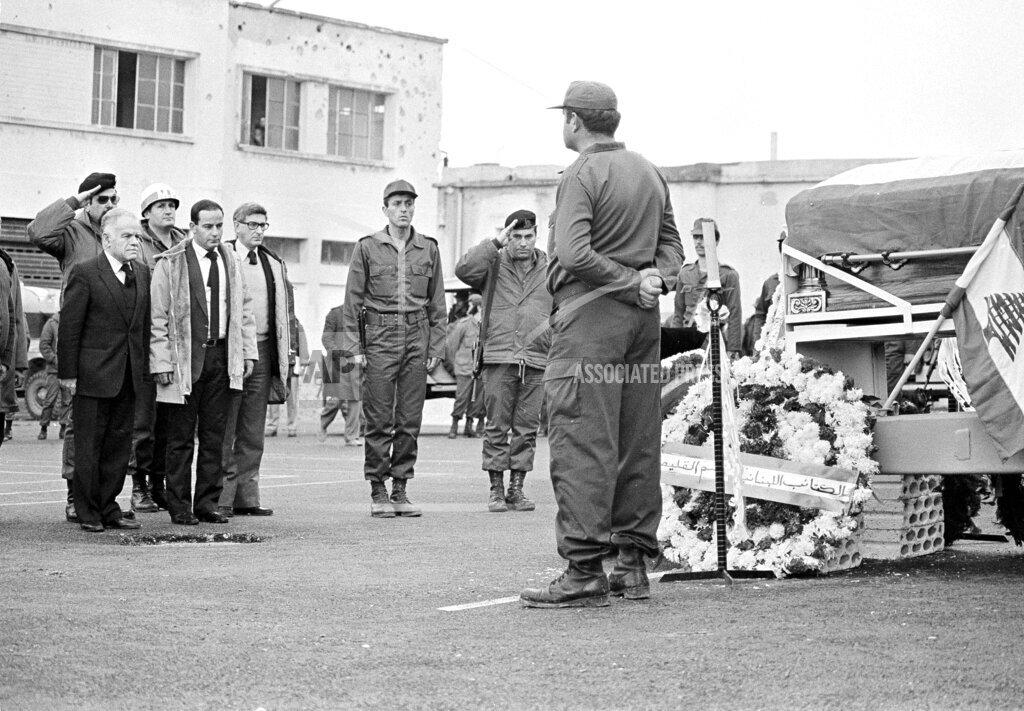
Major Saad Haddad, the pro-Israeli commander of a rightist southern Lebanese militia, was buried in Marjayoun, Lebanon. Haddad died Saturday of cancer. Among the thousands attending the ceremonies were more than a dozen Israeli dignitaries-including Prime Minister Yitzhak Shamir, Army Chief of Staff Moshe Levy, former Defense Minister Ariel Sharon and Labor Party leader Shimon Peres. Lebanon’s government and regular army were not represented.
President Reagan conducts a meeting with the National Association of Arab Americans to discuss policy issues in the Middle East.
Guerrillas of the Algerian-backed Polisario Front said they killed 130 Moroccan soldiers in a clash in the Western Sahara. Morocco had no immediate comment on the report. A statement, reported by the Algerian news agency APS, said a Polisario unit launched a “fierce attack” against Moroccan troops inside defensive lines set up around Amgala. During a four-hour battle, the guerrillas breached the defenses, killing 130 Moroccans, wounding many others and destroying 35 vehicles, the Polisario Front said.
France will arm Saudi Arabia with a mobile system of antiaircraft missiles for the protection of its oilfields and other important ground installations. France announced it had reached a $4.5 billion arms sales agreement with the Saudis, and that it was the largest it has ever received from an arms customer. France has agreed to provide Saudi Arabia with an advanced anti-aircraft defense system, the French press reported. Various reports put the deal’s value at $4.1 billion to $4.7 billion, which would make it the biggest French overseas arms sale in history. Neither the Defense Ministry nor the main supplier in the deal, Thomson-CSF, would release details.
Prime Minister Olof Palme of Sweden, whose country last year asserted that Soviet submarines violated its territorial waters, won a pledge of respect for Sweden’s territorial integrity from Soviet Foreign Minister Andrei A. Gromyko. Palme, who met with Gromyko before the European security conference in Stockholm, said Gromyko told him, “The Soviet Union respects Swedish neutrality and will not infringe upon Swedish territorial integrity.”
Military policemen searched today for six antinuclear activists an American soldier said had held him hostage for 43 hours and threatened to kill him before releasing him unharmed. The soldier, Specialist 4 Liam T. Fowler, 21 years old, was listed in good condition at the United States Army’s Fifth General Hospital in Stuttgart, where he was recovering from exhaustion. In telephone calls to his wife, Specialist 4 Fowler reported he had been kidnapped by members of the Pacifist Initiative Group, a previously unknown organization. A United States Army spokesman, Major Anthony Maravola, said the military police were treating Specialist 4 Fowler’s disappearance as a kidnapping. But officials have not dismissed the possibility the incident was faked.
Prime Minister Andreas Papandreou today appointed four new Cabinet ministers and switched around four existing portfolios in his two-year-old Socialist Government. He called back two former Economic Ministers, Apostolos Lazaris and Sakis Peponis, appointing Mr. Lazaris to the top post of Minister to the Prime Minister and Mr. Peponis as Minister of Broadcasting. Interior Minister Georgios Gennimatas was switched to the sensitive post of Minister of Health; Agamemnon Koutsogiorgas, up to now Minister to the Prime Minister, was appointed Minister of the Interior, and Foreign Under Secretary Carolos Papoulias was promoted to full Cabinet rank as alternate Foreign Minister, a new post.
Troops from Ecuador and Peru clashed along their jungle border, and there were conflicting reports on the number of casualties and on responsibility for the incident. The Ecuadoran Defense Ministry said Peruvian troops fired at an Ecuadoran military base at Conocano, 400 miles southeast of the capital of Quito, killing one soldier and wounding another. The Peruvian military command said soldiers at a Peruvian outpost repelled an Ecuadoran attack. Peruvian news reports said 15 of the attacking soldiers were killed. The jungle border, an area rich in oil reserves, has been a source of dispute since the 1940s.
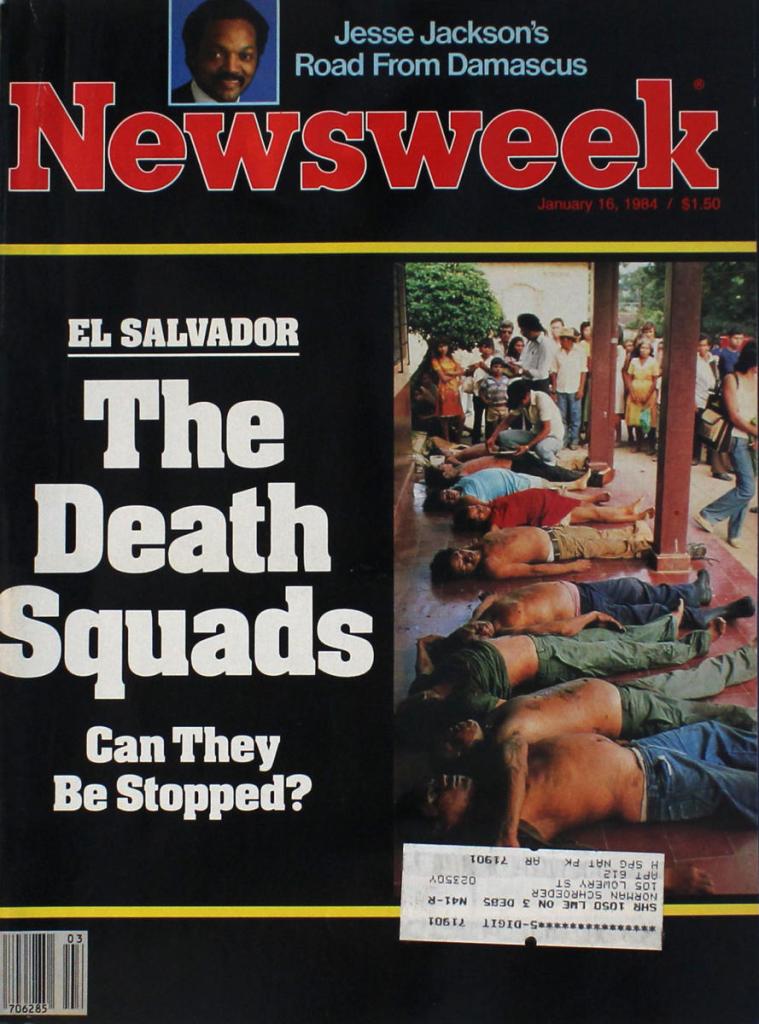
Guerrillas in El Salvador attacked a strategic railroad bridge for the second time in three days today as part of a possible attempt to split the country into two, military sources said. They said a seven-hour firefight between rebels and United States-trained troops of the Atonal Battalion and local “hunter” battalions ended before dawn. Two soldiers were wounded in the fighting at the bridge, which has also carried cars and trucks over the Lempa River since October 15, 1981, when rebels destroyed the nearby Bridge of Gold. It was the second attack on the bridge since Friday, an indication that guerrillas are testing defenses for a possible attempt to destroy it and sever the Pacific Coastal Highway, which connects eastern El Salvador with the rest of the country. The only other road leading into the eastern section of the country is a dam crossing the Lempa River on the Pan-American Highway.
White-ruled South Africa and its neighbor Mozambique discussed ways to achieve mutual peace and security after nearly a decade of hostility. In a statement after the talks, which took place in Pretoria, the South African government said the two countries considered measures to stop rebel groups from using one country’s territory for attacks against the other. The statement did not reveal whether any agreement was reached. South African forces have entered Mozambique, a black nation under Marxist government, several times to strike at guerrilla bases of the African National Congress. Mozambique accuses South Africa of backing anti-government rebels of the Mozambique National Resistance.
President Reagan is leaning against setting up a special commission to develop proposals to reduce future budget deficits, Administration officials said today. This indication of where the President stands comes after a week of discussions among his top advisers over whether such a commission was a good election-year alternative to budget proposals for substantial deficit reduction. The officials have reported that the President will propose only small domestic spending cuts and no major tax increases in the budget proposal for the fiscal year 1985 that he is to send to Congress February 1. Together, the tax and spending decisions mean the President has chosen to delay major efforts to reduce budget deficits until after the election, officials said. One critical official said, “We’re just in retreat from reality.”
Other officials said that the President, in a reversal of earlier decisions, had decided not to propose a plan to cut Medicare costs by having patients pay more for short hospital stays in exchange for better coverage of the costs of a long-term illness. An official said a package of spending increases, which totaled $2.8 billion in a preliminary draft of the budget, was expected to be larger. Because these increases offset cuts elsewhere in the budget, this means the net domestic spending reductions for 1985 will be less than $4 billion, an official said.
The Federal civil rights panel voted to issue statements affirming its independence of the White House and criticizing Walter F. Mondale for threatening to dismiss commissioners appointed by President Reagan if he is elected President. In a move indicating its new, more narrow interpretation of civil rights, the United States Commission on Civil Rights also voted, 5 to 3, to cancel a study investigating how cutbacks in student aid affected colleges where most of the students were black or Hispanic Americans.
Senator John Glenn warned today that if President Reagan was re-elected, he would reshape the Supreme Court in his “far-right political ideology” and endanger the advances of the civil rights movement. Speaking in the high school of this snowy community of Victorian buildings and old mills, the Ohio Senator said a second term would give Mr. Reagan an opportunity to “remake the Supreme Court.” By Inauguration Day a year from now, Mr. Glenn said, five of the nine Supreme Court Justices will be over 75 years old. “I think that fact is one of the great issues in this Presidential campaign,” Senator Glenn said, “for I am absolutely convinced that my appointments to the Supreme Court will be far, far different from those Ronald Reagan would make.”
Mr. Glenn’s criticism of what he termed the President’s “overwhelming bias” in Federal court appointments came a day after he attacked former Vice President Walter F. Mondale, his principal rival for the Democratic Presidential nomination, accusing him of failing to specify the costs of his social programs. Mr. Mondale responded to the accusation, made in a three-hour debate Sunday afternoon at Dartmouth College, about 20 miles north of here, by asserting that Mr. Glenn’s characterization of his program was based on “voodoo numbers.” In a counterattack this morning, Mr. Glenn said: “He says it’s voodoo arithmetic. It’s not. It’s third grade, elementary arithmetic.”
Thousands of Americans around the nation celebrated the birthday of slain civil rights leader Dr. Martin Luther King Jr. two years before it becomes a national holiday. Coretta Scott King, addressing about 1,500 persons at a luncheon in Philadelphia, said her husband should be remembered as a man who fought for peace and love. “He was a man who refused to lose faith in the ultimate redemption of mankind,” she said. King, a Baptist minister who was assassinated on April 4, 1968, would have been 55 on Sunday.
A suburban Cleveland man accused of being the Nazi death camp guard “Ivan the Terrible” testified today that he would be executed if he was ordered out of the country. John Demjanjuk, 63, a retired auto worker from Seven Hills, was stripped of his citizenship by a federal judge in 1981 after survivors of the Holocaust named him as an operator of the gas chamber at Treblinka in Poland where hundreds of thousands of Jews died. His deportation hearing, which was recessed last October, reconvened today. His lawyer cited a federal law that permits asylum if the person being deported faces persecution. Government officials have sought Mr. Demjanjuk’s deportation to the Soviet Union because he was born in the Ukraine. Answering questions through an interpreter, Mr. Demjanjuk said he was under four death sentences in the Soviet Union. But the government presented a memorandum from the Soviet Government that said Mr. Demjanjuk had been convicted of no crimes.
A study of suicides shows that persons are most likely to take their own lives on Monday, on the fifth day of the month and in the springtime. Saturday is the least likely day and December the least likely month, according to a report in the American Journal of Epidemiology. Why these patterns occur is a mystery, though experts suspect that they reflect particularly stressful times for persons who are depressed, the report said. The latest study is based on an analysis of 185,887 suicides in the United States from 1972 through 1978.
The Food and Drug Administration has approved one of the nation’s most unusual new prescription drugs, a chewing gum that contains nicotine and is designed to help smokers who want to quit. Officials of the FDA and Merrell Dow Pharmaceuticals Inc. of Cincinnati said the company has been given permission for production of the gum, to be called “Nicorette.”
A teen-ager was charged with murder, burglary, rape and child molesting for the beating deaths of a Fort Wayne, Indiana, newspaper editor and his family. Calvin Perry III, 18, was charged with killing Dan Osborne, 35, his wife, Jane, 34, and their son, Ben, 11. A daughter, Caroline, 2, was beaten and sexually assaulted but survived. Perry was accused of breaking into the Osborne home on September 17 “with the intent to rape and burglarize,” then bludgeoning the family and their pet dog with a baseball bat found in the basement.
A panel of federal judges upheld secret jury questioning in the civil rights trial in Winston-Salem, North Carolina, of nine Ku Klux Klansmen and members of the American Nazi Party accused in the 1979 shooting deaths of five leftist demonstrators. The appeals panel upheld U.S. District Judge Thomas A. Flannery’s decision to close the courtroom during jury selection. Eight North Carolina newspapers had asked that the jury selection process be opened. The nine defendants are accused of violating the civil rights of five members of the American Communist Workers Party killed during a bloody shoot-out with Klansmen and Nazis during a 1979 “Death to the Klan” rally in Greensboro.
An unfinished nuclear power plant in Indiana has been abandoned by the Public Service Company of Indiana because of overwhelming increasing costs and insufficient money to finish construction. After announcing its withdrawal from the Marble Hill plant near Madison, the utility asked the Indiana Public Service Commission for $105 million in emergency rate relief and slashed stockholder dividends by 65 percent to insure adequate working capital.
Putnam County (Ohio) officials and a union of migrant farm workers reached an out-of- court settlement today of a $2 million civil rights suit that asserted the workers and their union had been harassed. The $180,000 settlement was announced shortly before a federal trial was to begin on the Farm Labor Organizing Committee’s suit against Putnam County Sheriff Robert Beutler and several deputies charging harassment, intimidation and illegal surveillance. The case stemmed from a sitdown strike on Labor Day 1979 by several dozen union members in a Putnam County tomato field. The migrants were arrested and while their lawyer, Jack Kilroy, was talking to his clients he was assaulted, the lawsuit said, by Sheriff Beutler, his deputies and an Ottawa police officer. Mr. Kilroy’s skull was fractured.
A judge today set March 16 as the execution date for James W. Hutchins, a convicted murderer whose execution was blocked last week just 40 minutes before he was to die. Mr. Hutchins, 54 years old, was sentenced to death in 1979 for the murders of a Rutherford County sheriff’s deputy and a State Highway Patrol trooper. He was sentenced to life in prison for killing another deputy. Today’s hearing was the first legal step in the case since the State Supreme Court blocked his execution Friday. The United States Supreme Court had lifted an earlier stay of execution, and the state Supreme Court then ruled that a new execution date had to be set. Tom Manning, a defense lawyer, argued that there had not been enough time to prepare for the hearing. Judge William Freeman of Polk County Superior Court said the case was “thoroughly litigated through the courts of this state and this country.”
School board members in Pennsylvania tonight upheld the dismissal of a high school senior from the National Honor Society, a move she says resulted from her giving birth out of wedlock. “I’m not giving up,” said Arlene Pfeiffer, 17 years old, after the Marion Center Area School Board voted unanimously to affirm her dismissal by a five-member faculty council. Chere Winnek-Shawer, the Pfeiffers’ lawyer, said the family would file a complaint with the Pennsylvania Human Relations Commission and the Federal Equal Employment Opportunity Commission. Miss Pfeiffer, who gave birth on August 15 and decided to raise the child herself, was informed last November 9 that she would be dismissed from the National Honor Society.
Black women hold public office in comparatively greater percentages than white women, who make up about 10 to 20 percent of white elected officials. The Joint Center for Political Studies in Washington reported recently that after a 13.6 percent increase in the last year, women now made up nearly one-fourth of all black elected officials. The increase for black elected officials as a whole was 8.6 percent.
One of Einstein’s basic concepts will remain unconfirmed if scientists do not succeed in their striving to detect cosmic messages so subtle that they challenge the finest technology of measurement. The elusive transmissions that are the objects of the international effort are gravitational waves that ripple across the universe at the speed of light.
Some self-blame can help victims of a crime, accident or illness cope with the experience, a recent series of studies has found. Assuming some responsibility for becoming a victim was associated with more effective recovery among women who had been raped, wives who had been battered, people paralyzed by an accident, and cancer patients.
A storm approaching blizzard strength and causing whiteouts whipped a foot of snow through parts of Montana and South Dakota and swirled across a frigid America from Nevada to New England. A snowstorm blamed for seven traffic deaths earlier in Oklahoma and Missouri pushed into the Eastern Seaboard, spreading ice over the streets of Washington, D.C., and temperatures dropped to record subzero lows in at least nine cities in New York, Maine, Michigan and Colorado. “It’s just one long stream of snow, freezing rain or rain,” said Harry Gordon of the National Severe Storms Forecast Center in Kansas City.
Paul and Linda McCartney were arrested in Barbados for possession of cannabis.
11th American Music Awards: Pat Benatar and Michael Jackson win.
Dow Jones Industrial Average: 1267.59 (-2.51).
Born:
Stephon Heyer, NFL tackle (Washington Redskins, Oakland Raiders), in Lawrenceville, Georgia.
Matt Maloney, MLB pitcher (Cincinnati Reds, Minnesota Twins), in Sandusky, Ohio.
Jared Slingerland, Canadian rock guitarist and electronic musician, in Kelowna, British Columbia, Canada.







 History Diaries