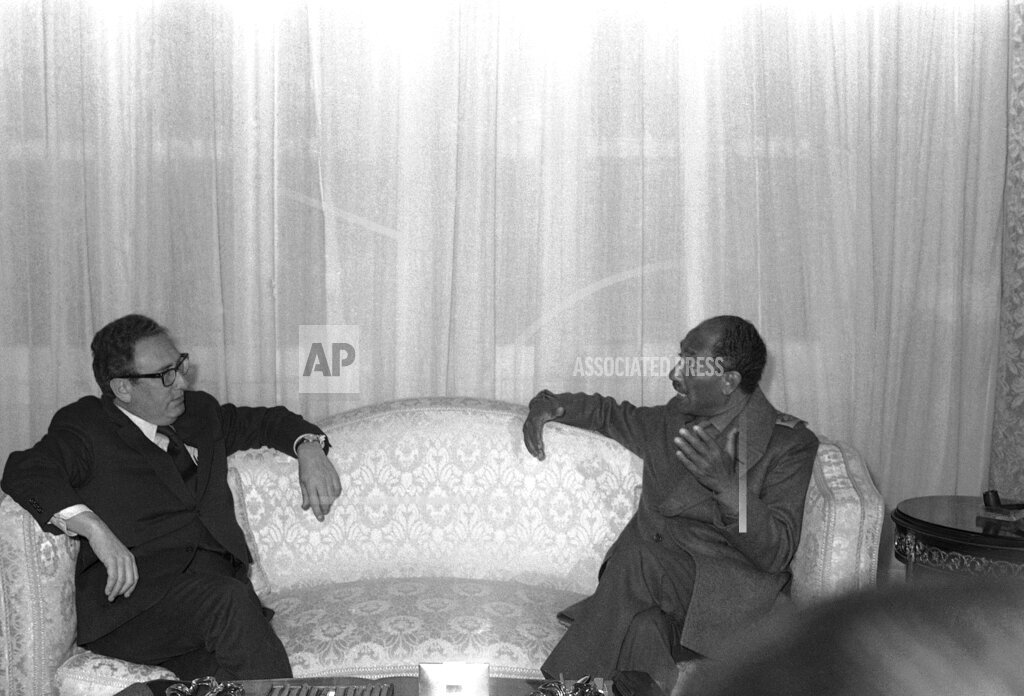
Secretary of State Kissinger spent the day in Egypt with President Anwar el‐Sadat today, making what the Secretary called “very good progress” toward narrowing differences on separating the Israeli and Egyptian armies near the Suez Canal. Then, returning here late tonight in a heavy downpour, Mr. Kissinger brought with him the Egyptian response to the Israeli proposal for disengagement. It was in the form of a detailed map and a counterproposal to an Israeli map and disengagement plan that Mr. Kissinger had carried last night to Aswan, where he and Mr. Sadat met today, and was drawn up there. His “shuttle diplomacy” has now completed two rounds.
American officials, talking to newsmen aboard Mr. Kissinger’s Air Force 707 jet during the two‐hour‐and‐10‐minute flight between Aswan and Tel Aviv, voiced general optimism that by the end of the week a fairly detailed agreement on “terms of reference” for the Geneva negotiations on disengagement could be achieved. But even though Mr. Kissinger says that he has reduced the gap between the Israeli and Egyptian positions substantially, American officials said there were still sharp differences that must be resolved. Some are on matters of principle, others involve details on the actual separation of forces. Mr. Kissinger said he would discuss the Egyptian ideas at length with Israeli officials tomorrow — and perhaps on Wednesday — and then would return to Aswan.
Talks scheduled for tomorrow between Israeli and Egyptian military negotiators on disengagement have been postponed while the Egyptian delegation returns to Cairo for consultations, an Egyptian spokesman said tonight. “We expect they will be gone for two. or three days,” the spokesman said. “We shall see what happens after that.”
For some two decades, since the advent of the Soviet H‐bomb, the dominant concept in American military planning has been that there could be no winners, only losers, in a strategic nuclear war with the Soviet Union. The central aim of Presidents Eisenhower, Kennedy and Johnson was “deterrence.” To deter Soviet use of nuclear weapons against the United States and its allies, a “second strike” strategic offensive force was built, capable of absorbing a Soviet surprise “first strike” and retaliating to inflict unacceptable damage on the aggressor’s industry, population and urban centers. A fundamental change in this strategy has now been set in motion by President Nixon. Since last summer, as Defense Secretary Schlesinger has now disclosed, the Pentagon has been retargeting strategic missiles to give Mr. Nixon, at his request, the option of fighting a nuclear war, rather than simply deterring one. The development of this so‐called “nuclear war‐fighting capability” has begun with the retargeting of some Minuteman ICBM’s, previously pointed at Soviet cities, for the “counterforce” mission of striking at Soviet missile silos — before they have launched their ICBM’s — and at other military objectives.
About 30 South Vietnamese soldiers were back today in a remote border base in the Central Highlands nearly four months after the base was overrun by Communist tanks. A South Vietnamese military spokesman said that a platoon was taken in helicopters to the Lê Minh camp, on a hilltop near the Cambodian border in Pleiku Province. The men met only slight resistance from Communist forces in the area, the spokesman said. They were flown in after one of the most intense bombing raids since the cease‐fire a year ago — there were 40 strikes at the base itself and 60 more in the surrounding area, according to military sources. A regimental column, of more than 2,000 men was repotted advancing along the 28 miles of road between Pleiku city and the camp to support the advance party. The spokesman said that the column could reach the base tomorrow morning if it did not meet heavy resistance.
The North Vietnamese 320th Division, whose troops had taken the base with tanks and had left 200 Government troops killed, wounded or missing on September 22, has pulled out of the area. Military sources said that the Government can hold onto the base, its recapture would be as a big a boon to South Vietnamese military morale as its fall was a setback. Government commanders said after the base fell that the Communists took it because it: was too close to a new road, they were building from North Vietnam, through the Viet Cong border zones.
After quick, quiet stops in Singapore and Malaysia, Premier Kakuei Tanaka of Japan landed here tonight on the last stop of his Southeast Asian tour and ran immediately into Indonesia’s student protesters. Despite a heavy armed guard at the new international airport, some of the 800 students broke through the lines and gathered across the route of Mr. Tanaka and his host, President Suharto. But the soldiers, aided by decoy convoy, cleared the way and the motorcade sped to the government guest house without incident. Although the protest tonight was considerably milder than the one Mr. Tanaka ran into in Bangkok, Thailand last week, his conversations with the Indonesians were expected to be the touchiest in his five‐nation tour. About 12 percent of Japan’s oil comes from Indonesia — a point on which the Japanese are sensitive during the energy crisis.
President Park Chung Hee invoked his constitutional emergency powers and announced that South Koreans earning less than 50,000 won ($125) a month would not have to pay income tax. Others earning up to 100,000 won will have their taxes reduced. Park also decreed that the government pay farmers more for their rice. A fund to finance small enterprises also was announced. Park said the measures were designed to safeguard the country’s economy against international uncertainties.
After five and a half hours of talks, Prime Minister Heath and Britain’s union leaders failed tonight to reach an agreement on ending the dispute with the coal miners. The inability to find a formula for resolving the country’s worst industrial crisis in years promptly intensified speculation that Mr. Heath would’ decide to call an early general election. But there were no signs that he had made up his mind yet. At issue in today’s talks was a proposal by the Trades Union Congress that the miners, who have been offered a pay rise of some 16 percent, be given’ more, even though the settlement would represent a breach of the Government’s anti‐inflation curbs. In return, the union leaders said, they would pledge not to use that settlement as leverage in pressing other pay demands. It was clear tonight, however, that Mr. Heath remained skeptical whether the leaders could guarantee the positions of their unions. In other words, Government sources said, Mr. Heath felt that the Trades Union Congress pledge would not prevent further demands for settlements beyond the legal pay limits.
Allison Thompson, 18, of Santa Barbara, California, and two men friends were ordered held without bail for another week at a British court hearing on charges they were part of an Arab terrorist gunrunning conspiracy. Their court hearing in suburban London was heavily guarded by armed police, a rarity in Britain. Miss Thompson and Abdelkbir el Hakkaoui, 25, a Moroccan also living in Santa Barbara, were arrested at London airport December 29 when guns and ammunition were found in her luggage. Athar Naseem, 21, a Pakistani living in Santa Barbara, was arrested December 31 when he flew to London.
Ten French Jews and two Israelis were denied entry to Norway and sent back to Denmark because they gave unsatisfactory explanations for their visit, police sources reported in Oslo. A police spokesman refused to comment on suggestions that the group planned to cause trouble during the trial which is under way in Oslo of six persons, including several Israelis, for the murder of a Moroccan waiter in the town of Lillehammer last July.
Yugoslav authorities moved to crush dissent at Belgrade University by formally demanding the expulsion of eight faculty members accused of resisting Communist Party control. The professors from the philosophy faculty had been shielded by their colleagues, who had rejected a number of informal calls for their ouster. There is speculation that the university may be shut down if the philosophy faculty rejects the formal demand.
A U.S. Army program, used to check 145,000 Europe-based troops for drug use, was ruled unconstitutional by U.S. District Judge Gerhard Gesell in Washington, D.C. Under the plan, which the judge ordered canceled, the soldiers could be subjected to mass strip searches and their private property could be examined by Army inspectors. The government had argued the necessity of the plan because of a serious drug problem. But the judge said, “One does not automatically forfeit the protections of the Constitution when he enters military service.” He also questioned the Army’s claim of increasing drug use in Europe.
Jules Léger was sworn in as the 21st Governor General of Canada, succeeding the retiring Roland Michener.
Senator William Proxmire’s joint committee of Congress investigating the energy crisis heard from administration energy czar William Simon, who assured the committee that the energy crisis is real. Simon conceded that mandatory reporting systems are needed for oil companies to verify their profit and supply data. Simon stated that 55% of domestic oil consumption is not controlled by government prices, and added that he doesn’t think the price of gasoline will jump to 70 cents per gallon. Consumer advocate Ralph Nader claims that no fuel shortage actually exists, but an energy crisis for consumers exists because oil companies are in collusion with the government to make quick profits. President Nixon will meet with Simon to review the energy situation.
The Federal Government’s allocation program for gasoline, which takes effect tomorrow, will give filling stations supplies of about 80 to 85 per cent of their cur rent requirements, an official of the Federal Energy Office said tonight. The implied reduction of 15 to 20 per cent of supplies was roughly in line with recent estimates by officials and was appreciably less than the cutback of 25 to 30 per cent projected by officials about a month ago. The final regulations will be published in the Federal Register tomorrow and take effect immediately. The regulations, which became known tonight, assign priority to agriculture, emergency services such as police and fire departments, energy production, telecommunications, and passenger transportation services. These consumers will be entitled to claim from their suppliers enough gasoline to meet what the regulations call “100 per cent of current requirements.”
Some areas are low on fuel supplies. The Consolidated Edison Power Company, which serves the New York City metropolitan area, is down to a 10-day supply of fuel. A 5% voltage reduction has been ordered.
Oregon’s plan for regulating gasoline sales began today. Motorists will be permitted to purchase gasoline only on certain days, according to their license plate number.
States which count on gasoline taxes for revenue are feeling the effects of the fuel situation. Rhode Island’s revenue is 20% below expectations.
The National Highway Traffic Safety Administration reported that the death toll dropped 15% in states with lower speed limits in December. When all states lower their speed limits uniformly, the death toll will drop considerably.
A panel of three Maryland judges concluded that former Vice President Spiro Agnew was “unfit” to be a lawyer and that he should be disbarred in order to “protect the public.” “His conduct, characterized as it must be, as deceitful and dishonest, strikes at the heart of the basic object of the legal profession, and constitutes conduct prejudicial to the administration of justice,” the panel said in a unanimous report.
Senator Frank Church has alleged in letters to Secretary of State Kissinger and Attorney General William Saxbe that “secret” decisions by the government have shaped the nation’s energy policy for 20 years. Mr. Church, Idaho Democrat, is chairman of the subcommittee on multi-national corporations, which is scheduled to begin hearings on the oil industry January 30. He asked that 38 sensitive documents, written in the 1950’s, be declassified by the Nixon administration on the ground that they “throw light on some of the most important decisions of the postwar era.”
Attorney General William B. Saxbe has been asked to referee a dispute over proposed Federal controls on crime records sent to state and local governments. The issue presents Mr. Saxbe with a conflict between the Federal Bureau of Investigation, which maintains the computerized crime files, and the Law Enforcement Assistance Administration, which finances many state and local computer projects dealing with criminal records. Mr. Saxbe faces another probable dispute between the two agencies over a Law Enforcement agency proposal to take the job of gathering crime statistics away from the F.B.I. and other agencies and put it in the hands of a new and independent Bureau of Criminal Statistics. Both issues test Mr. Saxbe’s willingness and ability to exert authority over the FBI, which rarely acceded to any Attorney General’s control during J. Edgar Hoover’s tenure as director.
Skylab 3’s astronauts had a record setting day as they became the world’s longest-flying space travelers, a mark that may stand for a decade. Astronauts Gerald P. Carr, William R. Pogue and Edward G. Gibson have surpassed the single-mission endurance record of 59 days, 11 hours and nine minutes set last September by the Skylab 2 crew. The Space Center in Houston calculated that the Skylab 3 crew, when it set the new record, had traveled more than 24.5 million miles since launching November 16. The space endurance mark will be much greater by the time the men complete their mission of 84 days with splashdown set for February 8. On their record-setting day, the astronauts had a full schedule of earth resources, solar astronomy and medical experiments.
Delta Air Lines argued that federal air traffic controllers were responsible for the July 31 crash of a Delta jet at Boston’s Logan International Airport. All 89 persons aboard were killed in the crash. In papers filed in federal court in Concord, New Hampshire, the airline, which has been sued for $2 million in connection with the crash, named the United States as a third-party defendant in the suit. The airline denied that it was at fault and asked that the government be required to pay any damages won by the family of one of the dead passengers.
A police officer testified that Byron De La Beckwith was believed to have been driving toward the home of a prominent Jewish leader when he was arrested September 27 in New Orleans with an armed bomb in his car. The Jewish leader was identified as Adolph I. Botnick, regional director of the Anti-Defamation League of B’nai B’rith. Earlier in the day, an all-male jury of 11 whites and one black was seated for the trial.
A young kidnapping victim was killed by a blow to the head four or five days before his body was discovered bound to a tree in snow-covered woods near Jamestown, New York, authorities said. District Attorney Robert Sullivan of Chautauqua County said he would seek murder indictments in the death of Daniel Ebersole, 14, whose body was found Sunday. Three youths accused of kidnapping the boy for $15,000 ransom were being held in lieu of $100,000 bond cash on federal charges of kidnapping. The medical examiner estimated that Daniel had been killed before his father, Dr. Glen M. Ebersole, paid the ransom.
The Consumer Product Safety Commission said it had ordered formal hearings to determine if 4 million electric frying pans and 334,000 gasoline-powered chain saws were hazardous. The pans were identified as Presto, 15-inch size, Model Nos. FP15AD and FP15HD. The saws are the McCulloch No. 14 “Mini Mac” series. In each case, the commission said, it has decided to turn the matter over to an administrative law judge. The hazard with the pans involves an electrical leakage that might cause minor shocks, while the saws can leak fuel, posing the threat. of an explosion, commission officials said. No injuries have been reported from the pans or the saws.
U.S. Senator Bill Bradley (30) weds professor Ernestine Schlant.
Dow Jones Industrial Average: 840.18 (-1.30, -0.15%).
Born:
Nancy Johnson, U.S. sport shooter (Olympic Gold medal, 10-meter air rifle for women, 2000), in Downers Grove, Illinois.
Fabiana Luperini, Italian cyclist, 5-time winner of the Giro Donne (formerly the Giro d’Italia Femminile); in Pontedera, Italy.
Kevin Jefferson, NFL linebacker (Cincinnati Bengals), in Philadelphia, Pennsylvania.
Mike Frank, MLB centerfielder (Cincinnati Reds), in Pomona, California.
Kevin Durand, Canadian actor (“Lost”, “The Strain”), in Thunder Bay, Ontario, Canada.
Died:
Östen Undén, 87, longtime Minister for Foreign Affairs for Sweden, 1945 to 1962, and acting Prime Minister of Sweden for six days in 1946.
Josef Smrkovský, 62, Czechoslovak communist politician.
Günther Niethammer, 65, German ornithologist and Waffen-SS member, profiled in the 2008 novel Die Vogelwelt von Auschwitz; the Niethammeriodes genus of moth and at least seven subspecies of birds have been named for him.
Hugo Stoltzenberg, 90, German chemical warfare engineer.
Joseph Dippolito, 59, underboss of the Los Angeles crime family within the American Mafia; Dippolito was stricken with a heart attack two days earlier at his daughter’s wedding.









 History Diaries