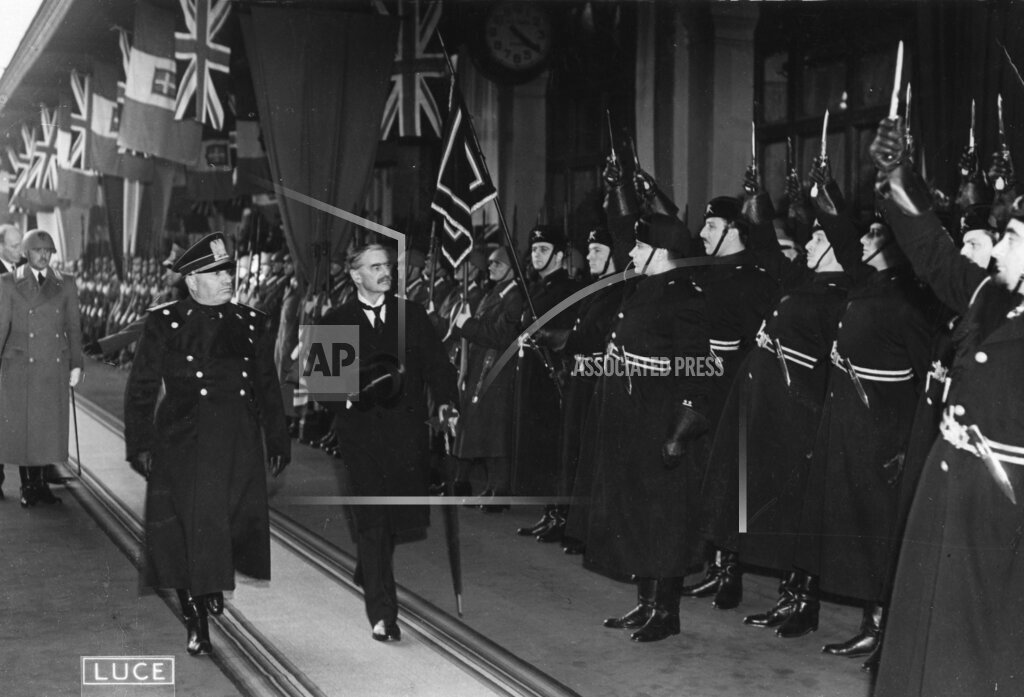
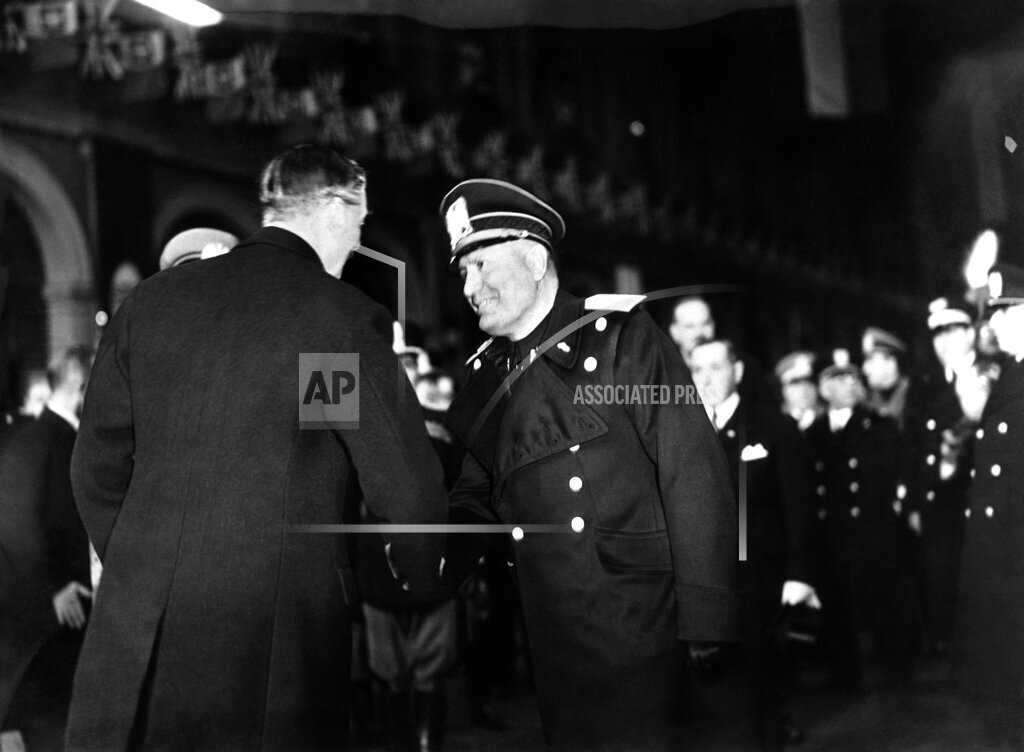
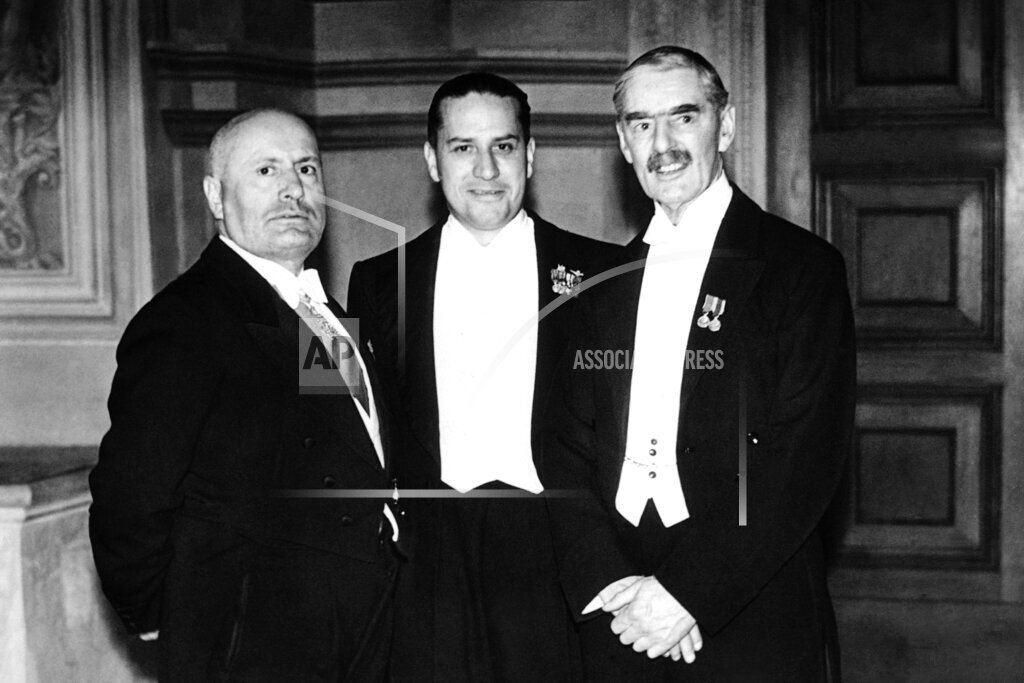
British Prime Minister Neville Chamberlain and Italian Premier Benito Mussolini met and pledged peace. Talks between British Prime Minister Neville Chamberlain and Italian Premier Benito Mussolini began today, focusing on French-Italian issues. Premier Mussolini of Italy and Prime Minister Chamberlain of Great Britain tonight assured each other they desired peace, but defined their objectives differently. They spoke at a brilliant state banquet arranged for the British statesman who sought to bring his European appeasement policy to the Mediterranean. Mussolini, toasting Chamberlain at the dinner in the Palazzo Venezia, invoked “peace with justice.” Chamberlain spoke for peace “by the method of negotiation.”
Foreign observers saw in Mussolini’s definition an expression of a view frequently stated in recent weeks by his spokesmen that without colonial concessions for Italy and Germany. there can be no appeasement in Europe. In other words, Italy insists she be treated with justice, first of all. Chamberlain’s declaration was seen In these same quarters as an admonition that appeasement could not be realized unless the Fascist claims were put forward in diplomatic form. So far Italy’s demands for recognition of her claims in France’s Tunisia, Corsica, Djibouti, the strategic East African port on the Gulf of Aden, and a share in control of the Suez Canal have been made almost entirely through her high-pressure propaganda campaign.
In his toast the elderly British prime minister announced that Britain and Italy had already begun an exchange of military information. This was in accordance with the terms of their Easter friendship treaty which was made effective November 16. It was noteworthy, Chamberlain said, that the two governments “yesterday, here and in London, were able to proceed to an exchange of military information.” He added that the Mediterranean interests of the two countries, “while of vital importance to us both, need in no way conflict.” This statement was interpreted by political circles as indicating his desire for an agreement on the Spanish question. Fascist sources said the civil war there, in which Italians are helping the rebels, was solving its own problem through rebel victory. But British quarters declared Chamberlain desired more concrete assurances from Italy in view of Italy’s participation in the present rebel offensive.
Spanish rebel dispatches to the border tonight said the entire government position north of Tarragona had been turned by the capture of Montblanch and an after dark advance to within fifteen miles of the coastal city. Fighting through a soupy fog, Navarrese troops virtually surrounded Montblanch, formerly a town of 5,000 inhabitants, earlier in the day and then by a frontal attack drove out the defenders. Montblanch is the heart of a network of roads for southern Catalonia and about eighteen miles northwest of Tarragona, principal seaport of southern Catalonia. Tarragona is about fifty miles southwest of Barcelona, the government capital.
At the same time the position of Tarragona was further menaced by rebels advancing from the southwest, near Falset. General Francisco Franco’s men were reported by their commanders to be within four miles of Falset and about twenty-six miles from Tarragona. Rebels asserted the loyalists had ordered the evacuation of Falset. Falset is only twelve miles from the sea. The twin drive threatened to cut off all lower Catalonia and isolate government militia guarding the lower Ebro River line around Tortosa. Rebel dispatches said Montblanch fell after nearly twelve hours of one of the most furious assaults of the current campaign that started on December 23. The rebels’ heaviest artillery, tanks, planes, mortars, and crack infantry units were pressed into the battle. Encircling Montblanch from the north they first took Solivella on the northwest, Pira on the north, and then Barbera on the northeast.
On the southwestern front the government forces reported they had brought the direct rail line connecting Seville, southern headquarters of the rebels, with Burgos, their northern capital, under the fire of heavy government artillery. Dispatches from the government side said the offensive, which began on January 5 and was designed to offset General Franco’s big drive in the northeast, had been carried to within eight miles of Llerena, one of the main stations on the railway. The city lay within range of the government’s heavy artillery, these reports said. Llerena is about fifty miles east of the Portuguese border. The government air force was extremely active in trying to hinder the arrival of rebel reinforcements, it was reported from Madrid. Forty trucks carrying fresh troops were bombed on the road between Pueblo Nuevo del Terrible and Penarroya, near the base of the government’s salient into the west. The airmen also bombed military objectives at Penarroya and Belmez. Belmez, Penarroya and Pueblo Nuevo del Terrible are clustered in an important mining district some forty miles east of Llerena.
Cutting of the Burgos-Seville rail connection would not destroy all rail communications through the fifty-mile corridor held by rebels along the Portuguese border. There is a second line about twenty-five miles west of Llerena. The rebels were reported preparing to shift their heavy traffic to the second line which adds nearly 100 miles to the route. On either flank of their deep salient, the government reports said, the principal points of rebel resistance were being encircled. To the south, the militiamen were said to have captured the heights dominating Penarroya, leaving only a narrow corridor open to the southwest. On the north, Monterrubio, where the rebels had massed reinforcements, was reported three-fourths encircled.
[Ed: What these accounts of the time miss is the stark truth that, while the government successes in the southwest are a problem for Franco, what is happening in Catalonia is a disaster for the loyalists. The reduction of Barcelona will free up a good portion of Franco’s troops to face the dwindling government area around Madrid, and signals the beginning of Endgame in Spain.]
The Danzig Senate orders 1,000 of the 4,000 Jews still in Danzig to leave by the end of the month.
General Friedrich-Wilhelm von Rotkirch und Panthen takes command of the 13th Infantry Division of the Heer.
The Czech Cabinet is split on anti-Semitic legislation.
Hungary threatens a counter-attack if Czechoslovakian troops invade their territory. A series of reported attacks on Hungarian border villages by Czecho-Slovaks kept the capitals of southeastern Europe on edge today. One newspaper, Az Est, said several Czecho-Slovaks were wounded when regular troops attacked at Barkaszo on the border of Carpatho-Ukraine (formerly Ruthenia), the eastern province of Czecho-Slovakia. Other newspapers reported six attempts by Czecho-Slovak machine gun units to cross into Hungary in the vicinity of Ungvar. The official news agency asserted thirty carloads of “Ukrainian terrorists” arrived in the vicinity of Ungvar, former capital of Carpatho-Ukraine before the town became part of Hungary in the Vienna award of November 2. These reports followed a warning from Hungary that new violations of the frontier would bring a Hungarian invasion.
Princess Mafalda of Italy is critically ill.
The French Army took delivery of its first 37L tracked carrier. In April 1936, the French Army had issued requirements for a fully armored fuel and munitions supply vehicle that would help extend the operational range of tank units. The Lorraine company completed a prototype tracked carrier in 1937 and received approval for production later in the same year. It was designated the Tracteur de ravitaillement pour chars 1937 L, or 37L for short. Three orders were made in 1938 totaling 278, and another three orders in 1939 totaling 274; the demands of war would eventually increase the total order size to 1,012 vehicles. The first vehicle was delivered in Jan 1939, by the start of the European War a total of 212 were delivered, and by the time the French signed the armistice with Germany in 1940, between 480 to 490 were delivered. These vehicles were unarmed, which was reported as a major shortcoming by their crews during the short German invasion of France.
The Chairman of the Inter-Governmental Committee of Refugees negotiates better trade arrangements with Germany in exchange for help in emigrating Jews from the country.
Congress debates the Neutrality Act and how it affects national defense. A heated congressional battle over so-called neutrality legislation was foreseen today as expiration of provisions of the present Neutrality Act neared. The Neutrality Act will offer a new front for the conflict which has arisen between legislative and executive authority. It will center upon the administration’s efforts to broaden the President’s powers under the act and the insistence of the conservative congressional bloc that congress maintain the present restrictions on his authority.
The immediate bone of contention is expected to be the “cash and carry” provisions of the act. These provisions require belligerents to pay in cash for nonmilitary purchases and to transport them in ships flying their own flags. The act requires the President to place an embargo on war materials when he finds a state of war exists. The administration will seek to vest more discretionary power in the chief executive, so that he could apply the “cash and carry” provisions against countries which have violated peace treaties with the United States. This would enable the administration to discipline Germany, Italy, and Japan for their activities in Spain and the Far East.
There has been a mounting demand in Washington from radical organizations that the administration lift its embargo on Spain to benefit the loyalist forces and hamper the rebels which are being aided by Germany and Italy. The shipping of nonmilitary materials in American ships, which would be possible if discretionary power on the “cash and carry” provisions were vested in the President, would be considered a step toward lifting the embargo against the communist loyalist forces.
[Ed: Which is, of course, at this point simply angels dancing on the heads of pins. It’s simply too late for the Spanish Republic, if it was even worth saving in the first place. Catalonia is about to be overrun. The manpower losses of 1938 have left the loyalists unable to stop Franco, and things will only get worse in the coming two months.]
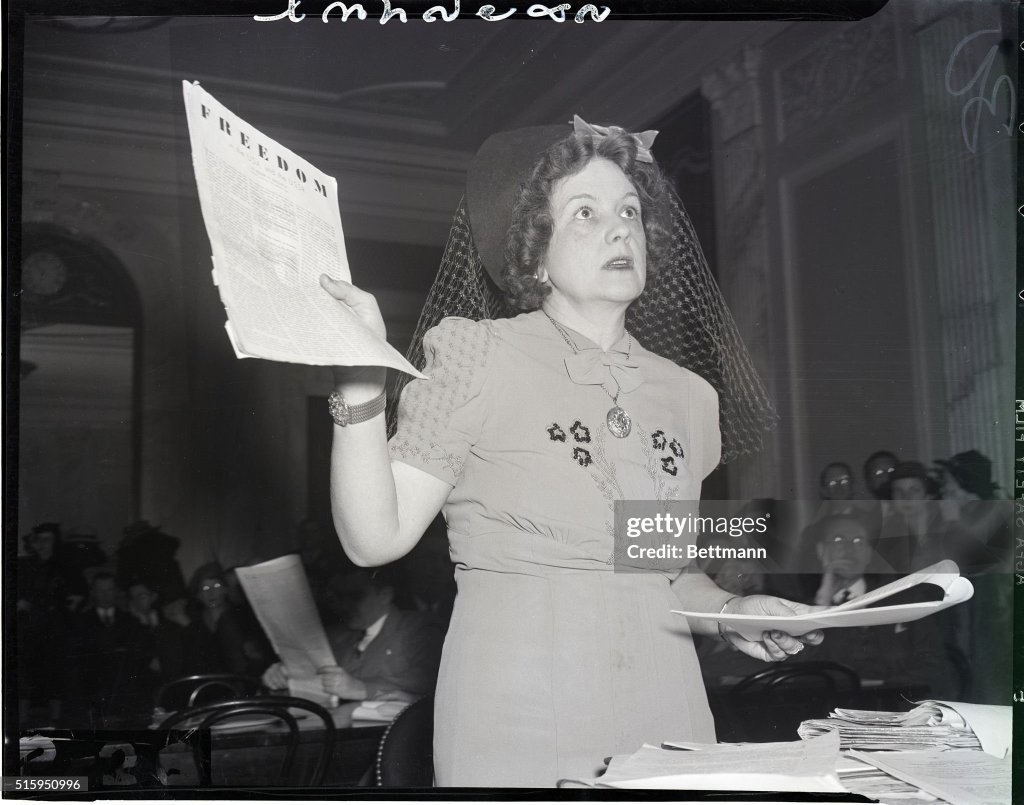
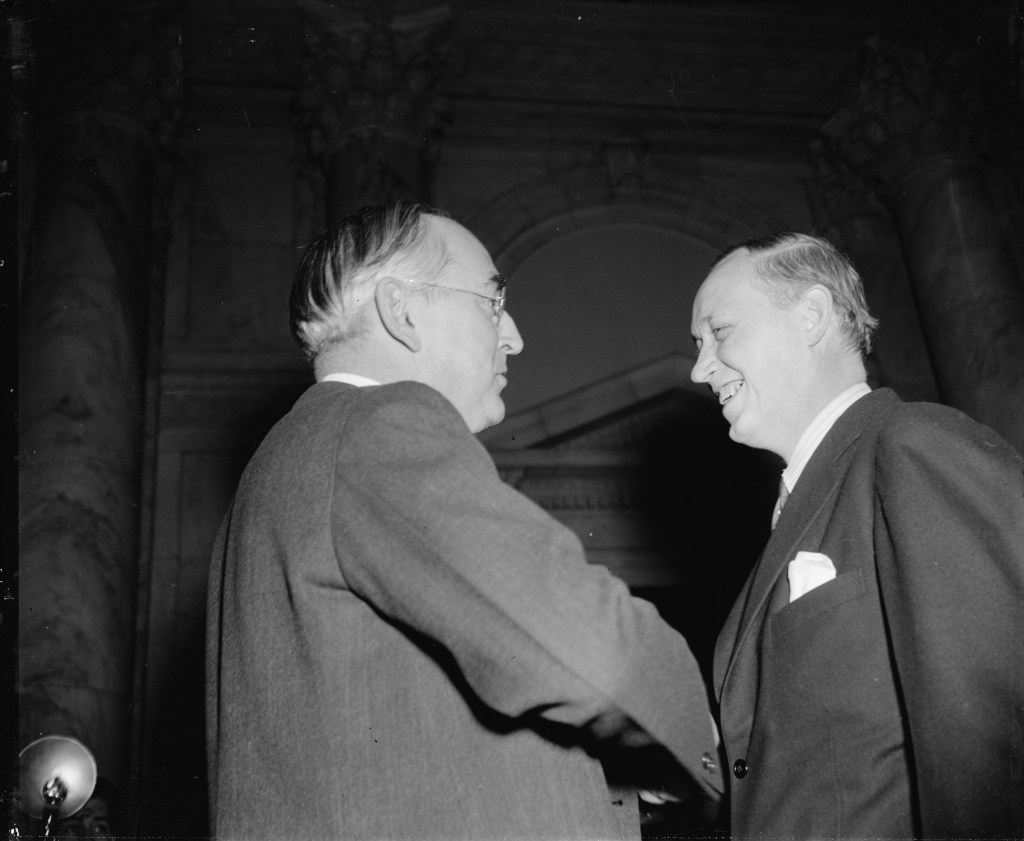
Harry Hopkins, Secretary of Commerce nominee, concedes error in making political speeches while working with WPA programs. The story of Harry L. Hopkins’ political activities as administrator of the WPA and dispenser of 9 billion dollars appropriated for relief was placed on the record of the Senate Commerce Committee today. The committee is investigating Hopkins’ fitness and qualifications to be Secretary of Commerce in President Roosevelt’s cabinet. Under cross-examination by Democratic and Republican members of the committee, Hopkins admitted that his own political activities while acting as relief administrator were wrong and said he would pursue a different course if he had the job to do again. He admitted that the political corruption of the WPA organization itself in the state of Kentucky was so rotten that he should have fired the whole administrative setup.
He acknowledged the truth of charges made by the Senate Campaign Expenditures Committee which, as administrator of the WPA, he repeatedly denied during the campaign of President Roosevelt’s “Dear Alben” Barkley, Democratic leader of the Senate, for renomination. Hopkins offered only one excuse for his own political activity — loyalty to President Roosevelt. “I am an administrative employee of the President,” Hopkins said. “I work for him all the time. I believe in him. Members of the President’s administrative group work together as a team. I am on that team. When that team starts to move it moves.” Hopkins offered no excuse for the WPA political corruption in Kentucky. He said the record was bad, that he didn’t like it, and that he didn’t wish to minimize it. But he insisted that the Kentucky situation was not representative of the whole national picture.
President Franklin Roosevelt is criticized for his nomination of Frank Murphy as Attorney General.
Ambassadors Joseph Kennedy and William Bullitt tell Congress that war is imminent in spring as Italian Premier Benito Mussolini imitates Adolf Hitler’s land acquisition.
A former Herbert Hoover Cabinet member warns that President Franklin Roosevelt may provoke war by acting as judge of the world.
The American Farm Bureau Federation asks President Franklin Roosevelt to make private jobs more attractive than relief jobs.
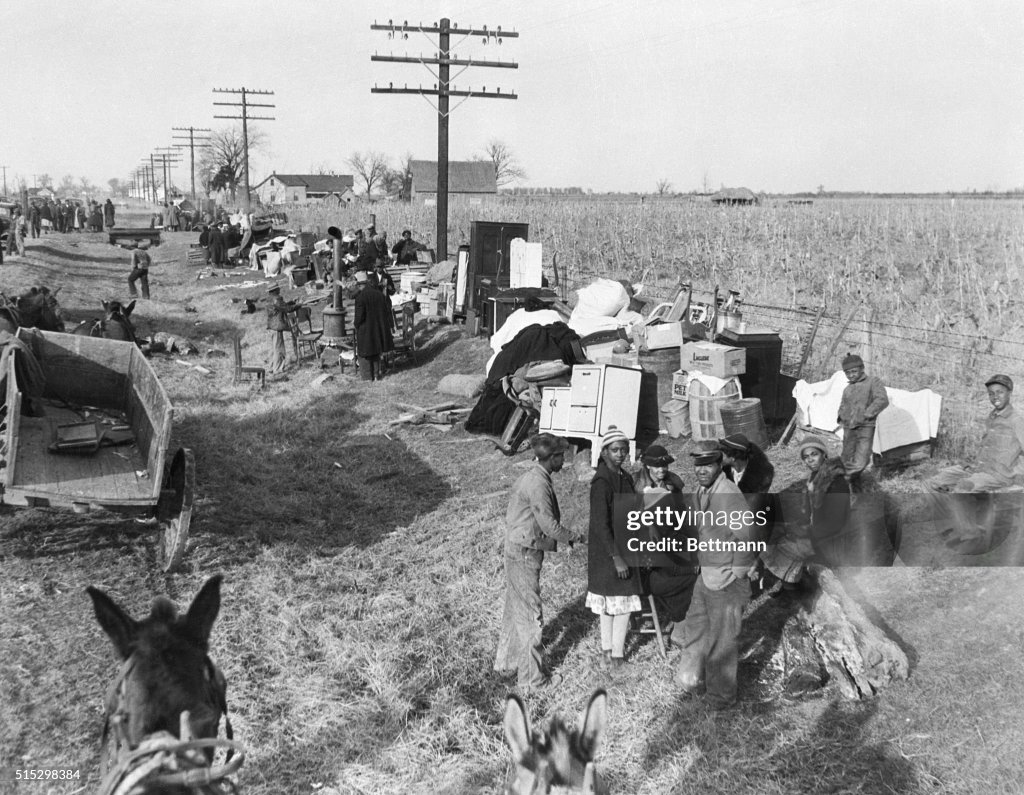
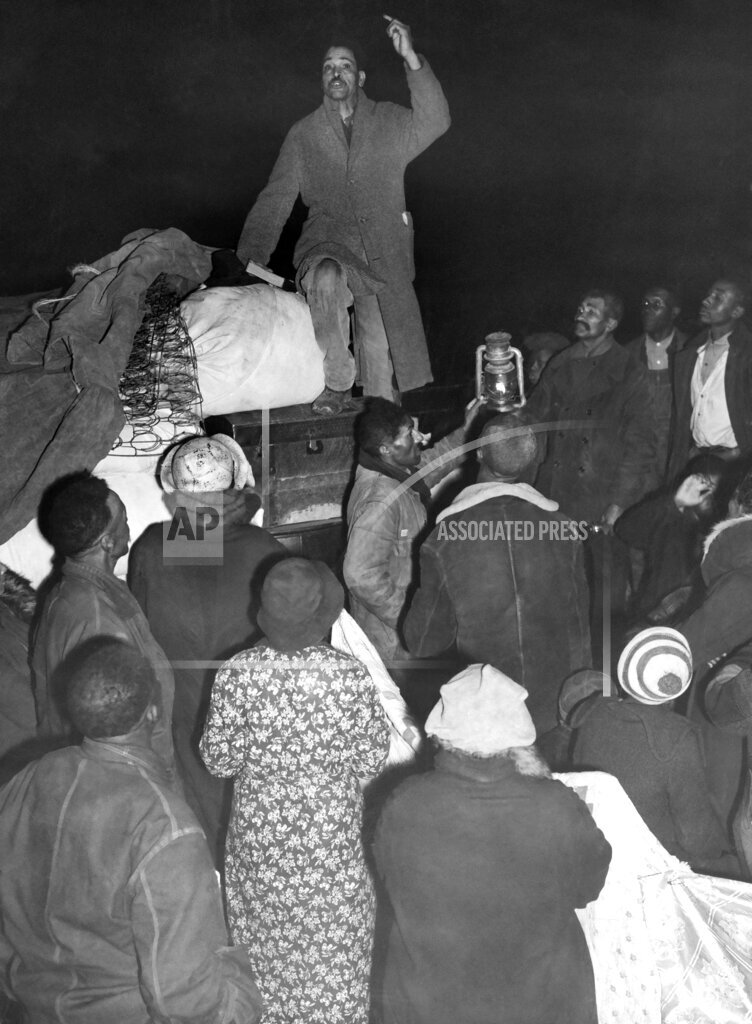
A ragged army of homeless men, women and children anxiously scanned overcast skies today and wondered how soon predicted rain or snow might fall on their open-air camps in southeastern Missouri. Already shivering from near freezing temperatures, more than 1,000 members of sharecropper families huddled in blankets about their few possessions or despairingly tried to erect makeshift shelters. The campers, many of them flood refugees two years ago, blamed their present plight upon operation of the federal AAA crop benefit laws. They moved out of their shanties yesterday in a mass demonstration against wholesale evictions in winter.
Along 150 miles of two major southeast Missouri highways U. S. routes 50 and 61 they spread their blankets, erected tents if they had them, and sat down to wait for rescue or whatever fate has in store for them. Health authorities studied the danger of an epidemic outbreak and expressed fear the health of the farm families, particularly of the children, will be undermined by exposure. Lack of milk for infants is a common problem, and only small stores of food remain for anyone. No disorder was reported at the hundreds of camps. Policemen toured the roads along which campfires burned brightly through the night, offering assistance and guarding against trouble.
The sharecroppers, about one-fourth white and the others Blacks — blamed their circumstances on the federal farm program of restricting the acreage of cotton, the main crop in this “boot-heel” Missouri country. With the expiration of tenant contracts at the end of the calendar year, farm owners were unable to continue hiring workers and their families on an annual basis because of the requirement that they limit their cotton crop. The sharecroppers say landlords plan to hire casual labor. This will permit them to keep for themselves the government crop benefit payments they otherwise would have to share with the tenants.
A therapeutic pool for sufferers of infantile paralysis opens in the Bronx.
The American Bar Association seeks a ban on divorces requested by mail.
Colonel Jacob Ruppert, owner of the New York Yankees, is in failing health.
Cowboy actor Max Baer wants a rematch with heavyweight boxer Joe Louis.
Ford Frick, president of the National League, commemorates the 100th anniversary of baseball.
At the Conference of Intellectual Cooperation in Chile, Mexico’s proposal to allow unlimited access and entry of all books is defeated.
A Pan-American Highway Conference begins in Chile.
General Saturnino Cedillo, who led a revolt against the Mexican government last May, dies in a skirmish with Federal troops.
Chile and Britain renew their trade pact for another six months.
Telephone and mail service is restored in major Chinese cities.
The Japanese-collaborationist Nanking regime of China makes a plea for peace.
Japan threatens retaliation if the United States and Britain exert economic pressure because of China. Foreign Minister Hachiro Arita was quoted by the newspaper Nichi Nichi today as declaring Japan would prepare “retaliatory measures against the mainlands and dependencies of the United States and Britain” if they seriously exerted joint economic pressure upon her. The minister, quoted in a long interview, was pictured as optimistic, however, believing that tariffs, blacklists, and other instances of assistance to China at present were mere political gestures. “Japan’s intention of attaining its objective in the holy war (in China) is firm enough to break iron, and it will definitely reject whatever obstacles third parties might place in its way,” Arita was reported as saying.
“Britain and the United States are believed to be aware that should they resort to serious economic pressure against Japan, Japan would have sufficient determination and preparation to resort to retaliatory measures against the mainlands and dependencies of the United States and Britain. If they suppose that in that case retaliatory measures would be taken only against rights and interests in China which they so zealously are defending, they will have to be extremely cautious.”
Nichi Nichi concluded its article, with its own observation: “In short, the foreign minister’s intention seems to be to meet the legitimate demands of Britain and the United States regarding their China interests with an attitude of complete goodwill, but to cope with any restraining or threatening actions on their part with a stern policy.”
A record temperature of 42.2C (108.0F) is recorded today in Canberra, Australia.
Dow Jones Industrial Average: 148.65 (-1.83).
Born:
Anne Heggtveit, Canadian alpine skier (Olympic gold, Slalom, 1960), in Ottawa, Ontario, Canada.
 History Diaries