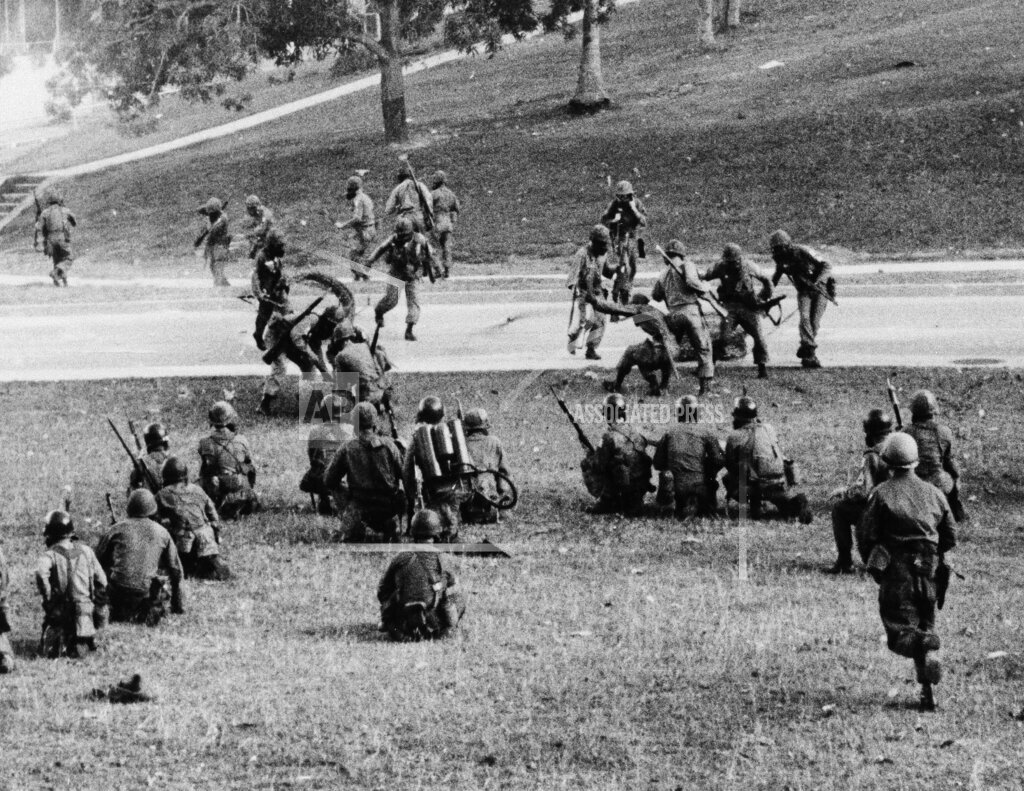
Fighting between Panamanians and United States soldiers with fixed bayonets broke out again tonight. At the same time, President Roberto Chiari’s government charged that Castro supporters and Communists had infiltrated anti-American demonstrators in Panama City and all cars were being stopped and searched for arms. Panamanians stormed through barbed wire barricades at the Canal Zone’s Tivoll guest house. But American soldiers with fixed bayonets formed a wedge and drove the rioters back.
Two thousand Communist-led students milled about on the border of the American-controlled Canal Zone tonight as anti-United States mob violence erupted for the third day. There were additional clashes between United States soldiers and Panamanians. Two soldiers in Cristobal were wounded by sniper fire from Colon. Army authorities announced that a sharpshooter returned the fire with live ammunition and wounded a sniper. He was taken to a hospital in Colon. Panamanians asserted that three civilians were wounded by American gunfire.
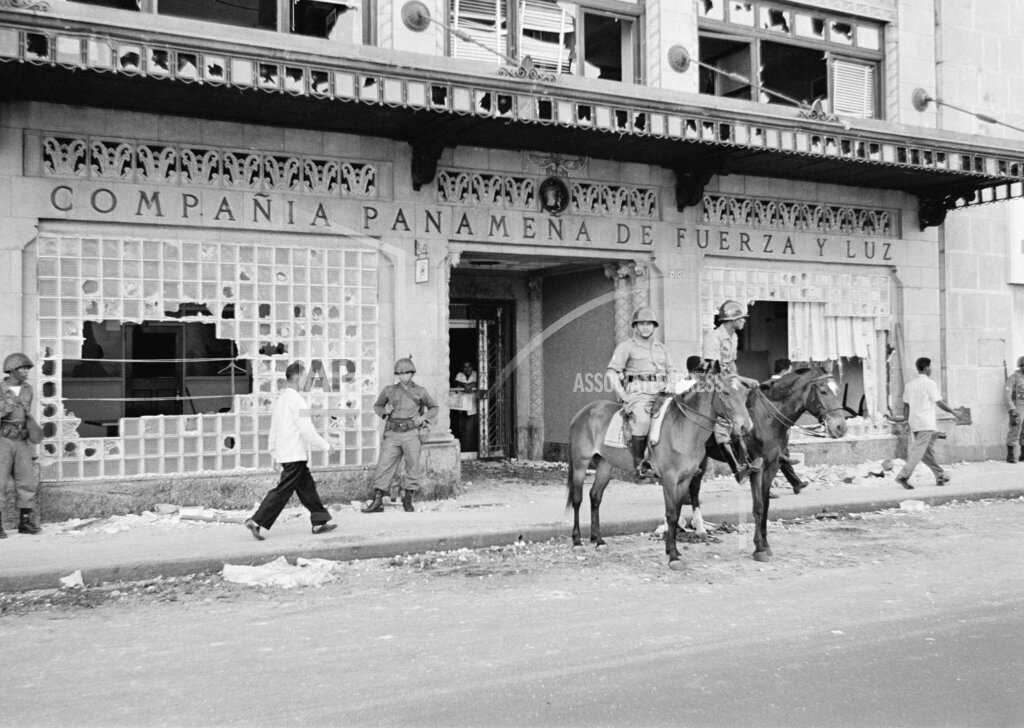
From Colon, agitators hurled rocks at American soldiers in the Canal Zone. The troops responded with tear gas fire and held the mob in check. The old switchhouse of the Panama Railroad near the boundary between Colon and Cristobal was set afire by rioters this afternoon. The fire quickly spread to the Cristobal commissary, which is the Canal Zone’s supermarket and department store. Fires were set at the American Masonic Temple and at the Y.M.C.A. which had been burned Thursday. Earlier there was an exchange of gunfire between American soldiers and Panamanians near the Thatcher ferry bridge which crosses the canal at Balboa, but no casualties were reported. Panama City was generally quiet though anti-American agitators burned three cars.
Venezuela orders its ambassador to the Organization of American States to support Panamanian charges in the Canal Zone crisis. The government of President Romulo Betancourt expressed today its “fraternal adhesion to the Panamanian people and government” in the crisis over the Canal Zone. A statement added that it had instructed Venezuela’s ambassador to the Organization of American States, Enrique Tejera Paris, to support Panamanian charges. The statement said, however, that the government did not consider the incident precisely an act of aggression by American forces.
Students of the national university in Managua, Nicaragua burned a United States flag in a pro-Panama demonstration today. Authorities intervened and broke up the demonstration. There were no arrests.
British and French newspapers criticized United States policy in Latin America, seeing it as the cause of anti-American mob violence in Panama. All British national dailies carried front page reports of the Panama Canal crisis. The Times of London said it was obvious that Panama was going through the same nationalist process as the rest of Latin America. A Times editorial said the basic impulse behind the second such clash within four years was the same — the Panamanians wanted more money and higher status.
The liberal Guardian said American occupation of the Canal Zone remained essentially that of a colonial power. It added: “It will perhaps involve the United States in a little embarrassment to have charges of colonialism leveled against it by the countries whose crusades it supported, but these charges ought to be heeded. “Latin America is becoming as sensitive as Africa to control of its affairs from outside.” The Daily Telegraph said it would not be right for Britons to recall America’s own disassociation from the Anglo-French invasion of the Suez Canal Zone in 1956.
The probability that the Berlin Wall will be partially reopened to West Berliners within two to three weeks apparently picked up force today. Only West Berliners in certain hardship cases would be allowed to go through the Communist wall to visit their kin in East Berlin under conditions offered by Eric Wendt, state secretary in the Walter Ulbricht regime of East Germany. Such cases at present would include sickness, deaths and marriages. Other compassion reasons might be added later. Wendt’s offer, which obviously had the approval of both Soviet Premier Nikita S. Khrushchev and Ulbricht, surprised Mayor Willy Brandt of West Berlin, the City Senate and Horst Korber, who is negotiating on Brandt’s behalf.
The Soviet Union formally agreed today to buy one million metric tons of wheat from the United States. The agreement was first announced last week in the United States by the Continental Grain corporatio of Kansas City, Missouri, which has been granted an export subsidy by Washington. It was the first in what is expected to be a series of American grain deals with the Soviet Union. Signing of the agreement here was announced by the official news agency Tass.
It identified the signers as Leonid Matveyev, chairman of the soviet government trading organization known as Export-khleb, and Roy Folk, vice president of Continental. The one million metric tons amounted to about $7.6 million bushels, said Continental. The price of the wheat was 78.5 million dollars, exclusive of shipping costs. The Soviet Communist Party today summoned an extraordinary meeting of its ruling central committee for February 10 to take up the country’s agricultural problems. The party, headed by Premier Nikita S. Khrushchev, appointed Agriculture Minister Ivan Volovchenko to lead the discussions, but Khrushchev will no doubt make the main speech.
Indian Prime Minister Jawaharlal Nehru, apparently more seriously ill than the world had been led to believe, delegated his routine duties to two senior members of his cabinet Saturday. An official source said the arrangement would last at least a week. Taking over as Nehru’s leadership representatives are Home Minister Gulzari Lal Nanda, 65, and Finance Minister Triuvallur T. Krishnamachari, 63. The decision for this temporary shift in the high command was communicated to President Sarvepalli Radhakrishnan, the figurehead chief of state, who is recovering from an eye operation.
Instead of returning to New Delhi as expected, Nehru remained under doctors’ care in Bhubaneswar, the Orissa State capital 800 miles southeast of this city. The 74-year-old Indian leader was stricken by fatigue and high blood pressure there Tuesday after attending part of the 1964 convention of his Congress Party. He is not expected to be consulted on anything less than major policy decisions for a month or more and may never be able to resume the 16-hour days he had been working.
“Arab unity is like chewing gum,” say the cynics in the bazaars of Baghdad and Beirut. “You always keep it in your mouth but you must never swallow it.” Nevertheless, the kings, presidents, sheiks, crown princes and premiers of an Arab world stretching from the Persian Gulf to the Atlantic Ocean will sit down together warily Monday for a council of war. Summoned by Egypt’s dynamic President Gamal Abdel Nasser to the neutral ground of Arab League headquarters on the Nile, the Arab summit conference brings together as unlike a collection of leaders as might be imagined-absolute monarchs and modern minded kings, constitutional presidents and military dictators, multi-billionaire oil lords and spartan socialists, western oriented politicians and some newfound friends of Red China’s Chou En-lai.
What brings these 13 governments together is ostensibly Israel and its announced intention of diverting Jordan River waters from the Sea of Galilee to the Negev Desert sometime in the spring. But only Jordan, Syria and Lebanon have riparian rights in the Jordan. Only these three, plus Iraq, Saudi Arabia and Egypt, declared war against Israel in 1947 and remain formally belligerents after 15 years of frustrated and sometimes fatal recriminations over who was to blame for the Arabs’ defeat.
U.S. organizations in Japan were preparing for a “second round” of personnel cuts, following a directive to reduce Air Force manpower by 3,500, which also meant reduction of dependents by 2,000.
Sometime before the end of this year, eight diplomats hope to see a U.S. destroyer manned by sailors from each of their nations take to the water as the flagship of a truly international fleet.
Land reform, the cornerstone of President Joao Goulart’s deeply mired legislative program, now appears to be the tool Goulart has chosen to perpetuate his political influence.
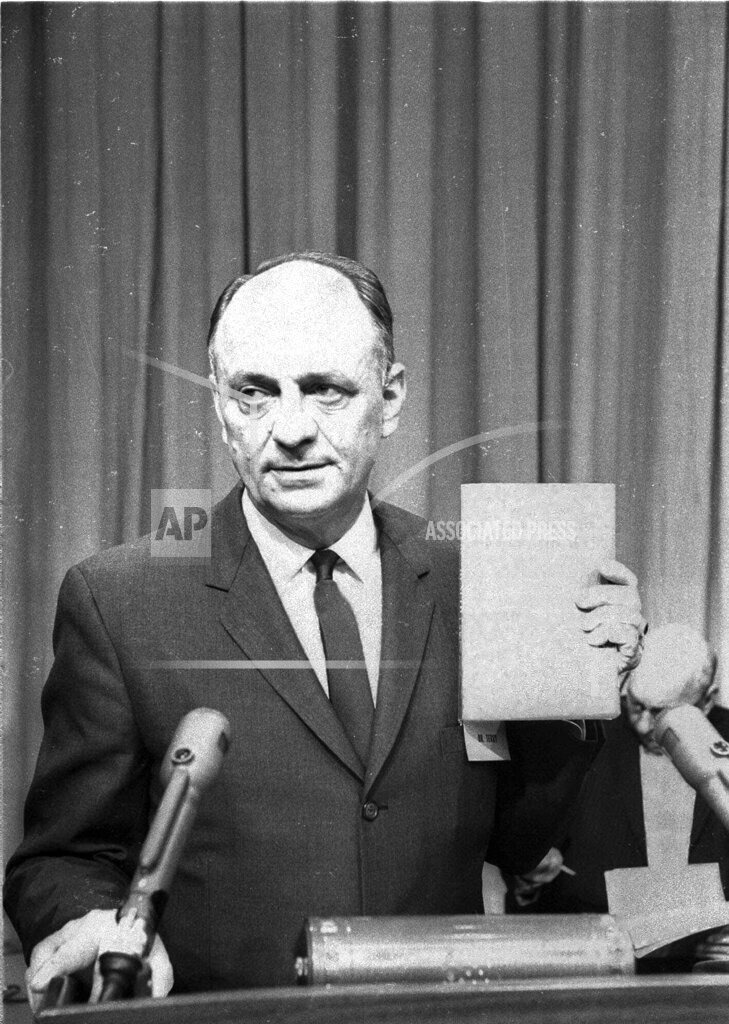
The government, in a new report, for the first time flatly tied smoking cigarettes to lung cancer. United States Surgeon General Luther Leonidas Terry released the report of a committee of experts and made the first American governmental acknowledgment that smoking could be hazardous to one’s health. The 387-page document, Smoking and Health: Report of the Advisory Committee to the Surgeon General of the United States, was written by a select committee of 11 scientists (five of whom were cigarette smokers). It was not released to the press until 9:00 on a Saturday morning, a day chosen because the American stock markets were closed during the weekend and in order to reach the greatest number of readers in Sunday newspapers; and only then to a gathering of journalists who were invited to a secure auditorium at the U.S. State Department building and not allowed to use a telephone until the press conference was over.
The panel noted that 41,000 Americans died of lung cancer in 1962, while another 15,000 died from bronchitis and emphysema, and over half a million from arteriosclerotic heart disease. and concluded that “Average smokers had a nine-to-tenfold risk of developing lung cancer compared to nonsmokers, and heavy smokers had at least a twenty-fold risk.” The Advisory Committee unanimously endorsed the statement that “Cigarette smoking is a health hazard of sufficient importance in the United States to warrant appropriate remedial action.” The effect was an 18% drop in cigarette use from the year before, when per capita consumption had reached a record high of 4,345 cigarettes per year (12 per day for every person in the U.S.); an author would note in 1999 “In 1966, about 43% of American adults regularly smoked cigarettes; today about 25% do.”
The president of the Tobacco Institute declared that the industry stands ready to increase its support of additional research into smoking.
Dr. Wendell G. Scott, president of the American Cancer Society, called for a six-point program to implement the surgeon general committee’s report on the relationship of smoking to lung and throat cancer.
A private pilot and his three neighbors were killed when his Mooney M20 airplane crashed into the 28th floor of the Southwestern Bell building in downtown Kansas City, Missouri, 300 feet above 11th Street and Oak Street. Because it was 5:35 p.m. on a Saturday, nobody inside the building was injured, and no pedestrians were struck by the debris, which was scattered over across several blocks. The group was returning from a hunting trip in Buffalo, Missouri and ran into snow and fog as they approached the city.
Senator Barry Goldwater still looks like the frontrunner for the Republican Presidential nomination in the opinion of the GOP national chairman.
Wall Street is enthusiastic over President Johnson’s plans for a budget cut, but there are some doubts over whether he can produce.
Three of the highest-ranking California Democratic Party leaders said they have informed U.S. Senator Clair Engle (D-California) “unified” re-election support will be forthcoming only if he discloses all the pertinent medical facts about his brain surgery last August.
California Governor Edmund “Pat” Brown said President Johnson is “reluctant” to enter the California Presidential primary and “has not made up his mind yet.”
Jerry Bock and Sheldon Harnick’s musical “She Loves Me”, based on the film “The Shop Around the Corner”, closes at Eugene O’Neill Theater, NYC, after 302 performances and a Tony Award for Jack Cassidy.
The British teenage girls’ magazine Jackie was published for the first time.
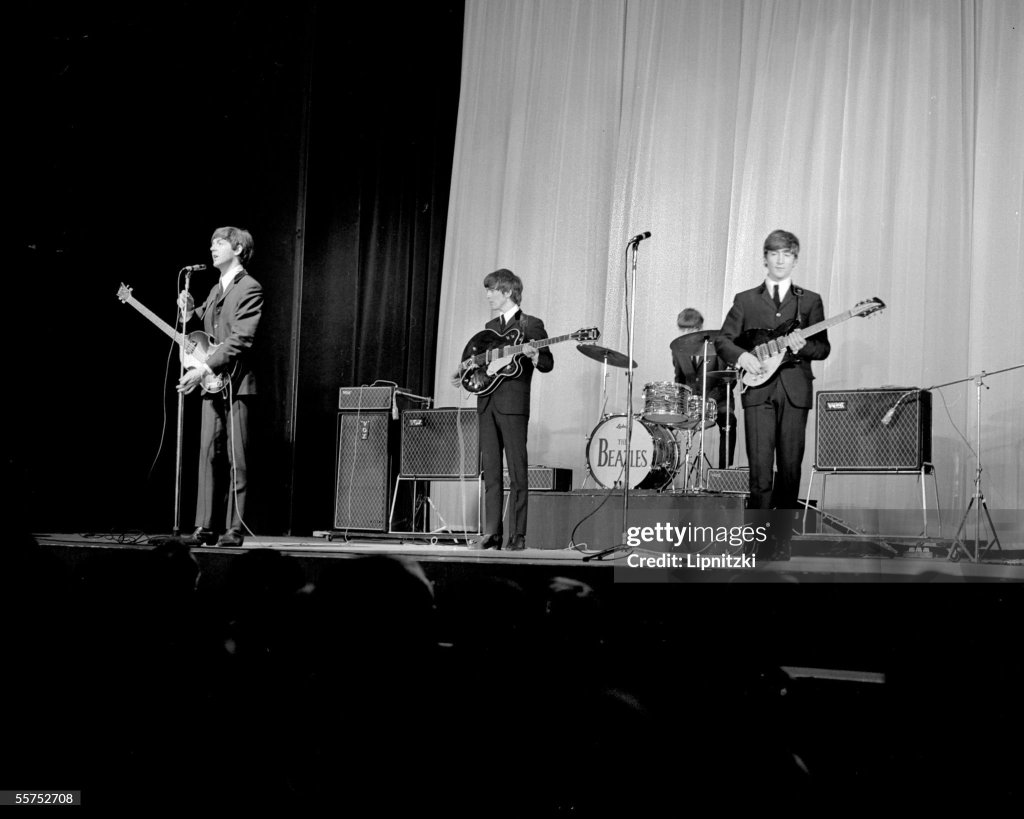
The Beatles single “I Want to Hold Your Hand” reaches #80 in US (Cashbox).
Born:
Dan Clancy, American technologist and computer scientist (CEO of Twitch), in New Orleans, Louisiana.
Died:
Bechara El Khoury, 73, the first President of Lebanon, who served 1943 to 1952.

 History Diaries