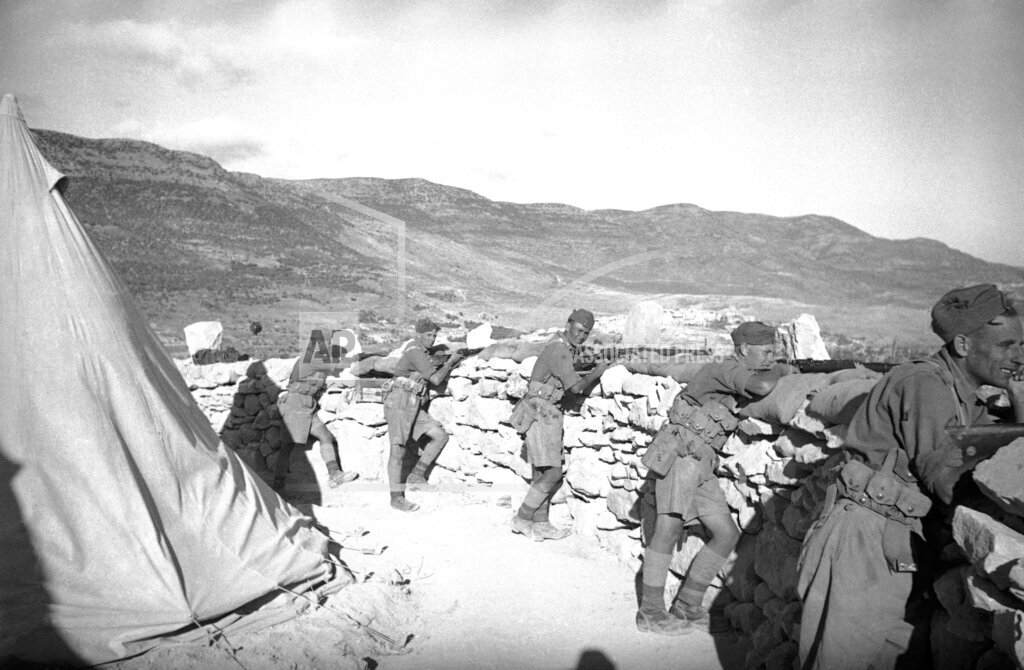
Both sides in the Spanish civil war report gains. Spanish government forces tonight prepared to launch a second great counter offensive against the rebels in an effort to offset and perhaps nullify General Francisco Franco’s successes in his Catalonian drive. The loyalists were massing troops near Seo de Urgel, which is twenty miles south of the French border. The town is at the northern end of the Catalonian battlefront. Franco has gained all along the Catalonian line except in the northern sector from Tremp to Seo de Urgel. A blow there now might flank his whole offensive.
Reports from Puigcerda, in Spain near the French border, said that all day there was a continuous flow of loyalist troops, tanks, and artillery moving westward to Seo de Urgel. The rebels reported new gains in the Lérida sector-the center of the Catalonian line, about fifty miles south of Seo de Urgel. After crossing the Segre River yesterday, the rebels joined two columns at Bellvis, then drove down the road to Mollerusa. Mollerusa is fifteen miles east of Lérida and thirty miles west of Cervera on the main road to Barcelona, the rebels’ objective. Mollerusa also is at the midpoint of the Balaguer-Borjas Blancas defense line which the loyalists set up as the first western defense of Barcelona. The line is about seventy-five miles west of Barcelona and the rebels now hold Borjas Blancas, Mollerusa, and Balaguer.
Southeast of Lérida, in the direction of coastal Tarragona, the loyalists still were falling back under heavy rebel pressure, but they felt confident that their secondary defenses in the Montsant Mountains would halt the rebel drive. The mountains are about twenty-five miles northwest of Tarragona and that port is about sixty miles down the coast from Barcelona. In that sector, the rebels captured Vimbodi, on the main Lérida-Tarragona Road. That the loyalists’ Estremadura offensive — in southwestern Spain — is a serious threat to the rebels was evident today when General Franco began a hurried movement of reinforcements to the sector. Gibraltar dispatches said Franco was drawing new men from the garrisons at La Linea (north of Gibraltar), at Tarifa and Algeciras (west of Gibraltar), and Ceuta, Spanish Morocco. Even civil guards were being included in the troop movement.
The loyalists continued their offensive along the Badajoz and Cordoba fronts, inflicting thousands of casualties on the rebels and capturing several important positions. The aim of this offensive is to deprive Franco of troops he needs to keep his Catalonian offensive going, and if possible, to split northern and southern rebel Spain in two parts as Franco did with Catalonia and the rest of loyalist Spain last spring. The government forces now are about sixty-five miles east of the Portuguese border, but only about twenty miles from Llerena, a station on the vital Seville-Salamanca railroad which links the two rebel sections. The loyalists captured Granja de Torrehermosa, east of Llerena. Four columns are driving westward in the direction of the railroad and the government is sending heavy artillery into the sector.
Rebel bombers attacked four cities and towns in Catalonia today, killing seven persons and wounding sixteen. Barcelona, Reus, Tarragona, and Borjas Del Campo were the points bombed.
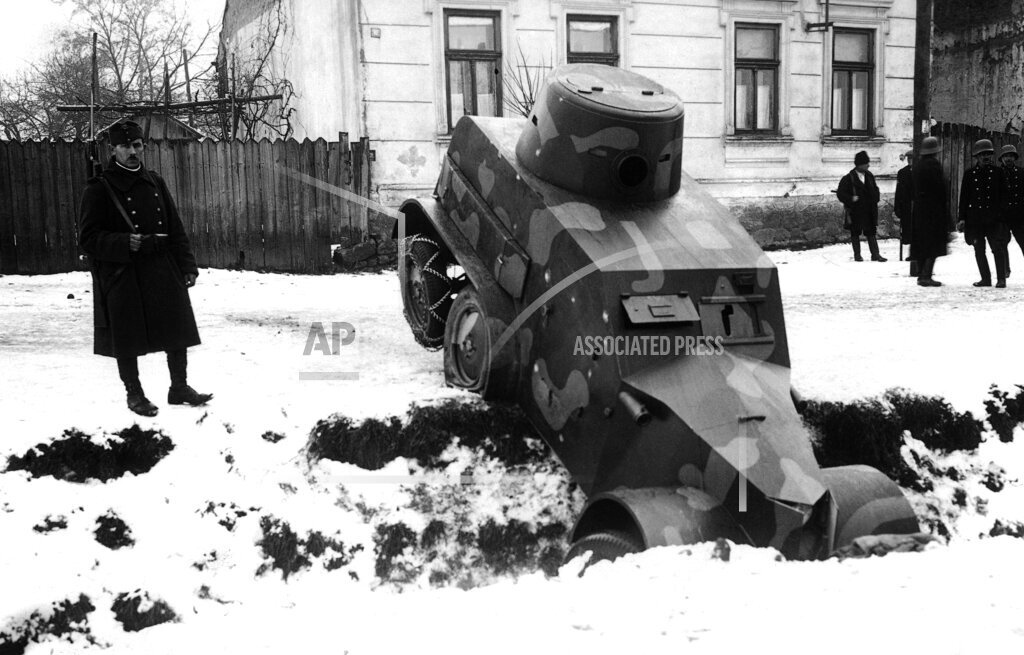
Tensions remain high between Hungarians and Czechs on the frontier. Soldiers strung barbed wire across snow-covered fields along the Hungarian side of the Carpatho-Ukrainian (Ruthenian) border today. Brisk military movements were reported on both sides of the troubled boundary. No shooting was reported in the Munkacs and Ungvar districts but Hungarians reported a large Czech and Ukrainian force had moved up to the demarcation line at Derczen.
The Hungarians said a concentration of Hungarian troops near Derczen forestalled another incident such as that of last Friday when Munkacs was shelled by Czecho-Slovak artillery and the bombardment yesterday of a village near Ungvar. Unlike the Munkacs incident, no loss of life was reported from the village of Nagygejoce where it was said incendiary shells were used.
Although British Prime Minister Neville Chamberlain and Italian Premier Benito Mussolini deny the rumor, it is believed that the main purpose of their meeting is to discuss French-Italian issues. British Prime Minister Neville Chamberlain, his bag packed with appeasement and fortified by President Roosevelt’s thundering denunciation of dictators, will set out for Rome tomorrow morning. If possible, he will try to find out Premier Mussolini’s price for evacuating Italian troops from Spain and for leaving Reichsführer Hitler in the lurch. At the same time British opponents of Chamberlain will keep a close eye on the Rome conference to see that the “old fellow” does not give anything away as he did at Munich last September when Germany won Sudetenland from Czecho-Slovakia.
A crowd of 400 demonstrators swarmed down Whitehall tonight crying “Chamberlain must go!” Police reserves were called out to head them off from Downing Street. Only a small delegation was allowed to approach No. 10 — the prime minister’s official residence — to present a petition. Chamberlain will be accompanied to Italy by Viscount Halifax, foreign secretary; Sir Alexander Cadogan, undersecretary for foreign affairs; Maurice Ingram, head of the Italian department of the foreign office, and three secretaries. The delegation will remain in Rome from Wednesday through Saturday. The visit will include Roman festivities and one heart to heart talk between Chamberlain and Mussolini in the Palazzo Venezia with no interpreters present.
Italian Premier Benito Mussolini summons the Fascist Grand Council to meet on February 4 to set Italy’s course for 1939.
Italian Royal Decree No. 70 was issued to make Italian Libya within the metropolitan territory of Italy, thus lifting the region’s status from a mere colony to a part of the Italian Empire.
What has happened to the British Royal Air Force, which once had the jump on all the rest of the world? This is a question of growing public concern in Great Britain since American sources began disclosing figures on comparative production capacity. Alarmed Britons are asking this question: Why, when the British air organization was at one time so far advanced as compared with other countries, did last September’s war scare leading up to the peace of Munich reveal the axis powers, Germany and Italy, so overwhelmingly superior in the air? Not only are statesmen such as Winston Churchill and his son-in-law, E. D. Sandys, and other public figures dismayed. The public, too, is jittery at what is alleged to be inefficiency not only in aircraft production and organization but also in the methods of defense against aircraft.
These fears have been increased in England, which is the world’s best target for bombing, by reports that German aircraft production has in no way abated, but on the contrary has increased since the Munich pact which dismembered Czecho-Slovakia. This seems to confirm reports that Reichsführer Hitler has ordered his air force to be ready for any emergency by early spring. The British deny the accuracy of statistics compiled by experts of the United States war department to the effect that Germany had 10,000 fighting planes last September and that the axis powers were six times stronger than France, Britain, and the United States. However, without mentioning figures the British admit the German first line strength is more than twice that of Britain. They also admit that the Germans are employing 400,000 workers in two eight-hour shifts in aviation plants and in some cases three, while Britain has only 100,000 similarly employed. This would tend to confirm that German production is going on at a rate of four times that of the British.
The Reich Office of Racial Research exempts Karaites from antisemitic legislation.
Karl Burk was made the commanding officer of the 8th SS-Standarte (Niederschlesien) regiment.
Pay cuts are ordered for Soviet plant workers, with dismissal required for those who are 20 minutes late to work.
Two French warships arrive at Djibouti, a territory of contention between France and Italy.
Arab delegates are expected to demand national rule at the upcoming London conference.
The Council of Jewish Organizations requests help in colonizing Jewish refugees in Palestine.
The Senate Commerce Committee agreed today to investigate the charge that Harry L. Hopkins, former WPA administrator and newly appointed Secretary of Commerce, expressed the whole philosophy of the Roosevelt administration in an aphorism. “We will spend and spend, tax and tax, elect and elect,” Mr. Hopkins is reputed to have told intimates at the Empire race track in Yonkers, New York last fall. Two Washington newspaper men, Frank Kent of the Baltimore Sun and later Arthur Krock of the New York Times, attributed this remark to Hopkins in their respective columns and he denied having made it. They insisted, however, that their informant was thoroughly reliable.
The Senate Commerce Committee, which has under consideration Hopkins’ nomination, today subpoenaed Kent and Krock to appear Wednesday before the full committee in open session. Hopkins was invited to appear at the same time or to send a representative if he could not be present. He announced that he would appear. Thus Mr. Hopkins and his accusers will be brought face to face. Senator Josiah W. Bailey (D-North Carolina), new anti-New Deal chairman of the Commerce Committee, made no public announcement concerning the summoning of Kent and Krock, but it was learned from members of the committee that they had been called. Later it was learned that the newspaper men had received summonses. Chairman Bailey also declared that Hopkins would be questioned about the use of relief appropriations for political purposes. The report of the Senate Campaign Expenditures Committee, condemning the political activity of the WPA, will be used as the basis for this phase of the examination, Senator Bailey said.
Calls are made from the American Left for the abolishment of the Dies Committee and the formation of a Department of Justice committee that genuinely investigates “un-American activities.”
The American Federation of Labor demands nine changes in labor amendments.
The steel industry rebounded to 52 percent capacity in December.
Immediate adoption of a program for developing a stronger air defense and for expanding the aircraft industry was recommended in the report of the National Advisory Committee for Aeronautics (NACA) which President Roosevelt transmitted to congress today. The report is the prelude to the special message on strengthening the defense of the United States which the President will transmit this week, possibly tomorrow. Mr. Roosevelt will recommend expansion of naval, land, and air defenses costing about 500 million dollars. He read the first draft of the message today to Vice President John N. Garner and Senate and House Democratic leaders.
The United States, said the committee, has led in the technical development of aircraft because of the support of organized scientific research in the Langley field laboratories, but now this leadership is threatened by the great expansion of research facilities in other nations. With patent reference to Germany the report said: “The history of 1938 bears witness as to how a nation in the space of a few years, by concentrating much of its scientific research and industrial resources on the development of air power, could gain, for the time being, a dominating position.” The information the committee obtained regarding German aviation is known to have been supplied by one of its members, Charles A. Lindbergh.
General William Haskell states that American industry is not prepared for war, nor does the United States have a sufficient supply of raw materials.
The Navy completes design of two 45,000-ton battleships; said to be the most powerful ever designed.
Jewish War Veterans of the United States vow to continue the fight against Communism.
The American Bar Association is asked to approve a resolution censuring Nazis.
Motorists breathe into a balloon-like “drunk-o-meter” to test alcohol consumption.
Cornell University develops an improved atom-smashing gun.
Owners revive the American Professional Football League; play is set to begin in the fall.
The new Chilean government offers justification and explanation for sweeping changes in official positions.
Chinese forces report they reclaim Wencheng. Chinese reported today that their forces in western Shansi province had recaptured Wencheng, on the east bank of the Yellow River, in an attack which also forced other Japanese units to withdraw from the river shore. Before the town was taken, they said, Japanese artillery at Chungshih mistakenly shelled Wencheng, causing heavy casualties among their own troops.
In three days’ fighting at Lishih, in western Shansi, Chinese said they had captured eleven Japanese pillboxes, inflicted 1,800 casualties, and disabled eight cannon. Japanese planes bombed Ichang in western Hupeh and Taoyuan, in northern Hunan province, and scattered propaganda handbills over Changsha and Nanchang.
Japanese planes bombed Shekki, south of Canton, today and destroyed an electric light plant. Twelve workmen were killed. Weichow island, 35 miles south of Pakhoi in the gulf of Tongking, was reportedly occupied by Japanese marines after three cruisers and an aircraft carrier concentrated near the island. Chinese sources said Tsengshing, northeast of Canton, was recaptured by the Chinese after heavy fighting.
Dow Jones Industrial Average: 150.19 (-1.35).
Born:
Susannah York [as Susannah Yolande Fletcher], English actress (“They Shoot Horses, Don’t They?”, “Superman”), in London, England, United Kingdom.
Paul Oglesby, NFL tackle and defensive tackle (Oakland Raiders), in San Francisco, California (d. 1994).
Guido Grilli, MLB pitcher (Boston Red Sox, Kansas City A’s), in Memphis, Tennessee.
Naval Construction:
The Royal Navy “K”-class destroyer HMS Kingston (F 64) is launched by J.S. White & Co. (Cowes, U.K.).
 History Diaries