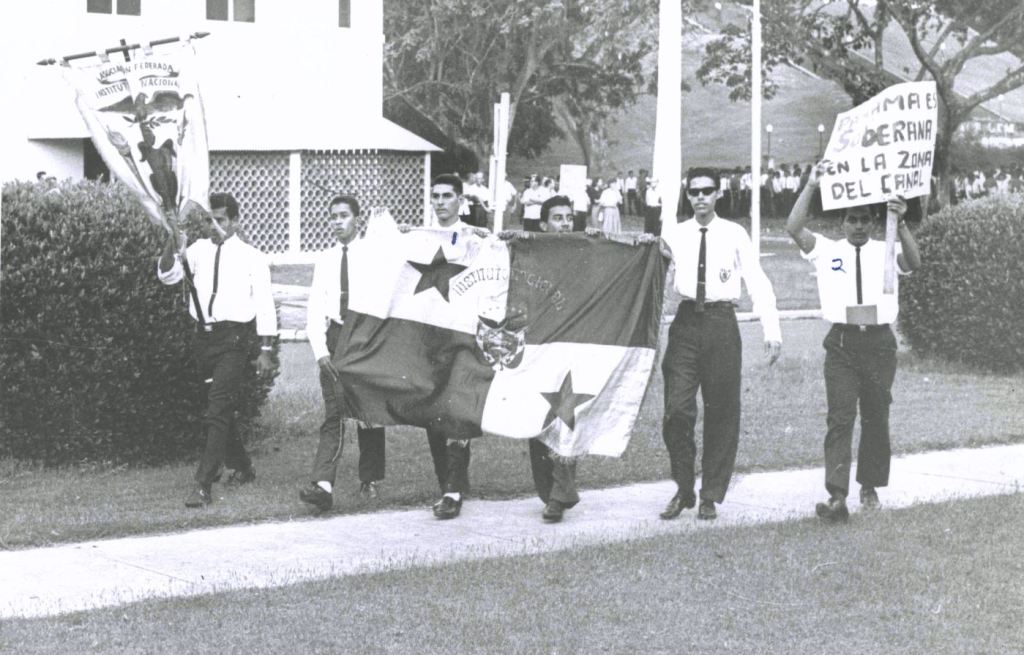
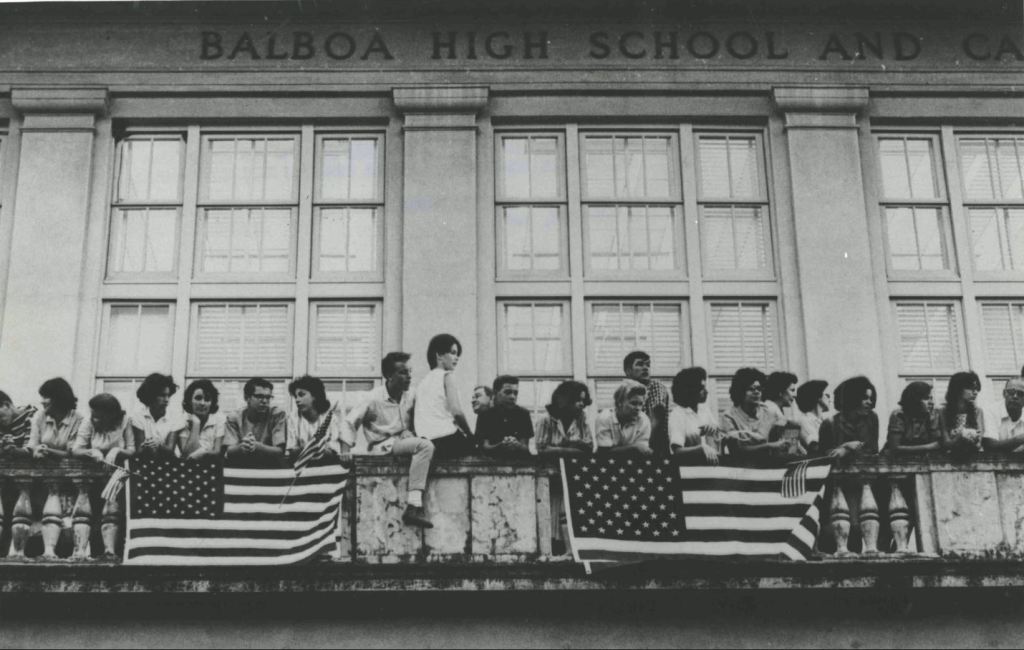
At 7:30 in the morning, a student at Balboa High School in the U.S. controlled Panama Canal Zone raised the American flag at a flagpole outside the school building, marking the third day in a row that the American students had defied the Zone Governor’s order that no flags be raised at schools until the Panamanian flag could be flown alongside; despite growing bitterness between the Americans inside the Zone and the Panamanians outside, Governor Robert Fleming departed on a previously-scheduled flight to Washington that afternoon “in a blunder he came to regret”. High school students at the Instituto Nacional in Panama City were given permission by their principal to make a peaceful march to Balboa High School, and at 4:50 in the afternoon, about 200 students and four teachers walked through an unguarded entrance to the Canal Zone. Zonian policemen then stopped the group and allowed six students to carry a Panamanian flag to Balboa High, where American students and adults were waiting for them. In the confrontation that followed, the Instituto’s flag received some rips, and U.S. police ordered all students out of the Zone.
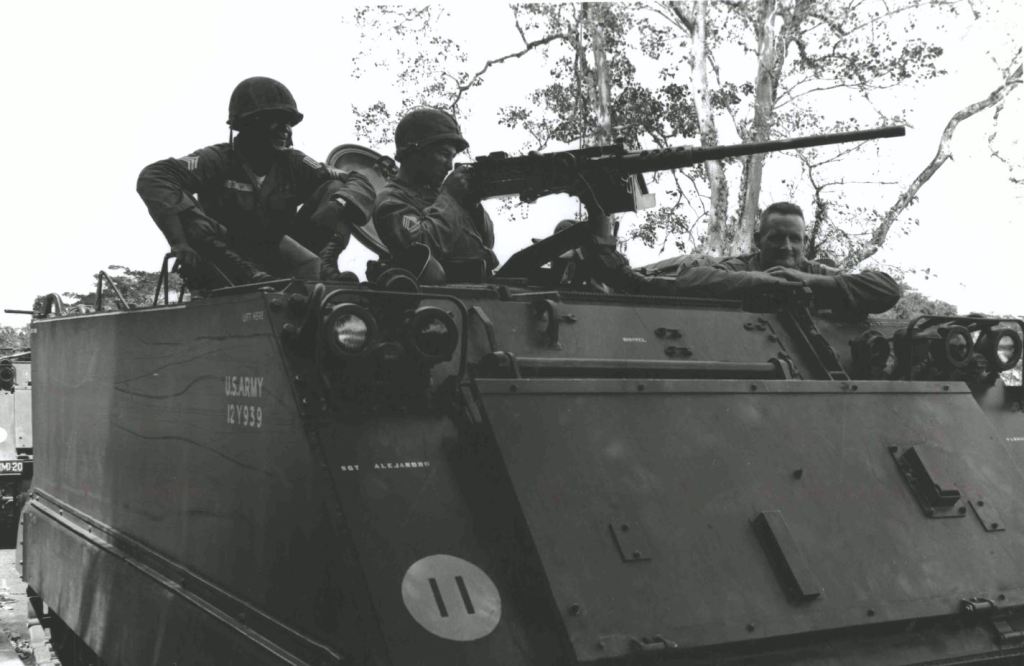
By 7:30, word had spread of the humiliating incident, and over 3,000 Panamanians tried to force their way across the boundary. Since there were only 80 Zone policemen, the acting governor, U.S. Army Colonel David Parker, asked for American soldiers to defend the area at 8:00, and the rioting escalated got worse. Panama’s President Roberto Chiari refused to allow Panama’s civilian police to respond to the violence, and the rioting spread to the city of Colón. By the time the violence subsided on Sunday, 21 Panamanians and four American soldiers were dead, and 465 Panamanians and 103 Americans were injured or wounded. The Balboa High School student who had organized the flag raising, a 17-year-old boy, would tell reporters later that his only regret was the deaths of the four American soldiers. January 9 is now observed in Panama as a public holiday referred to as “Martyrs’ Day” (Día de los Mártires).
The Panamanian government recalled its ambassador to Washington and charged that American Canal Zone police had shot down unarmed Panamanian students. President Roberto Chiari said in a radio broadcast the recall constituted a “suspension of relations” and charged American officials with “aggression against the Panamanian people.” Chiari’s action did not constitute a formal break in diplomatic relations, however.
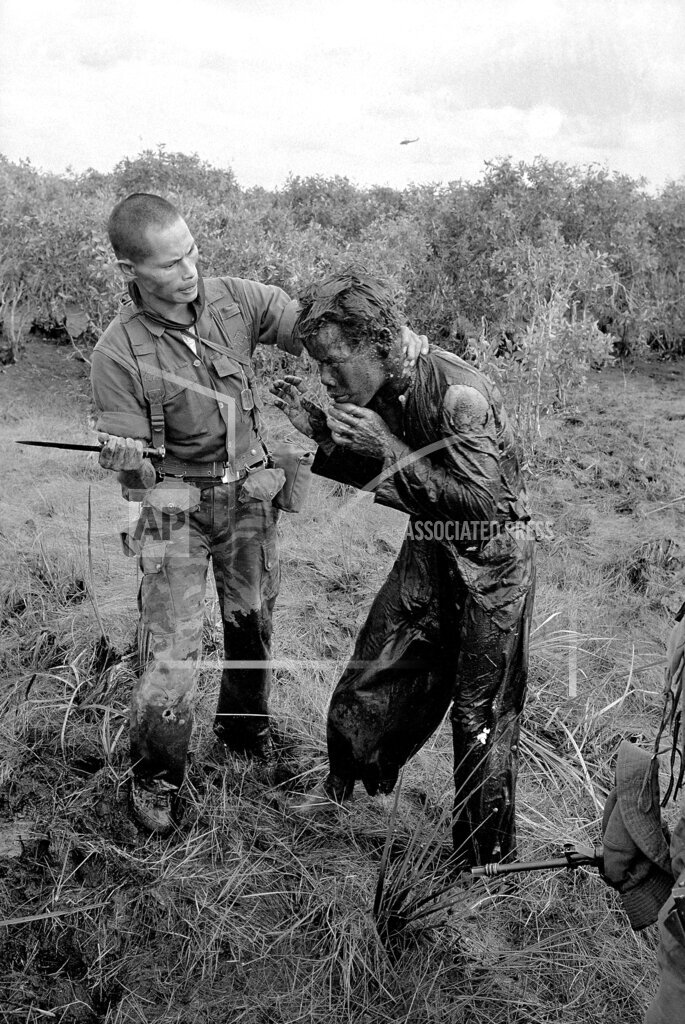
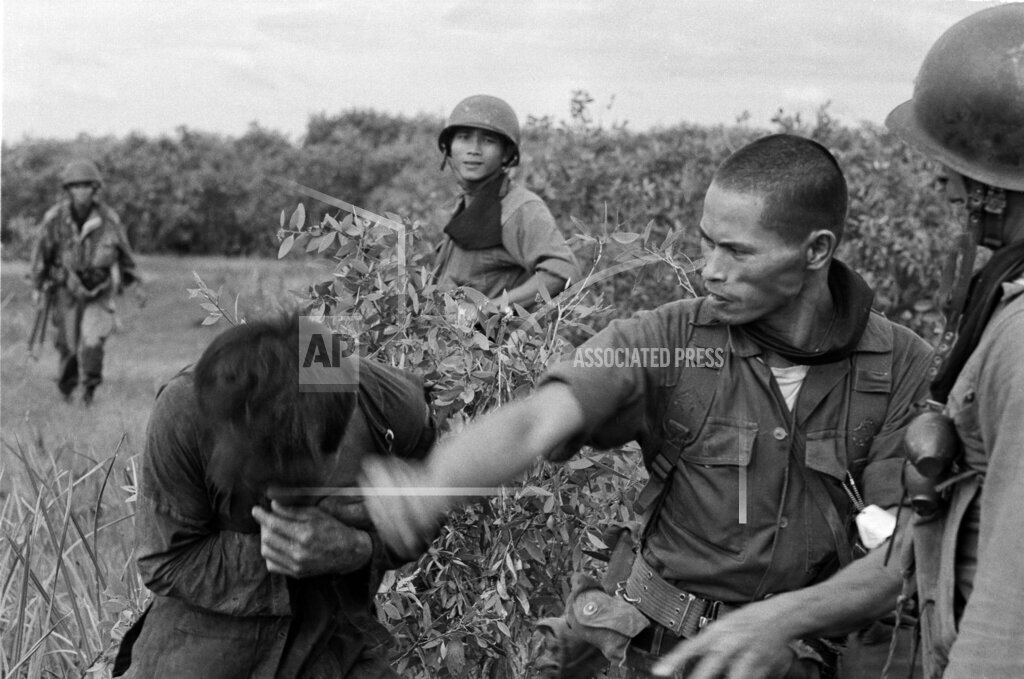
South Vietnamese troops occupied a Viet Cong guerrilla village without difficulty, but a peasant prisoner talked too late to enable them to engage the enemy.
Meanwhile, correspondent Malcolm Browne writes in the Chicago Tribune:
“The United States may soon have to choose between watching the Communists win in South Vietnam or sending in major U.S. combat units.
“The time for such a decision has not arrived but top American officials in Saigon are looking at the odds closely. A possible middle ground is that Saigon’s new military government will recover the initiative from the enemy guerrilla army.
“The United States has hopes that this can be done. Ranking American observers say military setbacks are the result of confusion following the November 1 coup which ousted President Ngo Dinh Diem. The situation will straighten out in a few months, they hope.
“What if it doesn’t?
“No one has ready answers. Neutralization of South Vietnam advocated by French President Charles de Gaulle, by Cambodia and by the Communists could be regarded as an indirect surrender to the Communists. North Vietnam has said it would be satisfied “for the time being” with a neutralized South Vietnam with no American troops. “We could wait for a few years on that basis before reunifying South Vietnam with our country,” a Hanoi official said recently in nearby Cambodia.
“Diplomats are weighing the advantages and disadvantages of using U.S. combat units.
“The main advantage, many veteran U.S. officers here believe, would be to give Americans command initiative. There are 15,000 Americans here now. In their limited role as advisers and in support elements, many American officers and men feel handicapped. “With a couple of divisions of U.S. airborne or marines, we could clean this place up fairly fast,” one said.”
[Ed: Le Sigh.]
The Central Intelligence Agency staged an unprecedented press briefing today to warn the western world that Russia may have to ask for credit to buy 2 billion dollars’ worth of equipment for its chemical industry. The top secret agency welcomed a group of reporters into its well-guarded headquarters five miles outside of Washington in a wooded area on the Virginia side of the Potomac River. The CIA’s aversion to publicity has been so great that there are no road signs to guide an inquisitive public to its building.
The gist of the CIA briefing, given by a battery of economists on the agency’s payroll, was that the Soviet Union’s economy is slipping. The information had been leaking out of the agency for several days. Today’s briefing, held with the approval of President Johnson, was called to give general distribution to the data on which the appraisal of the Russian economy was based. The briefing was held in a double-doored room, its windows covered by thick drapes. It is the scene of the weekly meeting of the United States intelligence board, made up of the intelligence chiefs of the CIA, Defense Department, military services, State Department, and Atomic Energy Commission.
All but one of the 31 people on board Aerotransportes Litoral Argentino (ALA) Flight 143 were killed when the DC-3 airliner crashed short of the runway as it was attempting to make an emergency landing at the city of Zárate. The plane had caught fire while flying from Rosario to Buenos Aires, and the pilot was forced to try a landing in a field six miles from the Zarate airport.
West German Chancellor Ludwig Erhard pushed for unification of West Europe and urged establishment of a common parliament.
Prime Minister Jawaharlal Nehru, still ailing, missed the first public session of his ruling Congress Party’s 1964 Convention.
The Johnson Administration began final preparation on a disarmament package with some new variations of old ideas to present to the 17-nation conference later this month in Geneva.
Senator Barry Goldwater (R-Arizona), winding up a three-day drive for delegates in New Hampshire’s Republican Presidential primary, today attacked President Johnson’s state of the Union message as a “trick” aimed at deluding American citizens. Before taking off for Washington, the senator attended informal gatherings over coffee and doughnuts in Portsmouth, Dover, and Rochester as well as visiting various newspaper offices. He is seeking the Granite state’s 14 delegates to the Republican national convention. The primary will be held March 10. An ice storm forced Senator Goldwater to cancel his final stop and coffee reception at the town of Exeter. He took off in his small chartered plane from Pease Air Force Base for Washington early in the afternoon.
In one statement during the day, the senator charged that this country’s intercontinental missiles were “undependable.” He criticized Washington for cutting down production of air force bombers while the Soviet Union continued to turn them out. “We may get caught with our planes down,” he said. Appearing at a press conference at a Portsmouth motel, the candidate tore into President Johnson’s message of yesterday as not squaring with financial facts. “Because of the refusal of Congress to rush through appropriations bills, and because the Congress reduced the Kennedy requests in such areas as foreign aid, the actual spending for 1964 will be somewhere around 95 billion dollars,” he said.
Secretary of Defense Robert S. McNamara personally injected himself into the 1964 Presidential campaign today by assailing a statement of Senator Barry Goldwater as “completely misleading, politically irresponsible, and damaging to the national security.” McNamara’s blast — approved by President Johnson — was prompted by a recommendation of Goldwater that the United States should retain manned aircraft in its defense system because long-range missiles, in the senator’s opinion, are not completely dependable.
“I’m very fearful that we may get caught sometime with our planes down,” the Republican Presidential candidate said in Portsmouth, New Hampshire. He noted that he would “probably catch hell for saying this,” but added: “I wish the Defense Department would tell the people how undependable the long-range missiles are…. I can’t tell you just how undependable they are, it’s classified information.” In one of the fastest reactions to critics on record for McNamara, the secretary said: “Senator Goldwater’s reported statement that the United States long-range missiles are not dependable is completely misleading, politically irresponsible, and damaging to the national security.
“There is no information, classified or otherwise, to support the false implication that our long-range missiles cannot be depended upon to accomplish their mission. “The importance of long-range missiles to the defense of this country and the evaluation of their effectiveness by our leading military authorities is indicated by the strong support given by the joint chiefs of staff to the missile program.”
President Johnson today called for Senate passage of the administration’s 11-billion-dollar tax cut bill ahead of action on civil rights legislation. “Every day of talk in the Senate costs workers new jobs,” the President asserted in apparent reference to an expected southern filibuster over civil rights.” Johnson assigned No. 1 priority to the long-pending tax reduction bill in speaking to two private groups supporting the legislation.
The groups — the Business Committee for Tax Reduction and the Citizens Committee for Tax Reduction and Revision in 1964 — met with the chief executive in the White House. The President made similar informal remarks to both organizations at separate meetings. Remarking that the two organizations had come to the White House to offer their help in support of the tax bill, Johnson told them, “That support was never more needed or welcome than it is now.”
He said no single measure will do more to stimulate the national economy and ease such major economic ills as unemployment, idle production capacity and “chronic deficits in our budget and in our international accounts.” The President noted that “we must have been talking about the tax bill for almost a year now.” He contended that every month of delay in putting a tax cut on the statute books makes more than 550 million dollars’ worth of difference to the country’s economy because lower taxes would mean adding that amount to the take-home pay and purchasing power of American workers and consumers.
The Senate Finance Committee strikes out two major revenue provisions inserted in the 11-billion-dollar tax cut bill by the House. The larger of the two restores deductions on auto licenses and gasoline, which would have provided 330 million dollars in revenue. The committee also eliminated a provision taxing premiums paid by a company on group insurance of more than $30,000.
The civil rights bill begins its bumpy trip through the House Rules Committee with Chairman Howard W. Smith (D-Virginia) asserting it is “as full of boobytraps as a dog is of fleas.” As Smith leads the assault on the bill, Rep. Emanuel Celler (D-New York), chairman of the Judiciary Committee which drafted the measure, defends its provisions. Smith hints the bill was railroaded through the Judiciary Committee, and Celler denies it.
Democratic politicians in Washington foresee Attorney General Robert F. Kennedy as a possible running mate for President Johnson on the 1964 ticket. R. Sargent Shriver, peace corps director, also is a likely candidate for Vice President.
[Ed: LOL. No. LBJ and Bobby Kennedy can’t stand one another.]
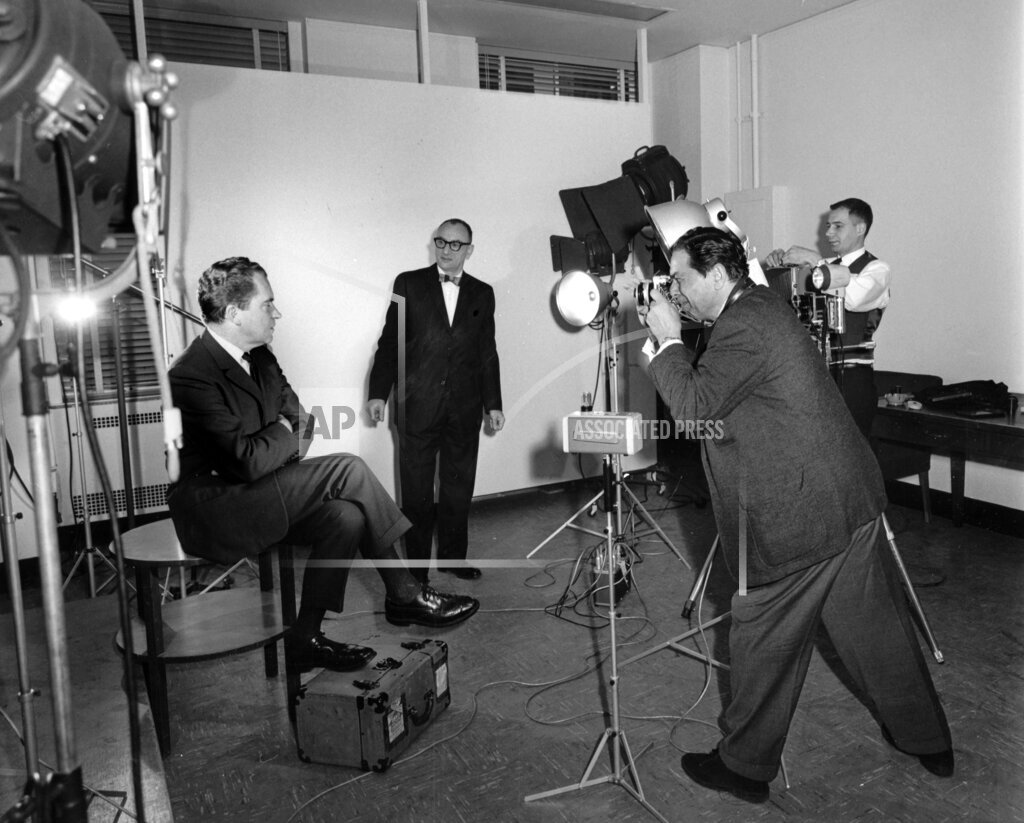
Former Vice President Nixon says that as soon as he decides who the Republicans’ strongest Presidential candidate is, he “will make any sacrifice” to see that the man is nominated. The former Vice President does not say that this could mean he will accept the nomination.
Governor Nelson A. Rockefeller charges that Senator Barry Goldwater’s proposal for a “voluntary” social security program would bankrupt the system and leave millions of Americans without funds to finance their retirement years. Rockefeller resumes his campaign in New Hampshire for the Republican Presidential nomination just five hours after the Arizonan flies back to Washington.
Dow Jones Industrial Average: 776.55 (+2.09).
Born:
Stan Javier, Dominican MLB outfielder (World Series Champions-A’s, 1989; New York Yankees, Oakland A’s, Los Angeles Dodgers, Philadelphia Phillies, California Angels, San Francisco Giants, Houston Astros, Seattle Mariners), in San Francisco de Macorís, Dominican Republic.
Chuck Washington, NFL defensive back (Green Bay Packers), in Topeka, Kansas.
 History Diaries