India’s Prime Minister Jawaharlal Nehru suffered a stroke while visiting the city of Bhubaneswar in the Odisha state. During his recovery, he brought former Minister of Home Affairs Lal Bahadur Shastri back into his Cabinet as a minister without portfolio. On May 27, Nehru would die and Shastri would become his successor.
Fidel Castro’s promises of a bright new future for the Cuban man in the street have not materialized in the Havana of today. The Cuban worker has neither enough to eat nor to wear. He has to get by on three ounces of coffee a week and a quarter pound of butter a month; fresh meat is virtually unknown. There is plenty of Russian and Polish sausage if he has the money to buy it.
Shoes are a luxury, and he is allowed only one new shirt a year. There is adequate milk for children, but little for adults. This is the situation a correspondent from Ottawa found in Havana when he was admitted there recently to cover the trial of two Canadians on charges of spying against the Castro government. He saw much but heard little. Most Cubans he met were reluctant to talk with outsiders. Although more money is circulating in Cuba than in pre-Castro days, the economy in the last four years has become progressively worse. The food shortage verges on the critical. Many staples are severely rationed. Consumer goods have nearly disappeared from store shelves. The Cuban with money in his pocket has little to spend it on.
British officials predict relations with the United States will not be hurt by the 11.1-million-dollar British buses-for-Cuba deal. Prime Minister Alec Douglas-Home’s cabinet is said to believe that Washington, having made known its unhappiness, will let the matter die. The deal may lead to a 28-million-dollar contract for the British Leyland Motor corporation.
In his first general audience since his return from the Holy Land, Pope Paul VI likens his pilgrimage to “a stroke of a plow which moved soil that had become hardened and inert.” He says he immensely enjoyed and was amazed by the welcome given him in the cradle of Christendom.
U.S. President Lyndon Johnson has politely turned down a French hint that he meet President Charles de Gaulle at the Caribbean island of Martinique, it was reported tonight. Paris was told that Johnson’s duties bar him from leaving the United States. However, the long-standing invitation to de Gaulle to come to Washington is still open. De Gaulle is scheduled to visit Mexico soon, and it was in this connection that the French were said to have indirectly sounded out the possibility of the two heads of state meeting at the French island of Martinique.
The Department of Defense tonight confirmed that it anticipates closing by July 1 the B-47 bomber base of the Strategic Air Command in Zaragosa, Spain, and consolidating its operations at two remaining fields. A Pentagon spokesman also confirmed that eight radar sites will be turned over to Spain and that negotiations are underway to sell some planes to Spain, although no decision has been made. No date is set for the radar site transfers.
The spokesman said there were two squadrons of F-104 fighters (40 aircraft) and one squadron of F-105 (18 aircraft) in Zaragosa and 40 B-47s. About 3,500 airmen and 4,500 dependents are at the base. All of the units at the base are there on a rotational basis. At regular periods they return to the United States and are replaced with new units. The spokesman said these functions will be consolidated in Moron and Torrejon.
Ghana President Kwame Nkrumah tonight ordered the arrest of this African nation’s former opposition leader and purged top police ranks in retribution for last Thursday’s abortive attempt on his life. A government announcement said detention orders were issued against former opposition leader Dr. J. B. Danquah, Deputy Police Commissioner S. D. Amanin and Assistant Police Commissioner M. K. Awuku. In addition, Police Commissioner E. R. T. Adjitey and seven assistant police commissioners were removed from their posts.
Western nations which have visions of opening rich new markets in Red China are doomed to disappointment, the Yugoslavian newspaper Borba warned in a dispatch from Peking.
Assessments of the United States this year for regular and peace-keeping costs of the United Nations total $39,766,948, the lowest since 1960.
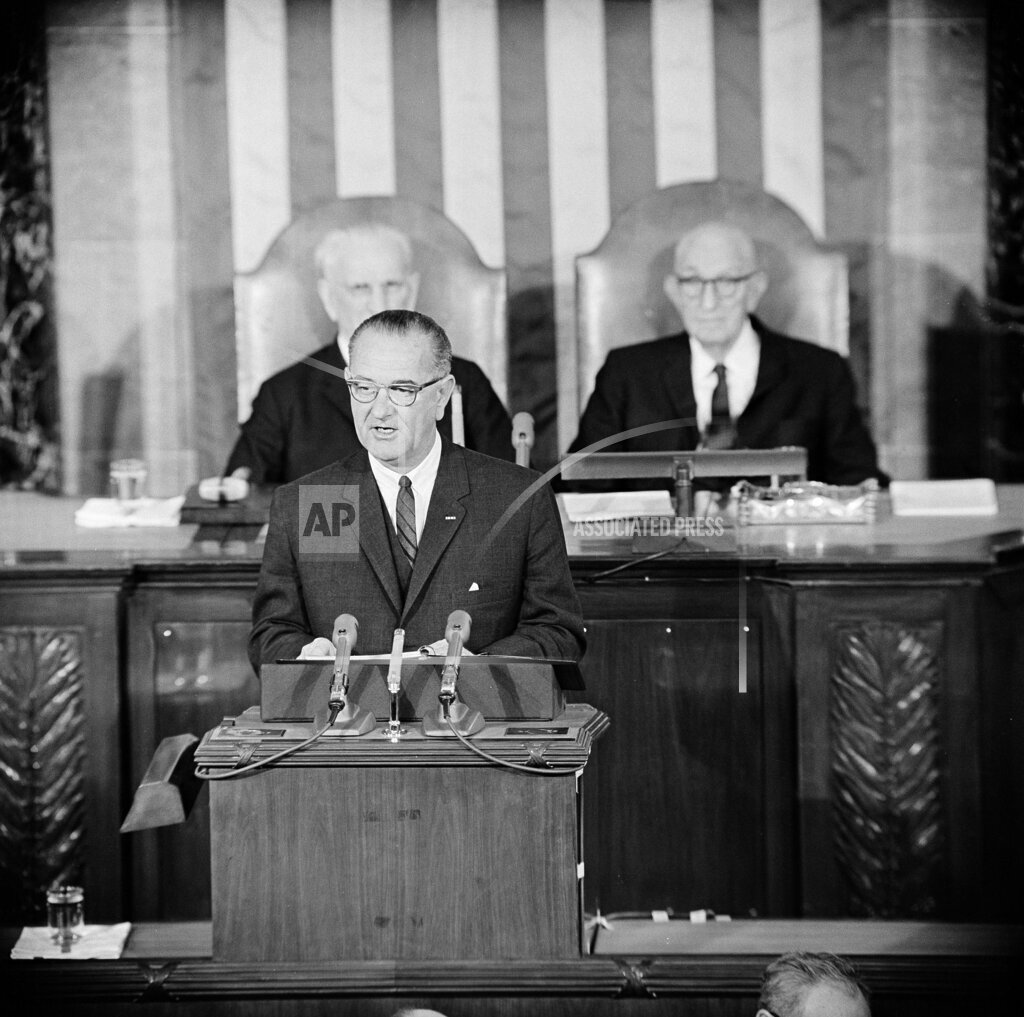
In his first State of the Union Address, U.S. President Lyndon Johnson announced the “War on Poverty”. Asking Congress immediately, “let us work together to make this year’s session the best in the nation’s history… as the session which declared all-out war on human poverty and unemployment in these United States,” Johnson told Americans watching television, “This administration today, here and now, declares unconditional war on poverty in America. I urge this Congress and all Americans to join with me in that effort.”
In a short and dramatic report on the State of the Union, President Johnson today announced a surprise budget cut and hurled a peace challenge to Russia. In his second appearance before a joint session of Congress since the assassination of President Kennedy, the new chief executive put aside the tones of humility he sounded on November 27. He was forceful and confident in laying down more than two dozen personal goals for prosperity at home through unconditional war on poverty and for peace in the world. He also announced a unilateral cutback in the production of fissile material for nuclear weapons.
Johnson drew his greatest applause when he asserted the United States does not intend to bury anyone but will not be buried; that the nation will fight, if it must, but prays that it will never have to fight again. His second greatest applause came when he announced his budget cut and told senators and representatives assembled in the House chamber that they can complete their work by summer.
Washington officials say President Johnson’s “economy” budget will harm neither the defense nor diplomatic efforts of the United States. One says the nuclear capacity of the United States has been increased 50 percent in the last three years. Officials, who decline to be identified, claim that cutbacks in atomic plant operations will not weaken America’s power in the struggle with world communism.
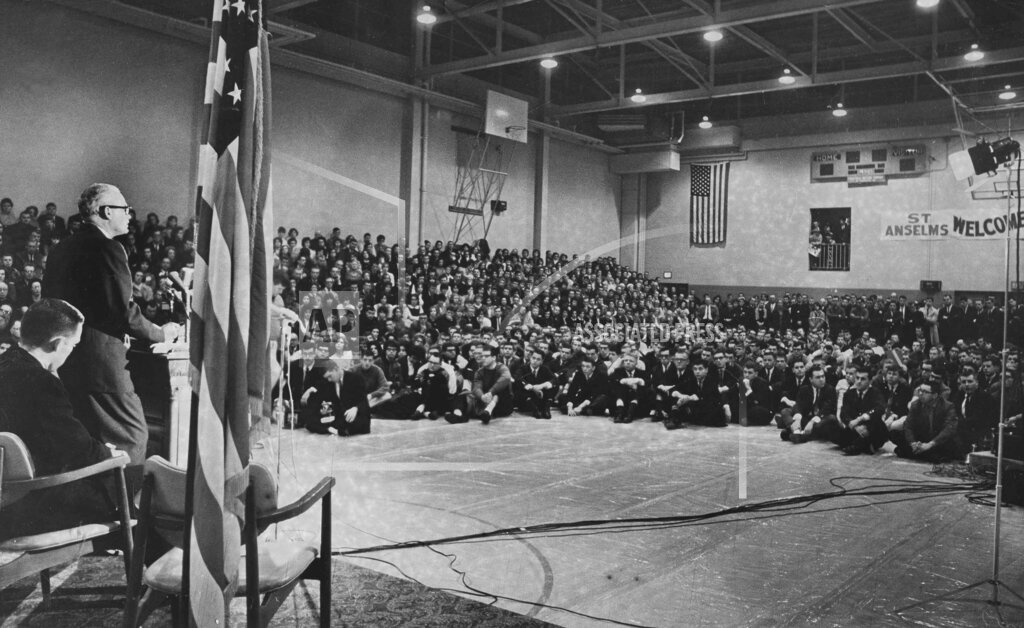
Senator Barry Goldwater (R-Arizona), stumping New Hampshire for the Presidential nomination, tonight called for “a reappraisal of the United Nations.” He spoke before a crowd of 1,500 students jammed into the new gymnasium at St. Anselm’s College. The senator delivered a broad-based attack on the administration’s foreign policies at the end of his second full day of campaigning for the Granite state’s 14 delegates to the Republican national convention. They will be chosen in the nation’s first primary campaign, March 10. Governor Nelson A. Rockefeller of New York is the other main contender.
Tonight’s rally was an enthusiastic affair. The program was switched from the theater seating 500 to the gym because of the demand for seats. St. Anselm’s, perched on an ice-glazed hilltop overlooking Manchester, was founded in 1889 by Benedictine monks. Senator Goldwater, still with his right foot encased in a heavy cast as a result of a heel operation, hobbled down the main aisle without the use of a cane to an improvised platform under the basket at the far end. Students rose and cheered. The senator had already spent a hard day greeting voters in informal coffee hours at homes in the industrial towns of Nashua, Amherst, and Milford. He was accompanied by Senator Norris Cotton (R-New Hampshire), state chairman of Goldwater forces.
The House Rules Committee prepares to open hearings today on the controversial civil rights bill. President Johnson was the Senate Democratic leader when the civil rights bills of 1957 and 1960 were enacted over the opposition of southern Democrats. Today, a southerner opposed to civil rights legislation, Rep. Howard W. Smith (D-Virginia) will convene the Rules Committee. The omnibus rights bill was drafted by the Judiciary Committee after five months of work.
Tax writers in Congress see little hope for passage of a tax cut bill by February 1, as demanded by President Johnson. They estimate it cannot be done before March or sometime in April. The Senate finance committee, however, in response to pressure from the President, approves a reduction in corporation taxes and a new minimum standard deduction for persons of low incomes.
Two former U.S. presidents disagreed on the presidential line of succession and whether a disabled president who recovers should regain his office. The former presidents, Republican Dwight D. Eisenhower and Democrat Harry S. Truman, along with former Vice President Richard M. Nixon, agreed, however, that the law should be clarified. They gave their views Wednesday night in separate interviews on the Columbia Broadcasting System’s television documentary, “The Crisis of the Presidential Succession.” Mr. Truman and Nixon advocated that the electoral college elect a new Vice President to replace one who succeeds to the Presidency.
General Eisenhower, who preferred a special national election if the new President comes from the Cabinet and has a year to serve, did not think congressional leaders should be in the line of succession, as at present. This makes it possible, he said, for a different political party to take over the White House suddenly. Mr. Truman, however, said, “The Speaker of the House has usually been a member of the House for a good long time… and when he’s elected Speaker, he comes more nearly being elected by the country at large…” Both Nixon and General Eisenhower rejected a proposal by their fellow Republican, U.S. Senator Kenneth Keating of New York, that two Vice Presidents be elected at four-year intervals.
United States District Judge Alexander Holtzoff upholds a ruling by a railroad arbitration panel that could eliminate 90 percent of the firemen in diesel freight and yard service. He overrules a challenge by four operating brotherhoods affected by the decision. The unions contended that the panel had gone beyond its authority under the law passed by Congress last summer to head off a nationwide strike, and also that the law itself was unconstitutional. Holtzoff ruled: “…The award made by the arbitration board is valid; Congress had the power to order the arbitration; and, the board acted lawfully within the orbit of authority delegated to it.”
Dow Jones Industrial Average: 774.46 (+2.73).
Born:
Joe Dixon, NFL nose tackle (Houston Oilers), in Fort Smith, Arkansas (d. 2023).
Died:
Julius Raab, 72, Chancellor of Austria from 1953 to 1961.
Martin Stixrud, 87, Norwegian figure skater and coach (Olympic bronze 1920, coached Sonja Henie).



 History Diaries