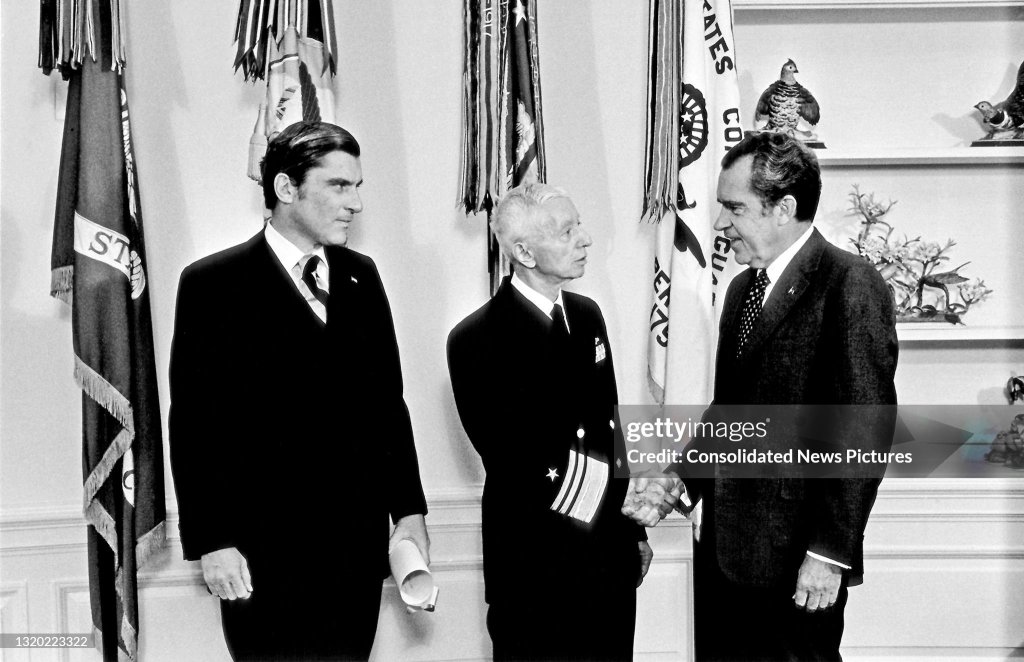
Secretary of State Kissinger may soon visit the Middle East again to help work out an agreement between Egypt and Israel on separation of their forces along the Suez Canal, State Department officials said.
In response to increasing demands by protesters for more freedom, South Korea’s President Park Chung Hee issued an emergency decree making it illegal “to deny, oppose, misrepresent, or defame” the president’s decisions, as well as prohibiting the reporting of news of dissent “through broadcasting, reporting or publishing, or by any other means.” The South Korean press immediately ceased reporting on protests. Persons violating the decree were subject to arrest without a warrant and to trial by a military court, punishable by a maximum of 15 years in prison. He proclaimed two presidential “emergency measures” under the Constitution as a group of 30 civic and religious leaders pressed their two-week campaign to collect a million signatures on a petition to him for a democratic Constitution, despite Mr. Park’s previous warning.
Communist‐led Cambodian insurgents intensified pressure on Phnom Penh’s defensive perimeters yesterday, striking from north and south, according to reports from the field. The insurgents opened a front to the north, posing a new threat to the capital. Large rebel forces were also reported to the west and northwest of the city. American sources termed the step‐up the first phase of dry‐season offensive, with the objective a military take‐over. But they expressed a belief that the government forces would hold. The Khmer Rouge insurgents have pushed to within five miles of Phnom Penh from the west and eight miles from the north. American sources said the insurgents had 60 battalions with a total strength of 18,000 men within a radius of 25 miles of Phnom Penh. Their total strength across Cambodia is estimated at 150 battalions, or 45,000 men.
At dawn today the insurgents fired two rockets into a residential area of Phnom Penh, killing one woman and injuring two persons, military officials said. The casualties were caused by a 100‐pound, Soviet-built 122‐mm rocket, which hit a slum dwelling. The other rocket smashed into the ground near the villa of a French Embassy employe. No casualties were reported. Reports from the field said the insurgents assaulted a government battalion of 300 men on the eastern bank of the Bassac River nine miles southeast of Phnom Penh and encircled it. Gunboats and helicopter gunships were called in to relieve the government battalion. The drive from the west appeared to have been contained for the time being. Sources in the field said that to the north of Phnom Penh, the insurgents attempted to abduct between 400 and 500 families from a village trapped in the battle zone. Government artillery shelled the rebels and about 200 families managed to escape across the Tonle Sap River, they added.
Hundreds of refugees fled the scene of a major battle north of Phnom Penh’s Pochentong Airport today as fighting that has taken a heavy civilian toll tapered off. Refugees, most headed for the village of Pochentong, four miles west of Phnom Penh, escaped in oxcarts and on bicycles and motorbikes. Government forces supported by T‐28 aircraft were reported nearly 2,000 strong when the battle began Sunday, facing, an insurgent force estimated at 5,000 men. The insurgents moved into seven villages in the area north of Pochentong early Sunday, it was reported, setting fire to at least 50 houses.
China opened a new front in its marathon quarrel with Russia by attacking Moscow’s treatment of political dissidents, thus touching one of the rawest Soviet nerves. The attack, in an article in the official People’s Daily, criticized the ‘Brezhnev clique’, referring to party chief Leonid I. Brezhnev, for using a wide range of methods to suppress dissidents. China’s official news agency said that the Soviet government is “sitting on a volcano” with its suppression and that Soviet society “is permeated by sharp class antagonisms, national contradictions and social upheavals.”
The Central Intelligence Agency member who sent the Thai government a phony cease-fire offer purportedly from a Communist insurgent leader has left Thailand and appropriate disciplinary action has been taken,” American Ambassador William R. Kintner said. The agent, reliably reported to be an American, was said to have hoped the letter would increase defections to the government.
Premier Kakuei Tanaka of Japan told the Philippines today that the Japanese Government would exercise “administrative guidance” over Japanese businesses here and elsewhere in Southeast Asia to harmonize them with the needs and ways of their, host nations. Mr. Tanaka, after a day with President Ferdinand E. Marcos that began on the golf course, said that the provision of such advice would be a task for a new minister, who would be added to the Cabinet in April. “Administrative guidance” by the Japanese Government has the effect of law. In his first stop on a tour of five Southeast Asian nations, Mr. Tanaka said to reporters that the issue of how Japanese business conducted itself was common to all the countries on his itinerary—the Philippines, Thailand, Singapore, Malaysia and Indonesia.
Defense Department payments to Air America, an airline that operates in Indochina and is linked to the Central Intelligence Agency, increased from $17.7 million in fiscal 1972 to $41.4 million in fiscal 1973, according to Rep. Les Aspin (D-Wisconsin). He said almost all the funds were for operations out of Thailand and the contracts “reflect substantial U.S. involvement in the Southeast Asia War.” A CIA spokesman said the agency has a policy of not commenting on questions involving Air America.
U.S. Army Pvt. Richard D. Bucklin, who said the Vietnam war was stupid and immoral, was convicted of being absent without leave from his post in West Germany, sentenced to 15 months at hard labor and given a bad-conduct discharge. At Ft. Carson, Colorado, his attorney said the verdict would be appealed through military channels and, if necessary, to the U.S. District Court in Denver. The jury also ordered Bucklin to forfeit his $326 monthly back pay for the more than four years he was AWOL and living in Sweden.
A bomb explosion damaged a hotel in Newcastle, a Northern Ireland town southeast of Belfast, and another bomb planted in a culvert blasted a hole in a road near the border with the Irish Republic. A police spokesman said no one was injured in the blasts. He said gunmen gave a warning when they planted the bomb at the hotel.
Former Bolivian President Victor Paz Estenssoró and five members of his Revolutionary Nationalist Movement were deported. to neighboring Paraguay, according to an official announcement in La Paz. They were accused of attempts to create division among the armed forces, which back the rightist government of President Hugo Banzer. The exile came six weeks after Paz Estensso ro’s left-leaning party withdrew its support of Banzer’s government.
The U.S. State Department discounted a Panama report that the two countries were on the verge of signing a new treaty on the Panama Canal. Spokesman George Vest said talks were progressing well and “we are reasonably encouraged by the way things are going,” but he did not want to give the impression an agreement was near. Asked about a report that Secretary of State Henry A. Kissinger would visit Panama to sign the treaty, Vest said there was no firm plan for any Latin American visit by Kissinger other than one to Mexico City next month.
A boiler exploded aboard the Greek oil tanker Atrotos in the middle of the Gulf of Mexico as the ship headed toward Corpus Christi, Texas, with a load of Venezuelan fuel oil, but the captain said the crew managed to extinguish the resulting blaze. A Coast Guard spokesman said the captain radioed that he would be able to proceed to his destination as soon as the boiler was repaired. A cutter and two aircraft had been dispatched to assist the ship. At one point the flames were raging near the vessel’s fuel tanks and the crew was prepared to abandon ship if the fire got out of control.
Gold hits a record $126.50 an ounce in London. The price of gold soared today the London and Zurich, Switzerland, bullion markets, while the United States dollar gave up some of its recent sharp gains.
Silver hits a record $3.40 an ounce in New York.
President Nixon acknowledged that he took “traditional political considerations” into account in ordering a controversial 1971 increase in federal milk price supports. But he said that charges that he granted favors to milk producers and to the International Telephone and Telegraph Corporation in return for campaign contributions were “utterly false.” The President’s position was set forth in two White House statements that Mr. Nixon last November promised to make public to get out the “facts” on both cases. But documents supporting the statements were not made public on the ground that they previously were voluntarily delivered to the special Watergate prosecutor.
The President denied that pledges of campaign funds from ITT and the dairy industry influenced his actions in either case. He insisted that his only action was to contact deputy Attorney General Richard Kleindienst and order him to drop appeals of the ITT case to the Supreme Court, which was done at then-Attorney General John Mitchell’s urging; otherwise, Solicitor General Ervin Griswold would have resigned in protest. ITT president Harold Geneen had requested a meeting with President Nixon to discuss the case, but no meeting occurred. Nixon denied charges of raising milk price supports in exchange for campaign contributions.
President Nixon may be willing to accept a limited compromise with the Senate Watergate Committee on the release of documents and tape recordings despite the stern position he took last week against the committee’s subpoena, White House officials said. The White House also announced that Charles Alan Wright, a constitutional lawyer, had returned to the White House as a part-time consultant to represent the President on the question of executive privilege.
Vice President Gerald Ford said he is encouraged over the reaction to the plan between the Senate Watergate Committee and White House regarding subpoenas. Committee chairman Sam Ervin is apparently ready to compromise.
The nation’s worst inflation since the unusual conditions following World War II continued unabated in December, figures from the Labor Department disclosed. With energy and food products leading, the Wholesale Price Index rose 2.2% last month after allowance for normal seasonal price changes. In “normal” times the index seldom changed by more than two-tenths or three-tenths of 1 percent in a month.
Price increases for food and fuel accounted for most of the increase. Overall, wholesale prices in 1973 were up 18.2% over 1972 as prices increased steadily over the course of the year. White House economic adviser Herbert Stein and Treasury Secretary George Shultz declined on-camera interviews regarding the price rises.
Labor Secretary Peter Brennan said that if the rate of inflation continues to climb, workers are entitled to higher wages. The administration may ease its 5.5% guideline for pay increases.
President Nixon is expected to propose to Congress this month a national health insurance program for all Americans that would cost about $37.5 billion next year. About $5.6 billion in new federal funds would be spent on the plan, in addition to money that would have gone into the existing Medicare and Medicaid programs, plus contributions from employers, employees and states.
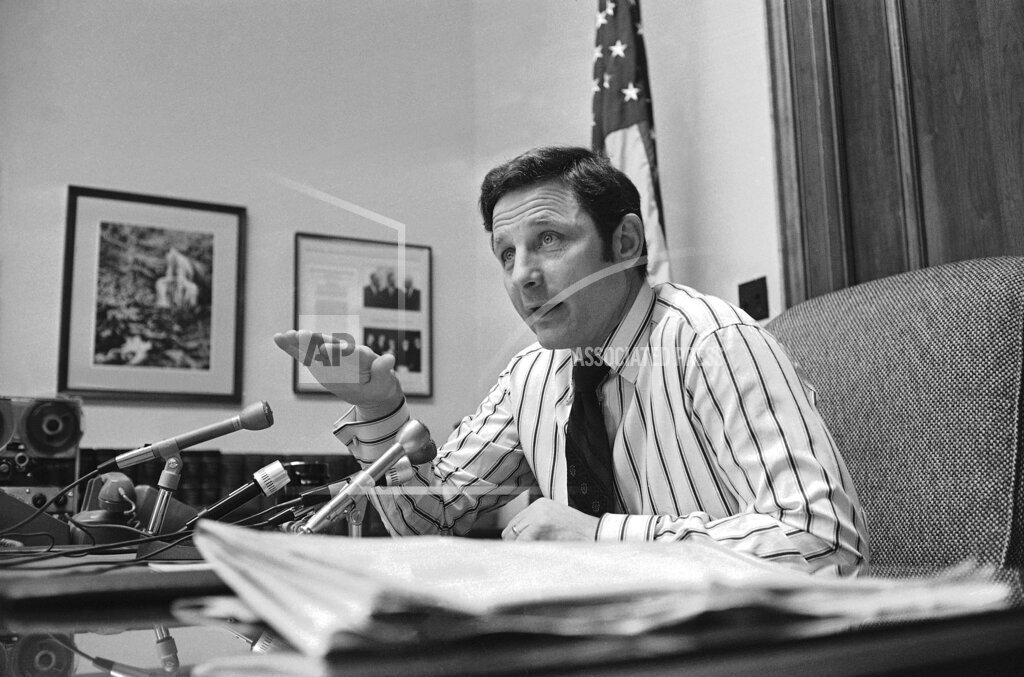
Barry Goldwater, like a Republican cloth coat rediscovered in the closet at the end of a fashion era, is back in style. For a decade, Democrats gleefully scorned him; now they quote him. Republicans tried to forget his political legacy; now they applaud him. The reason is Watergate — and Senator Goldwater’s outspoken criticism of President Nixon and what he plainly believes is Mr. Nixon’s failure to deal effectively with the scandal. The blunt candor that devastated the Senator’s campaign for the White House in 1964 appears to many to have become something of a national treasure in 1974, and each passing day seems to yield new evidence that the Arizona Republican is in the midst of a political renaissance.
The Small Business Administration will lose no more than $50,000 on an $11 million loan that triggered a congressional investigation six weeks ago when allegations were made that the SBA had mishandled government funds, said SBA Administrator Thomas S. Kleppe. He told a group of businessmen at a luncheon in Bismarck, North Dakota, that the SBA’s total “exposure” on the loan made in Richmond, Virginia, was $800,000 and the total loss, if any, would not exceed $50,000. Kleppe, a former North Dakota congressman, said Civil Service regulations, which prevented him from firing certain officials, were partly to blame for the controversy.
A federal grand jury in Cleveland viewed scores of photographs in an attempt to pinpoint where Kent State University protesters and Ohio national guardsmen were standing when four students were killed on May 4, 1970. The shootings occurred after guardsmen were called during a campus demonstration against the U.S. presence in Cambodia. Photographer John P. Filo said the jurors hinted at their interest in what he said is known as “the big surge theory,” the concept that a surge of students toward the guardsmen precipitated the shooting. Another witness, photographer William J. McGuire III, said he was 170 feet away when the gunfire began and heard no order to shoot. He said he could see no danger to the guardsmen.
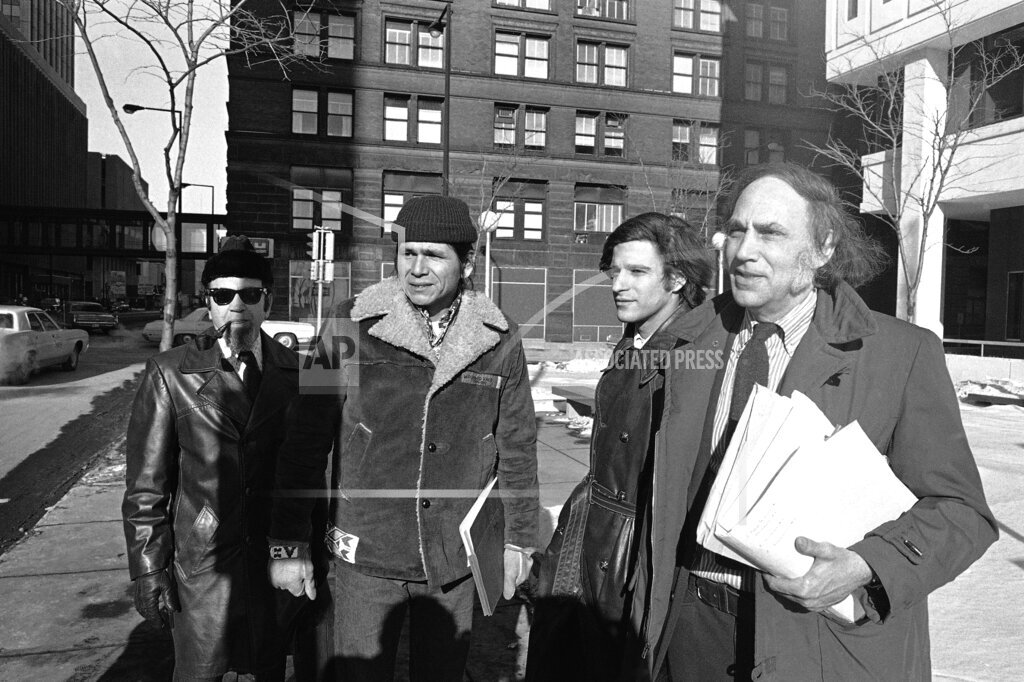
The trial of two militant Indians, charged in last year’s occupation of Wounded Knee, South Dakota, opened in federal court in St. Paul, Minnesota, with tentative approval of two jurors. U.S. District Judge Fred Nichol said selection could take two weeks. Dennis Banks, 41, of Minneapolis, and Russell Means, 34, of Porcupine, South Dakota, leaders of the American Indian Movement, are charged in a 10-count indictment with conspiracy, burglary, larceny and illegal possession of firearms in the 71-day takeover of the historic hamlet on the Pine Ridge Reservation. If convicted on all counts they each could be sentenced to 80 years in prison. The trial is the first in a series involving nearly 130 other persons in connection with the Wounded Knee incident.
The alleged boss of the south Texas narcotics world, Fred Gomez Carrasco, entered a surprise plea of guilty in Corpus Christi to a charge of assault to murder a police officer and was sentenced to life in prison. The state dropped charges of murder and illegally carrying a weapon as well as a charge of assault to murder against his wife, Rosa. The charge of assault to murder San Antonio Police Lieutenant Dave Flores grew out of a July 22 shootout in which Carrasco was captured. Carrasco, 33, also had been accused of murdering Gilberto (The Cow) Escobedo last March.
Women and part‐time students are the fastest‐growing segment of higher education, according to a report by the United States Office of Education on enrollment in the country’s colleges and universities. The overall enrollment in institutions of higher education is put at 9,662,763, an increase of 3.9 percent over the 1972‐73 enrollment of 9,297,787. A smaller overall increase was expected by some authorities, and the continued influx of women and part‐time students was apparently what bolstered enrollments the most. The enrollment of full‐time women students grew by 7.5 percent in public universities and 2.5 percent in private universities. At the same time, fulltime male enrollments increased 2.3 percent in public universities and declined 3.3 percent in private universities.
The Consumer Product Safety Commission is preparing for a public hearing on the fire hazards of aluminum wire used in up to 2 million houses built during the last decade.
E Wilson Jr’s musical “Let My People Come” premieres in New York City.
Delegates to a meeting of the National Collegiate Athletic Association (NCAA) made a major change in the rules of amateur athletics, amending the NCAA rules to allow athletes to receive money to play as professionals in one sport and to play at the college level in other sports. The resolution, requiring two-thirds approval, passed by four votes, 258 to 123.
Dow Jones Industrial Average: 861.78 (-15.07, -1.72%).
Born:
Michel Martone, Italian jurist and academic; in Nice, France.
Kamla Abou Zekry, Egyptian TV and film director known for her 2004 romantic comedy Sana Oula Nasb (“The First Year of Deception”); in Cairo, Egypt.
Nicholas White, South African racing cyclist; in Johannesburg, Gauteng, South Africa.
Massimiliano Mori, Italian road bicycle racer; in San Miniato, Tuscany, Italy.
Died:
Charles G. Bond, 96, member of the United States House of Representatives from New York.
Michael Dempsey, 55, American bishop of the Catholic Church.
Charles-Édouard Ferland, 81, Canadian jurist and politician.
Blanche Reverchon, 94, French psychoanalyst.
Arnold Arbeit, 62, American artist and architect.
Lizette Hermant Sarnoff, 79, French-born widow of David Sarnoff.


 History Diaries