General Francisco Franco, Spanish rebel commander in chief, was reported tonight to be rushing reinforcements to the Estremadura front in southwestern Spain in an effort to halt a government drive which apparently was gaining momentum. Government troops were said to have advanced approximately twenty-one miles in three days. The attack was intended to relieve insurgent pressure on Catalonia in the northeast, where Franco’s command reported important successes. Late in the afternoon the government reported capture of the communications centers of Peraleda de Saucejo and Fuente Ovejuna. in the region about 170 miles southwest of Madrid. Barcelona dispatches said the drive thus far had resulted in capture of 250 square miles of insurgent territory.
To the south, government troops approximately fifteen miles north of Cordoba were fighting their way westward through the Sierra de Morena. The insurgents reported, however, that the diversion attempted by the loyalists in the southwest had failed to check the rebel drive against Barcelona, provisional government capital in the northeast. General Franco has ordered the insurgent fleet, previously stationed near Gibraltar, to support the Catalonian drive possibly by shelling Tarragona, a major seaport about fifty miles southwest of Barcelona. Maneuvering by land and sea threatened to make Tarragona the target of a converging land offense and naval assault at the same time.
The rebel drive extended from the vicinity of Artesa, which fell during the week, southward to the Falset-Tarragona Road area, apparently at no point closer than sixty miles to Barcelona. The principal point of insurgent Infantry and artillery pressure was in the Sierra de la Llena where an army division was said to have hemmed in the village of Ulldemolins, about twenty-five miles northwest of Tarragona on a highway descending to Reus and the Tarragona coast. This division, part of the southern wing of the offensive, had swung about ten miles eastward from Granadella in a week.
Foggy weather slowed the insurgent advances east of the Segre River toward the fertile Urgel tableland. Insurgents based on Lérida pushed beyond Borjas Blancas, southeast of Lérida, to the village of Vinaixa, about twenty-five miles from Tarragona and sixty miles west of Barcelona. Borjas Blanchas fell on Thursday. Fanning out from Artesa on the northern flank, the insurgents reported capture of Doncel, five miles southeast of Artesa.
A bloody clash occurs at the Czechoslovakia and Carpatho-Ukraine border. One dozen die and Germany is seen as a potential instigator. Hungarian police wounded three persons in a crowd of Slovak sympathizers today in the uneasy border situation which precipitated a battle between Czecho-Slovaks and Hungarians yesterday at Munkacs. Guns were silent in the Munkacs region. Unverified Hungarian reports asserted forty Czecho-Slovaks and seven Hungarians died in yesterday’s battle and that the Czecho-Slovak forces took hostages with them when they retreated. Semi-official quarters in Prague denied these reports. The Czech government in a preliminary reply to the Hungarian protest suggested “neighborly” consultations on the question of restoring quiet in the frontier zone.
Today’s incident occurred in the Hungarian village of Komarom-Csehi, northeast of Budapest and more than 200 airline miles southwest of Munkacs. The village is near the city of Komarom. The police fired five shots. The shooting occurred as officers were arresting a man on a charge of insulting Admiral Nicholas Horthy, regent of Hungary. The police reported that a crowd of 150 persons, “excited by Slovak agitation from across the border,” attacked them with sticks and stones and that they shot in self-defense. At Munkacs, a city of 30,000 in the territory awarded Hungary from Czecho-Slovakia November 2 by Italo-German mediators in a post-Munich territorial settlement, there was no resumption of hostilities even though the truce arranged yesterday by military authorities ended at 1 p.m.
The Italian press accuses President Franklin Roosevelt of manufacturing a sense of danger to keep Latin American countries in line and to appease Jewish capitalists.
British-French talks are scheduled before Prime Minister Neville Chamberlain meets with Premier Benito Mussolini. Chamberlain is expected to request Mussolini’s aid in persuading Hitler to allow the evacuation of Jews.
A roundup of Jews who have failed to leave the country within the time limit fixed in expulsion orders issued against them or whose attempts to emigrate are deemed insufficiently strong by the police is under way in Germany. Those concerned include both German Jews and Jews without citizenship. The number of Jews still in Germany illegally is estimated variously from several hundreds to several thousands. The roundup is likely to continue for some days. Among those arrested are Polish Jews, whom Poland has deprived of citizenship, who were given time limits to leave, but have been unable to obtain visas for any country; Jews without citizenship, who failed to obtain German residential permits, and German Jews, who were given passports to emigrate, but who still are in Germany.
A brief conference in Rome today between United States Ambassador William Phillips and Italian Foreign Minister Count Galeazzo Ciano spurred hope that President Roosevelt’s memorandum to Premier Mussolini on the Jewish question would produce concrete results.
Germany commissioned its first new battleship, the 26,000-ton Scharnhorst.
SS-Hauptsturmführer Alexander Piorkowski was named the commandant of Dachau Concentration Camp in southern Germany, replacing Hans Loritz.
President Roosevelt tonight threw aside the mask of indifference with which he has concealed his dismay over the rout his administration suffered at the November election and begged for peace in the Democratic party. “If we Democrats lay for each other now,” he said, “we can be sure that 1940 is the corner where the American people will be laying for us.” The President spoke before 1,000 Democratic leaders on the day set for paying homage to the memory of a party saint, Andrew Jackson — soldier, pioneer and president. Those at the banquet paid $100 each for the meal and the oratory.
The spectacle of a fighting President pleading for harmony four days after he had defied dictators of the world in opening the 76th congress surprised both his supporters and opponents alike. “The way to avoid fighting among ourselves,” said Roosevelt, “is to fight against the enemies of the American people-inertia, greed, ignorance, short-sightedness, vanity, opportunism — all the evils that turn man against man. “If we do that, by the eternal (Jackson’s favorite oath), we shall never have to strike our colors.”
[Ed: This is thoroughly amusing, coming from a man who just tried and failed to purge his own party. Now that he lost in that effort, he wants unity. How noble…]
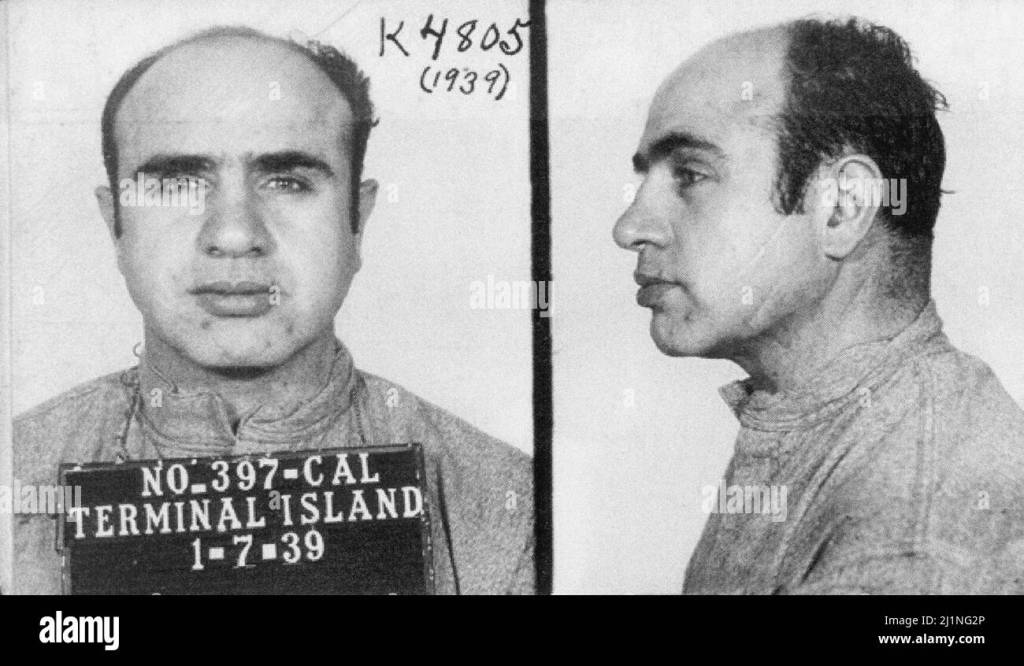
Alphonse Capone, most powerful of the gang chiefs of the bootleg era, no longer is in Alcatraz prison. Warden James A. Johnston today announced that he had been transferred to the federal correctional jail at Terminal Island, San Pedro, California. This is a jail where federal convicts are sent to serve their misdemeanor sentences. All that is known of his transfer trip is that he was moved by train from San Francisco. San Pedro is near Los Angeles and about 400 miles from Alcatraz, the gray penitentiary on “the rock” which houses the most dangerous of the government’s prisoners. “It was our job to get him there,” said the warden, “and he was removed secretly.”
Capone is suffering with paresis and is said at times to be violent. His term in the federal prison, with good behavior allowances, would expire on January 19, but he still has a year in jail to serve. It is expected that the government will use this added period in an attempt to cure him. If the maximum time off is allowed him at Terminal Island, he will be free by November 19. Found guilty of income tax evasion during the years of his great prosperity, Capone was sentenced to ten years in federal prison, an added year in jail and was fined $50,000. He began serving his prison sentence on May 4, 1932. His first stop was at the Atlanta prison the next day. He was moved to the grim confinement of Alcatraz in August of 1934.
Socialist union leader Tom Mooney is freed from San Quentin Prison. He had been jailed since 1916. Thomas J. Mooney was pardoned today by Governor Culbert L. Olson of California after serving twenty-two years in prison for the murder of ten persons in the bombing of the Preparedness Day Parade in San Francisco in 1916. Earlier in the day Mooney, now 56 years old, had been freed from San Quentin prison and had driven to Sacramento, accompanied by members of his family. Shortly before noon Olson, first Democratic governor of California in forty-four years and whose campaign platform included a promise to pardon Mooney, formally freed the prisoner in the state assembly chamber in a setting of movie cameras and microphones. “I am convinced,” Governor Olson said, “that Mooney is innocent, that he was convicted on perjured testimony and is entitled to pardon.” The governor also said he had received word from a former Mooney attorney that police and a private detective informed him they had shadowed Mooney the day of the bombing, and that there was no evidence he was connected with the crime.
House Democratic leaders today sought a compromise with Representative Martin Dies (D-Texas) who is asking for an appropriation of $150,000 to continue for two years his committee’s investigation into un-American activities. Speaker William B. Bankhead and Majority Leader Sam Rayburn called Dies into conference and told him they would agree to a continuance of the committee inquiry if Dies would consent to a one-year extension. An appropriation of $75,000 would be voted for the committee under this plan. The two leaders told Dies that the results of his investigation had caused the Democratic Party much harm in last November’s elections. Disclosures that members of the Communist Party and persons with communist leanings held key positions in the Roosevelt Administration caused the defeat of many a Democratic candidate and influenced thousands of voters, they reminded the committee chairman.
“All we want to do is keep the investigation out of the 1940 elections,” Bankhead and Rayburn told Dies. “Clean up the job this year and make your report next January. We don’t want hearings going on during the 1940 campaign. If you’ll do that, we’ll back your request for more funds.” Dies insisted that his committee would need two years to do a thorough job. It is believed, however, that eventually he will accept the compromise offer. It is believed the speaker and majority leader acted without consulting President Roosevelt. The President’s announcement yesterday that the Department of Justice was starting an investigation of communist, Nazi, and Fascist activities was regarded by political observers as a move to stifle the Dies committee inquiry. Foes of the committee were given thereby an argument against voting more money for a congressional investigation.
New York taxi drivers end their strike.
The National Association of Evangelists disagrees with Darwinism being taught in public schools.
One hundred U.S. ships are to pass through the heavily guarded Panama Canal on their way to maneuvers in the Atlantic.
Colonel Charles Lindbergh gives government officials a confidential report about German air strength.
President Franklin Roosevelt’s grandson is christened in the White House.
The shadow cast by the conflict in the Orient has fallen between the older and younger generations of Japanese in Hawaii. Some members of the younger generation disclosed recently that they had been kept in ignorance of the activities of their elders on behalf of Japanese soldiers fighting on the Chinese front. One of the motives of the elders in keeping quiet about their activities on behalf of the homeland, the youngsters said, was a desire to avoid “arguments” with their sons and daughters. The elders also were said to have sought to avoid incurring the enmity of Americans.
Nevertheless, some Japanese sources reported, the elders have accentuated this division of loyalties by fresh instances of active support of the homeland. The United States Securities and Exchange administration recently launched an inquiry into reports that 1,000,000 yen worth of Japanese emergency bonds were to be offered for sale in Hawaii without SEC registration, a legal requisite for such public offerings. One Japanese newspaperman reported that “gifts” of the Hawaiian Japanese to their government were “staggering.” He said rural Japanese on Oahu Island, on which Honolulu is situated, had donated money to buy seven heavy duty trucks for shipment to Japan. Chief sponsors of such projects, reliable sources said, were old time Japanese residents, recently arrived Japanese priests, and Japanese naval officers passing through Honolulu on tankers or other vessels.
Singer Marion Anderson performs at Carnegie Hall.
Mexico criticizes President Franklin Roosevelt’s desire to repeal the Neutrality Act, while Brazil praises the speech.
Japanese bombers attacked Chungking (today Chongqing), China during the day.
Japan attributes increased tension between Japan and the United States to President Roosevelt’s speech about aggressors.
Dow Jones Industrial Average: 151.54 (-1.33).
Born:
Prince Michael of Greece and Denmark, in Rome, Italy.
Bob Scarpitto, AFL flanker and punter (AFL Pro Bowl, 1966; San Diego Chargers, Denver Broncos, Boston Patriots), in Rahway, New York.
Andy Stynchula, NFL defensive end and defensive tackle (Washington Redskins, New York Giants, Baltimore Colts, Dallas Cowboys), in Greenwald, Pennsylvania (d. 1985).
Jim Hannan, MLB pitcher (Washington Senators, Detroit Tigers, Milwaukee Brewers), in Jersey City, New Jersey.
Naval Construction:
The Nihon Kaigun (Imperial Japanese Navy) Type B1 submarine I-21 is laid down by the Kawasaki shipyard (Kobe, Japan).
The U.S. Navy oiler USS Cimarron (AO-22), lead ship of her class of 8, is launched by the Sun Shipbuilding & Drydock Co. (Chester, Pennsylvania, U.S.A.).
The Kriegsmarine (German Navy) battleship Scharnhorst, lead ship of her class of 2, is commissioned. Her first commanding officer is Kapitän zur See (KzS) Otto Ciliax.

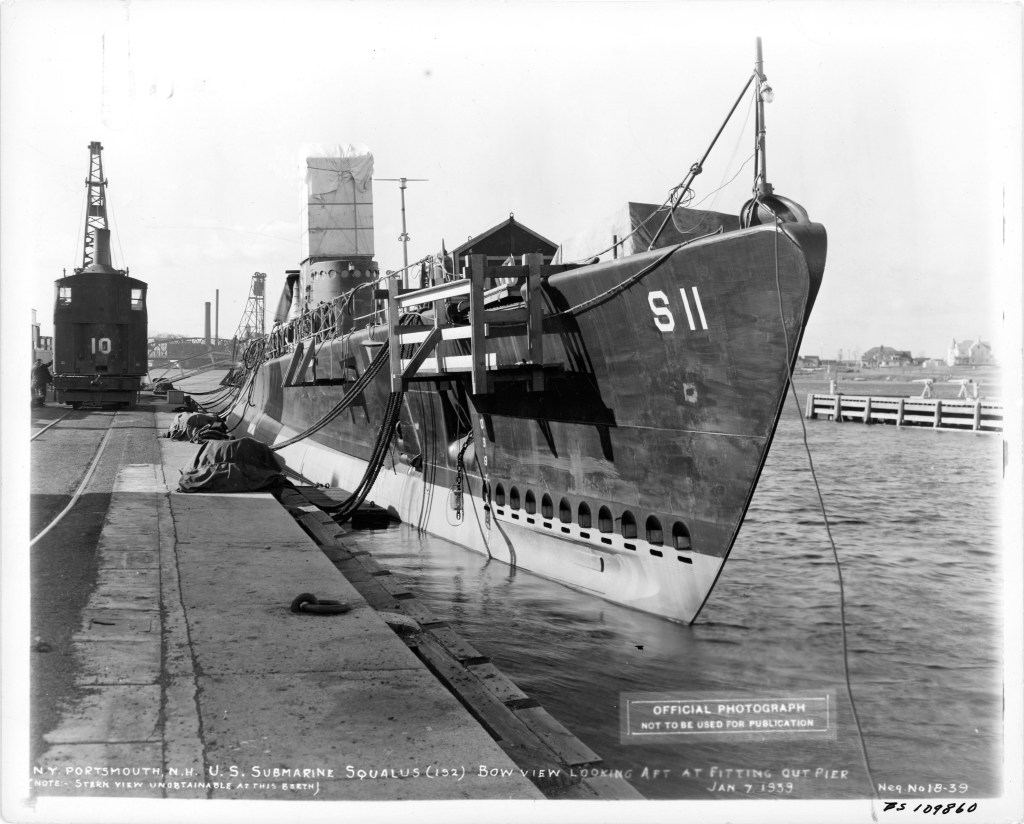
She is destined to suffer a disastrous accidental sinking — and one of the most remarkable rescue efforts in history.
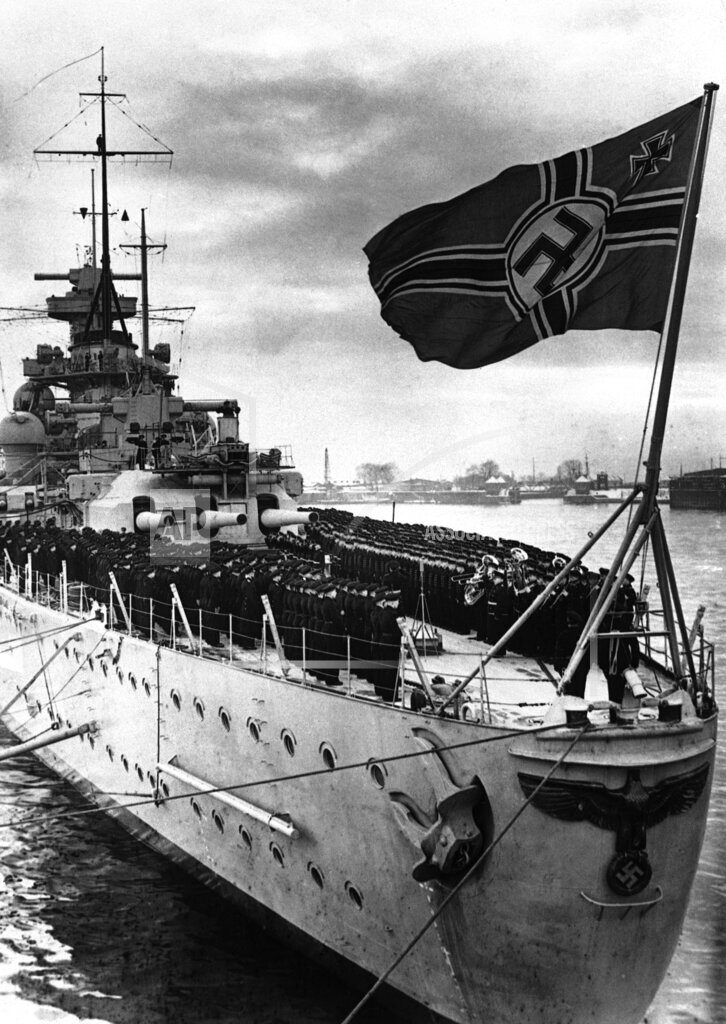
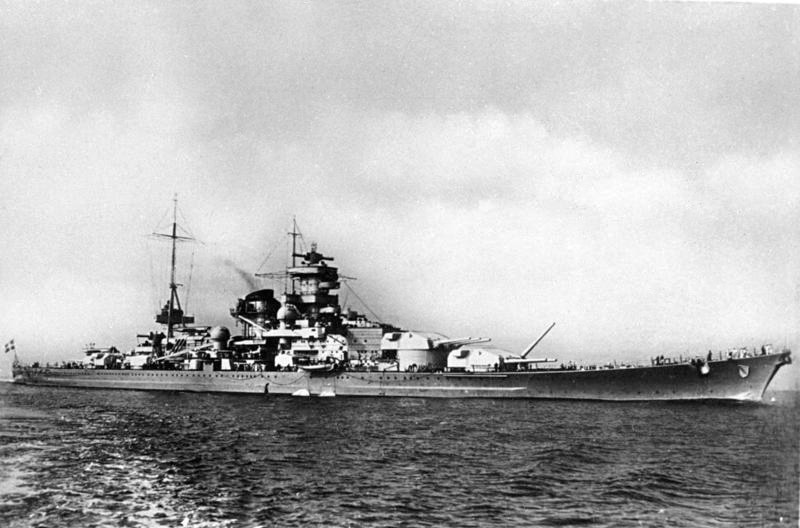
The battlecruiser Scharnhorst was commissioned early 1939, but returned to the shipyards in mid-1939 for a new main mast and a new bow that was more fitting for North Atlantic duties. Her first operation was a sweep into the Iceland-Faroes passage in November 1939 along with her sister ship Gneisenau; she sank the British Armed Merchant Cruiser HMS Rawalpindi. On 9 April 1940, the two sister battlecruisers engaged the British battlecruiser HMS Renown, but the engagement was inconclusive. Two months later, the pair sank the British carrier HMS Glorious and her escorting destroyers HMS Arcasta and HMS Ardent off Norway, but Scharnhorst incurred torpedo damage and was under repairs until late December 1940. As soon as her repairs were completed, she paired up with Gneisenau once again to raid the merchant shipping in the North Atlantic, but was turned back by heavy seas. She continued to participate in the raider role in early 1941, avoiding British capital ships and air power while preying on lightly escorted convoys in the North Atlantic off Iceland, Greenland, and Newfoundland. She ported in Brest on the French coast on 22 March after a successful run sinking 8 ships totaling 49,300 tons.
While in Brest, Scharnhorst and the other German ships were subjected to British air attacks, keeping her unavailable for operations until late 1941 or early 1942. In February 1942, she left Brest along with Gneisenau and heavy cruiser Prinz Eugen for Germany through the English Channel. Much to the embarrassment of the British, the ships were unable to stop the fleet; however, Scharnhorst and Gneisenau were damaged by mines.
Repair work and various troubles kept Scharnhorst in the shipyards until March 1943 when she left for Norway for training exercises. On 25 December 1943, she left port under the command of Rear Admiral Erich Bey to hunt down convoys JW.55B and RA.55A destined for northern Russian ports. With the aid of code breakers, British Admiralty learned of her approximate locations, and sent out a fleet to hunt her down. A force of three cruisers consisting of HMS Belfast, HMS Norfolk, and HMS Sheffield damaged Scharnhorst’s radar before Scharnhorst broke away from combat. That afternoon, British battleship HMS Duke of York and her escorts caught up with Scharnhorst and opened fire, damaging a turret and the hangar in the first round of battle, then caught up with Scharnhorst again for a second round, this time detonating Scharnhorst’s magazines. At 1820 another round from Duke of York destroyed a boiler room, reducing her speed to about 22 knots leaving her open to attacks from the destroyers. Scharnhorst was then chased by Duke of York, the cruiser HMS Jamaica, and the destroyers HMS Musketeer, HMS Matchless, HMS Opportune, and HMS Virago. After sustaining a series of attacks by gunfire and torpedoes, she sank at 1945 on 26 December 1943. Only 36 men survived. (WW2DB)
https://en.wikipedia.org/wiki/German_battleship_Scharnhorst#Service_history
 History Diaries