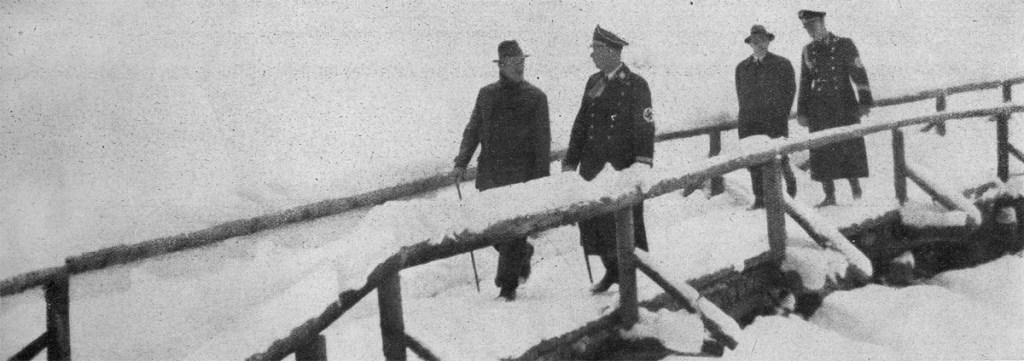
German Foreign Minister von Ribbentrop meets with Polish Foreign Minister Josef Beck in Munich to discuss the differences between the two countries. Von Ribbentrop proposes “the return of Danzig to Germany. In return, all of Poland’s economic interests in this region would be guaranteed, and most generously at that. Germany would be given access to her province of East Prussia by means of an extraterritorial highway and rail line. In return, Germany would guarantee the Corridor and the entire Polish status, in other words, a final and permanent recognition of each nation’s borders.”
Josef Beck replied: “For the first time I am pessimistic… Particularly in the matter of Danzig I see ‘no possibility of cooperation.’”
Polish-German diplomacy talks last three hours.
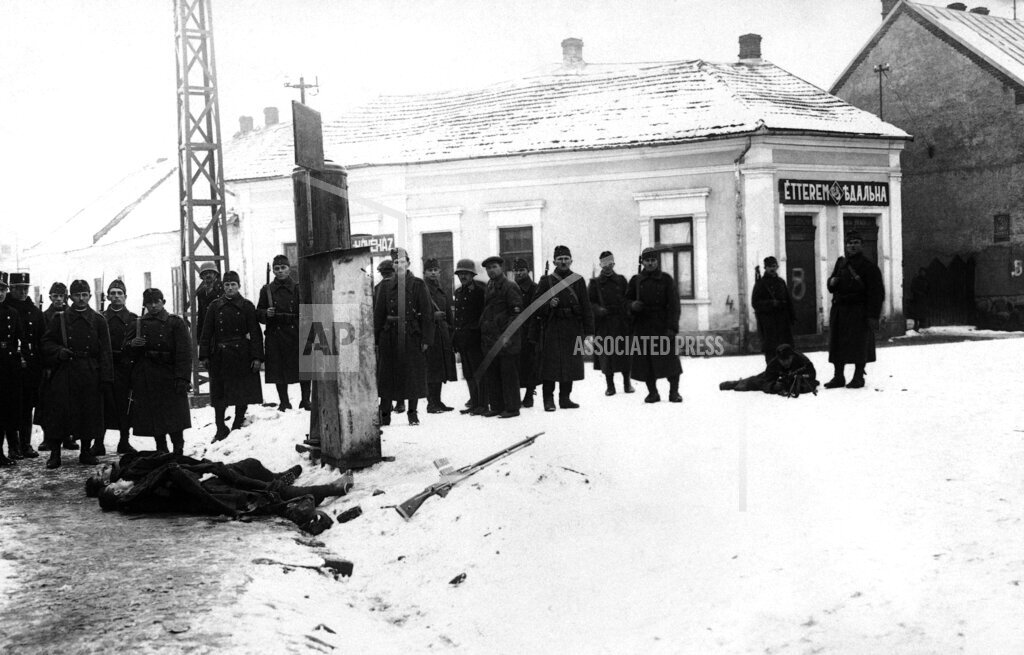
The Hungarian government tonight charged Czecho-Slovakia with invading Hungarian territory. The charge was made in a protest to Prague over a border battle in which machine guns, an armored car and even light artillery were said to have been used. The fighting, which aggravated the smoldering Czech-Hungarian quarrel, broke out this morning, in the neighborhood of Munkacs, a city of 30,000. Hungary acquired Munkacs on November 2 when Italian-German arbiters awarded 4,875 square miles of Czech territory to Hungary. Hungarian intelligence officers asserted they had evidence that Czecho-Slovak troops deliberately attacked Munkacs and the adjacent village of Orosveg, precipitating hostilities which were reported to have caused a dozen or more deaths.
A Czecho-Slovak army major had ordered two companies of the 36th Czecho-Slovak infantry regiment to attack Orosveg and Munkacs, the intelligence service charged. Budapest warned in its message delivered to Czech officials that “the Hungarian government holds the Czecho-Slovak government responsible for loss of life and property damage incurred. Hungary is obliged to take steps to assure prevention of a repetition of such surprises.” Fighting was started at 3:40 A.M. near Orosveg by Czecho-Slovak regulars and irregulars, and continued through the day, Hungarian sources said. Private reports tonight said a truce had been arranged by Czech and Hungarian officers. Hungarians said the “invaders” began shelling Munkacs, striking first a hotel, a motion picture theater and the municipal theater, and directed intermittent fire into the residential district this afternoon. At 4 P.M. Hungarian military authorities asserted the attackers had been repulsed.
The Czecho-Slovak version given in Prague was that Hungarian troops and “terrorists” provoked the clash and that it was on territory of the autonomous Czecho-Slovak province of Ruthenia (sub-Carpathian Russia) into which Hungarians were alleged to have crossed. Prague reported one Hungarian army officer was killed and several Czech gendarmes were seriously wounded. The Czecho-Slovak version said the fighting lasted eight hours. It was described as a local incident and a quick settlement was predicted. Munkacs formerly was in Ruthenia. The province juts east toward the Soviet Russian Ukraine, with Poland on the east and north and Hungary and Rumania on the south.
Hungary is considering a move to one political party.
Germany is disturbed by hints of economic sanctions by the United States; France and Britain are expected to follow the U.S. lead.
Italian Premier Benito Mussolini rejects a U.S. proposal to send Jewish refugees to Ethiopia; he suggests Russia, Brazil, or the United States.
The Spanish government reported tonight that its surprise offensive on the Estremadura front, in southwestern Spain, had shattered insurgent lines, and that the strategic town of Valsequillo had been recaptured. Valsequillo, about 200 miles southwest of Madrid and fifty miles northwest of Cordoba, was lost by the government a few months ago. It is a strategic communications center, where a north-south trunk railroad crosses four highways.
Shortly before midnight dispatches from Madrid said the almost equally important towns of Los Blasquez and La Granjuela, west and south of Valsequillo, were captured by the government. The attack now has swung to the south against Fuente Ovejuna, communications and manufacturing center of a rich mining area, these dispatches asserted. Since yesterday government troops reported they had recaptured all the territory lost in an insurgent drive last July, and in addition had penetrated several miles behind the line from which the insurgents began that drive. Despite reinforcements rushed in by the insurgents, said dispatches to the border, the government advance was spreading out fanlike along the border of Badajoz province. The insurgents’ two main lines of trenches were reported to be in government hands for a distance of many miles on each side of Valsequillo.
Loyalist forces apparently had succeeded, at least momentarily, in their objective of halting the insurgent campaign in Catalonia, at the opposite corner of the country. After hard won gains during the last thirteen days, the insurgents reported but little progress in the northeast. Dispatches from the headquarters of General Francisco Franco, rebel commander in chief, emphasized the strength of the government army and the difficulty of the next phase of operations. The government was reported moving up reinforcements to a new mountain defense line northwest of Borjas Blancas, which was captured by the insurgents yesterday. Military reports told of troop trains moving from the Madrid sector in central Spain to the coast, from where troops were shipped to Catalonia.
British Prime Minister Neville Chamberlain applauds Roosevelt’s State of the Union speech.
It is anticipated that President Franklin Roosevelt will present a $1.3 billion defense budget, the largest ever in peacetime.
President Franklin Roosevelt suggests new taxes to cover a $9 billion budget.
The national debt reaches nearly $45 billion.
Sixty-one percent of Americans polled say the New Deal is costing too much.
President Roosevelt’s new attorney general, Frank Murphy, through the agency of the Justice Department, has started an investigation of alleged violations of criminal laws by communist, Nazi, and other organizations. This was revealed today by the President at a press conference. Representative Martin Dies (D-Texas), chairman of the House committee investigating un-American activities, when apprised of this statement, said the investigation is “recognition of the fact that they are now taking seriously what they previously tried to laugh off.” “They thought they could ridicule our committee and our investigation,” he continued, “but now it is proved by their own acts that they are finally recognizing the public sentiment against the situations brought out by our hearings.”
The chairman has asked for $150,000 to continue the committee investigation for two more years. He disclosed that he had personal assurances from 100 Democratic colleagues that they would vote to continue the investigation with adequate funds. With the 170 Republican votes expected to go solidly for continuance of the investigation which has traced communistic inroads into administration ranks, the special committee would have sufficient votes to override administration opposition. Dies acknowledged that he had heard reports that a move might be made to hamstring the committee by voting an appropriation so small that it would be unable to carry on its work. He said he was certain that he had sufficient strength pledged to block such an administration strategy.
It is no secret that President Roosevelt has advised his leaders that he does not want Dies to continue the inquiry, which was partly responsible for the Democratic defeat in the November election. It was reported that the leaders, who will not admit having received White House instructions, informed the President that it will be impossible to block the continuance of the committee.
There were indications in the Senate today that careful consideration will be given to the batch of nominations received yesterday from President Roosevelt. Committee members said they were mindful of the lesson learned in rushing through the confirmation of Senator Hugo L. Black for the Supreme Court, without investigating the charge, later admitted, that he had been a member of the Ku Klux Klan. A sub-committee of the judiciary committee will begin hearings tomorrow on the nomination of Felix Frankfurter, Harvard law professor, White House adviser and purveyor of New Deal legal talent, to be an associate justice of the Supreme Court. The Commerce Committee on Monday will begin consideration of the recess appointment of Harry L. Hopkins, former WPA administrator, as secretary of commerce.
No plans have been made for consideration of the other major nominations pending — Frank Murphy, defeated New Deal governor of Michigan, for attorney general of the United States, and James P. Pope, defeated New Deal yes man of Idaho, for the board of the Tennessee Valley Authority. Members of the sub-committee on the Frankfurter nomination, headed by Senator Matthew M. Neely (D-West Virginia) said they would hear all witnesses that wanted to be heard and did not expect to make a report to the full committee before late next week. So far, there has been no disposition to call Frankfurter before the committee. Although the public comment on the nomination has been favorable, many conservative Democrats and Republicans have remained silent, refusing to commit themselves until hearing from the country. The conservatives were gratified by Professor Frankfurter’s refusal to endorse President Roosevelt’s proposal to pack the Supreme Court, but they have some misgivings about his theories of government by commission and constitutional amendment by judicial interpretation.
Naval cooperation between the United States and Britain is seen as a key to peace.
Bad weather delays further exploration of the Antarctic interior.
Blue Note Jazz record label is founded in New York with 50 pressings of the “Boogie Woogie Stomp,” by Alfred Lion and Mead Lux Lewis.
Pitcher Dizzy Dean signs a contract with the Chicago Cubs.
A commemorative service is held to honor Theodore Roosevelt on the 20th anniversary of his death tomorrow.
The Lima Consul General denies spying on U.S. news reporters at the Pan-American Conference.
Chinese sources reported today their forces had launched a series of counterattacks against Japanese attempting to cross the Yellow River into Shensi province in northern China from Shansi province bases. The Chinese asserted they had recaptured Taning, former Chinese Shansi province headquarters, and frustrated several Japanese efforts to reach the west bank of the stream.
China has sufficient munitions stored to last two years and does not fear a shortage of essential war supplies, General Pai Chung-kai said today. He is deputy chief of the Chinese general staff and commander of General Chiang Kai-shek’s headquarters in this town of southern China. General Pai expressed confidence in China’s ultimate victory in the war against Japan. He predicted that China would outlast Japan militarily and economically. The American and British tendency to support China — shown by recent credit grants — eventually will lead to the application of sanctions against Japan, he believes.
Increased friction between the United States and Japan as a result of President Roosevelt’s annual message to congress and the big American arms program was predicted today by the influential newspaper Tokyo Asahi. “The Japanese believe that Japan is one of the targets” of United States preparedness plans, the Asahi said. “The United States turns from good neighborliness to antagonism toward the totalitarian states,” the paper continued.
The Japanese Premier is considering the abolishment of the inner Cabinet, but states this is not a move toward a one-party political system.
Dow Jones Industrial Average: 152.87 (-0.31).
Born:
Murray Rose, Australian Olympic swimmer (Olympics, 4 gold medals, 1 silver, 1 bronze, 1956, 1960), in Birmingham, England, United Kingdom (d. 2012).
Charlie Rieves, AFL linebacker (Oakland Raiders, Houston Oilers), in Stuttgart, Arkansas.

 History Diaries