
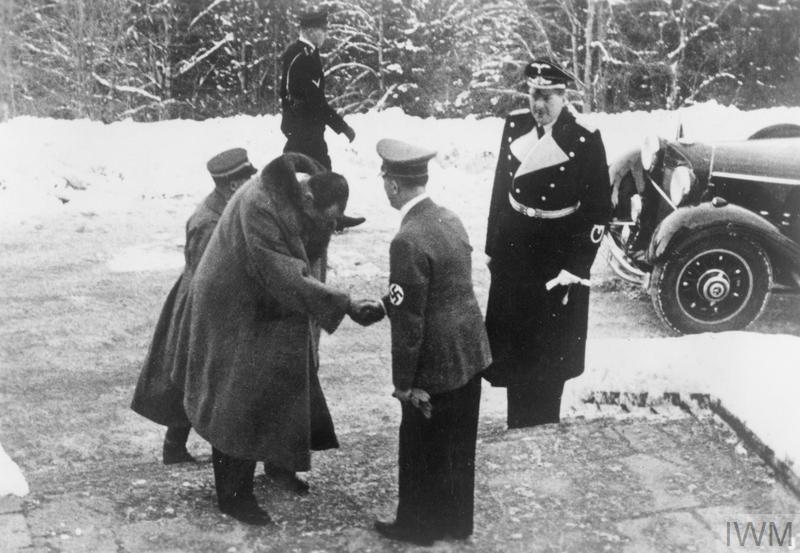
Hitler met Polish Foreign Minister Józef Beck at Berchtesgaden in southern Germany and, in a friendly manner, mentioned that Danzig was German, and it was in his interest to one day see it return within German borders.
The Polish government is courting diplomatic relationships with Germany and Italy.
Hitler says he is considering a formula that would make Danzig politically German and economically Polish, and that he is ready to give a formal and clear guarantee for the German-Polish frontiers.
Julius Streicher addresses the Nazi block wardens in Nuremberg: “I am happy to have opportunity to thank you at the beginning of the year. You all are part of the reason why we live today in a great German Reich, of which one speaks as if it were a miracle. We are entering a new year in which new miracles will happen if we all serve the Führer and people as we have before… I feel that we have already made a good beginning to the year 1939 and I also feel that good things will happen. The best thing we can do to please the Führer is to assure him: ‘Führer, we will follow you!’”
Spanish loyalists claim to still hold key territory. Success in a surprise offensive in southwestern Spain was claimed by government troops tonight after the rebel campaign in the northeast had rolled through Borjas Blancas, the second important rebel goal to fall in two days. Dispatches from Valencia and Madrid said rebel forces were in full retreat in the Valsequillo sector of Estremadura and had lost thousands of dead and prisoners in a battle that began shortly after dawn. At the same time the rebels were conquering Borjas Blancas, the southern key to the government defense lines in Catalonia.
The Madrid and Valencia reports said the entire Noria chain of mountains had been captured and that the railroad line from Cabeza del Buey, 140 miles southwest of Madrid, to Belmez had been cut. Rebel resistance in the Noria Mountains had collapsed, the government reported, when militiamen captured the strategic town of Papuido after six hours of hand-to-hand fighting. The government attack in the southwest, designed to offset General Francisco Franco’s gains in Catalonia, hit the rebels on one of their weakest fronts, from which it had been reported Franco had withdrawn large numbers of troops for the offensive against Barcelona. The tactics were a repetition of those by which the government halted Franco’s drive on Valencia late last summer. Then, an equally surprising government attack on Gandesa forced Franco to abandon a campaign against Valencia to clean out a pocket on the Ebro River.
The rebel command reported that it had followed up the occupation yesterday of Artesa, 65 miles northwest of Barcelona and heart of a highway network, with the conquest of Borjas Blancas, 75 miles west of Barcelona. From the lower Segre River, the jumping off point of the offensive that started on December 23, Franco has thus driven three salients eastward — 10 miles to Artesa, 16 miles to Borjas Blancas, and 12 miles to Vinebre.
An attempt is made to create an “all party” system in Britain, with the main goal of peace and unity.
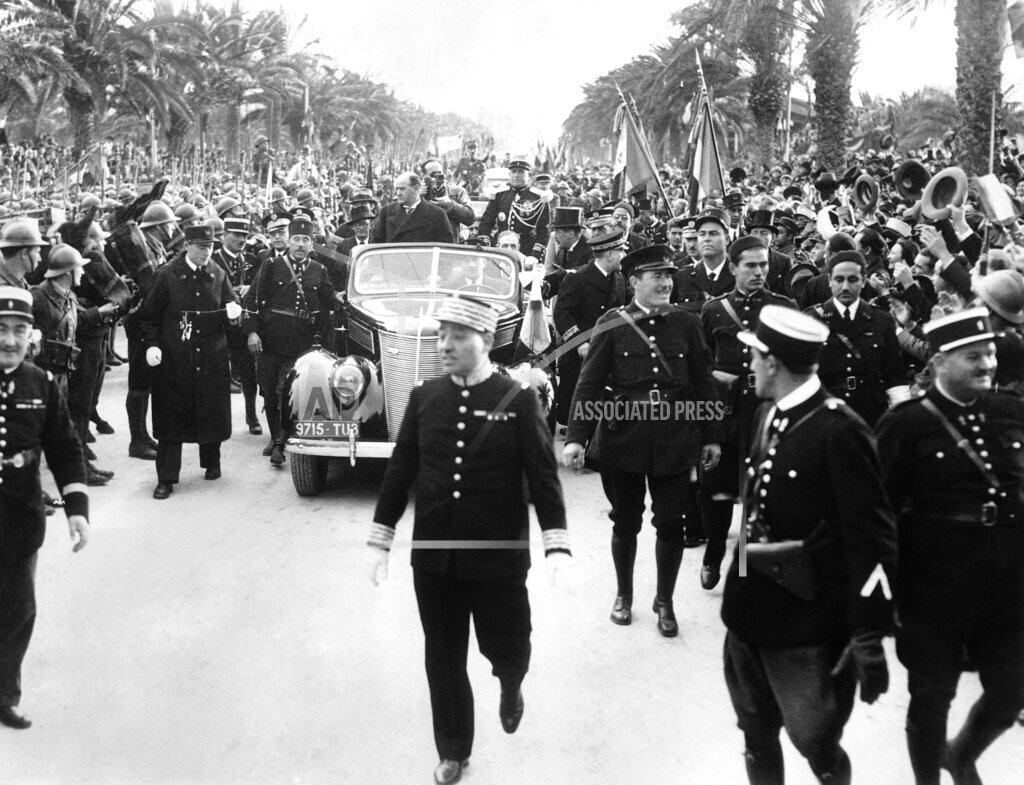
French Premier Edouard Daladier reviews the defense line along the North African border of French territories.
Premier Mussolini has turned down a proposal from President Roosevelt that he throw Ethiopia open to Jewish immigrants from Italy and other European countries, it was learned today. The proposal was submitted to Il Duce Tuesday by William Phillips, United States ambassador, in an hour’s conference. Mussolini not only refused to discuss the question, but refused to take up the matter with Reichsführer Hitler. The President’s proposal was contained in a letter which Phillips brought back to Italy upon his return from a visit to the United States, and which he presented to Il Duce in their conference. As explained verbally by Phillips, the proposal did not contain a specific solution, but submitted certain suggestions, leaving to Mussolini the means of carrying them out.
Sweden and Finland attempt to fortify the Aland islands against German or Russian invasion.
Palestine, Canada, and South American countries are to receive 10,000 non-Aryan refugees; funds come, in part, from Britain.
The King of Saudi Arabia sees no Middle East peace until Arabs obtain rights; he blames Jewish propaganda for the U.S. perception of the situation.
President Franklin Roosevelt warns Congress about slashing the budget, citing the importance of national defense and reduction of unemployment. President Roosevelt’s 10-billion-dollar budget for the 1940 fiscal year, Uncle Sam’s tenth year in the red, was received by congress today and greeted with derision by the Republicans and silence by the Democrats. With debt retirement and reimbursable postal expenditures excluded, the President calculated total expenditures at $9,496,329,000 and the deficit at $3,972,259,000 for the fiscal year 1939. For 1940 he estimated expenditures at $8,995,663,200 and the deficit at $3,326,343,200. With debt, postal and probable supplemental items included total outgo will be $10,190,311,483. According to these figures the public debt will stand at $41 billion June 30 next and $44½ billions June 30, 1940.
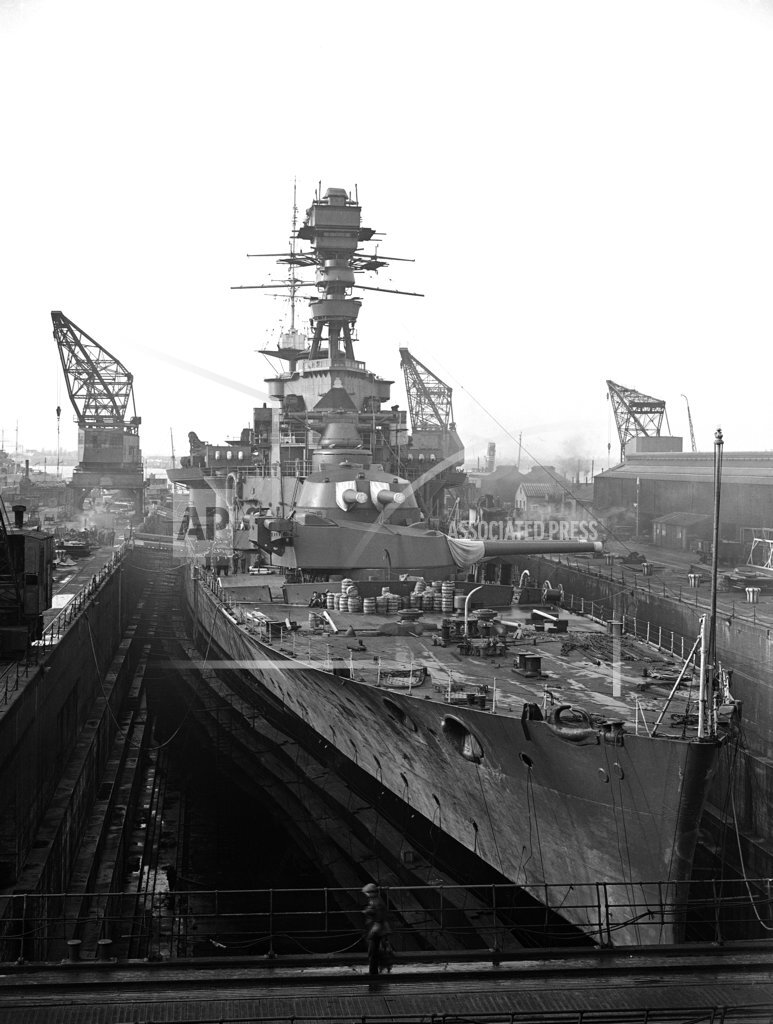
President Franklin Roosevelt reports the Navy needs an additional $36.5 million for ships and ordnance.
President Roosevelt today nominated Felix Frankfurter, a Harvard law school professor, to be an associate justice of the United States Supreme Court. The nomination found little enthusiasm among conservative Democrats and Republicans when it reached the senate. The prevailing opinion, however, is that Frankfurter will be confirmed. The nomination of Prof. Frankfurter, sponsor of more than 100 New Deal lawyers and “brain trusters” whom General Hugh S. Johnson calls “the happy hot dogs,” was transmitted to the senate with a long list of recess appointments previously announced and other new appointments, including that of former Senator James P. Pope (D-Idaho) to the board of directors of the Tennessee Valley Authority. Frankfurter’s nomination for the Supreme Court vacancy, to succeed the late Justice Benjamin N. Cardozo, surprised many senators, who believed that a western man would receive the next appointment.
President Franklin Roosevelt hints at support for economic sanctions for aggressors; Japan may be the first target.
Roosevelt wishes to see Neutrality Act legislation revoked.
President Roosevelt has asked his congressional leaders to block the request of Representative Martin Dies (D-Texas) for $150,000 to continue for two more years his investigation of un-American activities, it was reliably reported today. He was told that it could not be done. According to the same report, the President then suggested that the senate’s Civil Liberties Committee be provided more funds so that it could “blanket” the Dies investigation. The reply to this suggestion was that the Senate was not inclined to set aside another cent to this committee, headed by Senator Robert M. La Follette.
Roosevelt and two members of his cabinet, Secretaries Harold L. Ickes and Frances Perkins, have been sharply critical of the Dies committee and Representative Dies in return has repeatedly assailed the two cabinet officers and complained that the President’s criticisms came from “misinformation.” The congressional leaders told the President, it is asserted, that returning members have reported the Dies investigation has attracted widespread interest and approval throughout the country and that they feel it would be politically dangerous for them to vote against the Texas Democrat’s proposal to continue it. Dies today voiced the same opinion. He said that a careful survey of members at the recent Democratic caucuses had brought almost unanimous expressions of approval of his proposal to continue the investigations for two more years. Some members, he said, reported that the only pledges they made in their campaigns were that they would vote for such continuance. Many, he added, wanted approval of his resolution as soon as possible so they would be relieved of the job of answering letters urging such action.
Congress sharply divides along party lines in response to President Roosevelt’s State of the Union speech.
Republican presidential candidate Thomas Dewey calls 1940 the Year of the Republican. The New York governor urges a wire-tapping ban.
Concern rises over drought in the Wheat Belt.
The administrator of veterans’ affairs reports that veterans need jobs and hospital care, not pensions.
The former secretary of commerce, Daniel Roper, denies using a government boat for pleasure.
After she had been missing for 18 months, Judge Clarence Elliot Craig of the Superior Court of the County of Los Angeles County declared Amelia Mary Earhart legally dead in absentia, at the request of her husband, George Palmer Putnam II. She and navigator Fred Noonan disappeared while enroute from Lae, Territory of New Guinea, to Howland Island in the Central Pacific, 2 July 1937.
The family of Al Capone pays the majority of his outstanding fines in hope of a timely release from Alcatraz Prison.
The term of El Salvador’s presidency is extended six years with the support of the Nazi and fascist regimes.
Congress grants the former president of Chile the right to leave the country, despite protests of the Chilean Nazi party. Chile is at social, political, and economic crossroads, attempting to modernize and industrialize.
Fighting between China and Japan continues. Japanese and Chinese forces were disclosed by delayed dispatches reaching here today to have been locked in bitter fighting for days in a vast semi-circle along the Hupeh-Honan border roughly 100 miles northeast of Hankow. It was reported that large Chinese army units were scattered through the Tapieh Mountains opposing Japanese efforts to widen the strip they hold along the north bank of the Yangtze River. Daily and nightly skirmishes and battles are going on along an irregular line, extending all the way from Hwangmei, about 135 miles east of Hankow, to Loshan, 120 miles north of Pankow. At some points the line is only a few miles from the Yangtze.
Chinese advances are made in railway and highway construction.
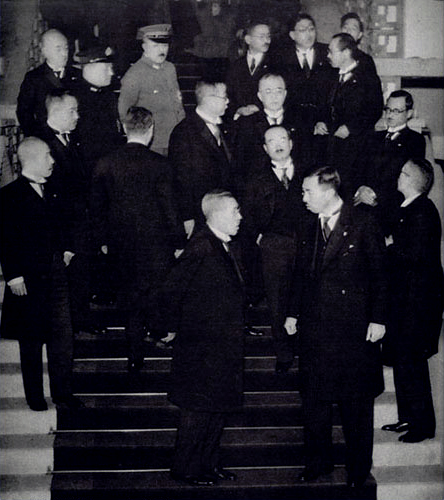
Baron Kiichiro Hiranuma is confirmed as the new Premier of Japan; the Cabinet remains much the same. The new Japanese Premier is called the “Hitler of Japan.” Kiichiro Hiranuma became the 35th Prime Minister of Japan. The Japanese army “will make every effort to achieve its objectives in China,” War Minister Lieutenant General Seishiro Itagaki declared tonight immediately after the new cabinet of Premier Baron Kiichiro Hiranuma was installed by Emperor Hirohito. Premier Hiranuma issued a statement saying “the nation is facing a situation of unprecedented difficulties and all the national energies will be devoted to attainment of the objectives of our crusade.”
The “objectives” are the bases of the Japanese plan for a “New Order in East Asia.” The objectives include the continued occupation of principal cities in China, the establishment of a Chinese government cooperating with Japan, and an alliance of China, Japan, and Manchukuo. Baron Hiranuma completed his cabinet with only four new ministers, retaining all key ministers of the old cabinet except Seihin Ikeda, who was finance minister, and Admiral Nobumasa Suetsugu, who was home minister. Prince Fumimaro Konoe, who headed the outgoing cabinet, was retained as minister without portfolio and was made president of the privy council, the post which Hiranuma held before becoming premier.
Hachiro Arita stepped down as the Minister of Foreign Affairs in Tokyo.
Dow Jones Industrial Average: 153.18 (-1.67).
Born:
Bridget Parker, British equestrian 3-day event (Team Olympic gold, 1972), in Northumberland, Great Britain, United Kingdom.
Naval Construction:
The Royal Navy Dido-class light cruiser HMS Cleopatra (33) is laid down by Hawthorn Leslie & Co. (Hebburn-on-Tyne, U.K.).
The Koninklijke Marine (Royal Netherlands Navy) sloop HrMs (HNMS) Van Kinsbergen (U 93) is launched by Rotterdamsche Droogdok Maatschappij, (Rotterdam, Holland).
 History Diaries