
The Soviet Union ridiculed Aleksandr Solzhenitsyn’s new expose of the Soviet prison system as a “blanket slander of the Soviet people,” born of the author’s “impotent rage” against Communist achievements. In the first authoritative Soviet comment on Mr. Solzhenitsyn’s “Gulag Archipelago,” the official Soviet press agency gave no hint of what actions might be taken against the author or the book’s foreign publishers.
Secretary of State Kissinger and Israel’s Defense Minister, Moshe Dayan, will meet in Washington on Friday, with the administration reasonably certain that the results of the Israeli parliamentary election, in which the governing Labor party lost about five seats, will not impede the Geneva peace talks. Mr. Dayan is also expected to talk with the Pentagon officials about military supplies for Israel.
Israel and Egypt announced that they had reached an “important stage” in their secret negotiations on disengagement of their forces along the Suez Canal front. The one-sentence report issued after the day’s session in Geneva shed no light on the issues being discussed by the military working group, which is scheduled to renew the talks on disengagement Friday.
Carlos Arias Navarro was sworn in as Prime Minister of Spain, having been appointed to the position after the December 20 assassination of Luis Carrero Blanco. Mr. Arias, 65 years old, former director of security and Mayor of Madrid, knelt before the Chief of State, Generalissimo Francisco Franco, and swore allegiance to the fundamental laws and the principles of the National Movement, the only political organization permitted in Spain. The ceremony took place at General Franco’s Pardo Palace on the outskirts of Madrid. Highly placed sources said that Mr. Arias would name his government very soon and that he would make major changes in the make‐up of the Cabinet.
Basque militants charged today that the French Government had “once more given in to blackmail from Madrid” by banishing six Spanish Basque refugees to forced residence in the north of France, far from the Spanish border. Basque circles said none of the six belonged to the Basque guerrilla organization known as E.T.A., which the Spanish authorities believe assassinated Admiral Carrero Blanco. One of the movement’s founders, Juan Jose Echave, 36 years old, was among those seized yesterday. He has said that he withdrew publicly from E.T.A. two years ago. Mr. Echave, who was at first assigned to live in Amiens, was finally taken late today to police headquarters in Montdidier.
A half-dozen bombs exploded across Northern Ireland in what police said could be the start of major terror campaigns by rival Roman Catholic and Protestant extremist underground forces. No one was hurt in any of the explosions. In Dublin, the Irish government announced that a person accused of murder in Northern Ireland could now be tried for the crime in the Irish Republic and vice versa. The action, which is not retroactive, was seen as foreshadowing a big push against the violent Provisional wing of the Irish Republican Army in the republic.
The British are holding five Americans who are suspected of being involved in an international arms ring. The five are part of a pro-Arab terrorist group.
French President Georges Pompidou, on receiving the credentials for Australia’s new ambassador, David Anderson, said that France would pursue nuclear testing in the South Pacific. But he told Anderson that he hoped the two countries would renew their friendship and cooperation. In asking for understanding of France’s interests in nuclear testing, Pompidou said, “I am sure that in such a climate, our relations will develop again very rapidly and in a very favorable manner.”
A record number of Jews were allowed to emigrate from the Soviet Union last year. Communist party leader Leonid Brezhnev allowed the increased emigration in return for trade benefits from the United States.
The Xinhua News Agency of the People’s Republic of China announced the sudden reassignment of eight of the 11 commanders of its military regions, in an apparent attempt to remove them from the power bases and networks that they had built over the years. General Xu Shiyou was moved from the Nanjing region to Guangzhou, while Guangzhou’s General Ting Sheng was moved to Nanjing. Chen Hsi-lien was moved from Manchuria to Beijing and replaced by Li Desheng, a Politburo member.
Japanese Foreign Minister Masayoshi Ohira left Tokyo for a four-day visit to Peking where he will sign a new Sino-Japanese trade treaty and attempt to unsnarl negotiations for air service between the two countries. The pact will be the first practical agreement concluded between the two nations since they restored diplomatic relations in September, 1972. Ohira will confer with Chinese Premier Chou En-lai and Foreign Minister Chi Peng-fei.
A South Korean army sergeant who shot up a tearoom in Taegu and killed two men and wounded two, surrendered, national police said. Reports said the soldier went on a rampage apparently because of a grudge against the commander of the military battalion to which he is assigned. After the shootings he held 30 persons hostage for 22 hours before giving up.
Scores of people were trapped in elevators in Singapore, cinemas were closed, traffic jams built up, and many families ate by candlelight as the island experienced one of its worst power blackouts since World War II. The public utilities board said the blackout was caused by a faulty cable at a power station, affecting about 90% of the island.
Prime Minister Indira Gandhi of India was jeered by a crowd of 300,000 as she tried to give a speech in the city of Nagpur defending her economic policies. Shoes were thrown at her amid cries of “bring down the prices.” In the town of Wani, police fired on a mob during a one-day general strike against inflation, killing six persons and wounding six. In Bombay, a strike protesting high prices halted the city’s transportation system and closed businesses and schools.
The American-owned oil rig Transocean III sank in the North Sea, 100 miles (160 km) east of the Orkney Islands, shortly after midnight on the morning of January 2. All 56 crew members were rescued.
The crippled Transworld 61, the second North Sea oil rig to run into difficulties off the coast of Scotland in 24 hours, was being towed to Stavanger, Norway, with 14 of its crewmen still aboard. Transworld 61, was reported by the Aberdeen coast guard to have sustained structural damage to two of its legs. Forty-eight crewmen were transferred to a supply ship from the rig. The crew members aboard the crippled rig were not reported in any immediate danger.
A major earthquake shook northern Chile, destroying some buildings in Calama and injuring three persons. The tremor had a force of 8 on the Richter scale, the Seismological Institute of the University of Chile said. Although the quake would have brought major disaster to a populated area, it was centered in a remote Andes Mountain area of Antofagasta province on the Bolivian border. Calama was the only populated center affected, reports said.
Trinidad’s Royal Jail was seriously damaged by a fire started by prisoners. Several firemen were attacked while fighting the blaze, the chief fire officer reported. No escapes or serious injuries were reported. The prison was estimated to be 80% destroyed, necessitating the transfer of all prisoners to other jails.
The worst fire in Argentina’s history destroyed 1.2 million acres of pampas. 3,000 square miles of the lowland’s rich brushland was burned. Every resident between 15 and 50 years old was called upon to help control the fire.
On their 48th day of spaceflight, the Skylab 4 crew held a televised news conference while in Earth orbit, during which astronaut William Pogue said that he tried too hard to do a good job in the early phases of the mission, but then “finally came to the realization that I’m a fallible human being”. Mission commander Gerald Carr said that he missed drinking cold beer while watching football. Astronaut Edward Gibson said that he was pleased to be contributing to science.
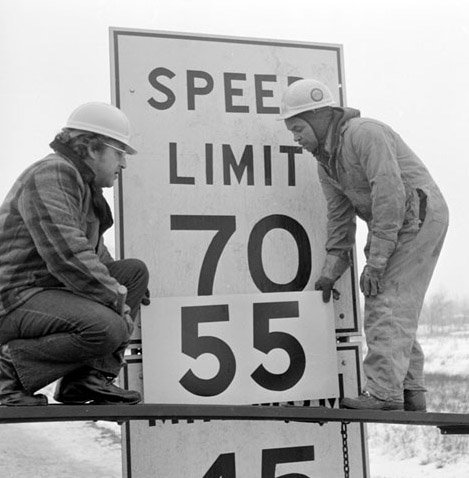
The maximum speed limit on U.S. highways was lowered to 55 miles per hour (89 km/h), a limit that would remain in effect for the next 13 years, in order to conserve gasoline during the OPEC embargo. The decrease in the speed limit (which had been 70 miles per hour (110 km/h)) was made as U.S. President Richard Nixon signed the National Maximum Speed Law. The result was a 23 percent decrease in fatalities on American highways with 853 fewer deaths in January 1974 compared to January 1973.
The Internal Revenue Service announced that it was re-examining President Nixon’s income tax returns but did not say which years were being covered by the audit. The disclosure, authorized by the President, left unclear whether the I.R.S. would examine the return for 1969. That was the year that the President claimed that he made a gift to the nation of his Vice-Presidential papers valued at $576,000.
President Nixon signed a bill that would withhold federal highway funds from states that do not reduce speed limits to 55 miles an hour and added his signature to the Regional Rail Reorganization Act, which provides federal financing to consolidate seven major bankrupt railroads in the Northeast and Middle West. In signing the speed limit bill, Mr. Nixon estimated that a 55-mile-an-hour speed limit on the nation’s highways would save “nearly 200,000 barrels” of fuel a day.
Watergate conspirator E. Howard Hunt has been released from prison pending the outcome of his appeal. Hunt thanked the courts, his lawyers and the general public for their support. Watergate burglar Bernard Barker will be released soon on the same basis. The former Central Intelligence Agency operative, who pleaded guilty a year ago to helping plan the bugging of the Democratic party headquarters here, was ordered freed last Friday by the United States Court of Appeals for the District of Columbia pending action on his request that his plea be withdrawn and the case against him be dismissed.
In its first survey of the effects of the fuel shortage on its nationwide rail system, Amtrak reported a sharp increase in patronage in the last weeks of 1973, with the gains on many routes growing week by week. Compared to a similar five-week period in 1972, Amtrak said, Metroliner passengers increased 30 percent, the New York-Boston run 37 percent and the New York-Florida run 26 percent.
American Airlines said it would ground ten of its sixteen Boeing 747 jumbo jets beginning Monday because of the fuel shortage, and Trans World Airlines said it would take two of its nineteen 747’s out of service the same day. The groundings will make a total of sixteen 747’s that have been withdrawn from service along with dozens of smaller planes since the emergence of the fuel crisis.
President Nixon signed bill a consolidating seven bankrupt railroads, with government money backing the plan. Transportation Secretary Claude Brinegar stated that rail service will be improved greatly as a result. However, labor problems may remain.
William E. Simon, the Federal energy chief, would like to consolidate in his new agency the energy research mission that the White House believes should be assigned to a new, independent agency. The White House, according to well‐placed sources, continues to prefer an independent energy research and development administration, a proposal approved by the House last month. One issue implicit in the status of energy research is the role of nuclear power in the Government’s slowly emerging strategy for making the United States substantially self‐reliant in energy. A number of analysts believe that nuclear power would get more money and attention in separate agency. As proposed by the White House, the new agency would be organized around the research elements of the atomic energy commission.
The Federal Reserve Board reduced the margin requirement for stock purchases from 65 to 50 percent, thus allowing investors to borrow as much as half the cost of buying securities. In announcing the action, the board cited the “sharp reduction” in stock market borrowing, which declined to $5.5 billion as of Nov. 30 from a peak of $7.9 billion in December, 1972. Margin requirements were raised from 55 to 65 percent in November, 1972.
Amoco raised its gasoline prices today, as did Sunoco. Home heating oil and diesel fuel will soon see price hikes also.
The Food and Drug Administration is planning to require certification of each batch of an important heart drug because some samples have not met acceptable standards in the rate at which the drug dissolves. The drug, digoxin, is used by an estimated 3.5 million Americans a year to produce a stronger heartbeat, but some of the pills have been found to take too long to dissolve.
The monthly food market reports follow: In Chicago, the cost of meat and dairy products has soared. Groceries which last March cost $19.99 are now $23.93. In Los Angeles, fruits and vegetables are up. A $20.00 basket of groceries last March now costs $21.78. In Atlanta, many grocery prices have increased. Items which added up to $20.00 last March now cost $22.58. In New York City, a basket of goods which were priced at $20.01 last March is now up to $20.99.
The first Supplemental Security Income (SSI) checks were mailed under the program in the United States to compensate impoverished persons who had been unable to work because of disability but who did not qualify for Social Security disability. The law authorizing SSI had come into effect on January 1.
Coleman Young was sworn in as the first African-American mayor of the U.S. city of Detroit. In his inaugural speech, he warned criminals to “hit the road”.
In the New England Journal of Medicine, two pediatricians reported 43 infants were allowed to die at Yale University’s hospital in New Haven because of deformities. At that hospital, doctors and parents decide if a child is too deformed to lead even a partially-normal life. Modern technology contributes to the problem of a deformed infant by sustaining the lives of “nature’s accidents”. One mother described the suffering and pain of her deformed child who was not allowed to die; at 10 months, the baby finally died.
Tex Ritter, the country music star, died of a heart attack in Nashville tonight. The 67-year-old singer, guitar player, actor and politician was visiting a friend at the county jail when he was stricken. The police administered oxygen and rushed him to the Baptist Hospital, where he died. Only three weeks ago, the country and Western entertainer went to Washington to present a special recording to President Nixon. It was an album composed of speeches by the President with narration by Mr. Ritter. There were only two copies of the album. The second was given to the Country Music Hall of Fame here.
Former Los Angeles Dodger bonus baby Dennis Daboll, 27, dies during a solo climb in the Grand Canyon. Caught in a blizzard, he slips off the trail and falls to his death. Daboll was on the L.A. roster in early 1965, but was optioned out before appearing in a game. He was then in the system of the Reds and the Cards and was out of baseball by age 24.
Dow Jones Industrial Average: 855.32 (+4.46, +0.52%).
Born:
Juha Lind, Finnish national team and NHL centre and left wing (Olympics-Finland, Bronze Medal, 1998; 6th, 2002; Dallas Stars, Montreal Canadiens), in Helsinki, Finland.
Ratcliff Thomas, NFL linebacker (Indianapolis Colts), in Alexandria, Virginia.
Ludmila Formanová, Czech middle-distance runner, 1999 world champion in the 800-meter run; in Čáslav, Czechoslovakia.
Slavko Duščak, Slovenian basketball player and coach, guard for the Slovenia national basketball team; in Ljubljana, Socialist Federal Republic of Yugoslavia.
Yin Yin, Chinese Olympic volleyball player for the China national women’s team; in Zhejiang province, China.
Died:
(Woodward) “Tex” Ritter, 68, American actor and country musician (“Wayward Wind”).
E. L. Cord, 79, American business executive, founder and chairman of the Cord Corporation conglomerate that controlled American Airways, the Checker Motors Corporation, and 150 other companies.
Ralph Block, 84, American film producer and screenwriter.
Mark Fax, 62, American classical music composer.
Neva Gerber, 79, American silent film actress.


 History Diaries