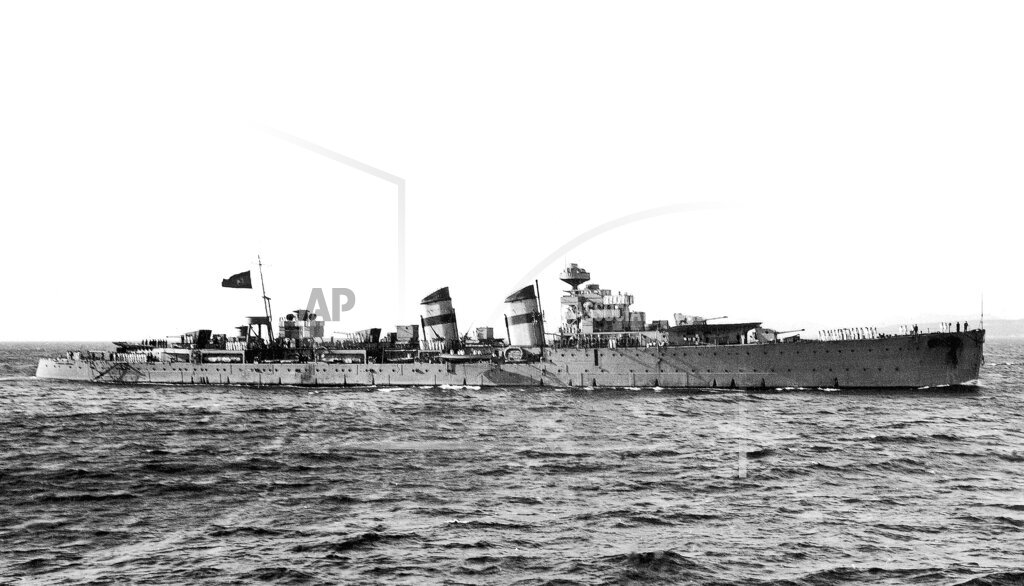
The Spanish government destroyer Jose Luis Diez was forced aground near Gibraltar early today after attempting a dash for freedom through a gantlet of rebel warships. Seven of her crew were killed and eleven wounded. Before running aground, it was reported, the vessel rammed and sank the 1,500-ton rebel minelayer Jupiter. Insistent gunfire from rebel land batteries at Ceuta and from the rebel cruiser Canarias and other rebel vessels forced the fleeing warship aground on Eastern beach, about fifty yards from shore. The destroyer began landing a few wounded, who were brought to a hospital in Gibraltar. The extent of casualties was not determined immediately. Apparently, the Jose Luis Diez was not hit directly. Rebel shells struck two houses of villagers living on Catalan Bay, injuring some of the occupants. The houses, which were in British territory, were destroyed. Catalan Bay is on the eastern shore of the Gibraltar peninsula. The Jose Luis Diez had been undergoing repairs in the refuge of this British port since last August 27, when she limped in after a punishing battle in the strait with rebel warships.
The Diez was so badly damaged this time that she had to be beached to stop her sinking. She was later towed to Gibraltar and remained there, interned, until the end of the war.
Spanish government troops launched a counterattack against the center of the insurgent lines today. The mission was to split the northern and southern wings of the offensive which General Francisco Franco, rebel commander in chief, is aiming at Barcelona, government capital. The counterattack developed south of Lérida in the direction of Sarroca, an important communication center three miles behind insurgent lines. An announcement issued by General Juan Hernandez Sarravia, commander of the government’s Catalonian armies, said a few hours after the drive began that it was proceeding satisfactorily. General Sarravia expressed confidence it would force the insurgents to withdraw and halt their push in this area.
Insurgent reports reaching the border, however, said that the advances of Franco’s southern column beyond Granadella and of the northern column against Artesa were increasing in intensity. Insurgents reported they had broken the government’s strong line of fortifications along the border of Tarragona province in the southern sector. The 5th Navarrese division under General Bautista Sanchez was said to have turned the government retreat south of Granadella, which lies due south of Lérida, into rout, capturing the villages of Pobla de Granadella and Bobera. The rebels reported the capture of Granadella yesterday. The insurgent dispatches indicated the offensive was driving along highways to Falset and Tarragona, opened up by a hard day’s fighting.
In the north the insurgents reported they had pinned down the government’s shock troops by cutting important communication lines. Insurgent dispatches said the highways were under such heavy artillery fire that government troops had lost all freedom to maneuver. The insurgents reported they occupied Camarasa, twenty-two miles northeast of Lérida, which put them within ten miles of strategic Artesa, “gateway to Catalonia,” and about seventy-five miles from the ultimate objective-the government capital of Barcelona. At the same time a second column pushed south toward Artesa, fighting to form a junction with the Camarasa unit. Artesa is on the Segre River and on the main Lérida-Balaguer-Puigcerda Highway, from which other trunk roads penetrate nearly all of northeastern Spain.
Hungary’s Premier Imrédy affirms his adherence to the Rome-Berlin Axis, including its racial policies.
As Danzig threatens to expel Polish Jews, Poland warns the city that it will expel Danzig citizens in retaliation.
Germany states that as long as America panders to Jewish interests at the expense of German ones, relations between the United States and the Reich cannot improve.
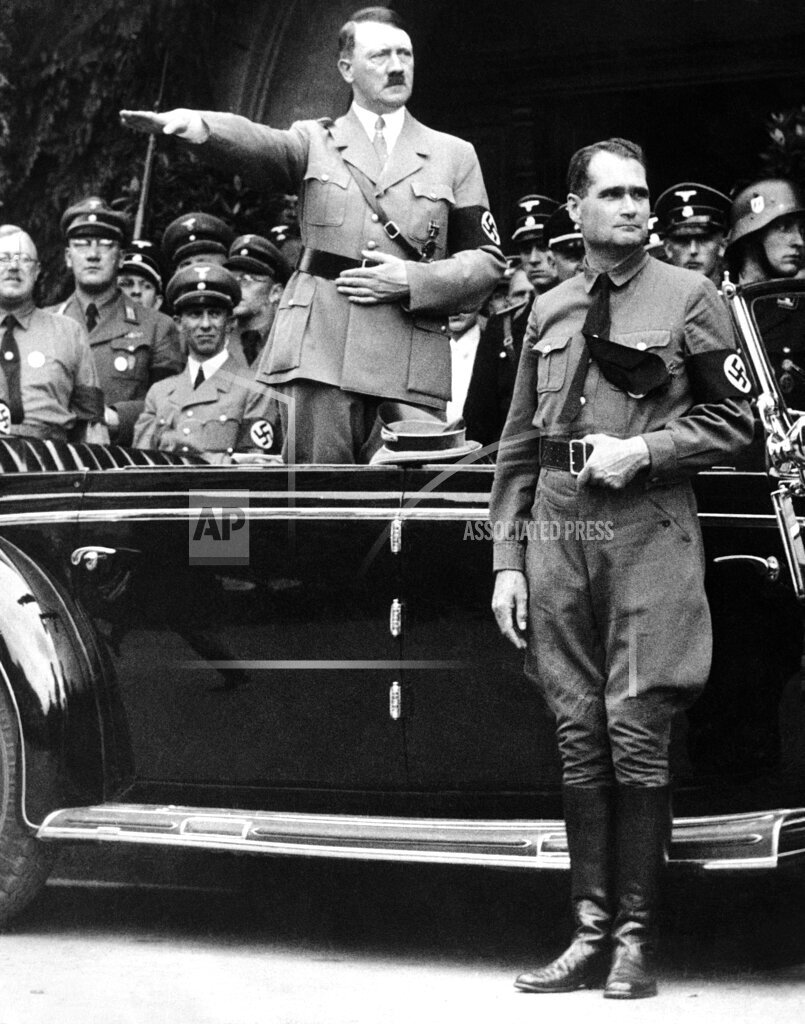
Joseph Goebbels’ extramarital affair with Czech actress Lída Baarová was revealed in the international press. Determined to prevent a public scandal among National Socialism’s top men, Reichsführer Hitler acted swiftly today to prevent Propaganda Minister Dr. Paul Joseph Goebbels from being divorced by his wife, Magda. Mrs. Goebbels is the unofficial first lady of the Reich and Hitler’s official hostess at most state functions. She is irate over her husband’s latest mishap, in which he was beaten almost to death by friends of the beautiful actress, Lida Baarova, but has been forbidden to leave Germany, the New York Daily News correspondent learned tonight. Mrs. Goebbels had been preparing to leave for Denmark to file action against Goebbels. Not only will Hitler’s move prevent her getting a divorce — since German courts would hardly grant a decree without Hitler’s approval — but also Mrs. Goebbels will be blocked from giving interviews that might prove embarrassing.
Other developments came rapidly as a result of the disclosure yesterday that Goebbels, reported suffering from acute intestinal influenza, actually was in a closely guarded Berlin clinic, cut and bruised. This was a result of his attentions to Miss Baarova, whose actor husband, Gustav Froelich, had been banished to a concentration camp by Goebbels. Goebbels, when told the affair had received publicity abroad, suffered a nervous breakdown, fearing — and with reason, said Nazi circles — that his official career might be at an end. Hitler, while publicly silent, conferred with Foreign Minister Joachim von Ribbentrop regarding the affair. No word was allowed to leak out as to the result of this conference, but it was pointed out that there was no official denial of the story.
At the same time it was learned that six actors and actresses, friends of Miss Baarova and Froelich, have been seized, and others are being hunted for participation in the beating. Miss Baarova herself was reported in hiding in a villa at Wannsee lake, near Berlin, uncertain as to what her fate might be. Official displeasure against her already has been shown in the banning of her pictures in Germany. That Goebbels actually might be on his way out as a Nazi leader was suggested by those who recalled that there long has been professional jealousy between the propaganda minister and Field Marshal Hermann Wilhelm Göring. Hitler’s right-hand man. Göring previously expressed his displeasure at Goebbels’ attentions to Miss Baarova.
Iran broke off diplomatic relations with France over an article in a Paris newspaper about a cat show. Rezā Shāh was insulted by a picture of a cat that carried the caption “His Majesty the cat” (the French word for cat is chat, pronounced the same as shah).
Public spending will be one of the most important issues before the 76th Congress. There may be more controversial questions, such as President Roosevelt’s stupendous armaments program and the bi-partisan movement to take the relief administration out of politics, but they are closely related to spending. When Mr. Roosevelt transmits the budget for the 1940 fiscal year to congress next week the tenth successive year of deficits will be in prospect. The deficit for the 1940 fiscal year, beginning next July 1, will be added to an aggregate deficit of approximately 24 billion dollars for the fiscal years 1931 to 1939, inclusive. The current fiscal year will end next June 30 with a deficit estimated at 4 billion dollars and the national debt will be close to 41 billion dollars. This is exclusive of some 6 billion dollars of contingent liabilities represented by government-guaranteed bonds, debentures, and notes sold to the public by government corporations.
Federal expenditures for the current fiscal year are estimated officially at 8 billion, 985 million dollars, greater than the record expenditures of 8 billion, 666 million dollars for 1936, and 8 billion, 442 million dollars for 1937, the fiscal years in which the 2-billion-, 237-million-dollar soldiers’ bonus was paid. Actually, expenditures for the current fiscal year will be considerably higher than 9 billion dollars, for the administration will request a deficiency relief appropriation of probably $750,000,000 immediately after congress convenes. This is to run the WPA from February 7 to June 30. Reliable reports are that the budget for 1940 will begin at not less than 8 billion dollars and be increased by at least another billion before congress adjourns. The administration, it is understood, will attempt to hold the WPA down to 1 billion, 500 million dollars for the 1940 fiscal year, as compared with 2 billion, 200 million dollars in prospect for the current fiscal year.
A contradictory proposal for peace from Wang Ching-wei suggests complete cooperation with Japan, economically and militarily. The published statement leaves no doubt that Wang has parted ways with General Chiang Kai-shek. Wang Ching-wei, former premier of China, came forward today in favor of peace negotiations with Japan on the basis of terms set forth by the Japanese premier, Prince Fumimaro Konoe, on December 22. At that time Konoe made a declaration of policy concerning China. Wang sent a telegram to General Chiang Kai-shek, Chinese commander in chief, declaring Konoe’s terms offered a “fair basis” for peace discussions. His telegram was sent from Hanoi, French Indo-China. Informed Hongkong circles looked upon Wang’s action as a bold gesture on his own initiative. He is a member of the central political council of the Kuomintang, Chinese government party, and a leader of the party’s peace faction. He was said to have split with Chiang because of the general’s admission of communist influence in the Chinese government.
Unanswered was the question of how far Wang represented any element of the Chinese government. He was once among the most powerful of China’s leaders and a favorite disciple of the late Dr. Sun Yat-sen, founder of the Chinese republic. Wang took up in his telegram the main points of Konoe’s terms. They were: A declaration of Japan’s readiness to aid China in abolishing foreign privileges and extraterritoriality and the formation of a political-economic bloc composed of Japan, China, and Manchukuo “for common defense against communism and for economic cooperation.”
A third major reorganization of the cabinet of Premier Prince Fumimaro Konoe was predicted tonight as a split developed over internal application of wartime policies. The premier himself and Home Minister Admiral Nobumasa Suetsugu, an outspoken advocate of fascism, were reported to be the leaders of contending factions in the ministry.
Dow Jones Industrial Average: 154.36 (+0.74).
Born:
Ron Wolf, NFL General Manager (Green Bay Packers), Pro Football Hall of Fame (inducted 2015), in New Freedom, Pennsylvania.
Naval Construction:
The Вое́нно-морско́й флот СССР (ВМФ) (Soviet Navy) Project 7U-class (Storozhevoy-class) destroyer Svirepy (Свирепый, “Fierce”) is laid down by Zhdanov (Leningrad, U.S.S.R.) / Yard 190.
The Royal Navy Tribal-class destroyer HMS Eskimo (L 75, later F 75, finally G 75) is commissioned. Her first commanding officer is Commander St. John Aldrich Micklethwait, RN.
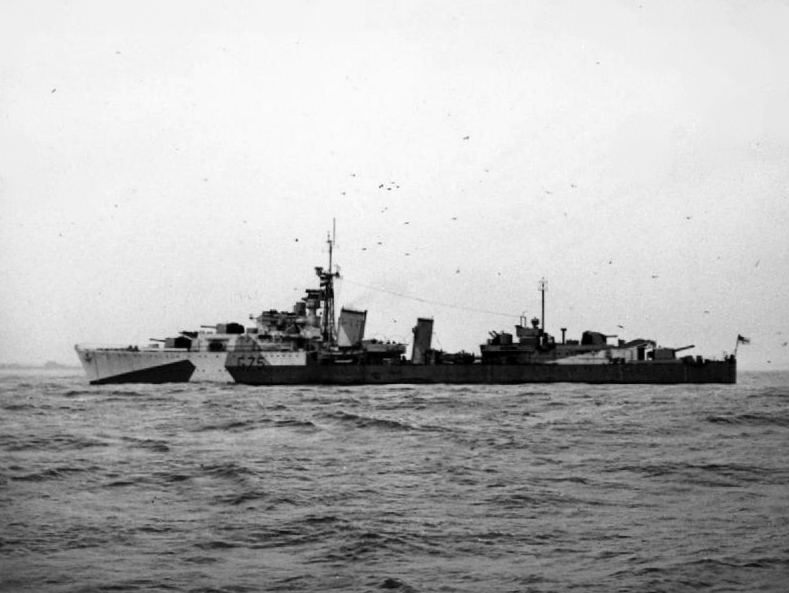
HMS Eskimo saw combat in almost every British theater of war during the Second World War. Eskimo participated in the Second Battle of Narvik in April 1940. On 12 April, Eskimo was hit by a torpedo fired from German destroyer Z2 Georg Thiele. The explosion caused severe damage, blowing off Eskimo’s bow. After temporary repairs by the shipwrights of the fleet repair ship Vindictive at Skjelfjorden in Norway, Eskimo was able to return to the Vickers-Armstrong works at Newcastle for rebuilding, which took until Sept. 1940.
She supported the Allied landings in North Africa in November 1942 and served with the 10th Destroyer Flotilla at Plymouth. Eskimo was extensively damaged when two German dive bombers attacked her in the Mediterranean while taking part in Operation Husky. She cornered and sank the enemy German submarine U-971 while in company with the Canadian destroyer Haida and a Liberator aircraft of the Czech air force in the English Channel north of Brest on 24 June 1944. On 13 July 1944, Eskimo and HMCS Huron engaged the vorpostenboote V 203 Carl Röver, V 213 Claus Bolten and the minesweeper M 4611 in the English Channel. Although V 213 Claus Bolten and M 4611 were sunk and V 203 Carl Röver was severely damaged, Eskimo was herself severely damaged by gunfire from V 203 Carl Röver. During the final days of the war, she operated in the Far East.
Battle Honours: NORWAY 1940-41 – NARVIK 1940 – ARCTIC 1942 – MALTA CONVOYS 1942 – NORTH AFRICA1942-43 – SICILY 1943 – NORMANDY 1944 – ENGLISH CHANNEL 1944 – BURMA 1944-45 – EAST INDIES 1945
HMS Eskimo completed refit in October and took passage to return to UK on 4th November 1945. She arrived at Sheerness on 8th December and Paid-off at Chatham. After reduction to Reserve status in February 1946 she went to Queenborough in the Medway for use as an Accommodation Ship for crews of minesweepers being placed in Reserve. The ship went to lay-up at Harwich in November 1947 and was used for Ship Target Trials in the Clyde area in 1948. On completion of these trials, she was placed on the Disposal List and sold to West of Scotland Shipbreakers at Troon where she arrived on 27th June 1949.
(Imperial War Museums/Royal Navy official photographer)
 History Diaries