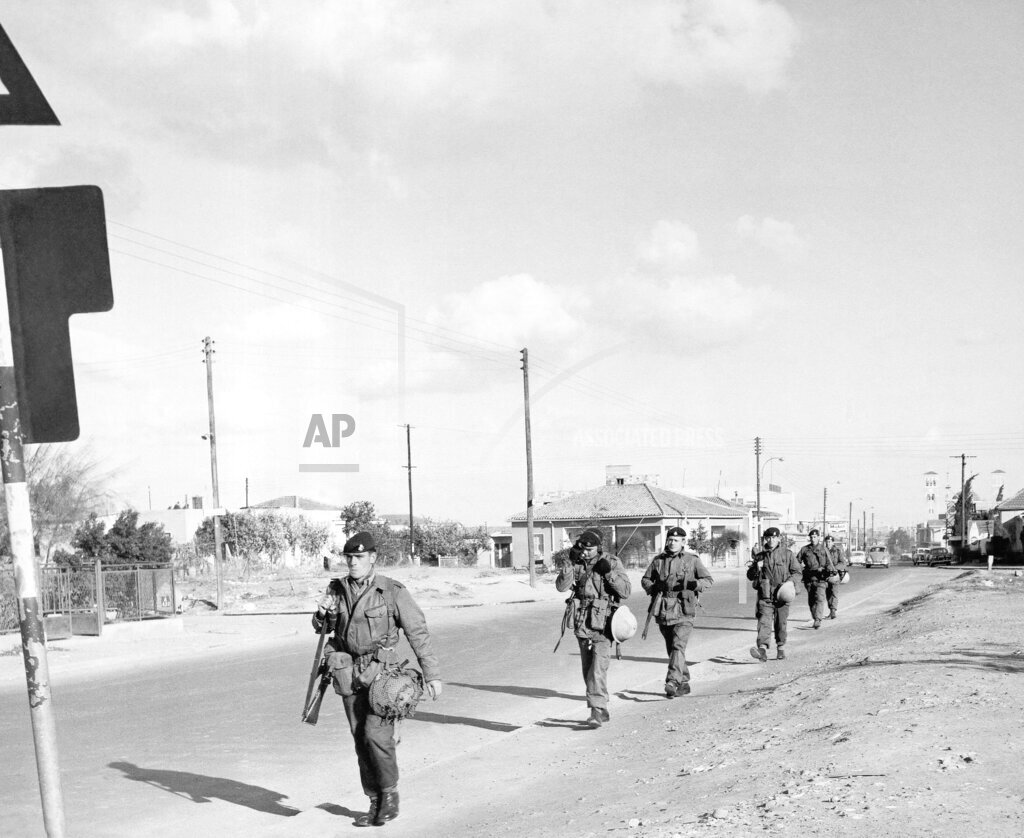
Vice President Fadhil Kutchuk said today that the Cyprus constitution no longer exists because the republic’s Turkish and Greek communities have shown in recent bloody clashes that they are unable to get along together. Kutchuk, a Turkish Cypriot, told newsmen who visited his residence that “the Cyprus constitution is dead.”
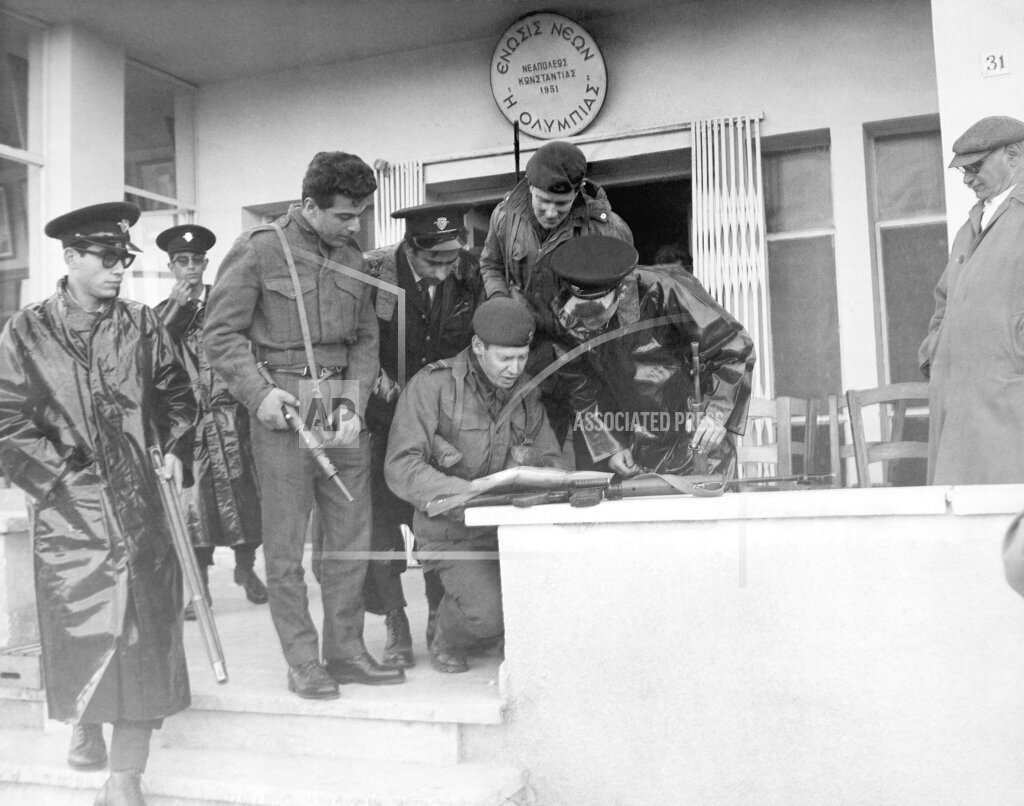
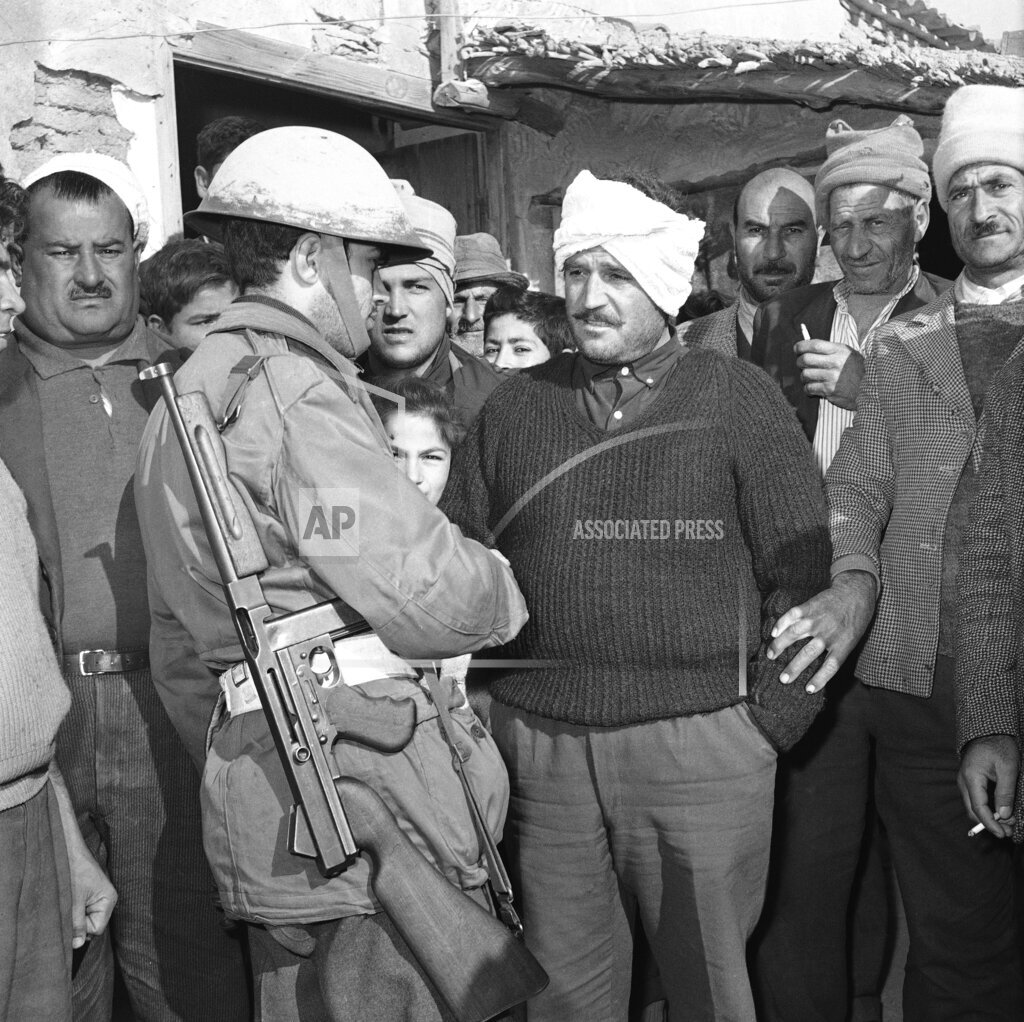
Asked if he wanted the Mediterranean island partitioned between the Turkish minority and the Greek majority, Kutchuk replied, “Call it partition if you like.” Kutchuk spoke as he signed an agreement aimed at restoring peace and order in Cyprus. Under the agreement, British troops moved into an agreed neutral zone along the Nicosia ceasefire line as Greek and Turkish Cypriot irregulars pulled out. The operation was to be completed by dusk. Kutchuk’s clothes were crumpled and he looked tired as he complained bitterly that his residence had been machine-gunned during bloody Christmas fighting between the two Turkish and Greek communities. “Our immediate task is to preserve peace and order, and save poor innocent people from being massacred,” he said. “Then we shall talk about the constitution.”
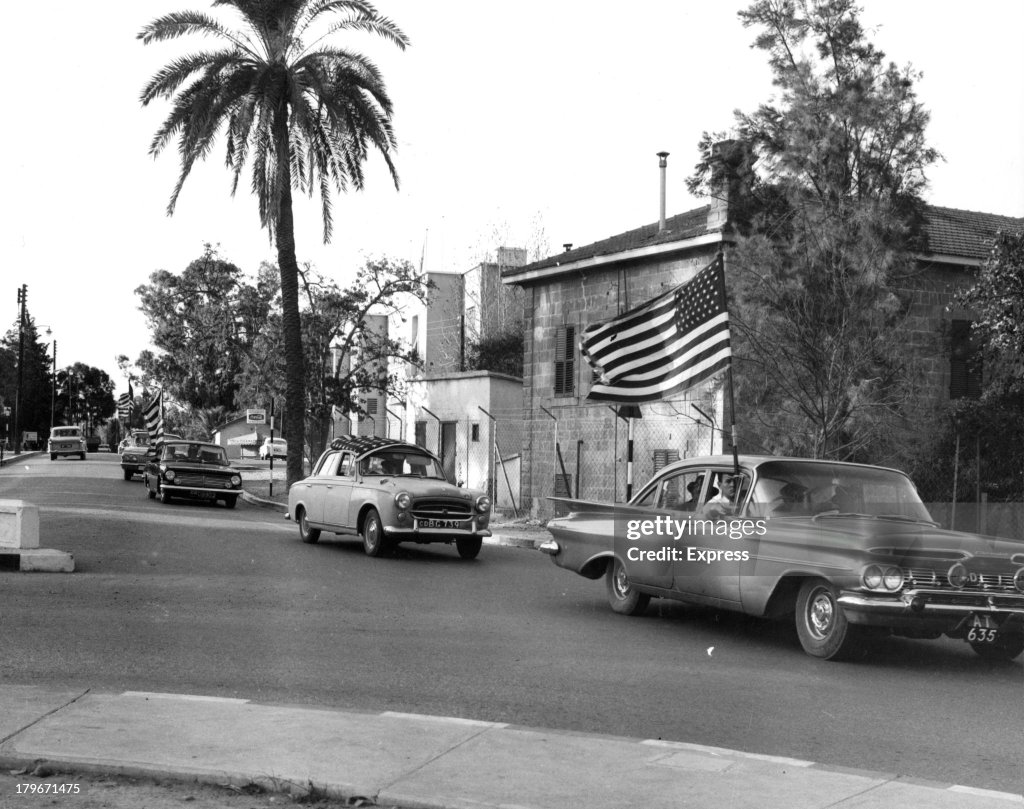
Cyprus Foreign Minister Spyros Kyrianou, a Greek Cypriot, called for an end to the island’s links with Greece and Turkey. The sole link should be with Britain, he said. President Makarios, also a Greek Cypriot, said tonight in a broadcast that Greek Cypriots would not attack Turkish Cypriots and that anything less than coexistence would be disastrous. Agreement on the Greek and Turkish pullout had been reached at an all-night session of a new political liaison committee headed by Duncan Sandys, British commonwealth relations secretary. The republic has been racked by communal conflict since Makarios proposed constitutional changes which the Turkish minority feels are a threat to its safeguards. Nicosia looked almost normal again today, with stores open and traffic heavy.
Georgios Papandreou resigned as Prime Minister of Greece as elections were called for February, and was replaced by a caretaker government led by Ioannis Paraskevopoulos.
The foreign ministry in Saigon has officially protested what it calls Indonesian President Sukarno’s “intolerable interference in Vietnam internal affairs,” the Vietnam press agency said today. The protest was delivered this morning to the Indonesian consul, General Soedjoko Hoedionoto, after Sukarno told a delegation of South Vietnam Liberation Front members that he hoped their struggle “will end victoriously” and that he would be able to visit a free Vietnam one day,” Vietnam Press said. The Liberation Front is the political wing of the communist Viet Cong movement.
Soviet Premier Nikita S. Khrushchev said today joint efforts by the United States and the Soviet Union can make 1964 “a year of decisive change for the better in the entire international situation.” In reply to three questions submitted to him in writing last week by a correspondent, Khrushchev said he was convinced the new year can bring east-west understanding on a broad range of issues and an easing of the cold war. He combined new year greetings and best wishes for the American people with a plea for “peaceful cooperation, good neighborliness, and friendship” between the two nations.
Chancellor Ludwig Erhard returned home from the United States today and said President Johnson was expecting West Germany to come up with suggestions for easing tensions with the Soviet Union. This, Erhard explained, is because Germany lies near Russia geographically. He did not say whether President Johnson had specified what kind of proposals these should be, nor did he offer any. Erhard and Johnson agreed in Texas that efforts should be pressed to ease tensions.
Erhard said the United States does not want the West Germans to do anything to complicate the Berlin situation. The main problem in Berlin now is what should be done to prolong the holiday arrangement under which the Communists have allowed West Berliners to make brief visits to East Berlin. One way that the situation could be complicated, Erhard said, would be to let the West Berlin government take too much responsibility. The four occupying powers and the West German government in addition to the West Berlin government all have responsibility in this, he said. The Americans welcome the holiday visits, however, for humanitarian reasons, he added.
West Berliners, returning from family reunions, are loath to make public comments derogatory to conditions they find in the eastern part of the divided city on their first visits in two and a half years. “I went over to see my old mother and had no time to look around,” said a middle-aged West Berliner, as he came out of the Oberbaumbruecke crossing point. All, however, seem to agree that reconstruction in the communist east sector had been making painfully slow progress. The inner city still offers a sad, depressing sight. Most new housing settlements are in the outlying districts, which few strangers visit.
The communist East German authorities have been trying to present a picture of prosperity, peace and international goodwill to the hundreds of thousands of year-end visitors. This picture, however, has been marred by the fatal shootings at the communist built wall which divided Berlin. At the crossing points, western visitors are welcomed by courteous communist border guards. But no one forgets that these same men in the green uniforms who bid “a pleasant visit in the capital of the German Democratic republic” shoot their own countrymen trying to cross to the west.
Karol Wojtyla of Poland was appointed by Pope Paul VI as the new Metropolitan Archbishop of Krakow, and made a Cardinal in the Roman Catholic Church. In 1978, Cardinal Wojtyla would be elected as Pope John Paul II.
The United States will withdraw 3,500 air force personnel and 2,000 dependents from Japan in a major realignment of air strength in the Far East, it was learned today. The realignment will include deactivation of the 5th Air Force’s B-57 bombardment wing — the last active unit of the big bombers in the United States air force. The 5th Air Force, with headquarters at Fuchu air base outside Tokyo, is the nucleus of American military strength in Japan that now totals 46,000 men. In addition, there are 54,000 servicemen’s dependents and 3,000 American civilian employees in Japan.
The reduction also will include, an informed source said, the transfer of F-100 fighter squadrons from Misawa air base in northern Japan to the United States, and the transfer home of one C-124 troop carrier squadron from Tachikawa air base The C-124 squadron will be returned to the United States by next fall. It is expected that many of the other changes will be completed by midsummer or fall. Tactical Air Command fighter squadrons will be rotated into Misawa air base from other bases to avoid leaving any gap in northern Japan’s air defenses, the source said.
Four reasons were given for the reduction:
- Washington desires to cut defense expenditures abroad and reduce the drain on United States gold reserves.
- Recent worldwide airlift exercises with strategy based on mobility prove the United States can defend against communism without so much emphasis on units permanently stationed abroad.
- Recent assignment of three squadrons of F-105s, a high-performance aircraft, provides necessary attack strength.
- Japan’s 273,000-man self-defense force can assume more responsibility.
Japanese defense officials have been assured, the source said, that the United States contemplates no change in its obligation to defend Japan against communist attack.
The Mausoleum of the Heroes Who Fought for the Freedom of the People and the Fatherland, for Socialism was dedicated in Bucharest as a repository for the cremated remains of all Romanian Communist Party officials.
U.S. President Johnson signed a bill authorizing the minting of a new version of the Kennedy half dollar, with the profile of John F. Kennedy on the obverse and the U.S. presidential seal on the other side. The new fifty cent piece replaced the coin with the images of Benjamin Franklin and the Liberty Bell, with the first coins being minted simultaneously on February 11, 1964, at the mints in Philadelphia and Denver.
The longest and, from the taxpayers’ viewpoint, costliest peace time session of Congress tottered to a close today with members still reluctant to quit talking. The final legislative action which permitted adjournment of the session, which started last January 9, was a Senate vote by which it agreed, 56 to 14, to provide 3 billion dollars in new money for foreign aid. The bill carried a controversial provision which gives President Johnson discretionary authority to provide government credit to Russia to buy bread grain here. Senators once again expressed the opinion that the United States was providing 3 billion dollars to “fight communism” in the very bill that opens the doors to sell food on credit to communist armies. Adjournment of this first session of the 88th Congress did not come easily. Before it could debate the merits of the aid bill, the Senate wrangled for an hour over the necessity of today’s session.
Secretary of Defense Robert S. McNamara disclosed today, after a budget conference with President Johnson and the joint chiefs of staff, that defense spending for fiscal 1965 will be one billion dollars less than the level for the current year. McNamara said the defense budget for the fiscal year beginning next July 1 will be about 51 billion dollars compared to $52 billion for the 1964 fiscal year.
He said the cut in defense outlays will in no way impair the military power of the United States or weaken national security. He predicted that, on the contrary, the lower defense budget “will yield a national defense superior to that at any time in peacetime history.” McNamara gave a preview of the Defense Department’s budget plans in general terms to reporters in Austin after he and the joint chiefs of staff met with the President at the Johnson Ranch, where the chief executive has been spending the holidays. McNamara said the conference represented the final decisions of the military advisers and the President on the 1965 defense budget with the exception of a few loose ends which will be taken care of in a week or so. The President will send the federal budget for the new fiscal year to Congress about mid-January.
President Johnson feared that any congressional restrictions on wheat sales to Russia would convince Soviet Premier Nikita Khrushchev and other world leaders that he was a weak chief executive easily overruled by Congress. A White House memorandum says that the President was concerned that allied leaders would lose confidence in United States leadership early in his administration, and that Khrushchev would seize the opportunity to start chiseling away at the western world. Because of this belief, the President pushed hard during the final days of Congress to remove from the foreign aid money bill a proposed restriction on credit guarantees for private wheat sales.
Twice the House wrote into its version of the bill a provision that would have prohibited the new President from using the Export-Import bank to guarantee any loans for sales to Russia by American grain dealers. Finally, after Democratic lawmakers had been summoned back to Washington from Christmas vacations, the House agreed to let the President use such credit if he deemed it in the national interest. The White House memorandum said congressional debate on the wheat sales obscured the real issue. The memo, reflecting the President’s views of the urgency of the situation, said “the real issue is whether the President of the United States will look strong or weak to other nations at a critical moment in our history.”
Senator Barry Goldwater today said he will announce his political plans for 1964 at his home Friday. Goldwater made the announcement in telegrams sent to friends and supporters around the country. The telegram said:
“From time to time during the last year I have discussed with countless Republicans like yourself our two-party system and our individual responsibility to this concept. Because we share a mutual belief in this regard I want you to know that on January 3 I am asking some leaders of the Republican party in Arizona to meet with me at 11 a.m. at my home in Phoenix to hear my decision regarding 1964.”
Goldwater is vacationing in Arizona before returning to Washington on Saturday. He spoke yesterday at the dedication of the new municipal building in Prescott, Arizona, but refused to discuss politics. The senator is recuperating from surgery performed to remove a calcium deposit from his heel. His foot is in a cast and he is using crutches. Goldwater was considered the front-runner for the Republican Presidential nomination until the death of President Kennedy confused the situation. Goldwater was elected to the Senate in 1952, defeating the then Democratic majority leader, Ernest McFarland. He quickly became one of the most articulate spokesmen of conservatism. He defeated McFarland again in 1958, and in the succeeding years began to loom as a serious contender for the nomination for President.
The city of Boston experienced one of the worst traffic jams in American history, caused by a combination of post-Christmas sales, a populace that had been homebound during the previous week by a snowstorm, and the need for private automobiles rather than public transportation to bring purchases home. As more than 100,000 cars competed for 37,000 available parking spaces in the downtown business district, streets were blocked at both ends by shoppers who were double-parking and triple-parking, the city was in gridlock from two o’clock in the afternoon until past midnight.
Stung by magazine and newspaper criticism, America’s seven original astronauts sell their equities in a Florida luxury motel, almost doubling their money in the process. Their attorney, motel partner and spokesman, says the decision is “a reluctant one” but all wanted to appease space agency officials, who had been annoyed and chagrined at the public outcry against the space men’s possible conflict of interest.
A multiple investigation involving Florida and Jacksonville marshals, building inspectors, and insurance investigators gets under way, seeking the cause of the Sunday fire in the Hotel Roosevelt in which 21 persons died and 60 were injured. William H. Johnston, owner of the hotel and president of the National Jockey club, makes no estimate of the loss, though the hotel has been appraised at 4 million dollars. Fire Chief G. R. Cromartie, criticized for not using fire nets, explains they are impractical for fires in high buildings.
Over protests of the United States attorney, a federal judge in Los Angeles reduces from $50,000 to $30,000 the amount of bail set for John W. Irwin, one of three suspects held in the ransom kidnapping of Frank Sinatra Jr. The judge credits Irwin, by surrendering to FBI agents, with solving the case and leading to recovery of most of the $240,000 ransom.
A total eclipse of the Moon, distinguishable from other eclipses for placing the Moon in almost complete darkness, took place.
The pilot edition of “I’m Sorry, I’ll Read That Again” was broadcast on the BBC Home Service under the title Cambridge Circus.
NBC-TV introduced a new game show, “Let’s Make a Deal,” hosted by Monty Hall, at 2:00 p.m. Eastern time as part of its regular daytime programming.
Dow Jones Industrial Average: 759.90 (-3.05).
Born:
Mike Pompeo, American politician, U.S. Secretary of State (2018-21), in Orange, California.
Chandler Burr, American journalist (U.S. New and World Report), author (“A Separate Creation; The Emperor of Scent”), and museum curator (Department of Scent Art), in Chicago, Illinois.
Alessandra Mussolini, Italian actress (Ferragosto OK), in Naples, Italy.
Robert Jenkins, NFL tackle (Los Angeles Rams, Los Angeles-Oakland Raiders), in San Francisco, California.
Jerry Quick, NFL tackle (Pittsburgh Steelers), in Anthony, Kansas.
Timothy Starks, NFL defensive back (Minnesota Vikings), in Mobile, Alabama.
Johnny Rogers, NBA power forward (Sacramento Kings, Cleveland Cavaliers), in Fullerton, California.
Died:
Prince Chula Chakrabongse, 55, member of the Thai royal family, of cancer.
 History Diaries