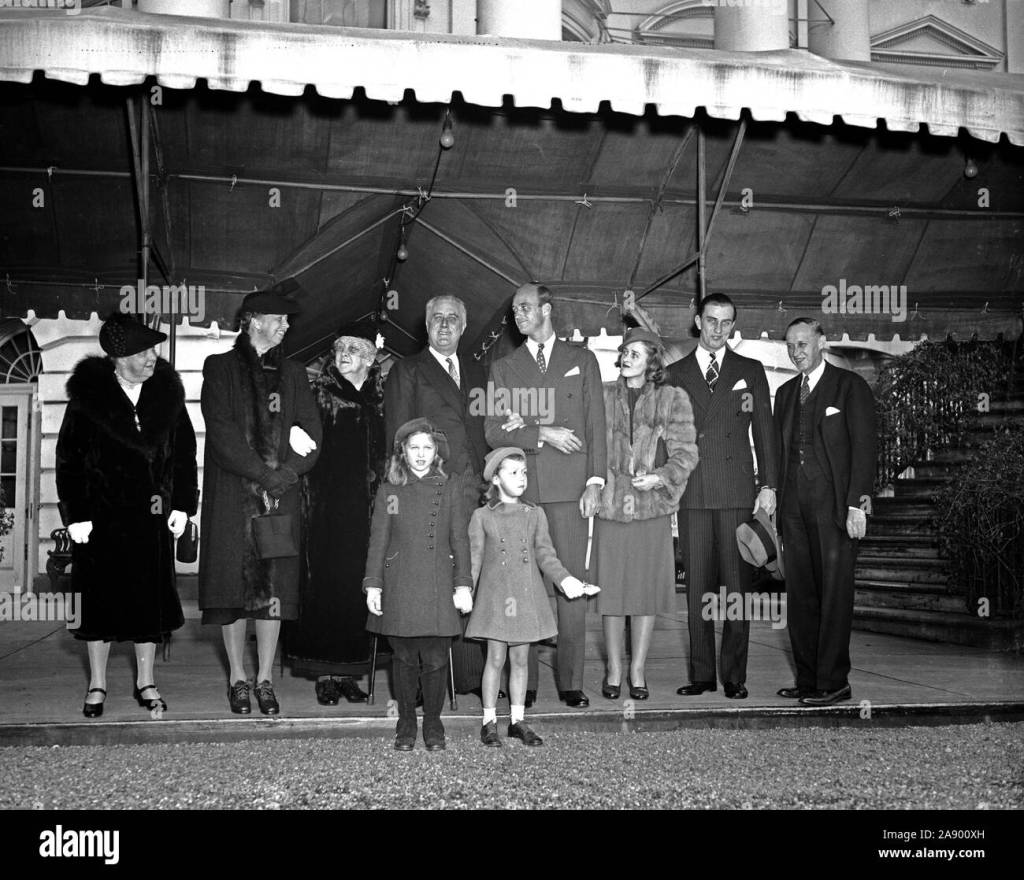
Christmas Day.
Spanish insurgent military dispatches today reported extensive victories in the Tremp sector of the northern front, where Italian legionnaires claimed to have pushed forward more than fifteen miles. Insurgent field reports reaching the border said the attackers had captured the towns of Figuerola, Penalda and Fontllonga. Farther south, between Lerida and Gandesa, insurgents said they had taken the villages of Sarroca, Mayals, Llardenos, Torrebes and Alcana. Government dispatches denied all insurgent claims, but acknowledged there was heavy fighting in the mountainous arca south of Tremp. This city is an important power center about ninety miles northwest of Barcelona.
Government bulletins said the insurgents used aviation artillery and tanks to support an infantry offensive. The Insurgents declared they had taken many prisoners and “enormous quantities” of war materials. Government dispatches reported that a number of Italian volunteers, including several officers, had been captured. The drive, which is General Francisco Franco’s long-awaited offensive in Catalonia, was regarded on both sides as a crucial test. A half million men were said to be arrayed on opposite sides of the 100-mile front in two of the greatest armies assembled for a single battle in the civil war, now nearly two and a half years old. Earlier military dispatches had indicated that the northern offensive, launched in blizzards and subzero cold, had been brought to a halt. In the Pyrenees mountains, near the extreme northern end of the battle line, veteran government mountain fighters, well entrenched in fortified positions, were said to have cut down Franco’s Italian and Moorish troops struggling across snow-swept fields.
Reports from border observers indicated that the northern end of the front had become quiet except for occasional artillery shelling. The advantage so far lay with the government’s seasoned troops in that sector, it was asserted. Heavy snowstorms had almost wiped out visibility and freezing cold made fighting virtually impossible in the snow-whitened Pyrenees. The insurgents were unable to advance their machine gun platoons to rake the government held summits, border reports said. Government rifle fire inflicted heavy punishment on insurgent infantry attempting to charge up the slopes in waves with fixed bayonets, it was reported. The rebel objective was not given, but the converging movement of the forces on opposite sides of Lérida indicated a possible pincer strategy such as was used by General Franco to capture Teruel. Battle casualties on both sides were said to be heavy, and both commands acknowledged severe suffering because of the weather with thousands of cases of frostbite.
Spanish insurgents make gains of up to five miles on the southern end of their new front. Rebels said the offensive was gaining momentum with all the northern columns pressing their advance which had gained from three to five miles. In the mountainous area south of Tremp, they said. Moroccan troops forced the defenders back over icy trails and captured four villages east of the Noguera Pallaresa River. The fighting about twenty miles south of Tremp apparently was localized. The rebels said they first took the towns of Figuerola and Penalda, then forced Catalan militiamen to retire eastward to Vilanova de Meya through Fontllonga. The weather benefited the campaign which began on Friday in blizzards and subzero cold. The snow had ceased and the temperature had risen.
Both sides pinned great importance on Franco’s long-awaited drive, the success or failure of which they agreed might be decisive in the war. Arrayed on the snow whitened front were an estimated half a million men in both armies, one of the largest concentrations for a single battle in the more than twenty-nine months of strife. The broader advance was reported from the region between the wide southerly bend of the Ebro River and the junction of the Lérida, Tarragona and Huesca province borders. The rebel attack, with war planes, tanks, artillery and troops, swept a front more than thirty miles long. Franco’s commanders said they had taken a chain of towns along the whole length of the sector from Almatret to Sarroca.
93 were killed in a train collision near Etulia, in Bessarabia, south of Chișinău in Rumania. At Etulia (now in Moldova), two passenger trains collide head-on on single track due to a misunderstanding between stationmasters. One is a local; the other is carrying soldiers going on leave. Altogether 93 people are killed, including a general and two colonels, and 147 are injured.
Czech author Karel Capek dies at age 48 of double pneumonia. Reportedly, he refused to eat after the German invasion of his homeland.
Rescue of two women and the crew of eighteen men from the sinking Norwegian freighter Smaragd, 500 miles southeast of New York, was described as a miracle by Captain Bernard W. Larsen when the party was landed today in New York. The rescue was made by a lifeboat crew from the American freighter Schodack. It was carried out at daybreak Friday in a 60-mile gale with seas running 40 feet high. Not a life was lost and even Captain Larsen’s dog and a puppy were saved. Officers of the two freighters and Captain Larsen’s daughter, Svanhilde, 18 years old, told of the dangerous exploit. The Norwegians praised the crew of the Schodack and its captain, Clifton Smith, who was rescued in 1916 when the transport he commanded was sunk by a submarine.
The Smaragd was leaking slightly when it left Norfolk on December 15 for European ports. When the Atlantic storm was encountered last Thursday, the seams opened wider and the ship began to fill with water. As the daylight hours passed, the crew was driven out of the hold to the deck and finally to the captain’s cabin, where Miss Larsen sang to keep up the courage of her parents and the crew. Ingwald Tindelund, second officer of the Smaragd, tied rags to a long pole, soaked them with kerosene and made a flare that finally attracted the attention of the Schodack’s lookout. The Schodack was far off its usual course or the Smaragd never would have been sighted.
The Latin patriarch of Jerusalem, who led reenactment today of the drama of Christ’s birth, asked prayers for “poor Palestine, watered with the blood of our Holy Redeemer and the tears of the Holy Mother.” Age-old ceremonies were carried out while thousands of British troops, some in armored cars and some at machine gun posts, ringed the little town to frustrate any attempt to mar the celebration. Following the post-midnight ceremony at the Church of the Nativity multitudes of devout Christians prostrated themselves before the traditional site of the manger and continued fervent supplications for peace. In all, 20,000 British kept an uneasy peace in the land where Christ was born and preached humility, forgiveness, unselfishness, and love.
The U.S. Navy is little concerned with President Roosevelt’s shift from national defense to continental defense, under which this nation would bar any attempt at aggression in the new world from the Arctic to the Antarctic. The promulgation of the new policy created little more than a ripple in the Navy Department as the navy high command always has felt that it might be called upon to uphold the Monroe Doctrine and built its fleet with an eye to such a call. On the other hand, the army never before has concerned itself with defense of more than continental United States and its possessions.
It is expected that there will be some expansion of the recently recreated Atlantic fleet. The fleet would be needed to convoy possible expeditionary forces to Latin America to afford protection against aggression from without the hemisphere. This would make necessary only a relatively small outlay of additional funds. The navy high command is more concerned over the recent developments in Europe. Many high-ranking officers have come to feel that America must not count too heavily upon Great Britain to patrol the Atlantic with her mighty fleet. With Britain backing down before Germany’s Adolf Hitler at Munich, many officers feel that serious consideration must be given to maintaining a two fleet navy — one in the Pacific and the other in the Atlantic. However, no immediate consideration is being given to the question. The majority of officers hold that to maintain two equal forces would violate all military precepts and would be both impractical and impossible. Nor has such an idea developed within the administration, which is counting on an alliance, written or unwritten, under which Britain would patrol the Atlantic and the United States the Pacific.
[Ed: The Navy might not be immediately considering a Two-Ocean Navy — but this is exactly what it will need, and what will be built, in the very near future.]
Senator Arthur H. Vandenberg (R-Michigan) today put forward his personal program for the approaching 76th Congress. Vandenberg listed the following as his special interests in the session which convenes January 3:
- Reorganization of the relief system to provide more relief for less money by returning administrative responsibilities to the states.
- Revision of the social security act to eliminate the full reserve fund provision for old age benefit payments. He said he wanted to “eliminate the possibility the reserve may reach the nonsensical total of 47 billion dollars by 1980.”
- Elimination of “the last vestige of the iniquitous undistributed profits tax on thrift.”
- Reasonable experimentation with “the new idea of incentive taxation” to encourage business men to try profit-sharing or other desired policies.
- Recapture by congress of powers delegated to the President under various emergency acts.
- Keeping the United States out of foreign wars.
“If the President asks congress to permit him to identify aggressor nations and apply American sanctions,” said Vandenberg, “I’ll try to see he doesn’t get what he asks.” Vandenberg is a member of the Senate Foreign Relations Committee.
As a member also of the Senate Finance Committee, Vandenberg said he was interested in a balanced budget and pledged himself to vote for all economy measures which might be submitted by the administration. “I’m anxious to see the budget balanced before my grandson grows old and dies,” he said. He agreed with Minority Leader Charles L. McNary (R-Oregon) that it was not the business of congress to go on record against a third term for the President. If the senate was asked to vote on the question, Vandenberg said, he would oppose a third term. But he added: “I certainly won’t raise the question.” Vandenberg, a member of the Social Security Board’s Advisory Committee, fought last session for a smaller reserve for old age payments. The committee considered his proposal in its recent meetings.
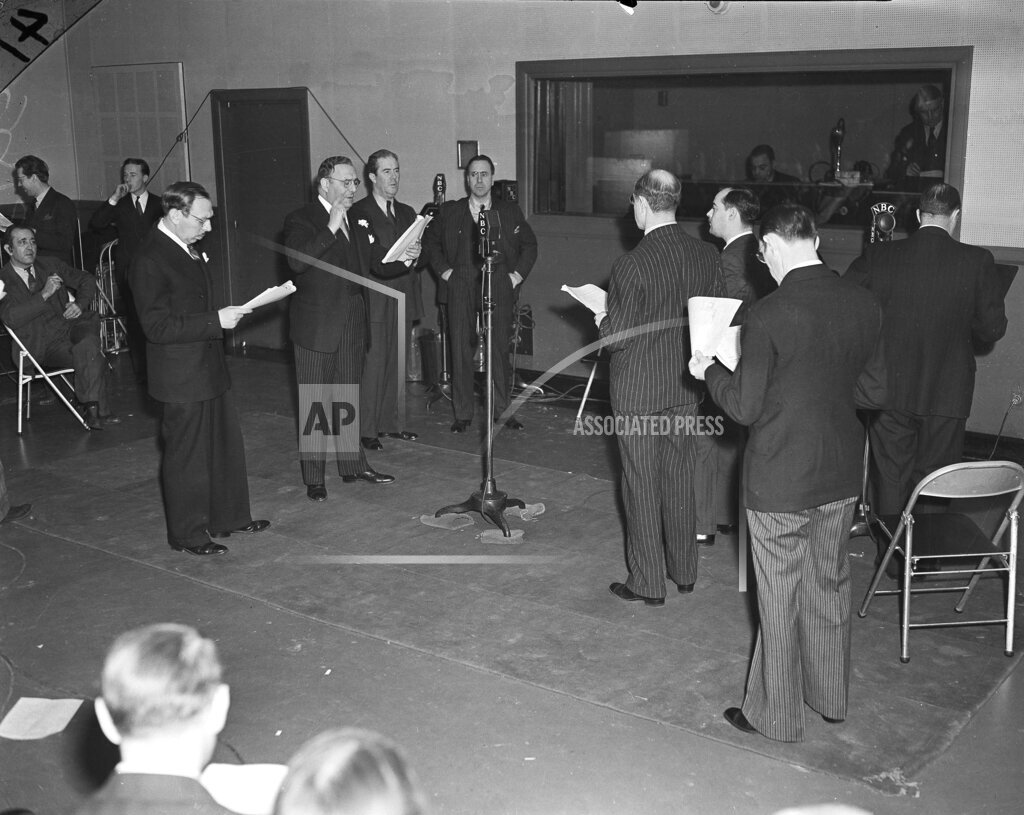
The radio play “The Plot to Overthrow Christmas” by Norman Corwin was first performed on CBS.
George Cukor announces Vivien Leigh will play Scarlett O’Hara in “Gone With The Wind”.
Japanese pilots bomb major cities in three provinces: Wuchow and Kweilin in Kwangsi, Sian in Shensi, and Changteh in Hunan. Japanese bombers systematically raided important Chinese cities today in three provinces. At Kwellin, capital of Kwangsi province, 100 houses were destroyed and a direct hit demolished a dugout on the grounds of the Baptist church. Wuchow, a strategic defense point blocking Japanese invasion of Kwangsi province in South China, again was bombarded from the air. Frequent air raids have caused at least half of the Wuchow civilian population to migrate inland up the West River. Two persons were killed, seven others wounded and ten houses destroyed in an air raid on Sian, capital of Shensi province, straddling the main trade route between China and the Soviet Union. Changteh, in Hunan Province also was raided.
China’s Foreign Minister Wang Ching-wei leaves Chungking for Hong Kong, either due to illness, or to negotiate a truce with the Japanese.
Born:
Jack Hamilton, MLB pitcher (Philadelphia Phillies, Detroit Tigers, New York Mets, California Angels, Cleveland Indians, Chicago White Sox), in Burlington, Iowa (d. 2018).
Noel Picard, Canadian NHL defenseman (Montreal Canadiens, St. Louis Blues, Atlanta Flames), in Montreal, Quebec, Canada (d. 2017).
Hank Rivera, AFL defensive back (Oakland Raiders, Buffalo Bills), in Los Angeles, California (d. 1996).
David Borden, American jazz and minimalist keyboard player and composer, in Boston, Massachusetts.
Duane Armstrong, painter, in Fresno, California.
Died:
Karel Čapek, 48, Czech author, playwright and critic (R.U.R.), coined term “robot”, (of pneumonia).
Naval Construction:
The Вое́нно-морско́й флот СССР (ВМФ) (Soviet Navy) “M” (Malyutka)-class (3rd group, Type XII) submarines M-94 and M-95 are laid down by Sudomekh (Leningrad, U.S.S.R.) / Yard 196.


 History Diaries