The French government was presented with a new headache today. Italy notified France that the 1935 Laval-Mussolini accord regulating colonial questions in Africa between the two nations is “no longer valid.” Under the agreement France conceded Italy extensive territory in Libya; yielded Italy territory in French Somaliland and ceded her 3,000 shares in the Djibouti-Addis Ababa railroad, and provided for the progressive removal of Italian citizenship and other rights in Tunisia by 1965. There are 94,189 Italians to 108,068 French living in Tunisia.
Rome’s reason for denouncing the accord, as announced in Paris, is a technical one — that the two governments never exchanged ratifications. From the French point of view this so-called pretext merely serves to mask Fascist plans for a new — and perhaps this time official — demand for a slice of the French colonial empire. No one in Paris political circles believes that the Italians are not serious in their determination to bid by all means at their disposal for a preponderant position in the Mediterranean — a position which, the French say, can be gained only at their nation’s expense. The French already have announced they are determined not to give Italy a toe hold in any French possession.
Italy today waited for France to offer concessions after giving notice that the Fascist government considered the 1935 Mussolini-Laval convention concerning Tunisia to be invalid. Virginio Gayda, the authoritative Fascist editor, warned the French that Rome would meet “with equal arguments and equal force” France’s “insidious fury” if France wanted to fight.
Premier Édouard Daladier won an important political victory early today by forcing a vote of confidence from the chamber of deputies, which almost overthrew his government yesterday afternoon. The vote was 366 to 229. The balloting was on the approval of budget expenses and receipts along with financial decrees which had raised so much protest among the opposition. Parliamentary observers said yesterday’s first close vote of confidence, when only seven votes kept the government standing before the chamber, had frightened wavering right and center deputies into line. The vote gave final approval to the ordinary budget, which is met by taxation and other revenues, of $1,735,537,440, of which $346,081,596 was for armaments. This represents an increase of almost $78,978,000 over 1938 armaments expenditures.
Czechoslovakia suspends all Jewish teachers and professors from German, but not Czech, schools. All Jewish government officials are dismissed.
Nine hundred men, most from Vienna, are released from Dachau. They join the 7,000 let out of German concentration camps over the last fortnight. Many suffer from pneumonia and have lost limbs because of frostbite.
The German ambassador in Moscow, Russia began a second round of discussions with Soviet representatives regarding a potential trade agreement.
Police arrest 34 IRA members in early morning raids in Northern Ireland, for plotting to overthrow the government with multiple assassinations.
A strange fish was found on a fishing trawler in East London, South Africa. It was later identified as a coelacanth, previously thought to be long extinct.
On the eve of the opening of the Seventy-sixth U.S. Congress, it is apparent that the major item of legislation for consideration at the first session will be a vast, rearmament program. In his annual message on the state of the Union at the opening of congress, which President Roosevelt will deliver in person, and in his budget message, which he will send up a few days later, the chief executive is expected to call for almost a doubling of the peace time record 1 billion, 100 million dollars voted the army and navy last spring.
Mr. Roosevelt will call for increasing the army air force to 9,000 planes and the navy air force to 3,000 planes. He will seek at least one and perhaps two 45,000-ton battleships; he will recommend construction of new air bases in the Atlantic and Pacific; and he will ask about 500 million dollars for strengthening and modernizing the army and building up material reserves for a possible war. These are the major items in the program the administration will offer congress and which will lead to a complete analysis of defense needs. The presidential program is expected to promote a battle as it has been under fire front and rear as a pro motion of war scare propagandists and as an adoption of the dictator scheme of spending on armaments for recovery.
Harry L. Hopkins, who has spent almost 12 billion dollars as head of the Federal Emergency Relief Administration, the Civil Works Administration, and the Works Progress Administration, tomorrow is to be named secretary of commerce. Nomination papers for the Iowa boy, who spent his way to fame, were made out today at the State Department and probably will be issued tomorrow when the resignation of Daniel Calhoun Roper becomes effective. No hitch in plans is expected. Hopkins had already moved some of his papers from his office at WPA head. quarters over to the commerce building. Roper began to move out when he submitted his resignation ten days ago.
Colonel F. C. Harrington, assistant WPA administrator, is expected to move into Hopkins’ old quarters. Colonel Harrington, a United States army engineer and close friend of Hopkins, leaped over the head of Aubrey Williams, deputy WPA administrator, in presidential favor. Williams will continue as head of the National Youth Administration. The Harrington appointment was looked upon as a natural outcome of President Roosevelt’s desire to take the heat of investigation off the easy money spending administration during the coming congress. From all quarters within and without the administration there has been a persistent demand for an investigation of WPA spending from the points of extravagance and politics. When the demands for investigation of WPA extravagance and vote buying reached their peak, Hopkins was revealed as the President’s choice to succeed Roper as secretary of commerce. The plan almost fell through when Roper refused at first to resign.
The American investigation of Japanese shipping begun on December 12 ends as the two shipping companies agree to change their unfair practices and pricing immediately.
Senator Pittman, chair of the Foreign Relations Committee, comments that the American people do not like the governments of Japan or Germany, and the people have the right to enforce morality in their treaties.
Brazil’s new immigration law takes effect, requiring registration of 3 million immigrants and restriction of future immigrants to 2 percent of the nationality’s entry over 50 years.
A state of emergency is declared in Burma, where nearly 100 have been arrested. Three men, one a member of the House of Representatives, are fined and imprisoned, to the acclaim of demonstrators.
Japanese Prime Minister Fumimaro Konoye gave a speech in which he proclaimed a New Order of East Asia, encompassing Japan, Manchukuo and China. Tokyo announces its terms for peace in China. They include freedom for Japan to trade, live, deploy troops, and exploit resources anywhere in China, but no territory is demanded. Japan’s basic policy in China in the future will be to adjust relations with that country for the purpose of establishing “a new order in east Asia,” Premier Konoe announced tonight.
The policy includes five demands on China, agreed upon in an Imperial conference held last month in the presence of Emperor Hirohito, Konoe pointed out. He enumerated the demands as follows:
1 — Establishment of diplomatic relations between China and Manchukuo, the Japanese-sponsored state in former Chinese Manchuria.
2 — Conclusion of an anti-communist agreement between China and Japan.
3 — Stationing of Japanese troops in China and designation of Inner Mongolia as a special anti-communist area.
4 — Recognition of freedom of residence and trade for Japanese in interior China.
5 — Extension to Japan of facilities for the development of China’s natural resources.
The premier’s statement was interpreted as a move to abolish extraterritoriality in China. A nation enjoying extra-territoriality in another has the right to try its own nationals there under its own laws and in its own courts.
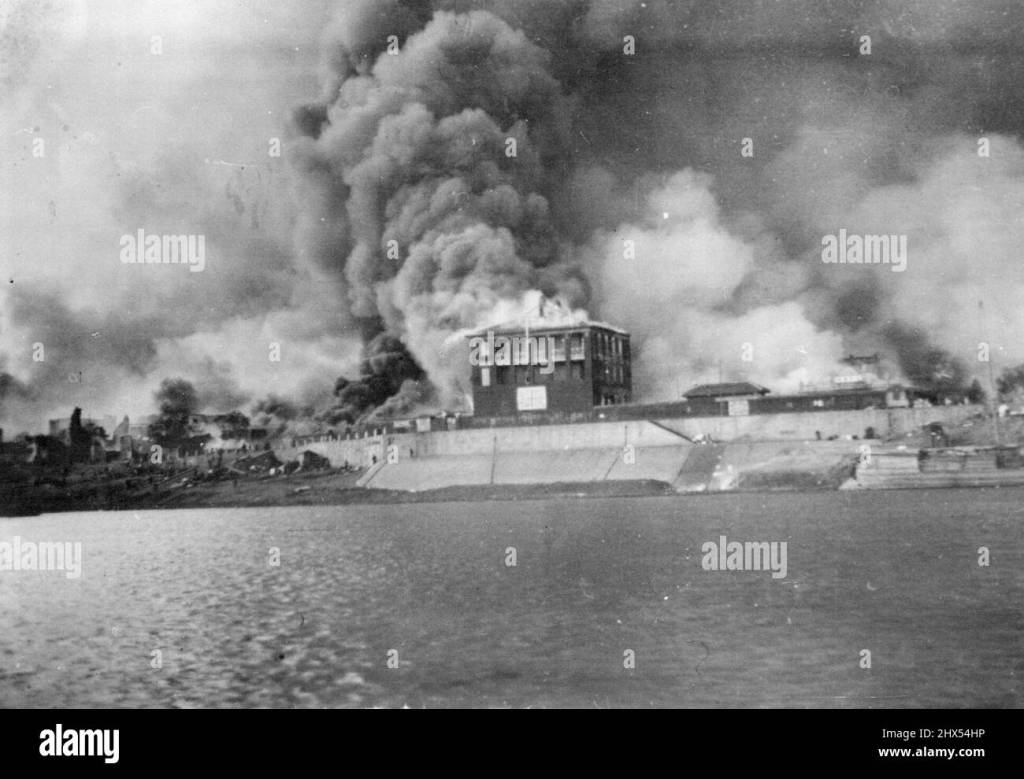
Chinese today reported their troops had smashed Japanese defenses before Yochow, gateway to unconquered Hunan province. To the north in Honan province, Chinese spokesmen said their guerrilla fighters had inflicted 2,000 casualties within the past two weeks.
A smallpox epidemic is reported in Shanghai. Foreign health officials in Shanghai announced that the number of smallpox cases here had reached epidemic proportions. Statistics of the International settlement and French concession showed that 1,013 Chinese and 85 foreigners, including three Americans, had contracted the disease.
The Joint Commission of the Peiping and Nanking governments meets and discusses reprisals against nations that aid China’s Kuomintang.
Dow Jones Industrial Average: 150.53 (+0.95).
Born:
Matty Alou, Dominican MLB outfielder and first baseman (World Series Champions-A’s, 1972; National League batting champion, 1966; All-Star, 1968 1969; San Francisco Giants, Pittsburgh Pirates, St. Louis Cardinals, Oakland A’s, New York Yankees, San Diego Padres), in Bajos de Haina, Dominican Republic (d. 2011)
Fred Brown, AFL halfback (Buffalo Bills), in Atlanta, Georgia (d. 2022).
Bob Wiesenhahn, NBA small forward (Cincinnati Royals), in Cincinnati, Ohio.
Lucien Bouchard, French Canadian lawyer & politician, born in Saint-Cœur-de-Marie, Quebec, Canada.
Brian Locking, rock bassist, in Bedworth, England, United Kingdom (d. 2020).
Naval Construction:
The Royal Navy M1-class minelayer HMS M2 (M 34) is laid down by George Philip & Sons Ltd. (Dartmouth, U.K.).

 History Diaries