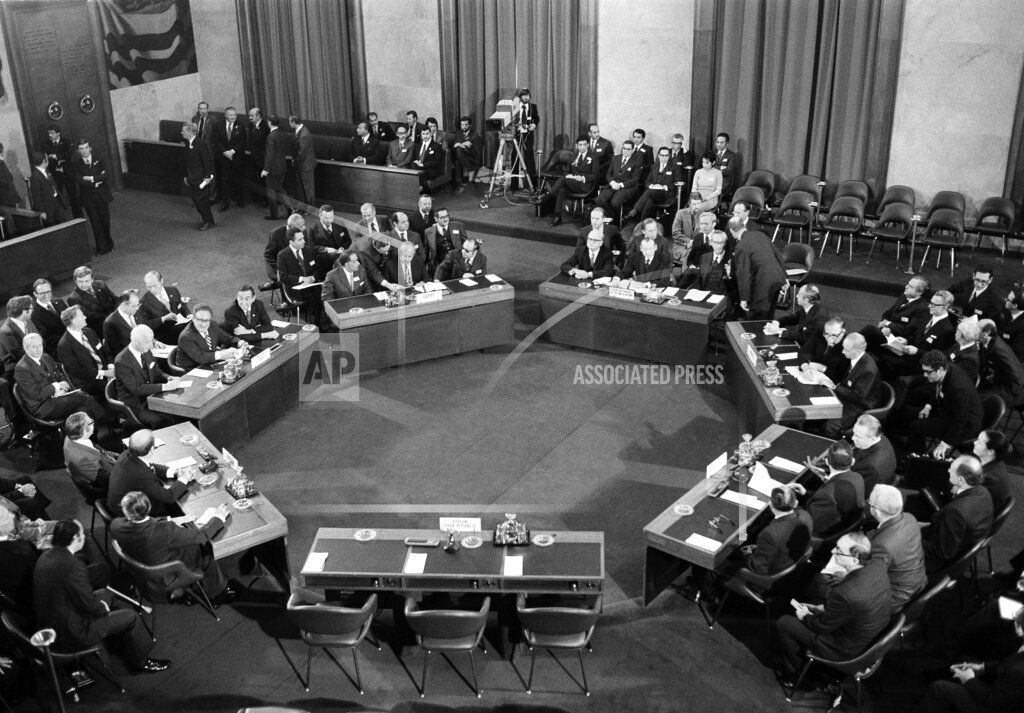
The Geneva Conference opened under the auspices of the United Nations, in an attempt to negotiate a solution to the Arab–Israeli conflict. From the conference, disengagement agreements would be worked out in 1974 between Israel, Egypt and Syria, and an agreement on the Sinai Peninsula in 1975. Arabs and Israelis met in Geneva, Switzerland, to open the Mideast peace conference. The start of the meeting was delayed over a seating squabble.
The absence of pomp, the severe security arrangements and the meticulous protocol observed as the delegates to the Middle East peace conference filed into the meeting room reflected a point on which all could agree: What happened in Geneva was not a culmination but at best a beginning, and no one could even be sure of that.
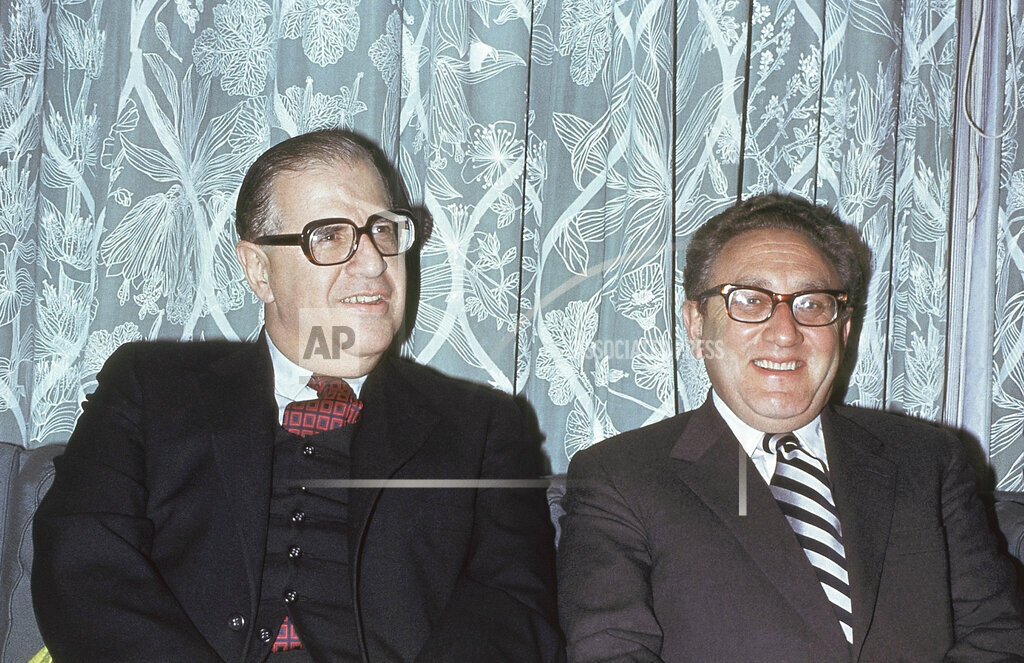
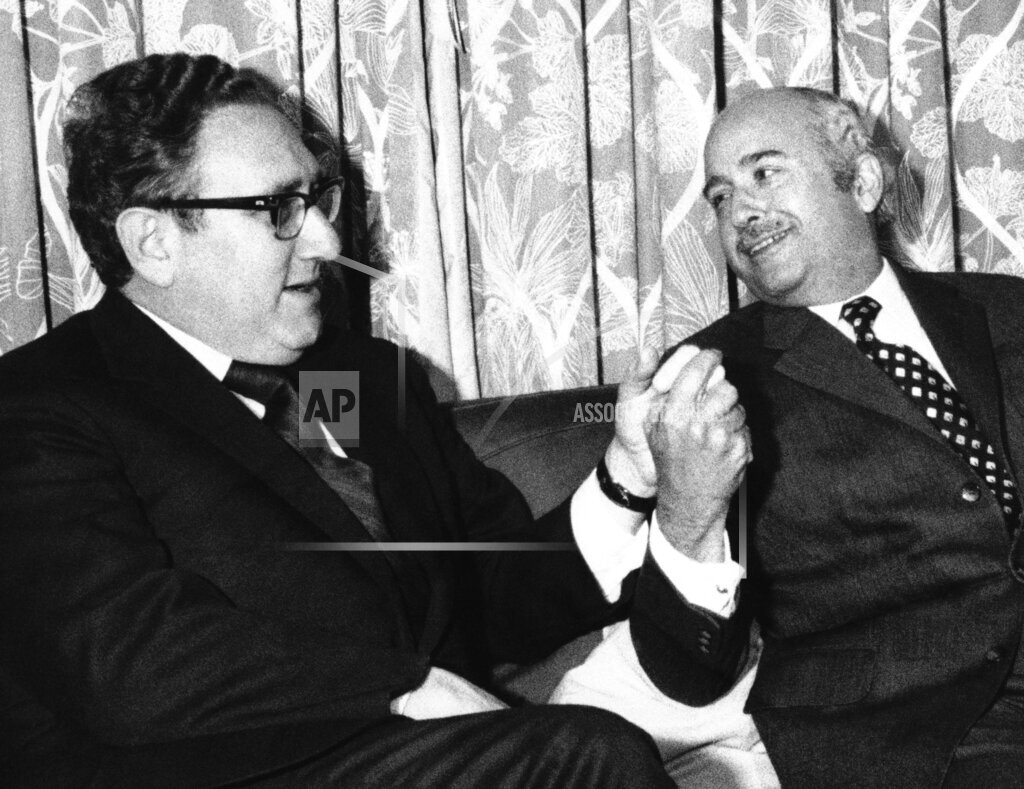
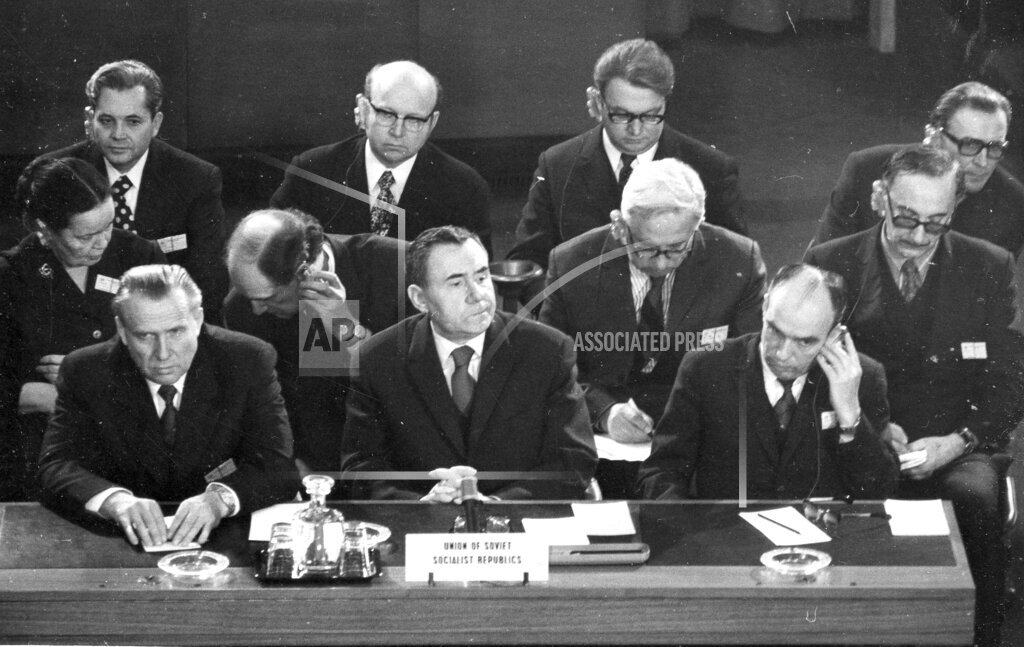
United Nations Secretary General Kurt Waldheim opened the conference. Soviet foreign minister Andrei Gromyko declared that Israel must withdraw to the 1967 cease-fire line; Egyptian foreign minister Ismail Fahmy echoed Gromyko’s words. Secretary of State Henry Kissinger stated that this peace conference must be dedicated to peace, not propaganda. Israeli foreign minister Abba Eban flatly refused to withdraw to the 1967 lines. Eban stated that Israel has been proposing peace since 1949, and Fahmy retorted that Israel is the one distributing propaganda. The historic summit meeting will continue tomorrow. As negotiations began in Geneva, Egypt reported sporadic fighting with Israeli troops.
The Shah of Iran has declared that any tightening of the Arab oil embargo would lead to an economic disaster and has urged the Persian Gulf nations to end the measure. “I think they should drop the embargo because it is as if you deprive the world of bread or something vital,” the Shah said in an interview last night. “Playing with the oil weapon is extremely dangerous.” “What’s the use of all that money in the bank if the whole system crumbles?” the Shah added, “What good does it do if the monetary system collapses? I hope they realize the impact over the long run of certain actions.” The Shah said that he was “a little surprised” at the record auction prices offered here last week for Iranian oil, and noted that he had thought the price for a barrel of oil would hover between $12 to $14. Instead, oil company bids reached as high as $17.34, more than three times the going rate.
The Premier of Japan, Kakuei Tanaka, has declared a state of emergency to deal with the current oil shortage and inflation. He immediately ordered a 20 per cent cutback in oil and electric power to major industries, acting under emergency bills passed by the Japanese Diet that gave the government power to fix prices and regulate the production and supply of oil and a wide range of other daily necessities. In another action, the Bank of Japan increased its official discount rate from 7 to 9 percent, a record.
Judging from the activity at European and Middle East ports, the much‐discussed shortage of oil may not be as acute as many thought it would by now — about two months after the Arabs announced their oil embargo. In fact, the tanker loadings at Arab terminals and arrivals at some European ports have never been higher.
The latest war in the Middle East could stimulate sluggish programs to improve the quality of front‐line equipment in Europe, according to officials at the North Atlantic Treaty Organization in Brussels. The war provided the allies with vivid lessons in the way combat tactics are changing. New weapons such as antitank and antiaircraft missiles employed by the infantry are available, but in many cases, nations have not purchased them because of budgetary pressures. The war has also given the allies what one NATO source called a more wholesome respect for Soviet equipment, ranging from deadly antitank rockets to the excellent bridging equipment used by the Egyptians to cross the Suez Canal. The lingering belief in NATO that Western weapons are generally superior has disappeared and, according to one diplomat, the Western Europeans especially may feel a compulsion to be at least as well armed as the Middle East combatants.
Funeral services for Spanish Prime Minister Luis Carrero Blanco took place in Madrid. Vice President Gerald Ford represented the United States. Demonstrators lined the funeral procession. Dictator Francisco Franco did not attend the funeral. Blanco was buried this afternoon after a tense funeral procession that extreme rightists turned into a political demonstration. Behind the public display of emotion and indignation by the regime’s supporters, an intensive hunt was under way for two young men who had rented a basement apartment across the street from where a bomb was set off under the Premier’s car. The car was blown 50 feet into the air, clearing the roof and landing in the patio of a church where the Premier had just attended morning mass. Today, as Spanish and foreign dignitaries, including Vice President Ford, marched in a biting wind down the broad Castellana parkway behind the coffin, spectators shouted for the army to take power. They screamed insults against high officials of the Roman Catholic Church with whom the late Premier had occasionally clashed.
When the Archbishop of Madrid, Vicente Cardinal Enrique y Tarancón, a moderately liberal churchman, entered the central government building where Premier Carrero Blanco lay in state in his admiral’s uniform, he was called assassin by members of the crowd. There were calls that he be put against a wall and shot. Along the funeral route, tens of thousands of mourners gave the stiff‐armed Falange salute as the coffin passed. “Death to the Communist priests!” many shouted, “Death to the Reds! Long live Spain!” Admiral Carrero Blanco was buried in El Pardo outside Madrid close by the palace of Generalissimo Francisco Franco, whom he had served for more than 30 years. General Franco had chosen him to carry on his authoritarian kind of government.
In the aptly named British Midlands town of Coalville, where four out of five families are headed by coal miners and the fifth family gets its living from the four others, there is little argument over the merits of the miners’ demand for a bigger pay envelope. “It’s the worst job in the world; I wouldn’t do it for double the money, and they’re not asking anywhere near that much,” said Ralph Raphael, a 28‐year‐old real estate agent whose father, two uncles, seven cousins and both grandfathers have worked in one or another of the six mines in and around Coalville. “We’re not in this fight because we are anti‐Government though most of us are Socialists,” Mr. Raphael said. “But we do know what is right, and we are all behind the fight the men are making with the Government to have right done them.” The miners’ weapon in that fight is a ban on overtime work, which has cut coal production 40 per cent and has so imperiled the country’s ability to produce electricity that Prime Minister Heath ordered British industry on a three‐day work week beginning Jan. 1.
The Soviet Union today disclosed an agreement to provide, a broad range of economic aid to the Communist‐led Provisional Revolutionary Government of South Vietnam. Pravda reported that Moscow would send machines, farm equipment, oil products, fertilizers, metals, medicines, foods and other goods under an agreement signed by Vladimir N. Novikov, a Deputy Premier, and Mrs. Nguyễn Thị Bình, the Foreign Minister of the Viet Cong’s Provisional Revolutionary Government. Reflecting evident concern over the danger of sharper and more serious hostilities in Vietnam, the Soviet press also quoted Leonid L. Brezhnev, the Soviet Communist party leader, as reaffirming support for the cease‐fire. Some Western observers saw the moves, in connection with the visit to Moscow of Nguyễn Hữu Thọ, leader of the Viet Cong’s National Liberation Front, as part of a Soviet effort to bolster the fragile peace agreement and increase pressures on Saigon and Washington to move toward a political settlement.
The cost of living rose 0.7% for November. White House economist Herbert Stein predicted further price increases due to the energy crisis. AFL-CIO president George Meany accused the Nixon administration of being responsible for getting the economy into this mess. The nation’s most serious peacetime inflation continued in November unabated, according to Labor Department statistics. The Consumer Price Index rose eight‐tenths of 1 percent after adjustment for normal seasonal changes in some prices. This was the same as in October, and was also equal to the monthly average rise in prices so far this year. Food prices resumed climbing after being relatively stable in September and October, and the index for all commodities, except food, rose seven‐tenths of 1 percent, its biggest monthly increase this year.
The Cost of Living Council cut 15% off the rate increase requested by the Postal Service.
The White House stated that President Nixon was not aware of the request for IRS tax audits of those on the White House “enemies list”. A study by Congress concluded that persons on the list were not harassed by the IRS, however the investigation will continue.
Senator Hubert Humphrey released details of his personal finances, including tax deductions he received from donating his political papers.
A military court of appeals upheld Lieutenant William Calley’s conviction. Ultimately, President Nixon will review the case.
Former United Mine Workers president Tony Boyle pleaded innocent to murder charges involving his rival Joseph Yablonski, who was killed in December, 1969. Boyle has begun serving a prison term in Springfield, Missouri, for misuse of union money.
Holiday travel turned into a mess because of the energy crisis and the weather. An ice storm hit Washington, D.C. today.
One of the two Rembrandt paintings stolen from the Taft Museum in Cincinnati was returned.
President Nixon’s friend Bebe Rebozo discussed his friendship with Richard M. Nixon — the man, not the President. Rebozo was asked if the President complains to him about presidential problems. Rebozo replied that Nixon doesn’t discuss his work with him, though he does like to reflect while visiting with Rebozo on his boat. Questioned if Nixon ever truly relaxes, Rebozo stated that a warm fireplace and boat riding both relax the President, who does his best thinking at those times. Rebozo added that the President has a quick sense of humor; jokes are part of his relaxation, and he is particularly fond of practical jokes. Questioned about the presidency and the tremendous pressures of the office, Rebozo said that the President doesn’t show the intense pressure he is often under.
Congress passed a bill to boost Social Security payments by 11%. The Senate and the House gave final approval to an 11 percent increase in two steps in Social Security benefits for about 29 million retired persons. With Congress eager to adjourn for Christmas, the increase quickly passed the Senate in a vote of 65 to 0. After only a brief debate and to the surprise of many Representatives who like to be recorded as voting in favor of. Social Security increases, the House rushed the bill through hours later, 301 to 13.
The emergency energy bill remains deadlocked in Congress as disagreements have begun to brew over the bill. Senator Henry Jackson stated that profiteering and price gouging must be removed if the energy bill is to work. The Senate is working on an emergency energy bill without any superfluous amendments.
The House rejected a modified emergency energy bill after the Senate had approved a version stripped of windfall profit curbs for the oil industry. Indications were that the Congress would adjourn without passing any emergency energy legislation.
The oil industry made record profits during 1973. The AFL-CIO stated that the industry shouldn’t profiteer from the hardships of Americans. Oil companies are embarrassed over the amount of the profits, and attempted to explain them.
Atlantic Richfield CEO Robert Anderson insisted that the charges against the oil companies can’t be substantiated. Exxon chairman of the board James Jamieson noted that profits are being used to explore new drilling sites and pay for costs that are incurred in the process of getting fuel from the oil well to the gasoline pump. Senator Warren Magnuson announced that he favors an excess profits tax on the oil industry.
White House energy czar William Simon requested a delay in revealing how much oil and gasoline has been allocated to business and industry.
Howard R. Hughes, the reclusive billionaire who had been living in London in the last year, has gone to the Bahamas, where he and his entourage established quarters in four penthouse suites at the Xanadu Hotel in Freeport, apparently to prepare a refuge from Federal indictments expected to be returned against him next week in Las Vegas. This was Mr. Hughes’s second visit to the Bahamas. He moved there in 1970 from Las Vegas.
The Cancer Letter, an influential weekly magazine, was launched by Jerry D. Boyd of the National Information Service company.
3rd Fiesta Bowl: #10 Arizona State beats Pittsburgh, 28-7.
Dow Jones Industrial Average: 818.73 (-9.38, -1.13%).
Born:
Mike Alstott, NFL fullback (NFL Champions, Super Bowl 37-Tampa Bay, 2002; Pro Bowl, 1997-2002; Tampa Bay Buccaneers), in Joliet, Illinois.
Tomasz Sikora, Polish biathlete and Olympic gold medalist; in Wodzisław Śląski, Poland.
Anita Lerche, Danish multilingual pop singer; in Glostrup, near Copenhagen, Denmark.
Died:
James Kennedy GC, 42, Scottish security guard for British Rail Engineering Limited, was killed while trying to prevent a payroll robbery.
 History Diaries