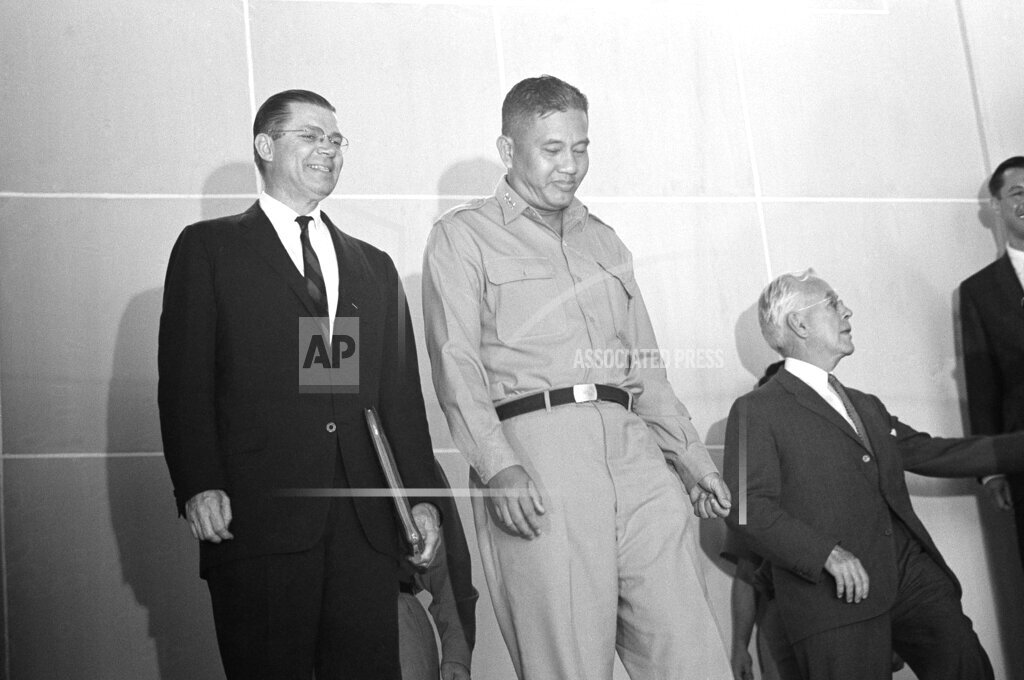
Expressing optimism for South Vietnam’s anti-Communist war, Defense Secretary Robert S. McNamara left Saigon for Washington. As he boarded an Air Force plane after a 30-hour stay in Saigon, he told reporters: “I am optimistic as to the progress that can be made during the coming year.” McNamara said he had heard in detail the 1964 plans of General Dương Văn Minh, head of the military junta which now rules South Vietnam, and his associates. He said he had also discussed thoroughly with Ambassador Henry Cabot Lodge and General Paul D. Harkins, commander of the U.S. military advisory group, U.S. plans to provide training and assistance. Observers construed Me- Namara’s remarks to mean that his optimism will last only as long as the plans are carried out properly. “Now let’s be real tough,” he was quoted as telling Minh.
[Ed: Privately, McNamara will tell the president something quite different, and not very optimistic at all.]
Thousands of South Vietnamese students mass around the French embassy in Saigon shouting “Down with de Gaulle.” Their demonstration is in protest against the French president’s support for a neutral Vietnam. The hour-long demonstration has the backing of the revolutionary government.
For the first time since the erection of the Berlin Wall in 1961, residents of West Berlin were allowed to cross into East Berlin. Waves of West Berliners surge into East Berlin for family reunions denied to them for nearly 2½ years. By agreement between West Germany and East Germany, West German applicants were granted one day passes in order to visit with family members in the Communist-controlled east side during the Christmas holidays. For 16 days, from December 20 to January 5, visitors from the west could cross the border, although the East German government would not allow its citizens to cross into the west. Starting at 7:00 in the morning, five designated checkpoints along the Wall were opened (forty had been allowed to pass through the night before) and by the end of the first day, 2,800 people had made the west–east crossing. By the end of the program, East German authorities reported that 1.3 million West Germans had visited, including 280,000 on the final day.
“Hans Schmidt” raced up the steps of a small East Berlin bungalow today. He whooped with joy and seized a middle-aged woman running down the stairs to meet him. She was Schmidt’s 55-year-old mother. He crushed her in a firm embrace and covered her face with kisses. Erika Schmidt wept. Hans Schmidt is not his real name. He does not want his name used because he fears communist retaliation against his family.
Erika Schmidt had traveled for 16 hours by train from deep inside communist East Germany for the reunion with her son. It was the first time they had been together since the Berlin wall was built 28 months ago. As they cried and laughed together, mother and son at first were without words. Hans held his mother at arm length. She smiled through her tears and said: “But you’re putting on weight.” Then Hans stood aside for the woman and the toddler who had followed him up the steps. The two women fell into each other’s arms. The younger was Christel, Hans’ wife, whom his mother had never met. No introductions were needed. They recognized each other from photographs.
Secretary of State Dean Rusk expressed hope of reaching further cold war agreements with the Soviet Union, possibly on specific disarmament questions.
Red Chinese Premier Chou En- lai said Peking’s rift with Moscow is not permanent and he also denounced the assassination of President Kennedy.
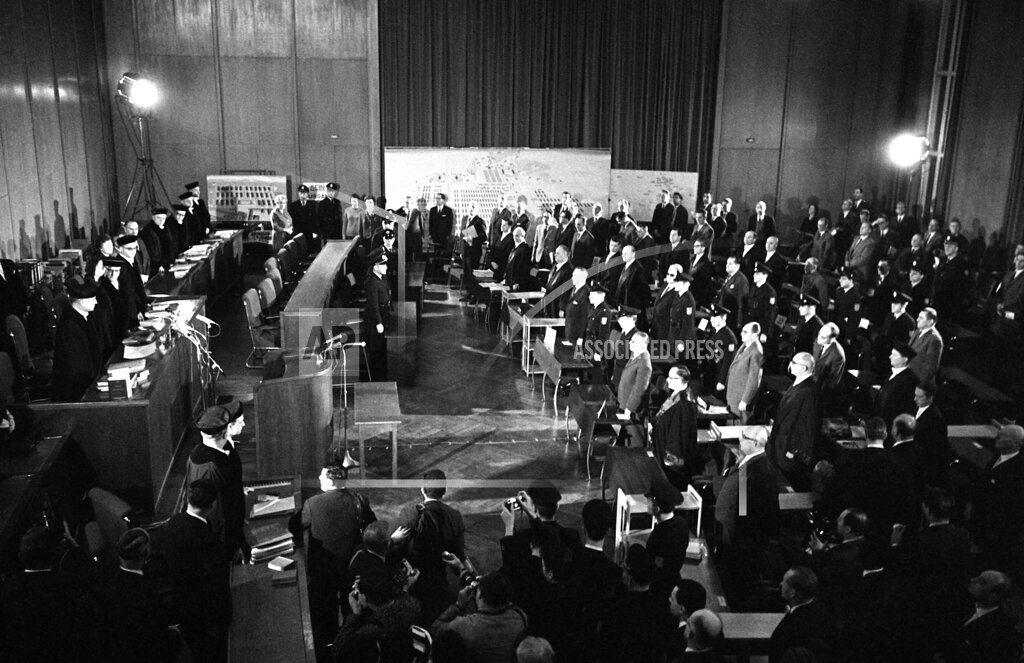
At war crimes trials held in Frankfurt, 18 years after the end of World War II, prosecutions began for the first 20 defendants, out of hundreds of members of the German SS who had helped operate the Auschwitz concentration camp network. Testimony would be taken and evidence presented and argued for the next 20 months, with 211 survivors of the camp appearing as witnesses. Administrator Wilhelm Boger, the overseer of the camp where more than one million inmates were killed, was one of the first to be brought on for charges before the court.
Russia warns African students who marched on Red Square in protest against the mysterious death of an African medical student that they must respect Russian laws or get out of the country. Their conduct “is resented by the Russian people,” Tass news agency says.
War was threatened between the neighboring West African nations of Niger and Dahomey (now Benin), after Niger’s President Hamani Diori ordered the 16,000 Dahomeyan residents in his nation to leave by the end of January, 1964, and fired all Dahomeyan government employees. The move came two months after Diori’s friend, Hubert Maga, had been overthrown as president in a coup led by Colonel Christophe Soglo. Dahomey would respond by sending troops to occupy Lete Island, claimed by both nations and located in the middle of the Niger River that separated them.
Massemba-Debate elected President of Congo-Brazzaville.
President Johnston welcomed home today three of four officials who had been held hostage by Bolivian tin miners for 10 days. Then, in a surprise move, the President presented the three men to the press. Johnson had greeted the men and their families in his office. He surprised reporters by leading his guests to an adjoining room where a press conference — not scheduled to include the President — had been set up. “I am delighted to have had these people as my guests,” the President said. “I am pleased these men have been spared.”
With Republicans leading the way, the House voted early today to put back into the compromise foreign aid bill a restrictive credit amendment aimed at the proposed sale of United States wheat to Russia. The vote was 141 to 136. The action threw into grave doubt whether the 3-billion-dollar appropriation bill will clear Congress this year. Congress was in an all-night session.
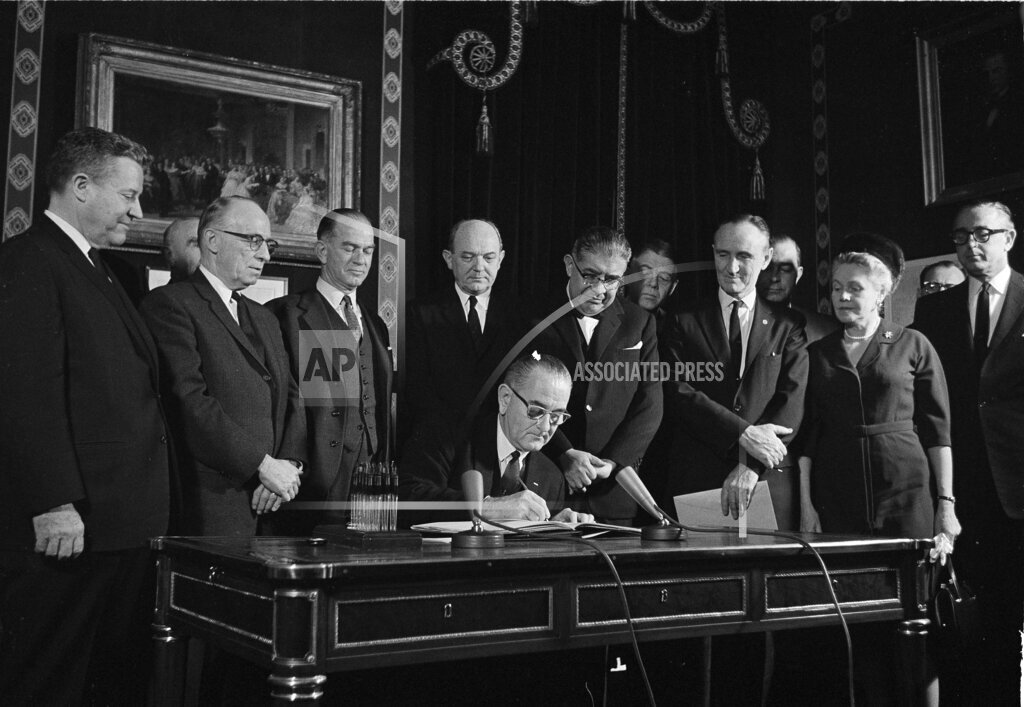
A Presidential commission recommended today that all states reduce the voting age to 18. The proposal was one of 21 designed to make it easier for American citizens to vote. President Johnson, in a statement accepting the report of the 11-man group, said he was “deeply concerned” that fewer than two-thirds of eligible Americans now cast ballots in Presidential elections and that it is easier to buy a gun in a hardware store than it is to vote. The President issued an executive order extending the life of the commission to March 30, 1964, to “provide impetus for consideration of the commission’s proposals by the individual states and to provide information and services for those states desiring assistance.”
Alabama Governor George C. Wallace says the federal government must bear full responsibility for five national guardsmen accused of setting off dynamite blasts near the University of Alabama campus. Wallace points out that the soldiers were federalized at the time of the blasts. None of the accused is charged with harboring anti-Black sentiments
Flags throughout the nation, and many in foreign countries, will fly at full staff again Monday morning. The official period of mourning for President Kennedy ends at sundown Sunday, 30 days after his assassination in Dallas. Since the American flag traditionally is not displayed at night, this means that it will not fly normally again until dawn on Monday. Candlelight services in memory of the slain President will be held Sunday afternoon in Washington and in many other cities.
Although the half-staff position of the flag is the principal outward evidence of the nation’s grief, other signs of mourning also will be withdrawn after Sunday. Among these will be the black drapes around the White House doors and along mantels in the executive mansion. At the White House, these will be replaced on Monday by the traditional Christmas decorations, even though President Johnson and his family are to leave the capital Sunday night for Christmas in Texas. The black cloth around the front portico will give way to a large wreath on the big door. Two cedars flanking the entrance will be strung with white lights.
President and Mrs. Johnson will leave Washington Sunday night to spend the Christmas and New Year’s holidays at their ranch near Austin, Texas, the White House announced today. Before leaving the capital, Johnson was scheduled to take part in a candle-lighting ceremony at the Lincoln memorial, honoring the late President Kennedy and ending the 30-day period of mourning for the assassinated leader. Also on the President’s Sunday schedule was the lighting of the huge Christmas tree — a West Virginia spruce — on the ellipse south of the White House. He was to throw the switch lighting the thousands of electric lights on the tree.
Pierre Salinger, White House press secretary, told reporters the Johnsons will leave from Andrews Air Force Base, Maryland, between 7:30 and 8:30 p.m. Eastern Standard Time in Air Force One, the Presidential jet transport. The President’s plane was to land at Bergstrom Air Force Base, Austin, and the Johnsons were to cover the last 65 miles to their LBJ ranch by helicopter. Johnson told a press conference Wednesday that he hoped to get in some hunting and to go out in the hills to “commune with myself” during the holidays, but his schedule was expected to contain more work than play. Chancellor Ludwig Erhard of West Germany will visit the ranch December 28 and 29, the joint chiefs of staff will come down December 30 to discuss the defense budget and other government officials are expected to shuttle back and forth between Washington and the ranch for the 12 to 14 days the President will be vacationing.
Richard Honeck, 84, who had served the longest prison sentence in American history, was granted parole from the Southern Illinois Penitentiary after serving 64 years incarceration. He had been incarcerated since September 2, 1899, for the brutal murder of schoolteacher Walter F. Koeller and had been eligible for parole since 1945, but had not been released because his immediate relatives had all died. On August 25, 1963, an article by Associated Press reporter Bob Poos brought the case to national attention. One of the people who read the article, Mrs. Clara Orth of San Leandro, California, agreed to take her 84-year-old uncle into her home. Honeck would survive 13 more years, dying on December 28, 1976, at a nursing home. His record had been be surpassed a year before by Paul Geidel, who had gone to prison in 1911 in New York. Geidel would spend more than 68 years behind bars until his release in 1980.
The manufacture of Studebaker automobiles in the United States came to a halt as the company’s factory in South Bend, Indiana, closed permanently and its last product— a red Studebaker Daytona hardtop— was completed on the assembly line, and the plant’s 6,000 workers were laid off. Canadian production of Studebakers would continue in Hamilton, Ontario for a little more than two years afterward, until March 16, 1966.
A cold wave, with temperatures ranging down to 35 below zero, grips the Midwest and spreads through most of the east and south. Cold records topple in a dozen cities. A freezing drizzle spreads a sheath of ice across Arkansas. Highways are closed in Oklahoma. Michigan wallows under snowdrifts 9 feet deep. No major warmup is in sight.
“Contempt,” a film directed by Jean-Luc Godard, starring Brigitte Bardot and Jack Palance, is released.
Dow Jones Industrial Average: 762.08 (-1.78).
Born:
Infanta Elena, Duchess of Lugo, in Madrid, Spain.
Tom Gibson, NFL defensive end and defensive tackle (Cleveland Browns, Los Angeles Rams), in San Fernando, California.
Mario Perry, NFL tight end (Los Angeles Raiders), in Chicago, Illinois.
Laz Chavez, NFL linebacker (Miami Dolphins), in Port Chester, New York.
Karen Moncrieff, American actress (“Xtro 3”, “Days of Our Lives”), in Sacramento, California.



 History Diaries