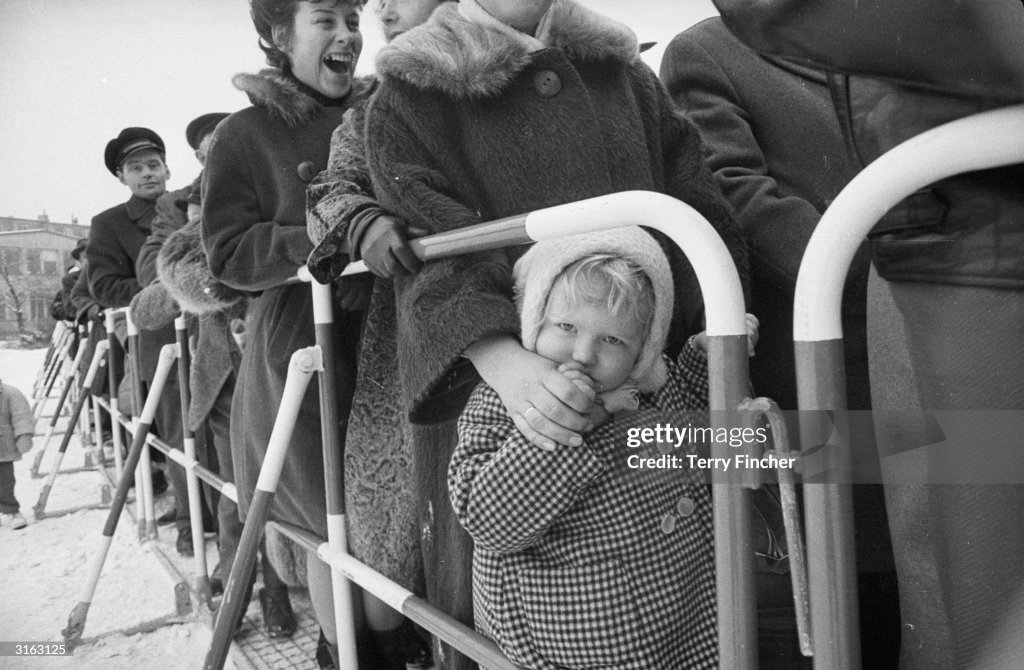
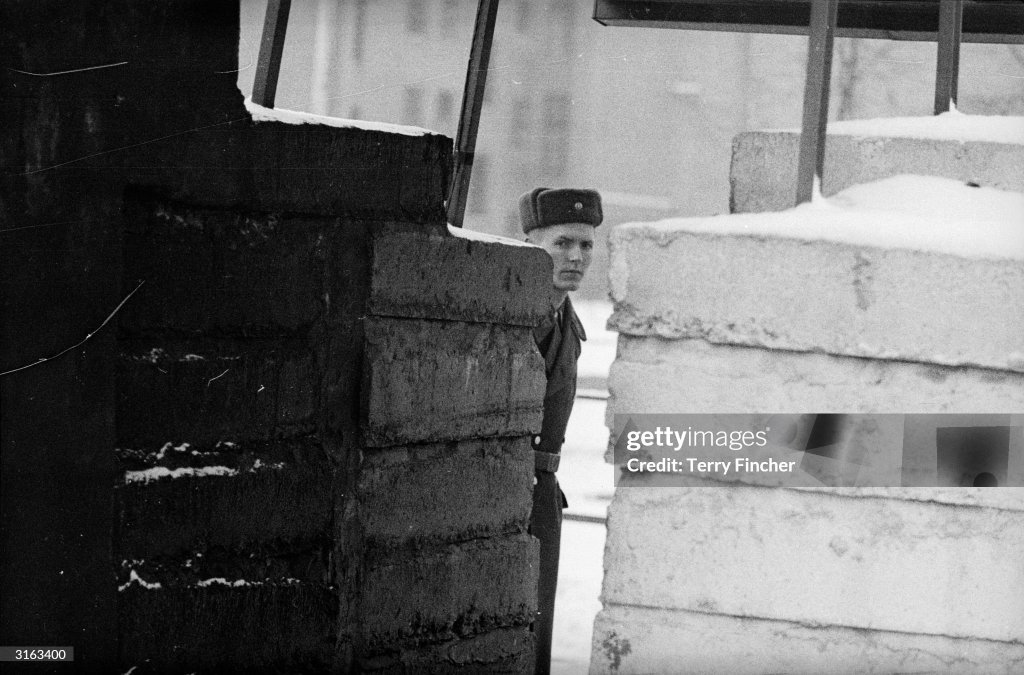
Police reserves in Berlin were called out tonight to control crowds of West Berliners besieging offices for permits to visit relatives in East Berlin at Christmas. When the 12 permit offices in West Berlin closed for the day there still were long lines of people waiting outside to file for permits. Some became angry. Police appealed through loudspeakers to people to disperse and come back tomorrow. There were angry complaints from disappointed applicants. At one office extra police were called out to disperse those who refused to go away, officials reported.
Berliners with relatives in the East have first to file applications for permits to pass through the wall for one-day visits. Then they must return the next day to collect the permits, if they have been approved by the communist authorities. This means the first successful applicants will be able to pass through the wall Friday. Western officials estimated that 25,000 applications were handed in today to the East German postal officials in the permit offices. The Communists chopped a hole in their wall today to enable West Berliners access to East Berlin. The Oberbaum Bridge which spans the Spree River between the two parts of the city has been walled off for 28 months. West Berliners will be permitted to walk across the span during the visiting period.
The three western allies in identical notes delivered to Russia today emphasized the allied right of free and unrestricted access to Berlin. Such a right, the notes said, “is in no way limited by procedures used since the summer of 1945, which have been intended solely to insure orderly and safe autobahn traffic.” The notes came after Russian harassment of allied convoys on the Berlin autobahn which started October 10 and climaxed with the long blockade of an American convoy November 4. Military traffic has been normal since then.
The notes, brief and mild in tone, were in reply to a Soviet note of November 21 in which Russia accused the United States of deliberately stirring up trouble on the autobahn by failing to comply with agreed control procedures. The Berlin autobahn incidents began October 10 when an American military convoy was stopped and the Russian control officers requested a headcount.
Five hundred angry African students storm into Moscow’s Red Square in a protest against the death of a medical student from Ghana. They scuffle with police and race along the Kremlin wall under the windows of Soviet Premier Nikita Khrushchev’s office. Thousands of Russians look on, amazed, until they are driven away by police. The demonstrators charge that the Ghanian student was stabbed to death by a Russian. About 500 African students, mostly from Ghana, in the Soviet Union organized a protest in Moscow, marching through Red Square and even scuffling with police, after the December 13 death of a 29-year-old Ghanaian medical student, Edmund Assare-Addo. It was the first known instance of foreign students marching in a public protest against the Soviet government, in a society not known for daring to protest against its leaders.
A United States Air Force jet transport carrying Defense Secretary Robert S. McNamara narrowly misses crashing into a Trans World Airlines jet airliner with 108 passengers aboard on the fog-blanketed runways of Paris’ Orly airport. McNamara’s Boeing 707 jet was racing down the airstrip for a takeoff when the pilot sighted the T.W.A. jetliner in his path. He braked immediately and reversed the four jet engines, skidding to a stop while blowing out four of the giant tires on the landing gear.
Secretary of State Dean Rusk lands in London from Paris for a working dinner with British Foreign Secretary Richard A. Butler and to see British Prime Minister Alec Douglas-Home. They are expected to keep up the pace of the west’s search for improvement in relations with the Soviet Union. Butler says he thinks the Soviet Union is “abandoning high risk policies” which led to the Cuban crisis in 1962.
Administration officials said the United States and six NATO allies have made encouraging progress in talks in Washington, D.C., and Paris to plan the organization of a seaborne nuclear missile force.
French President Charles de Gaulle shortened the deadline to Christmas for Common Market agreement on farm policy, posing a vague threat to the market itself.
President Johnson announced today he is coordinating the government’s Latin American policy affairs by making Thomas C. Mann a special Presidential assistant as well as assistant secretary of state for Latin American affairs. The President said the unprecedented move will enable the United States “to speak with one voice on all matters affecting this hemisphere.”
In another foreign policy statement. Johnson said he is “ready and willing” to meet with any of the world’s leaders — obviously including Russian Premier Nikita Khrushchev — whenever he believes such meetings would be “fruitful and productive.” The two statements were made to reporters summoned to the President’s White House office for the second surprise press conference in 10 days. The President pulled another surprise when he slipped out of the White House after the press conference and put in an unannounced appearance at a farewell luncheon for former Rep. Homer Thornberry (D-Texas) who has been named a federal judge.
Ahti Karjalainen resigned as Prime Minister of Finland, along with his entire cabinet, over a disagreement within the coalition over whether to increase taxes. President Urho Kekkonen appointed Reino Lehto to a caretaker government, which would last until September 12, 1964.
American Negro singer Paul Robeson and his wife, Eslanda, are on their way back to the United States to spend Christmas with their family, the official East German News agency, ADN, reported.
President Lyndon B. Johnson has committed his administration to developing new programs that will include an effort to eliminate poverty in the United States.
[Ed: The “War on Poverty” will succeed in spending an awful lot of taxpayer money. Its effect on poverty will be much less impressive. The poverty rate in the U.S. had been steadily falling since World War 2. That decline essentially ends in the next half-decade. It’s almost as if government made things worse…]
President Johnson said today the goal of his administration was “frugality and thrift” but that the country must be braced for an increase in federal spending. The President discussed budget and tax matters at a surprise press conference in his White House office. Asked how large a budget he would submit to Congress in January for the year beginning next July 1, Johnson said it was too early to tell because “we are trying the case, so to speak.” The Kennedy administration’s budget for the current fiscal year totaled 98.8 billion dollars, give or take a few hundred million.
The new President then outlined a few of the problems he faces in drafting a budget in line with his belief in “frugality and thrift.” Built-in increases — hikes in federal spending required by law — total about 3.5 billion dollars, the President said. They include military and civilian pay, space agency contracts, post office increases, urban renewal, and public assistance grants. “In addition to that,” the President said, “you are going to have increases that are requested for additional functions in various agencies. Such expenditures, the President said, are necessary because of the increase in population — up 21 percent since the Truman administration.
Congress today sent to the White House three big appropriations bills. The Senate by a voice vote cleared a $1,820,093,000 appropriations bill to provide funds for the state, justice, and commerce departments, along with the judiciary and related agencies. The action came 90 minutes after the big money bill had been approved by the House. The House and Senate also approved a compromise $313,093,424 money bill to operate the District of Columbia government.
The Senate also grudgingly accepted today a compromise 168-million-dollar money bill that settled for the time being a House Senate feud over congressional “junk mail” privileges. This was the third money bill passed in the day. The bill providing funds to finance the operations of Congress, the Library of Congress and related legislative agencies for the fiscal year which started last July 1 was sent to the White House.
Under pressure from the White House, the Senate rejected by a vote of 60 to 23 a proposal by Senator Wayne Morse (D-Oregon) to cut 50 million dollars from the 3.3-billion-dollar foreign aid bill under debate. A fight is expected today when Senator Karl Mundt (R-South Dakota) hopes to restore a House ban on credits for Russian purchase of American wheat.
The House Rules Committee will start hearings on the civil rights bill January 9, Chairman Howard W. Smith (D-Virginia) announced today. Rules for House debate of the bill will be established at the hearings. Smith told the House that he is calling his committee into session two days after the 88th Congress reconvenes to move along the rights bill. “I shall not encourage dilatory tactics,” Smith said. The bill is intended to outlaw discrimination in voting, education, employment, public accommodations, and the use of money appropriated by congress for such things as housing, schools, and hospitals.
Smith, whose earlier announcement that the hearings would be scheduled “reasonably soon in January” failed to satisfy so-called liberals, appeared to catch them completely by surprise with today’s announcement. It meant that hearings would start on the earliest possible date in the new session, something the most optimistic did not expect. The liberals made an abortive attempt to get the rights bill to the House floor through a discharge petition last week, but were able to collect only 165 of the necessary 218 names needed to give the Rules Committee the runaround. Smith told the House that “a good many members” have told him they would like to be heard at the Rules Committee sessions for determining how long the House will debate the rights bill.
U.S. Ambassador to the United Nations Adlai E. Stevenson said he will not participate in the 1964 Presidential campaign or be a candidate. His U.N. role is non-political, he pointed out.
The Defense Department plans a budget next year that will be at least $400 million below this year’s.
On order of Secretary of Defense Robert S. McNamara, the Navy has launched a comprehensive survey to determine whether any of the 11 shipyards can be closed.
President Johnson today said he hopes to spend Christmas with his family at his LBJ ranch in Texas. “I might even go hunting,” he told a press conference. “I haven’t had a chance to do that this year and I would even like to go spend a day out in the hills, communing with myself.” The President said he could not now be positive about his plans “because that will depend upon the situation here in Washington.” But he hopes to light the huge Christmas tree on the ellipse about 6:30 p. m. Sunday, and then appear at Lincoln memorial. Later that evening he may fly to the ranch, with the alternative of leaving the next day. The lighting of the tree will come on the last day of official mourning for the late President Kennedy, and on Monday American flags will be flown at full staff.
Senator Dirksen (R-Illinois) Senate minority leader, gives his warm approval to the minting of half dollars bearing the likeness of President Kennedy and then emits a mournful dirge on the passing from that coin of Benjamin Franklin. “I suppose times have changed,” he laments; “after all, this is the decade of deficits.”
Muskegon, Michigan gets 34 inches — nearly 3 feet — of snow from a three-day storm ending today. Visibility was near zero in the Lake Michigan city, and many roads were impassable. Heavy snow extends north and south from northern Indiana to Traverse City, Michigan.
“The Pink Panther” film premieres, directed by Blake Edwards and starring Peter Sellers and David Niven, with theme by Henry Mancini.
Ron Clarke runs a world record 10k (28:15.6).
Dow Jones Industrial Average: 767.21 (+0.83).
Born:
Brad Pitt [as William Bradley Pitt], American film actor (“12 Monkeys”, “Fight Club”), in Shawnee, Oklahoma.
Charles Oakley, NBA power forward and center (NBA All-Star, 1994; Chicago Bulls, New York Knicks, Toronto Raptors, Washington Wizards, Houston Rockets) and coach, in Cleveland, Ohio.
Jim Czajkowski, MLB pitcher (Colorado Rockies), in Parma, Ohio.
Kirk Timmer, NFL linebacker (Dallas Cowboys), in Butte, Montana.
 History Diaries