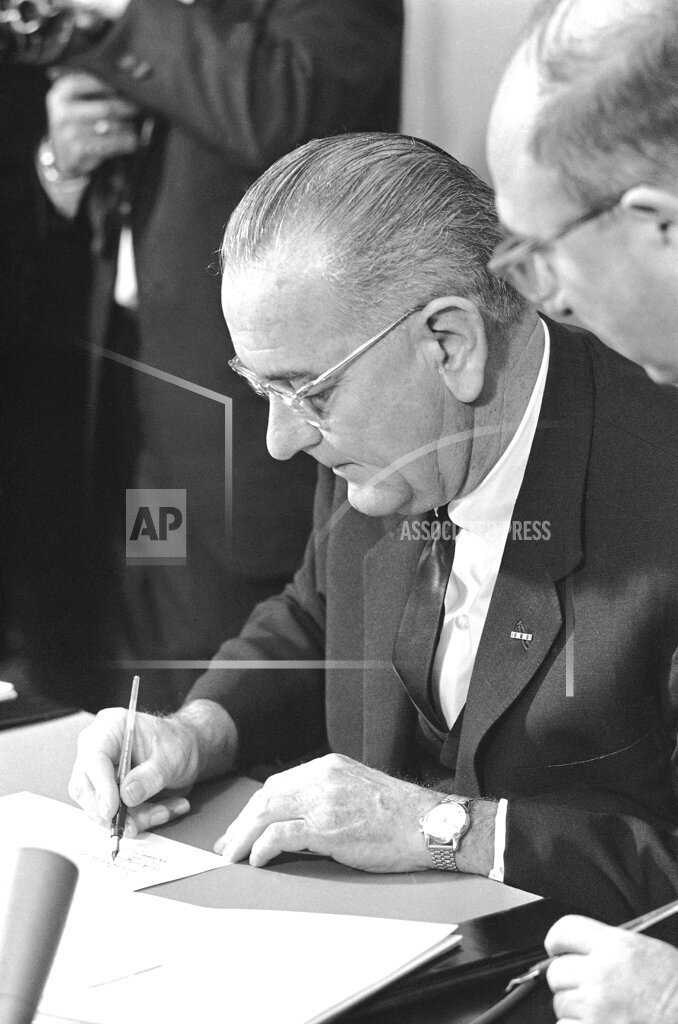
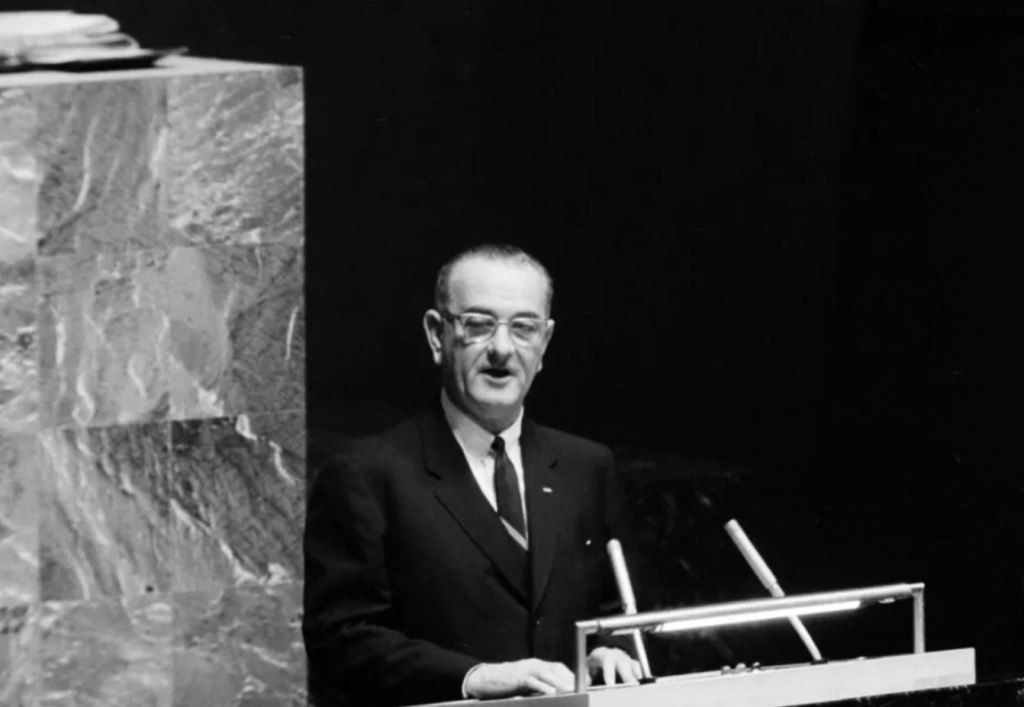
President Lyndon B. Johnson told the United Nations General Assembly today the United States wants to see the cold war end, once and for all. He called for curbs on nuclear weapons, disarmament, and an international effort to end hunger, disease, and ignorance. Delegates applauded when the President pledged that “more than ever we support the U.N. as the best instrument yet devised to promote the peace of the world and the well-being of mankind.”
Johnson told the delegates he appeared before them today “to make it unmistakably clear” that the assassin’s bullet which took his predecessor’s life did not alter his nation’s purpose. President Johnson said that, like all human institutions, the U.N. had not fulfilled its highest hopes, but he said the organization had grown in numbers, authority, and prestige. He asserted the U.N. “had worked” with its peace-keeping missions in the Congo and Middle East. He insisted that the transition from colonialism to independence had been largely accomplished, the arms race had slowed, and the struggle for human rights had gained new force.
The President, recalling he had entered Congress 27 years ago, called for a program like that of the late President Franklin Roosevelt to combat hunger, poverty, and disease on a “world scale.” Johnson said that if there was one commitment that he wanted to leave with the delegates more than any other it would be his determination to keep and strengthen the peace. “Peace is a journey of 1,000 miles and it must be taken one step at a time,” he said, departing from his prepared text.
Effective in 1965, the United Nations Security Council would have 15 members rather than 11, as the U.N. General Assembly voted 97–11 to amend Article 23 of the U.N. Charter. The number of permanent members, given the power to veto a Security Council resolution, remained at five, while the non-permanent members were increased from six to 10.
The semiannual North Atlantic Treaty Organization (NATO) ministerial meeting ended tonight with an official statement emphasizing the need to continue talks with the Soviet Union for the purpose of reaching some accord to relax international tension and to achieve “a real and fundamental” improvement in east-west relations.
Dirk U. Stikker, secretary general of NATO, told a press conference that no restrictions had been placed on any members who wanted to explore possibilities for a real entente, bilaterally, multilaterally, through international organizations including the United Nations. The statement closing the two-day meeting — shortest in NATO’s 14-year history — expressed grief over the tragic death of President Kennedy and welcomed the message from President Johnson renewing United States pledges to the alliance. It then stressed the “peaceful and defensive purpose of the alliance,” its solidarity, and the determination of member states to defend freedom and resist aggression.
West and East Berlin sign an accord about travel rules. The Berlin Wall will open for West Berliners Friday for the first time in more than two years. During the Christmas holidays an estimated 800,000 persons are expected to enter the communist zone to visit their relatives. The visits were made possible by an agreement signed today between representatives of the West Berlin city government and the communist regime of East Germany. While politicians weighed the possible implications of the first such deal over the wall, Berliners in both parts of the divided city were jubilant.
For the last two Christmas seasons they have been kept apart. Families have been divided. Foreigners and West Germans could pass through the wall but Berliners could not. From Friday until January 5, there will be one-way traffic. East Berliners must content themselves with being the hosts to their relatives from the west. Each permit will be valid only until midnight of a particular day, but many West Berliners are likely to get more than one permit. “At last, at last,” squealed Liselotte Schulz, a typist. “I will see my mother, my sister, and my aunt.”
As people scrambled to buy newspaper extras, a West Berlin fruit seller caught the spirit of the occasion. “Buy bananas,” he shouted. “You can take them to your relatives in the east.” Fruit is scarce in East Germany. An elderly man, Joachim Lindman, smiled and said: “There are grandchildren over there I haven’t seen yet. This is going to be a very happy Christmas for me.” In East Berlin there was similar joy. Three out of five people questioned on a street corner said they were joyfully awaiting relatives. Even the communist East Berlin guards on the wall seemed pleased. A reporter told one guard he would have extra work. “That does not matter,” was the guard’s quiet reply. “This is a step in the right direction.”
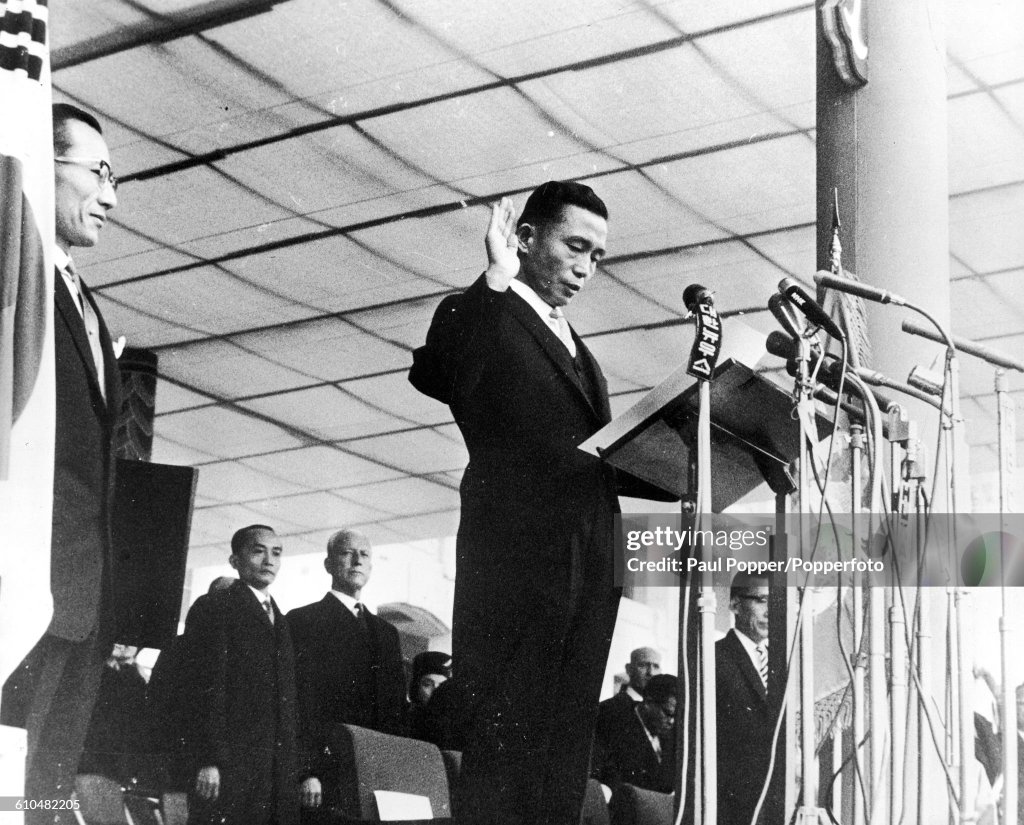
The era of the “Third Republic of South Korea” was inaugurated, as Park Chung-hee, the acting president and a former army general, took office as the first civilian president of South Korea under the new constitution. The Third Republic would exist for less than nine years, when voters would approve a new “Fourth Republic” constitution in a referendum on November 21, 1972.
Four Americans held prisoner for 10 days by Bolivian tin miners disclose they decided to get out of their makeshift prison when it appeared their captors were going to renege on a pledge to free them. They put on their coats and walked past their surprised guards into the open air and freedom.
The United States has cut Russia’s lead in space exploration to “a measure of equality,” according to the authoritative Jane’s “All the World’s Aircraft.” Jane’s says the United States may soon go ahead of the Soviet Union. Editor John W. R. Taylor bases his evaluation on performance in space during the last year.
The State Department tried to clear up a diplomatic misunderstanding growing out of a remark by Secretary of State Dean Rusk on the Moscow-Peking conflict.
President Johnson probably will hold to the 1965 deadline for pulling U.S. forces out of South Vietnam regardless of the status of the war against the Communists, U.S. sources in Paris said.
The Soviet Union expects to have a supersonic airliner by the early 1970s, Federal Aviation Administrator Najeeb Halaby said after discussing proposed Moscow-New York air service in the Russian capital.
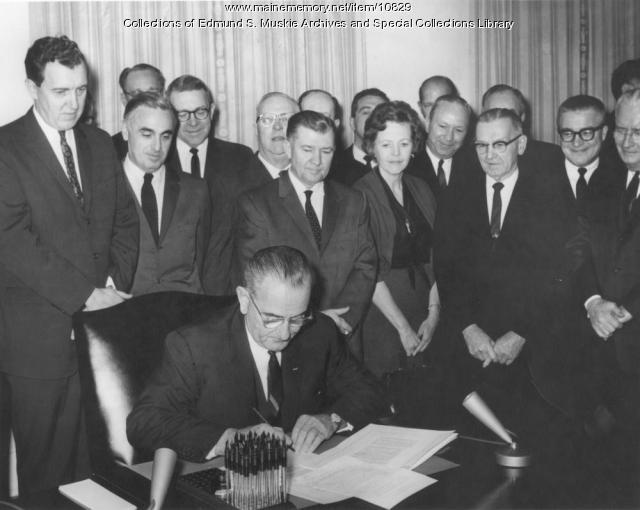
The Clean Air Act of 1963 was signed into law by President Johnson. The Clean Air Act of 1963 was the first federal legislation regarding air pollution control. It established a federal program within the U.S. Public Health Service and authorized research into techniques for monitoring and controlling air pollution. The 1963 act required development of State Implementation Plans (SIPs) as part of a cooperative federalist program for developing pollution control standards and programs. Rather than create a solely national program, the CAA imposes responsibilities on the U.S. states to create plans to implement the Act’s requirements. EPA then reviews, amends, and approves those plans.
It appropriated $95 million over three years to support the development of state pollution control programs, and authorized the HEW Secretary to organize conferences and take direct action against interstate air pollution where state action was deemed to be insufficient. The Constitution contains no provisions listing environmental standards as an enumerated Federal power, and until 1970 these were essentially handled at the state and local level. However, legislators of the 1960s had been heavily influenced by New Deal-era ideologies of government, allowing considerable expansion of Federal authority, often in excess of what was strictly allowed in the Constitution.
President Johnson, who received rough treatment in the House of Representatives yesterday, today won at least a temporary victory in the Senate where he once was majority leader. The Senate appropriations committee, responding to White House pressure, voted to restore 500 million dollars to a foreign aid bill which the House had reduced by $800 million.
As it will be reported to the Senate tomorrow, the appropriation measure will contain $3.3 billion. The House had fixed the amount at $2.8 billion. If the Senate upholds its committee, as is customary, the $500 million difference will probably be split 50-50, fixing the final amount at $3 billion plus. The Senate committee did not give the President all he had demanded the maximum of $3.6 billion authorized in the enabling legislation. He had pronounced any figure short of that total “a policy of weakness and retreat” dangerous to national security. “We voted as much as we dared in view of the House attitude,” said a committee member.
The committee also killed an amendment, approved by the House 218-169, which would prohibit federal guarantees of credits for sale of commodities to communist states. This was aimed at the pending Russian wheat sale. Senator Karl Mundt (R-South Dakota) announced he would lead a floor fight against the committee action.
President Kennedy was shot twice, both times from the rear, and it was the second bullet which proved fatal, pathologists who performed the autopsy revealed.
President Johnson agreed with Democratic leaders to deliver his first State of the Union message on January 8.
In the first trial heat contest conducted by the Gallup Poll since the death of President Kennedy, President Johnson holds a long lead over Senator Barry Goldwater (R-Arizona) in the states below the Mason-Dixon line.
An ex-convict carrying a pistol and 50 rounds of ammunition in a gunny sack was arrested at a railroad station in San Bernardino, California, an hour before the arrival of former President and Mrs. Dwight D. Eisenhower for their winter vacation. Although there was no immediate information to link the incident with an attempt on Eisenhower’s life, secret service agents and members of a 50-man security police force assigned to the railroad station interrogated the gunman at length.
They say Purcell Joshua Jones, 47, insisted he had no idea the Eisenhowers were arriving by train today, and was “just resting” in the railroad station restroom when a detective found him. Jones was booked as an ex-convict possessing a firearm. “His explanations don’t make sense,” said Detective Neil Pyatt, who said Jones claimed he had no money but still was able to buy a gun. The officers also said Jones had newspapers describing the Eisenhower arrival plans, despite denials he knew of their coming.
The House today approved the minting of a new 50-cent piece bearing the likeness of President Kennedy, while Senate and House committees were voting on still another memorial to him. A roll call vote on minting the new half-dollar became necessary when several Republicans pleaded with the Congress not to act too hastily in establishing memorials to the assassinated President. Few House members, however, were willing to risk a vote at this time against anything carrying the Kennedy name and the new 50-cent piece was approved 352 to 6.
The Department of Labor tonight announced an agreement had been reached between railroads and the Sleeping Car Porters union, thus forestalling a strike threatened for midnight Thursday. Secretary of Labor W. Willard Wirtz said the agreement calls for a gradual reduction in the work month from 205 hours to 174 hours beginning in July, 1965; hourly wages also will rise from $2.09 an hour to $2.53 an hour, retroactive to February 1, 1962, and porters were given assurance that whenever Pullman facilities are taken over by railroad companies, employe rights to priority in employment and seniority will be respected. The months-long dispute involved some 4,000 porters who work for the Pullman Car Company, owned by 53 railroads, and several other lines that have their own sleeping cars.
A brother of a suspect in the Sinatra kidnapping discloses his voluntary surrender dispelling the mystery of how FBI agents cracked the $240,000 venture in a matter of hours after payment of the ransom. James R. Irwin reveals that his brother, William, one of three men held in the crime, became “sick and tired” of the whole matter, came to his home to ask advice, and then turned himself in to FBI agents, leading to the arrest of two other suspects and recovery of most of the ransom.
A lithe and youthful blonde partner of Robert (Bobby) Baker in his get-rich-quick enterprises tells a Senate hearing of being frightened and mystified by huge cash payments made to her at various times and in various places by the erstwhile secretary to the Senate’s Democrat majority. Mrs. Gertrude Novak testifies to receiving $32,000 at one time, $13,200 at another time, and $12,000 in another deal — all in cash — and may have received other sums which she has forgotten. She also says she has no idea where Baker got the money.
As a new espionage indictment is returned against Robert K. and Joy Ann Baltch, the Department of Justice reveals it has traced Baltch’s background and finds he is a Soviet Georgia native named Sokolov.
A three-judge federal court of appeals annuls the conviction of the Communist Party of the U.S.A. for failing to register as an agent of the Soviet Union. The court upholds that registering would be tantamount to self-incrimination on the part of Communist Party members complying with the law. The government is expected to appeal the reversal to the Supreme Court, which in 1961 upheld the constitutionality of the law under which the party was convicted and fined $120,000.
Former U.S. Ambassador to Panama Joseph S. Farland, a Republican, said he resigned in major part because Sen. George Smathers (D-Florida). threatened to attack him personally for opposing a Panama housing project.
J. J. Pickle, friend of President Johnson, was elected to the U.S. House of Representatives from Texas.
Vice Adm. Hyman G. Rickover will be retired from the Navy on February 1 but will be recalled immediately to active duty to help America keep its nuclear propulsion leadership.
The appellate division of New York Supreme Court rules that Gareth Martinis, son of a Supreme Court judge, will not have to stand trial on vehicular homicide charges in the death of five persons in an automobile accident last May. Martinis was acquitted of reckless and drunken driving charges in the same case, and the appellate division rules that another trial would constitute double jeopardy.
Ara Parseghian is named the new head football coach at the University of Notre Dame.
Dow Jones Industrial Average: 766.38 (+4.74).
Born:
Ivan Korade, Croatian general and war criminal, in Velika Veternička, Yugoslavia (committed suicide, 2008).
Steve Griffin, NFL running back (Atlanta Falcons), in Charlotte, North Carolina.
 History Diaries